
Little Rock Look Back: 44 Teachers fired by divided LRSD School Board in 1959

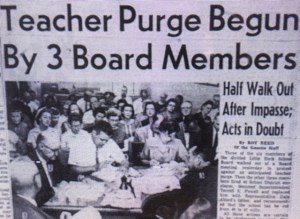
Arkansas Gazette coverage of the teacher purge

On Tuesday, May 5, 1959, the deeply divided Little Rock School Board met to consider contracts for the coming year.  The topic of contract renewal had been on the April agenda, but with two of the six members out of town, it had been delayed.

The 1958-1959 school year had been anything but routine in Little Rock.  To keep the high schools segregated, the city’s four high schools had been closed – first by action of Governor Orval Faubus and then by Little Rock voters.  Frustrated by actions taken at the State level, the School Board had resigned en masse by November 1958, except for the one member who had won a surprise write-in election to unseat Congressman Brooks Hays.  A new school board was elected in December and was equally divided between segregationists and those who felt the law and federal court rulings should be followed.

The May 5, 1959, School Board meeting began at 9am with a room packed full of spectators and was carried live on the radio.  There had been rumblings that the pro-segregation school board members were going to try to fire any teachers they viewed as in favor of desegregation.  Every vote in the morning session ended with a 3/3 vote as Everett Tucker, Russell Matson and Ted Lamb voted one way and the other three: Ed McKinley, Robert Laster and Ben Rowland, voted the other.

After lunch, Tucker, Matson and Lamb decided to leave the meeting. They saw no way to break the stalemate that was paralyzing the discussions. Upon advice of attorneys, they walked out. With only three members remaining, they three thought it end the meeting for lack of quorum.

School Board President Ed McKinley declared the remaining members a quorum. The trio alternated between open and closed sessions. At the end of the day, they had fired forty-four LRSD employees who they viewed as integrationists.  This included 39 whites and five African Americans.  Twenty-seven worked at Central High, while the other seventeen were scattered across other Little Rock schools.  Seven principals, thirty-four teachers, and three secretaries made up the group.  The meeting had lasted the entire day.  The afternoon Arkansas Democrat (with a mid-day deadline) carried a story pondering whether teachers would be fired.

At the same meeting, Superintendent Terrell Powell was fired.  He had taken the reins of the district in December 1958 after having been Hall High’s first principal.  Mr. Powell was replaced by Tom Alford, a former Jacksonville superintendent who was the father of congressman (and former LRSD school board member) Dale Alford.

During a portion of the school board meeting (which was at the corner of Eighth Street and Louisiana Street), phone calls were being made from the LRSD headquarters to a house a few blocks away.  That house was the home of Adolphine Fletcher Terry.  She was hosting an executive board meeting of the Women’s Emergency Committee that day.

Not ones to shy away on anything, the WEC executive board voted to condemn the firings and support the teachers.  Fairly quickly, the Parent Teachers Association of Little Rock, the Arkansas Education Association, League of Women Voters, and Little Rock Ministerial Alliance joined in the call condemning the action.  Leadership at the Little Rock Chamber of Commerce also joined in decrying the purge.

And the fallout was just beginning……
Little Rock Look Back: Pulitzer Prize to SOUTH PACIFIC

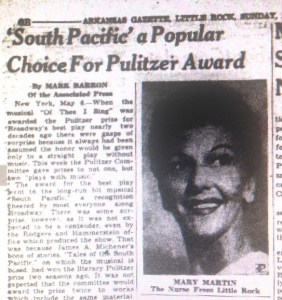
On May 5, 1950, the Rodgers and Hammerstein musical South Pacific captured the Pulitzer Prize in Drama. This would receive special attention in the Arkansas Gazette. The reason this carried such weight in Arkansas was that the musical had a connection to Little Rock.
The 1950 Pulitzer for Drama went to a musical, for only the second time in the history of the awards. The recipient was South Pacific by Richard Rodgers, Oscar Hammerstein II and Joshua Logan. The character was the leading lady of Nellie Forbush. She was an Navy ensign and a nurse stationed on an exotic island during World War II. The musical was based on a Pulitzer Prize winning novel, James Michener’s Tales of the South Pacific.

In the Michener novel, Miss Forbush is not from Little Rock. She is actually from a small town in Alabama. But the book does mention Nellie and her mother visiting Little Rock.  The part was written for Mary Martin from Weatherford, Texas. Rodgers, Hammerstein & Logan did not discuss why they relocated Nellie’s birthplace.

Originally the musical contained a song entitled “My Girl Back Home” in which Nellie sang of being from “Little Rock, A-R-K” while another character sang of being from “Philadelphia, P-A” and “Princeton, N-J.” It is possible the change to Little Rock was made because it offered more lyrical possibilities, but that is only a supposition on the part of the Culture Vulture. That song did appear in the movie version in which Mitzi Gaynor played Nellie Forbush. It was also featured in the 2008 Broadway revival, this time with Kelli O’Hara playing Nellie.

In the musical, Nellie struggles with her own prejudices. This issue of prejudice became an instance of fact meeting fiction. In 1957, a few weeks after Eisenhower sent troops into Little Rock to ensure that Central High would be desegregated, a production of South Pacific on Long Island was temporarily halted when the audience booed and yelled after Nellie mentioned she was from Little Rock. Interestingly, the movie was released in 1958, but retained references to Little Rock. That was either a testament to the expense of re-editing it, or the fact that audience reaction had lessened.

Little Rock Look Back: 2 Pulitzers for the ARKANSAS GAZETTE

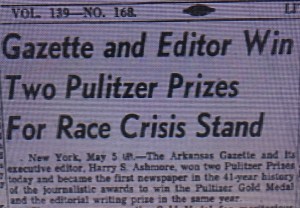
On May 5, 1958, it was announced that the Arkansas Gazette had received two Pulitzer Prizes.  These were for the coverage of the 1957 integration (or lack thereof) at Little Rock Central High School.

The first Pulitzer was for Public Service.  It was awarded to the newspaper.  The citation stated:

For demonstrating the highest qualities of civic leadership, journalistic responsibility and moral courage in the face of great public tension during the school integration crisis of 1957. The newspaper’s fearless and completely objective news coverage, plus its reasoned and moderate policy, did much to restore calmness and order to an overwrought community, reflecting great credit on its editors and its management.

The second Pulitzer was for Editorial Writing.  It was awarded to Harry Ashmore.  The citation read:

For the forcefulness, dispassionate analysis and clarity of his editorials on the school integration conflict in Little Rock.

This was the first time that the Pulitzer for Public Service and Editorial Writing went to the same publication in the same year.

The newspaper coverage in the afternoon Arkansas Democrat and morning Arkansas Gazette was provided by the Associated Press.  The Democrat‘s story ran on the afternoon of the announcement. The front page story had the headline “Pulitzer Honors Go to Gazette.”  The next morning the Gazette ran a longer story under the headline “Gazette and Editor Win Two Pulitzer Prizes for Race Crisis Stand.”  It included a quote from publisher Hugh Patterson, Jr.  He stated, “This recognition belongs to every member of the staff of the Gazette.  I am proud to be associated with these men and women.”

The Pulitzer for National Reporting went to Relman Morin of the Associated Press for his coverage of the events.  His citation noted:
for his dramatic and incisive eyewitness report of mob violence on September 23, 1957, during the integration crisis at the Central High School in Little Rock, Arkansas.

Photographer Will Counts of the Arkansas Democrat was the unanimous choice of the jury to receive the Pulitzer in photography for his photo of the crowd jeering at Elizabeth Eckford.  The board overruled that selection, as was their purview. Speculation was that the board may not have wanted to award four Pulitzers for the same news story.

LR native William Grant Still’s opera TROUBLED ISLAND produced by Opera in the Rock this weekend

Little Rock native William Grant Still was the leading African American composer of classical music throughout most of the 20th century.  In 1949, his composition, Troubled Island became the first grand opera written by an African American to be produced by a major company.  It premiered with the New York City Opera in 1949.

This weekend, Opera in the Rock is presenting a rare fully-staged production of Troubled Island.  It will be at the UA Pulaski Tech’s Center for Humanities and Arts on the evening of May 4 (7:30pm) and afternoon of May 6 (3:00pm).  The work is being performed by a cast of local and regional operatic talent.

The libretto for the opera was written by Langston Hughes and Verna Arvey.  The story is set in Haiti in 1791.  Jean Jacques Dessalines declares himself emperor of an independent Haiti. Corruption, revolution and assassination ensue.

Ronald Jensen-McDaniel is singing the role of Dessalines.  Others in the cast include Jordan Murdock, Jannette Robinson, Charles Moore, Nisheedah Golden, Anthony K. Valley,  and Chris Straw.

Arlene Biebesheimer is the artistic director of Opera in the Rock.

Ballet Arkansas in Concert this weekened

In partnership with the Stella Boyle Smith Trust, Ballet Arkansas is excited to present a three – year concert series, Ballet Arkansas in Concert, which pairs high profile works of classical & contemporary dance with musical accompaniment from world renowned musicians in the Spring of each year.

On May 4th – 6th at the Arkansas Repertory Theatre, Ballet Arkansas and Van Cliburn International Pianist Dr. Drew Mays take the stage for three stellar performances.

Featuring

  • Pas de deux from Agnes de Mille’s The Other

  • Christopher Wheeldon’s The American

  • Contemporary World Premiere by Artistic Director Michael Fothergill

In between pieces, Dr. Mays will present an engaging and stimulating discussion that highlights the lives of the composers, the finer points of their music, and our collaboration. After the completion of the dancing, Dr. Mays will continue to play a solo concert for Ballet Arkansas audiences to enjoy.

Performances are Friday, May 4 at 7:00pm, Saturday, May 5 at 7:00pm, and Sunday, May 6 at 2pm.  Tickets are $40 for adults, $25 for students/senior citizens.  Tickets are available at the discounted rate of $30 (25% discount) for a group of 5 or more.

PRESENTING SPONSOR
Stella Boyle Smith Trust

EDUCATION SPONSORS
Arkansas Blue Cross Blue Shield
Janna and David Knight
Marci and Stephen Warren

CONCERT D STEINWAY PROVIDED BY
Steinway Piano Gallery Little Rock

STAR WARS DAY Strikes Back

Today, May the 4th, is Star Wars Day.

This year marks 41 years since the first (fourth?/fifth?/soon to be sixth?) movie first opened!

The classic film first opened in May 1977 (though after May 4).  It did not reach Little Rock until June 24, 1977.

Given its status as a sleeper hit, it is no surprise that it came into Little Rock largely unnoticed.  In that day, major films opening on a Friday would be heralded the previous Sunday with a substantial advertisement.  The first Star Wars ad ran on Thursday, June 23, 1977, the day before it opened.  By contrast, Herbie Goes to Monte Carlo, which would play at the same theatre, had a large ad on Sunday, June 19.

The day it opened, there was a fairly large ad which incorporated the familiar beefcake Luke, Leia in flowing gowns, and Darth Vader mask.  On the Sunday after it opened, there was a slightly smaller ad with the same artwork.  McCain Mall also ran a small add for both Star Wars and Herbie. It noted that Star Wars was a film that management “does not recommend for children.”

Three years later, The Empire Strikes Back opened nationwide on May 21, 1980. Opening a film on the same date was a newer phenomenon, due in part to the success of Star Wars.  For the opening weeks, The Empire Strikes Back played an exclusive showing at the UA Cinema 150.  It would eventually play at other theatres in Little Rock.

On the day The Empire Strikes Back opened, the Arkansas Gazette had four different stories about the movie in that day’s edition.  While the Arkansas Democrat did not have any stories that day (though they would in subsequent days), they did carry a story on David Letterman preparing to start his (what would turn out to be short-lived) morning TV show.

On May 25, 1983, The Return of the Jedi opened.  The cost to see The Return of the Jedi in Little Rock in 1983 was $5.00 for adults and $2.50 for children.  (That would be the equivalent of $12.37 today for an adult ticket.)

Little Rock Look Back: Arkansas Arts Center produces first play at its theatre

The Arts Center Theatre view from the stage in 1963

On May 3, 1963, at 8:30 pm, the curtain rose as the Arkansas Arts Center produced its first show in its own theatre.  Though the building would not be officially dedicated until later in May (more about that later), programming had been taking place in the facility for several months.

In December 1962, a community theatre production was the first play in the Arkansas Arts Center theatre.  Over the ensuing months, it would play host to a variety of concerts and performances.  At the time, the Arkansas Arts Center planned to use the theatre as a house for its own productions (one series geared to adults, the other series geared to kids), other shows produced by Little Rock organizations, and touring shows which might be too small for Robinson Auditorium.

Friday, May 3, 1963, was a momentous evening, as the Arkansas Arts Center presented Rumpelstiltskin.  (Since the theatre space has been focused on children’s theatre since the late 1970s, it seems prescient that the first AAC produced play was a children’s production some fifteen years earlier.)

The production was overseen Joseph N. Carner, who was the theatre director.  It was his hope that the Arts Center plays geared toward children would also encourage other groups throughout the state to produce plays specifically for younger audiences.  Margaret Davies Carner, who taught speech at Little Rock University, directed the play.  She also taught drama classes at the Arts Center.

The cast included Garry White as the title character with Dell Blaine, Michael Hosman, Lesie Smith, Tom Abraham, Dickie Atchison, Butch Lashee, henry Fletcher, Charles McRaven, Ann Thomson, Dannette Joe Baker, Sallie Penn, Paul Motes, Leslie Newell, and Robin Hosman.

In addition to a Friday night performance, there were 2:30 matinees on Saturday and Sunday that were geared toward children’s audiences.