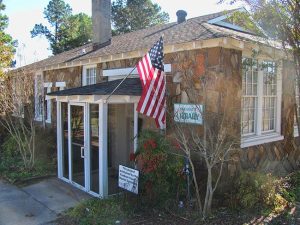
Legacies and Lunch at Butler Center at noon today (5/2)

The Butler Center’s monthly Legacies & Lunch program is today.
The speaker is Holly Hope, Special Projects Historian for the Arkansas Historic Preservation Program.  Her topic is “A Storm Couldn’t Tear Them Down: The Mixed Masonry Buildings of Silas Owens, Sr., 1938-1955”

Silas Owens, Sr. from Twin Groves, Arkansas was a farmer and self-taught rock mason who most notably produced buildings constructed in what the Arkansas Historic Preservation Program coined Mixed Masonries. These were cut stone buildings trimmed with brick. Owens introduced an artistry to a vernacular form that is unmatched and makes them easily recognizable.

Legacies & Lunch is free,  and open to the public. Programs are held from noon-1 p.m. on the first Wednesday of each month. Attendees are invited to bring a sack lunch; drinks and dessert are provided. For more information, contact 918-3033.

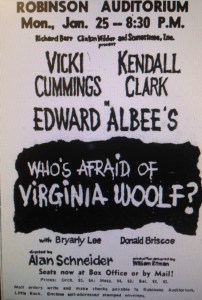
Pulitzers Play Little Rock: WHO’S AFRAID OF VIRGINIA WOOLF?

WAVW LR Jan65As April winds down, today’s featured play did not actually win the Pulitzer Prize for Drama.  In 1963, Edward Albee’s Who’s Afraid of Virginia Woolf? was the choice of the Pulitzer Drama Jury to receive the award.  However, each Pulitzer category’s jury can be overruled by the Pulitzer Board.  In 1963, they chose not to award the Pulitzer in Drama.
Though the Pulitzer board is notoriously tight-lipped about their decisions, the reason for their rejection of the Albee play is known.  At the time, the Pulitzer rules contained language (written originally by Mr. Pulitzer in setting up the prizes) that stated the prize winners must be uplifting and represent high moral values.  With its frank depiction of a fractured marriage and use of vulgarities, the Pulitzer board did not feel that Who’s Afraid of Virginia Woolf? met that criteria.

The resulting outcry over the exclusion of Albee’s play contributed to the removal of the clause.  Albee did subsequently win for his plays A Delicate Balance, Seascape, and Three Tall Women.

The national tour of Who’s Afraid of Virginia Woolf? came to Little Rock in January 1965.  The tour starred Vicki Cummings and Kendall Clark.  Bryerly Lee and Donald Briscoe played the younger couple.  The production was directed by Alan Schneider (who had won the Tony Award for directing the play on Broadway).

Little Rock native Ben Piazza was a close friend of Edward Albee.  When Albee was working on the play, Piazza participated in the first read-through of it. He did not appear in the original Broadway cast, but ended up playing the part of Nick on Broadway for most of the show’s run.  He still holds the record of appearing in Who’s Afraid of Virginia Woolf? in a Broadway run longer than any other actor.

2018 marks the 100th anniversary of the first Pulitzer Prize for Drama being given. To pay tribute to 100 years of the Pulitzer for Drama, twenty-nine days this month a different Little Rock production of a Pulitzer Prize winning play was highlighted.  Many of these titles have been produced numerous times.  This look veered from high school to national tours in an attempt to give a glimpse into Little Rock’s breadth and depth of theatrical history.

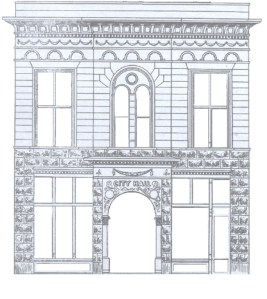
Little Rock’s former 1868 City Hall celebrated today

2018 marks 150 years since the opening of the 1868 Little Rock City Hall, which was located at 120 to 122 West Markham.  This two story building was the home to Little Rock civic life from 1868 until 1908, when the current building was opened.

After City offices moved out, the building housed private businesses until it was torn down in 1964 for urban renewal.  In the early 1980s, the land once again returned to public use when a portion of the Statehouse Convention Center was built on the site.

To mark the 150th anniversary of the opening of the 1868 City Hall, two plaques will be dedicated today.  The first pays tribute to the leaders who oversaw the construction and opening of the building and those who were present when the building closed as City Hall.

The other plaque honors the African American leaders who were on the Little Rock City Council between 1868 and 1893. It also pays tribute to Mifflin Wistar Gibbs who was elected Little Rock Police Judge in 1874.  He became the first African American to be elected to a municipal judgeship in the United States.

While Little Rock city government met in a variety of spaces between 1832 and 1868, records are incomplete as to the locations of those buildings.  The 1868 City Hall location is the first City Hall for which a location and appearance are known.

Pulitzers Play Little Rock: Lawrence Hamilton in THE PIANO LESSON at Arkansas Rep

LawrenceHamiltonAugust Wilson received his second Pulitzer for The Piano Lesson in 1990.   It was thirteen years later, that play would take the stage of Arkansas Rep in January 2003  And while he was not the lead, local favorite Lawrence Hamilton shone in the play.
Hamilton played Wining Boy, a musician and gambler who was smooth at hiding his secrets. (This being an August Wilson play, almost every character had secrets.)  Others in the cast were J. Bernard Calloway and Trish McCall as the brother and sister at the center of the play who were struggling about the future of a family heirloom.  Kevin E. Jones, Veronika G. Macon, Ron Scott, Dennis Bivings, and Marsha Murdock rounded out the cast.

The production was directed by Gilbert McCauley.  The design team included Mike Nichols (set), Yslan Hicks (costumes), Matthew Richards (lighting) and M. Jason Pruzin (sound).

Hamilton would revisit the role of Wining Boy in a production at Cape Fear Regional Theatre just a few weeks before his 2014 death.

2018 marks the 100th anniversary of the first Pulitzer Prize for Drama being given. To pay tribute to 100 years of the Pulitzer for Drama, each day this month a different Little Rock production of a Pulitzer Prize winning play will be highlighted.  Many of these titles have been produced numerous times.  This look will veer from high school to national tours in an attempt to give a glimpse into Little Rock’s breadth and depth of theatrical history.

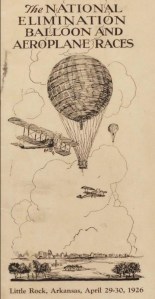
Little Rock Look Back: National Balloon Race starts in Little Rock

On April 29, 1926, nine hot air balloons took off from Little Rock’s airport (which was actually just an airfield at the time) in a national race to win the Litchfield Trophy.  In addition to the trophy, the winner would be on the American team in an international balloon race in Belgium.
The New York Times coverage noted that the weather conditions were ideal as the balloons took off in five minute intervals between 5:00pm and 5:30pm.  The test balloon (akin to a pace car in a car race) was the Arkansas Gazette‘s Skylark.  It took off at 4:25 and headed in the direction of the northeast, which was the desired direction.

The nine balloons, in order of liftoff were: the US Army from Phillips Field in Maryland; the US Army from McCook Field in Ohio; the Goodyear Southern California; the Detroit; the Goodyear IV (whose pilot Ward T. Van Orman had won the 1924 and 1925 contests); US Army from Scott Field; a balloon piloted by a Danish pilot Svend A. U. Rasmussen; US Army balloon from Langley Field in Virginia; and the Akron National Aeronautic Association balloon.

The pilots carried provisions for 48 hours and were equipped for sea flying.  Each had a radio and loud speaker.  KTHS radio of Hot Springs (a forerunner to today’s KTHV TV station) was broadcasting the location of each balloon.  As they left the Arkansas radio station’s range, there was a network of other stations which would do the same.

It was expected that the race would last between eighteen and thirty-six hours.  The last balloon aloft was Van Orman for the third year.  He lasted approximately 31 hours and landed near Chesapeake Bay.

Though no headcount was given, the New York Times called the viewing audience “the largest crowd ever assembled in Little Rock.”

Many thanks to Brian Lang of the Arkansas Arts Center for giving me the tip on this.

Little Rock Look Back: Sam M Wassell

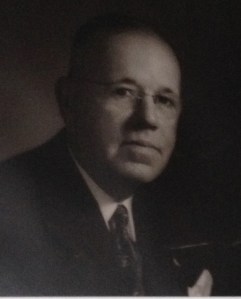
On April 28, 1883, future Little Rock Mayor Sam M. Wassell was born.  His grandfather John W. Wassell had been appointed Mayor of Little Rock in 1868.  He is the only Little Rock Mayor to be a grandson of another Little Rock Mayor.

Sam Wassell served on the Little Rock City Council from 1928 through 1934 and again from 1940 through 1946.  He is one of the few 20th Century Little Rock Mayors who previously served on the City Council.

Wassell was an attorney; he practiced law privately and also served as an Assistant US Attorney.  In 1930, he ran unsuccessfully for the Democratic nomination for the US Congress representing the 5th Congressional District, which at the time included Little Rock.

Wassell ran for Mayor in 1947 and was unopposed in the general election.  (Though the Democratic primary was heated as he took on the incumbent Dan Sprick.)   He was unopposed in his bid for re-election in 1949.  During his second term, President Harry S. Truman visited Little Rock.  In 1951, he sought a third term as Mayor.  No Little Rock Mayor had been successful in achieving a third consecutive term since 1923.  Though he received the Democratic nomination, the Republican party nominated Pratt Remmel who defeated Wassell by a 2 to 1 margin.

With a new USS Little Rock recently put into naval service, it is interesting to note that Wassell’s wife, Ruth Wassell christened the previous USS Little Rock in 1944.

Mayor Wassell died on December 23, 1954 and is buried at Roselawn Cemetery in Little Rock.

Little Rock Look Back: Major Nicholas Peay

On April 28, 1784, in Virginia, future Little Rock Alderman (and acting Mayor) Major Nicholas Peay was born the eleventh of at least thirteen children.  (His gravestone lists a May date for his birth, but all other records indicate April 28, 1784.) A veteran of the War of 1812 and the Indian Wars, he later moved to Kentucky (where he met and married his wife, Juliet Neill, in 1814) before settling in Arkansas on September 18, 1825.  At the time, they were the ninth family to set up residence in Little Rock.

After arriving in Little Rock, he bought the Little Rock Tavern. This started a fifty year tradition of his family owning taverns and hotels in Little Rock. In 1828, he was appointed Assistant Postmaster of Little Rock.  From 1825 to 1831, Little Rock residents were allowed to elect five Trustees prior to the formal incorporation. Major Peay was one of those who served on the Board of Trustees.

He later served on the Little Rock City Council, and in 1839 served for seven months as Acting Mayor due to the prolonged absence of Mayor Jesse Brown.  In 1841, his friend Gen. Zachary Taylor, paid a visit to Little Rock and stayed with him on the General’s way to Fort Smith.

Nicholas and Juliet Peay had at least eleven children, though only five appeared to have lived until adulthood. One of those, Gordon Neill Peay, served as Little Rock’s 23rd Mayor from 1859 to 1861. Other descendants of Nicholas Peay who followed him into public service include his grandson Ashley Peay, who was an Alderman in the 1920s (son of John Coleman Peay) and great-great-grandson Joseph B. Hurst (a great-grandson of Mayor Peay), who was a City Director from 1967 to 1970. In addition, City Director Hurst’s daughter-in-law, Stacy Hurst served three terms on the City Board from 2003 to 2014; she is now Director of the Department of Arkansas Heritage.

Major Peay’s egg-nog recipe has been passed down for generations. It is the inspiration for the Historic Arkansas Museum yearly Nog-Off.  Retired HAM director Bill Worthen and his daughter are the sixth and seventh generation of the family to make Peay’s egg-nog.

Major Nicholas Peay is buried with his wife and many other family members in Mount Holly Cemetery.

The Smithsonian Institution records indicate they have an oil painting of Major Peay as well as of his wife. But there are conflicting records as to whether they have been lost or are in private collections.