
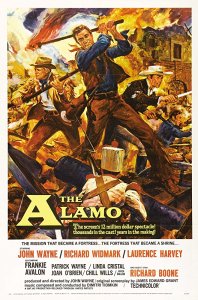
Rock the Oscars: THE ALAMO

One of the early settlers in Little Rock was a man from Tennessee named Davy Crockett.  He did not stay in Little Rock very long. He and several others ventured to the Republic of Texas.  His final days are depicted (with more liberties than the original Texans had under Mexican control), in the film The Alamo.  (While Stephen F. Austin does not appear in the movie, he was actually one of Little Rock’s founding fathers before becoming a founder of Texas.)

The very fictionalized, grandiose, and jingoistic movie starred John Wayne as Crockett, Richard Widmark and Col Jim Bowie, Laurence Harvey as Col. William Travis, along with Frankie Avalon, Patrick Wayne, Chill Wills, Ken Curtis, and Denver Pyle.

Though one of the top grossing films of the year, it was still a financial flop due to its excessive cost.  However, when Oscar time came around, the film received seven nominations. They were Best Picture, Supporting Actor (Wills), Cinematography-Color, Film Editing, Sound, Song, and Scoring of a Dramatic or Comedy Picture.

Wills took out an ad claiming that his fellow Alamo actors were praying for him to win even harder than the original Alamo soldier had prayed for victory.  There was much backlash.  It was felt that this may have affected award chances in all categories.  It only won the Award for Best Sound – which went to Gordon Sawyer and Fred Hynes.

The remake/new version of The Alamo received no Oscar nominations.
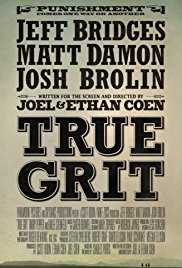
Rock the Oscars: TRUE GRIT, Part 2

In 2010, the Coen Brothers released a new version of Charles Portis’ True Grit.  (As a reminder, Portis had roots in Central Arkansas and was once a writer for the Arkansas Gazette.)
Co-written and co-directed by Ethan and Joel Coen, it starred Jeff Bridges, Matt Damon, Hailee Steinfeld, Josh Brolin, Barry Pepper, Domhnall Gleeson and Elizabeth Marvel.  Unlike the original film, which was filmed in Colorado, this film was actually filmed partially in Arkansas, where  several scenes takes place.  Filming also took place in Texas.  Many Arkansas actors appeared in the film, but at the risk of omitting some, there will not be an attempt to name them.

The film received ten Oscar nominations: Best Picture, Adapted Screenplay, Directing, Leading Actor (Bridges), Supporting Actress (Steinfeld), Cinematography, Costume Design, Sound Mixing, Sound Editing, and Art Direction.  Sadly, the film went home empty handed.


Little Rock Look Back: Museum of Discovery opens in River Market

Museum of Discovery Logo when it opened in 1998

Founded in 1927 as the Arkansas Museum of Natural History and Antiquities in a downtown storefront, by 1997, the museum had been located in at least two other spots and had several different names.  On February 21, 1998, it reopened as the Museum of Discovery in its new location in the recently launched River Market district.  It occupied space on the first floor and basement of the Museum Center building (formerly the Terminal building the erstwhile train station which later was used for printing the Arkansas Democrat.)

The new name and new space reflected a greater emphasis on the science aspect of the museum’s mission.  It featured many hands on and interactive exhibits.

The museum spent one-third of its $10.6 million cost on exhibits.  Of the $10.2 million pledged for the museum, 47 percent — or about $4 million — came from a half-cent city sales tax approved by voters about five years ago. Another 14 percent came from foundations and 2 percent from private organizations and individuals. The remaining 37 percent came from corporations, sometimes in connection with specific exhibits.

Following a February 20, 1998, preview party, the official grand opening was held on February 21, 1998.

The previous museum space (inside the Arsenal building in MacArthur Park) occupied 14,000 square feet, 8,000 of which was display space. After the move, the museum had 35,000 square feet of display space.

Little Rock Look Back: Billy Graham

bgpreaching-960x605With his death today at the age of 99, a look at two visits Billy Graham made to Little Rock.
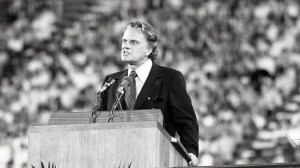
In 1959, as Little Rock was still grappling with the issue of desegregation, Graham brought his crusade to Little Rock.  Held at War Memorial Stadium, Graham insisted that the seating be desegregated. That was always a requirement of his.  He refused to give in to the segregationist protests.  That was probably the first time War Memorial Stadium had been desegregated.

Thirty years later, he returned to Little Rock and War Memorial Stadium.  Among the performers he had at this time was Arkansan Johnny Cash.  Also in attendance was Governor Bill Clinton.  He remarked that he had been a fan of Rev. Graham’s since the 1959 crusade and his stance on requiring desegregation.

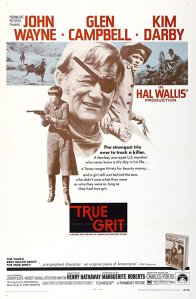
Rock the Oscars, TRUE GRIT – Part 1

Fifty years ago, former Arkansas Gazette reporter Charles Portis wrote a novel entitled True Grit.  It is more than a work of literature, it is a work of art.  In April 2018, the Oxford American will be celebrating the 50th anniversary of the publication of the novel with a series of events.
In 1969, the movie was made into a movie starring John Wayne and Arkansan Glen Campbell.  Kim Darby, Robert Duvall, Dennis Hopper, Jeff Corey and Strother Martin are also in the cast.  The movie was directed by Henry Hathaway, produced by Hal B. Wallis, and written by Marguerite Roberts.  Wilford Brimley and Jay Silverheels are uncredited actors in the movie.

Though set in Arkansas and Oklahoma, the movie was filmed in Colorado.  Elvis Presley was the first choice for the part Campbell would play. But when his manager demanded top billing (over Wayne), he was bypassed and the part went to Campbell.

The movie was nominated for two Oscars: Wayne for Best Actor and composer Elmer Bernstein and lyricist Don Black for the song “True Grit.”  The latter had been sung by Campbell in the movie.

Wayne won the Oscar that night, his only win.  He would reprise the character of Rooster Cogburn in the eponymously named sequel in 1975. This film, in which he co-starred with Katharine Hepburn, was his penultimate film.

In 1970, Campbell teamed up with Kim Darby again in a film written by Roberts based on a Portis book. This time it was Norwood.  It also starred Joe Namath, Carol Lynley, Meredith MacRae, and Dom DeLuise.  It did not repeat the success of the earlier Portis based movie.

Little Rock Look Back: Farewell to the Hotel Marion and the Grady Manning Hotel

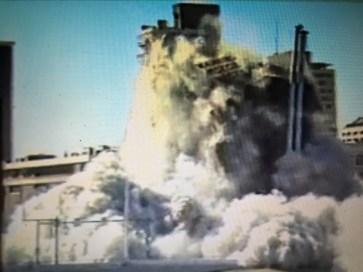
Manning Implosion.JPGOn February 17, 1980, a cold and clear Sunday morning, over seven decades of Arkansas history came tumbling down as the Hotel Marion and Grady Manning Hotel were imploded.  Thousands of people watched from places in downtown Little Rock and along the Arkansas River.  Many more were able to watch from live coverage carried on KATV, KARK and KTHV.  Those that missed it were able to see the replays multiple times on the news.

It was the first large-scale implosion in Little Rock’s history.  (It was likely the first implosion, but there could have been a small one that is not known.)  The two hotels were torn down to make way for the construction of the Excelsior Hotel and the Statehouse Convention Center.

The Hotel Marion, named after the builder Herman Kahn for his wife, opened in 1907. For four years it was Arkansas’ tallest structure.  It was the largest and grandest hotel in the City. For decades it would be the host to many dignitaries, conventions, and gala celebrations.

The Grady Manning Hotel was originally known as the Hotel Ben McGhee when it opened in 1930.   Manning was the head of the company which owned both the Marion and Ben McGhee properties.  Upon his untimely death by drowning in September 1939, the property was subsequently renamed in his memory.

The Manning Hotel, though taller, was never as grand a hotel as the Marion.  It was more of a mid-range property in pricing.

By the 1970s, both hotels were suffering from neglect and disinterest.  Changes in the lodging industry combined with a decline in downtown Little Rock had left both facilities with little business.

When Little Rock civic and government leaders decided to construct a larger convention center downtown with an adjacent hotel, it was decided that neither of these facilities could be properly renovated to be part of the project.  Instead, the land on which they stood (and the space in between) would be prime for the new hotel and center.

So, on the cold Sunday morning, the explosives were detonated, and the buildings came down.   Sunday morning was chosen because it would have the least impact on traffic flows since it would cause numerous streets to be closed for safety reasons.  The blast was delayed due to a rumor that someone might be in one of the buildings.  After checking both sites and finding them empty, the charges were set off.

And the Marion and Grady Manning became as much a memory as the long gone people who had once populated them.

The University of Arkansas’ Pryor Center for Oral and Visual History has a video of the implosion.

Rock the Oscars: Hal Holbrook

(Photo by Joseph Harris for the AP)

Oscar nominated actor Hal Holbrook’s visits to Little Rock have been fairly regular over the decades.  In the 1980s and 1990s, he came several times in conjunction with the TV shows “Designing Women” and “Evening Shade.”  He also made an appearance at Wildwood in his one man play Mark Twain Tonight.

His first visit to Little Rock was in the mid-1950s.  He was just out of college and on a national tour of schools and small towns performing scenes from Shakespeare opposite his then-wife.  In a lengthy essay reflecting on his early career, Holbrook speaks fondly of his visit to Little Rock and of the grandiose stage and auditorium at Little Rock Central High School.