Tony Awards Week – Trouble with a capital T and that rhymes with…. HAIR?

Ad for the original production of HAIR in Little Rock. Note the ticket prices. And that they could be purchased at Moses Music Shops.

Ad for the original production of HAIR in Little Rock. Note the ticket prices. And that they could be purchased at Moses Music Shops.

The Tony winning musical The Music Man may have featured a song about “Trouble in River City” but the Tony nominated musical Hair brought trouble to this “river city” in 1971 and 1972.

In February 1971, a young Little Rock attorney named Phil Kaplan petitioned the Little Rock Board of Censors to see if it would allow a production of Hair to play in the city. He was asking on behalf of a client who was interested in bringing a national tour to Arkansas’ capital city. The show, which had opened on Broadway to great acclaim in April 1968 after an Off Broadway run in 1967, was known for containing a nude scene as well for a script which was fairly liberally sprinkled with four-letter words. The Censors stated they could not offer an opinion without having seen a production.

By July 1971, Kaplan and his client (who by then had been identified as local promoter Jim Porter and his company Southwest Productions) were seeking permission for a January 1972 booking of Hair from the City’s Auditorium Commission which was charged with overseeing operations at Robinson Auditorium. At its July meeting, the Commissioners voted against allowing Hair because of its “brief nude scene” and “bawdy language.”

Kaplan decried the decision. He stated that the body couldn’t “sit in censorship of legitimate theatrical productions.” He noted courts had held that Hair could be produced and that the Auditorium Commission, as an agent for the State, “clearly can’t exercise prior censorship.” He proffered that if the production was obscene it would be a matter for law enforcement not the Auditorium Commission.

The Commission countered that they had an opinion from City Attorney Joseph Kemp stating they had the authority. One of the Commissioners, Mrs. Grady Miller (sister-in-law of the building’s namesake the late Senator Robinson who had served on the Commission since 1939), expressed her concern that allowing Hair would open the door to other productions such as Oh! Calcutta!

On July 26, 1971, Southwest Productions filed suit against the Auditorium Commission. Four days later there was a hearing before Judge G. Thomas Eisele. At that hearing, Auditorium Commission member Lee Rogers read aloud excerpts from the script he found objectionable. Under questioning from Kaplan, a recent touring production of Neil Simon’s Tony winning play Plaza Suite was discussed. That play has adultery as a central theme of one of its acts. Rogers admitted he found the play funny, and that since the adultery did not take place on stage, he did not object to it.

Judge Eisele offered a ruling on August 11 which compelled the Auditorium Commission to allow Hair to be performed. Prior to the ruling, some of the Auditorium Commissioners had publicly stated that if they had to allow Hair they would close it after the first performance on the grounds of obscenity. To combat this, Judge Eisele stated that the Commission had to allow Hair to perform the entire six day engagement it sought.

Upon hearing of the Judge’s ruling, Commissioner Miller offered a succinct, two word response. “Oh, Dear!”

In the end, the production of Hair at Robinson would not be the first performance in the state.  The tour came through Fayetteville for two performances in October 1971. It played Barnhill Arena.

On January 18, 1972, Hair played the first of its 8 performances over 6 days at Robinson Auditorium.  In his review the next day, the Arkansas Gazette’s Bill Lewis noted that Hair “threw out all it had to offer” and that Little Rock had survived.

The ads promoting the production carried the tagline “Arkansas will never be the same.”  Tickets (from $2 all the way up to $8.50) could be purchased at Moses Melody Shops both downtown and in “The Mall” (meaning Park Plaza). That business is gone from downtown, but the scion of that family, Jimmy Moses, is actively involved in building downtown through countless projects. His sons are carrying on the family tradition too.

Little Rock was by no means unique in trying to stop productions of Hair.  St. Louis, Birmingham, Los Angeles, Tallahassee, Boston, Atlanta, Charlotte NC, West Palm Beach, Oklahoma City, Mobile and Chattanooga all tried unsuccessfully to stop performances in their public auditoriums.  Despite Judge Eisele’s ruling against the City of Little Rock, members of the Fort Smith City Council also tried to stop a production later in 1972 in that city. This was despite warnings from City staff that there was not legal standing.

Within a few years, the Board of Censors of the City of Little Rock would be dissolved (as similar bodies also were disappearing across the US). Likewise, the Auditorium Commission was discontinued before Hair even opened with its duties being taken over by the Advertising and Promotion Commission and the Convention & Visitors Bureau staff.  This was not connected to the Hair decision; it was, instead, related to expanding convention facilities in Robinson and the new adjacent hotel.  Regardless of the reasons for their demise, both bygone bodies were vestiges of earlier, simpler and differently focused days in Little Rock.

Over the years, Hair has returned to the Little Rock stage. It has been produced two more times at Robinson Center,  UALR has produced it twice, and the Weekend Theater has also mounted a production.   The most recent visit to Little Rock at Robinson Center, which was the final Broadway show before the building closed for renovations, was based on the 2009 Broadway revival.  That production, was nominated for eight Tony Awards, and captured the Tony for Revival of a Musical.  Several members of the production and creative team are frequent collaborators of Little Rock native Will Trice.

Tony Awards Week – History of theatre in Little Rock

Joe E. Brown in HARVEY

Joe E. Brown in HARVEY

Little Rock existed as a theatre town for over 100 years prior to the Tony Awards.  But since this is Tony Awards week, “let’s start at the very beginning, a very good place to start” (words by my favorite lyricist Oscar Hammerstein II).

The first documented theatrical performance was on November 4, 1834, and in August 1838 the construction of the first theatre in Little Rock was announced.  Through Little Rock’s early years a variety of spaces were used for performances including the City Hall on Markham near Main Street which had been built in 1867.

The opening of the Capital Theatre in December 1885 would be Little Rock’s first large-scale, non-church space for performances and gatherings.  The Capital had a seating capacity of approximately 2,000 seats.  Designed to house theatrical productions, it also played host to civic events ranging from high school graduations (for both the white and African American high schools) to public memorials.  For instance, in 1901 it was the site of a public memorial for the recently assassinated President William McKinley.  In time, the Capital Theatre (which was situated on land that is now occupied by a portion of the Statehouse Convention Center) would be joined by a variety of other theatres, public houses, vaudeville houses and lodge halls.

The 1908 “temporary” City Auditorium probably played host to theatrical performances, but records do not exist for it.  The amphitheatre in Forest Park was home to many theatrical performances including appearances by Sarah Bernhardt.  Judy Baker Goss’s play Fond Farewell looked at one of Bernhardt’s visit to Little Rock.  (In the local production of that play, Bernhardt was played by Judy Trice, the mother of a three-time Tony winner Will Trice. His father, Bill Trice, played a Little Rock City Council member smitten with the actress.)

When Robinson Auditorium opened in 1940, it had space to host theatrical productions in the main music hall as well as in the lower level “little theatre.”  By that time, there were a variety of community theatre groups performing.  The first national tour to play in Robinson was Springtime for Henry starring Edward Everett Horton.

The first Tony winning production to play Robinson was the national tour of Harvey starring Joe E. Brown.  Brown, in fact, received a special Tony for starring in the national tour of the play.

Little Rock Look Back: Cornice placed on Robinson Auditorium

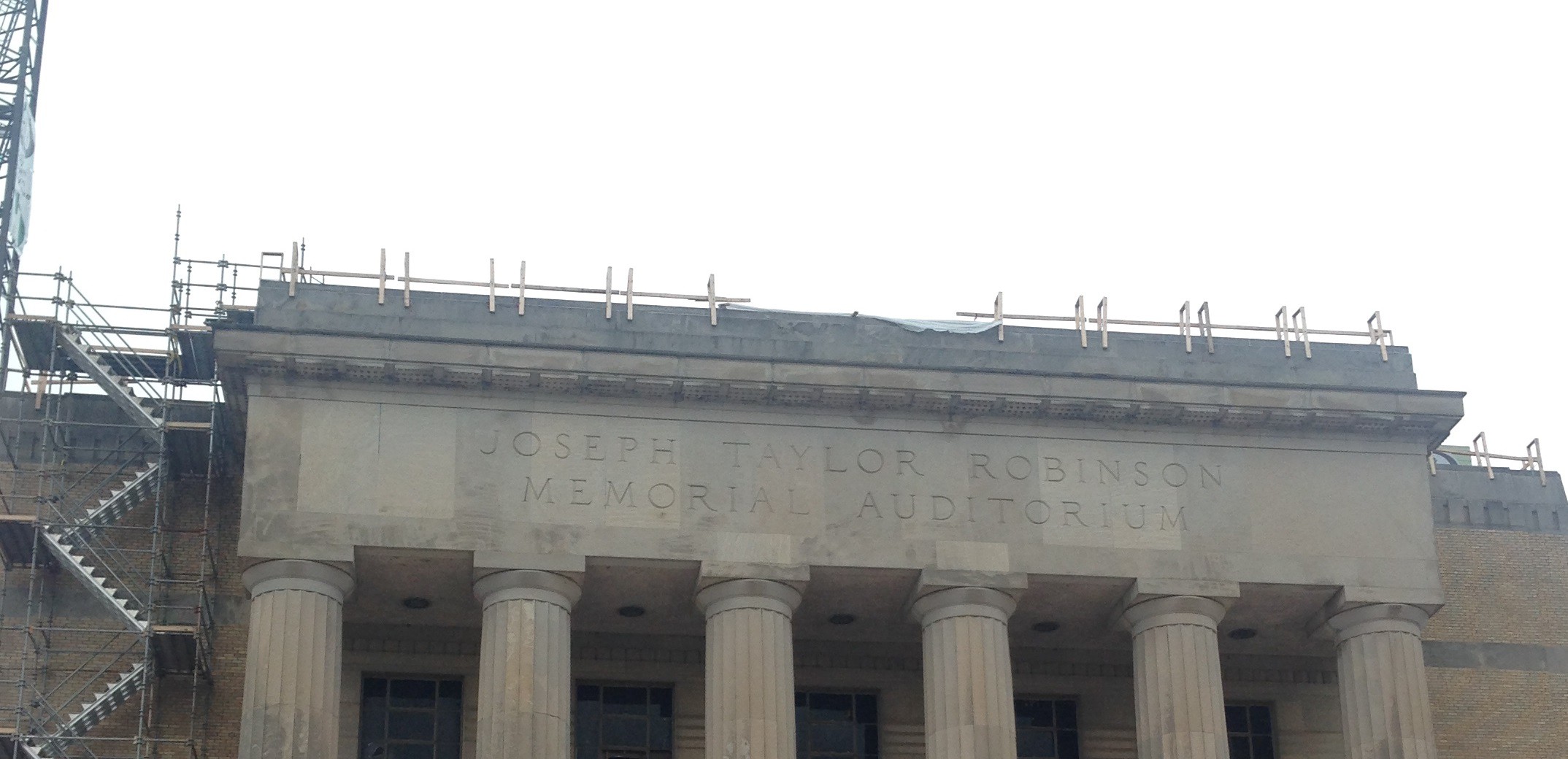
JTR CorniceOn June 1, 1939, the cornice was installed on Robinson Auditorium.  This granite slab noted the name of the building as the Joseph Taylor Robinson Memorial Auditorium.  (It is interesting to note that it used the more modern “u” instead of the classical “v” which was often used in buildings during prior decades – as evidenced by the Pvlaski Covnty Covrt Hovse across the street.)

This was a milestone marking the completion of the front facade of the structure.  Much work would continue on the interior of the structure.  This step in the construction was considered major enough that the Arkansas Gazette mentioned it in a news article.

Today the cornice is again surrounded by construction materials and braces. The front lobby, the cornice and columns are pretty much the only parts of the building not currently under construction as Robinson Center is readied for its second act.  It is scheduled to open in November 2016.

Heritage Month – Paul Laurence Dunbar High School

dunbarNow known as Dunbar Middle School, this building originally house students from junior high to junior college.  For years the Paul Laurence Dunbar High School was known throughout Arkansas and the south as an outstanding school for African American students.

From 1929 until 1955, Dunbar High School provided a high-quality education for African American students, not only within Little Rock but also from far-reaching corners of the state.   Today the National Dunbar Alumni Association is a well-organized network of former students with active chapters throughout the United States. 

The school is located in a residential area south of downtown Little Rock. George H. Wittenburg and Lawson L. Delony designed the edifice, built on a southeast-northwest axis. Both architects contributed to the design of Little Rock Central High School (1927; listed on the National Register in 1977), which is nine blocks west of Dunbar.

Dunbar was designed to accommodate an academic curriculum as well as the more traditional vocational programs often considered the limit of education for blacks. In 1980, Dunbar Junior and Senior High School and Junior College was listed on the National Register.

The significance of Dunbar Junior High School derives both from the unique place it occupies in the history of education in Arkansas and from the modern architectural concepts with which it was designed. Dunbar was a center of quality education for black Arkansans in the state’s segregated public school system, functioning as a junior high school, high school, and junior college until its last high-school and junior-college classes graduated in 1955.

It had further distinction as one of only two industrial arts schools in the south to attain junior college rating, also in 1931-1932, as well as the recognition and acceptance of the Dunbar curriculum as the basis for admission to colleges and universities throughout the United States. In 1943 the school was involved in a controversy concerning equal pay for black and white teachers in the Little Rock School System, which was resolved in Morris v. Williams, 149 F. 2d 703, heard before the 8th U.S. Circuit Court of Appeals. This was a landmark case in establishing the principle of “equal pay based on professional qualifications and services rendered.”

The architects’ achievement in designing an architecturally eminent setting for this progressive passage in Arkansas history is also noteworthy. With an eye toward form following function, the plan of the building promotes maximum use of space and expedient circulation. Aesthetically, the building is decidedly modern, with decorative brick and stone work and striking towers reflecting an interest in the Art Deco style of the period.

Heritage Month – White-Baucum House

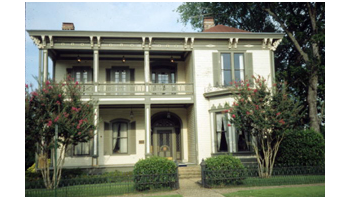
ahpp_nom_whitebaucumhouse_largeThe White-Baucum House is an architecturally significant structure with important historical. associations. The building, with its strong principal entrance, dominant porches and careful detailing, is one of the earliest and best examples of Italianate architecture in the state.

The home was constructed in 1869-1870 for Robert J. T. White, who was then Arkansas Secretary of State. In 1876 the building was sold to George F. Baucum, who entered business in Little Rock after distinguished service in the Civil War. Baucum operated a wholesale grocery business, was a cotton broker, was president of the Bank of Little Rock for a time and was one of the founders of the Board of Trade of the city. The Baucum family lived in the how until the mid-1920s. Lora B. Busick occupied the place from 1935 to 1957.

After being left vacant for four years, the house was adapted to new uses, It served as the home of two restaurants, an interior design studio, a nightclub, an advertising agency, and later an engineering firm.  For several years it sat vacant and fell into disrepair.  It has since been restored.

It was added to the National Register of Historic Places on Leap Day (February 29) in 1980.

Heritage Month – Knoop House

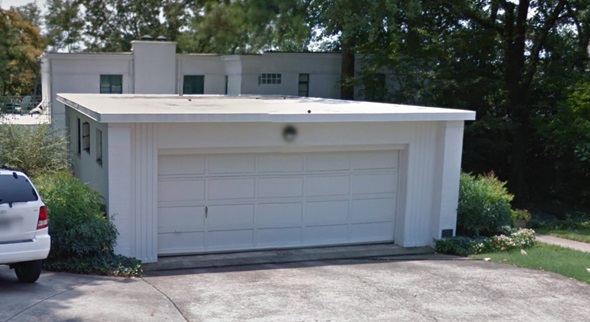
Knoop HouseToday’s historic property is unique for Little Rock.  It is one of the only (if not the only) Art Moderne style residences in Little Rock.

The Knoop House was built in 1936-1937 in Hillcrest for Werner and Faith Knoop. Designed by the architectural firm of Brueggeman, Swaim & Allen, the Art Moderne style of the house departed dramatically from, the mere typical period revival styles of the Hillcrest neighborhood. The Knoop House was (and still is) an outstanding Modernistic architectural statement in an area filled predominantly with English Revival, Colonial Revival, American Four Square, and Bungalow styles.

The house was built by Werner and Faith Knoop in 1936-1937.  In 1948, the original garaged was enlcosed and a new garage was added to the front of the house. Mr. Knoop was a mechanical engineer and founding principal in what is now the Baldwin & Shell Construction Company.  After having served on the school board, in 1957 Mr. Knoop became the first Mayor of Little Rock under the “new” city manager form of government and continued to serve the City on various committees even after his term as Mayor ended. Faith Yingling Knoop was a well-published author of magazine articles, textbooks, and children’s books.

The Knoop House’s simple, restrained detailing is typical of the Art Moderne style, as is the emphasis upon large uninterrupted expanses of smooth wall surface, the preference far a light palette and the selection of such modern materials as metal casement windows and glass block.

The Knoop House was added to the National Register of Historic Places in August 1990.

Heritage Month – Villa Marre

villamarreThe Villa Marre is located at 1321 Scott Street. The Second Empire-style Villa Marre was built in 1881 by Italian immigrant and Little Rock saloonkeeper Angelo Marre, who also served on the Little Rock City Council.

The distinctive home features a mansard roof covered in patterned slate, a central tower topped by wrought-iron cresting, and hood molding above the doors and windows. Marre died in 1889, and his widow, Jennie, remained in the house until about 1900. Arkansas Governor Jeff Davis rented the house for a few years, and in 1905, the home was purchased by E. B. Kinsworthy, former state senator and attorney general of Arkansas.

It is probably most famous today for being the outdoor exterior of Sugarbakers design firm in the CBS sitcom “Designing Women.”  For several years, it was the home of the Quapaw Quarter Association. It later returned to a private residence.  Currently it is a venue for weddings and other events.

It was added to the National Register of Historic Places on June 15, 1970.