Tonight in downtown LR – Anonymous 4 in concert at Christ Church

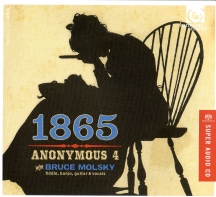
anonymous4Renowned for their unearthly vocal blend and virtuosic ensemble singing, the four women of Anonymous 4 combine historical scholarship with contemporary performance intuition to create their magical sound. They return for the last time (2015 will be the last season for Anonymous 4 to perform) with songs from their 1865: Songs of Hope and Home from the American Civil War tour.

1865 focuses on the personal experience of men, women, and children from the North and from the South, toward the end of the Civil War and in its immediate aftermath — as told in songs originally written for the stage and for the parlor, and in songs and instrumental tunes from the hills and back roads of America.

Many of the songs in 1865 were published between 1861 and 1865; others first appeared in print earlier, but were sung constantly during the war years, perhaps in an effort to bring to mind the familiar and the good. Yet other songs and instrumental tunes are not datable; by the year 1865, they had already been passed down from generation to generation without the aid of the printed page.

Joining Anonymous 4 for this project is renowned old-time fiddler, master banjo and guitar player, and heavenly vocalist, Bruce Molsky. 

Anonymous 4 and Bruce have put our own stamp on the songs in 1865: sounds include 5-part harmonies on the Stephen Foster gem “Hard Times, Come Again No More;” “Home, Sweet Home” and “Listen to the Mocking Bird” accompanied by the banjo; an homage to the Carter Family on “The Faded Coat of Blue;” the high lonesome sound on folk songs like “Bright Sunny South” and “Brother Green;” Bruce’s inimitable fiddle and banjo playing on instrumental tunes “Camp Chase,” “Rebel Raid” and “Polly Put the Kettle On,” and the four-part a cappella singing of Anonymous 4 on the hymn “Abide with Me” and the timeless anti-war song “Tenting on the Old Camp Ground.”


The concert starts at 7:30 pm at Christ Episcopal Church.  Tickets are $25, students $15, available at the door. CDs will be available after the performance for cash or check only.

 

Black History Month Spotlight: Dr. Patricia McGraw

bhm mcgrawDr. Patricia Washington McGraw is an educator and author.  Now retired from the University of Central Arkansas where she was a professor of English and African/African American Studies, McGraw is recognized for her achievements as an educational/civic leader and social advocate.  She has received over 300 teaching excellence and community service awards on the local, state and national levels.

McGraw graduated from San Francisco State College in 1957 and received her master’s degree in special studies in American literature from the college in 1967. In 1982 she earned her Ph.D. in sociolinguistics and Black studies from Washington University in St. Louis. She graduated with honors from each institution.

Despite her status as a retired professor, McGraw remains an active force in her community and abroad. From 1983-1994 she owned and operated The McGraw Learning Institute: Abilities Unlimited, a private school for African-American children. She has served as a literary consultant to two youth groups and has been an African storyteller at various museums throughout Central Arkansas.  She has co-hosted televisions shows and is the creator of a one-woman show, A Profile of Four Black Women: Look Upon Them and Be Renewed, that has received rave reviews and has been performed over 400 times in Africa, the West Indies and Canada.

Dr. McGraw is a noted author having published several books and more than 500 articles and works of poetry. Her work as a humanitarian has taken her to Africa seven times, having visited 18 countries on the continent. In 1999, on Lake Kivu, between the East African countries of Rwanda and the Republic of the Congo, members of the Rwandese Parliament presented an island to her.

She was inducted into the Arkansas Black Hall of Fame in 2004.  For more on Dr. McGraw and other inductees into the Arkansas Black Hall of Fame, visit the permanent exhibit at the Mosaic Templars Cultural Center. That museum is an agency of the Department of Arkansas Heritage.

Magic Lantern Show tonight at the Old State House Museum

OSH logoExperience a Victorian Valentine Magic-Lantern Show tonight at the Old State House Museum at 7:00 p.m.

Travel back in time with the boisterous fun of America’s only Victorian magic-lantern show. An authentic 1890s visual extravaganza projected on a full-sized screen—the kind of show that led to the movies! Valentine stories, animated comedy, and songs—all dramatized on screen by a live showman and singer/pianist.

The audience participates in the fun, creating sound effects, and joining in chants and sing-alongs. ~~ For 22 years, The American Magic-Lantern Theater has delighted audiences from Lincoln Center to Singapore. “What a hoot!” says NEED. “You’ll be enthralled!” says The Family Adventure Guide to Connecticut. But National Public Radio says it best: “It’s an incredible experience . . . Don’t miss them. They’re a living national treasure!” For adults and children 6+.

The Old State House Museum is an agency of the Department of Arkansas Heritage.

Little Rock Look Back: Abraham Lincoln

Abraham_Lincoln_November_1863On February 12, 1809, Abraham Lincoln was born in Kentucky.  One hundred and fifty years ago today, he celebrated his last birthday as he would be assassinated a little over two months later.

Lincoln never visited Arkansas. In the 1860 election, he barely registered on the Arkansas election map. Arkansas counties went strongly for Southern Democratic candidate John Breckinridge.  John Bell, the Constitutional Union/Whig candidate ran strongly in Pulaski County and a scattering of other counties.  Neither Lincoln nor Northern Democratic candidate Stephen Douglas carried a county in Arkansas.  In 1864, though Arkansas was officially under control of the Union forces, the state had not been readmitted. Therefore no Arkansans voted for Lincoln that year.

As President, Lincoln did correspond with several Arkansans.  It is said that the polite written exchanges he had with former Mayors C. P. Bertrand and Gordon Peay were helpful in maintaining a fairly peaceful occupation of Little Rock by federal forces.

In the listing of Presidential Streets of Little Rock, Lincoln is omitted.  On first blush, this might seem to be intentional to skip the name of the President who oversaw the “occupation.”  However, if that were the case, then surely Johnson would have been left out as well since he was President during the final years of the federal military occupation.  In fact, there once was a Lincoln Street. A portion of what is now Cantrell/Highway 10 was named for Lincoln. It predated the other Presidential streets.  At the time the other streets were laid out, Lincoln was skipped because a street already bore the name.

Over time, Highway 10 had been given multiple names for various sections: Lincoln, Q, and Cantrell. In the 1930s, these names were consolidated into Cantrell which was the longest section. The name Lincoln was dropped. There were very few addresses on Lincoln, most of it was railroad property.  The viaduct connecting Highway 10 with LaHarpe still bears the name of Lincoln Avenue.


A Lincoln Viaduct Portrait

Photo courtesy of the Arkansas Historic Preservation Program

Photo courtesy of the Arkansas Historic Preservation Program

Since today is Abraham Lincoln’s birthday, it is a good day to pay tribute to the Lincoln Avenue Viaduct.  This arched bridge is traversed by thousands of cars each day, with most having no idea the name of the structure.  The Lincoln Avenue Viaduct is the arched bridge connecting LaHarpe with Cantrell Road which (literally) bridges downtown with the west along Highway 10.

The Lincoln Avenue Viaduct is a reinforced concrete rainbow arch bridge. It was opened at 2:05 p.m. on Friday, December 28, 1928, and, despite later alterations, it remains particularly well-preserved. The Missouri Pacific Railroad Company, considered the most important railroad company in the state, constructed the bridge amid a series of improvements in Little Rock made necessary by the damage wrought by the infamous spring floods of 1927.

Though the bride was constructed by the railroad, the City had to give authorization to do so, this was accomplished by the passing of Ordinance 4,335, at the May 28, 1928, City Council meeting.

Lincoln Avenue was one of several names for stretches of Highway 10 in Little Rock. By the 1960s, the areas west of the Lincoln Avenue viaduct were all renamed Cantrell in honor of the man who had developed much of the area west of the Heights. The longest stretch of the road already carried that name. There had been an effort to rename Highway 10 (including sections named Lincoln, Q, and Cantrell) in Little Rock for Senator Joseph Taylor Robinson in 1930. He declined the offer because he did not want to diminish the contributions of Mr. Cantrell.  Over time the entire stretch bore the name Cantrell.

The stretches east of the viaduct which involved a couple of names were renamed La Harpe Boulevard in honor of the French explorer who first saw the Little Rock.

Though the street has been renamed, the bridge still carries the name of the 16th President of the United States.

A Look at Slaves in Arkansas’ Wilderness today at the Old State House Brown Bag lunchtime lecture series

oldstatehouseThe next installment in the Old State House’s Brown Bag Lecture series is today at noon.  It features Dr. Kelly Jones discussing “Opportunity on the Edge of the South: Slaves in the Wilds of Arkansas.”

While white settlers were successful in establishing a harsh regime of slavery in Arkansas, the abundance of “wild” spaces lent opportunity outside the master’s gaze. Kelly Jones leads a presentation that draws from WPA ex-slave interviews and plantation records to describe how enslaved people in Arkansas used the land around them to resist the demands of their bondage and keep up social ties.. Jones is currently a visiting lecturer at the University of Central Arkansas and has a Ph.D. in history from the University of Arkansas.

The Old State House Museum is an agency of the Department of Arkansas Heritage.

Black History Month Spotlight: Deborah Mathis

bhm deborahDeborah Mathis has deep Arkansas roots.  She grew up in Little Rock the daughter of Rev. Lloyd Myers, a Baptist minister, and Rachel A. Myers Jones, a teacher.

Her journalistic pursuits began as early as junior high school, when she became the first black editor of West Side Junior High’s school newspaper. In 1970 she became the first black and first female editor of Central High School’s Tiger student newspaper. From the early 70′s through the early 90′s, Mathis was busy establishing herself as a journalist and broadcaster. She served in various positions ” reporter, editor, columnist and anchor ” at statewide media outlets including the Arkansas Democrat, Arkansas Gazette, KARK-Channel 4, KTH V-Channel 11, and KATV-Channel 7 From Arkansas, Mathis career took her to briefly to Jackson, Mississippi before she landed in Washington, D.C., where she was a White House Correspondent for Gannett News Service from 1993-2000.

Since 1992, Mathis has been a syndicated columnist, appearing in more than 100 U.S. publications and periodicals. She is also a contributor to such outlets as USA Today and BlackAmericaWeb.com and a frequent commentator on political and public affairs talk shows such as PBS’s Frontline, CNNs Inside Politics NPR’s All Things Considered America’s Black Forum and Oprah, to name a few. She also field-produced, wrote and narrated two nationally aired documentaries: “Edukashun: The Cost of Failure” (1982) and “Return of the Little Rock Nine” (1987).

Mathis is the author of Yet A Stranger Why Black Americans Still Don’t Feel at Home, Sole Sisters: The Joy and Pains of Single Black Women and What God Can Do: How Faith Changes Lives for the Better.  She has also been an assistant professor at Northwestern University’s Medill School of Journalism (Washington office).  In 2003, she was inducted into the Arkansas Black Hall of Fame.

For more on Deborah Mathis and other inductees into the Arkansas Black Hall of Fame, visit the permanent exhibit at the Mosaic Templars Cultural Center. That museum is an agency of the Department of Arkansas Heritage.