Little Rock Look Back: President William Henry Harrison

A campaign ribbon from an 1840 Harrison and Tyler rally in Little Rock.

A campaign ribbon from an 1840 Harrison and Tyler rally in Little Rock.

On February 9, 1773, future US President William Henry Harrison was born in Virginia. Though he would later be viewed as a frontiersman (which he was), his early years were spent on a family estate as part of one of the FFV’s (First Families of Virginia).

At the age of 18, he was commissioned in the US Army and began an illustrious military career which spanned the Northwest Indian War and the War of 1812. This career took him into the wilderness areas of the US, which at the time were Indiana and Ohio.

Harrison launched his political career in 1798 when he was appointed treasurer of the Northwest Territory. The next year, he was elected to represent the territory in Congress. In 1801, he was named Governor of the Indiana Territory.  In 1811, while still Governor of Indiana, he led troops to defend against a Shawnee attack in the Battle of Tippecanoe.  The following year, with the outbreak of the War of 1812, he continued to command armies in the northwest areas of the US.  In 1813, he scored a major victory at the Battle of the Thames in Canada.  This solidified him as a war hero with the public.

In 1814, he was appointed by President Monroe to oversee negotiations with Indians. In 1816, he was elected to Congress from Ohio and served until 1819. In 1824, he was elected as a US Senator from Ohio and served until 1828. He was sent as minister to Columbia in 1828 and served until the Presidency of Andrew Jackson in 1829.

220px-William_Henry_Harrison_daguerreotype_editReturning to private life, he ran for President as a Whig in 1836. At the time, the Whigs ran several candidates hoping to split the vote and send the election to Congress. Harrison narrowly lost Pennsylvania and its 30 electoral votes. (Though since the Democrats retained Congress in the election, it was expected that Van Buren still would have won.)  Four years later the Whigs coalesced behind Harrison.

Though his opponents tried to paint him as old, out of touch, and backwoods, he and running mate John Tyler (also a landed gentry from Virginia) embraced the depiction. They felt it helped them relate to the average voters and, in turn, painted Van Buren as out of touch and elitist.  Though Arkansas’ electoral votes went to Van Buren, Harrison ran fairly strong in the state. He narrowly captured Pulaski County and ran strong in the southeast portion of the state.

Harrison served in office only one month.  While at the time it was believed to be related to the weather at his inaugural (and his record-long inaugural address), subsequent analysis has shown it to be due to entric fever, the result of a bacterial infection.

Harrison Street in Little Rock is named for him. His grandson, Benjamin, the only grandson of a President to serve also serve as President, is skipped in the row of Presidential streets.

Final Weekend for THE WHIPPING MAN at the Arkansas Rep

THEREP_THE WHIPPINGMAN (no credits)-page-001There are only three chances remaining to see the riveting play on stage at the Arkansas Rep – Matthew Lopez’s award winning The Whipping Man.  

An extraordinary tale of loyalty, deceit and deliverance, The Whipping Man opened off-Broadway in 2011 to critical acclaim, winning the 2011 John Gassner New Play Award from the NY Outer Critics Circle and becoming one of the most produced plays in the country.

On Passover, 1865, the Civil War has just ended and the annual celebration of freedom from bondage is being observed in Jewish homes across the country. One of these homes sits in ruins. As Jewish confederate officer Caleb DeLeon returns from the war, badly wounded, to find his family missing and only two former slaves remaining, Simon and John, the two men are forced to care for him.

As Caleb, Simon and John wait for the family’s return, they wrestle with their shared past as master and slave, digging up long-buried family secrets as well as new ones. With Passover upon them, the three men unite to celebrate the holiday, even as they struggle to comprehend their new relationships at a crossroads of personal and national history and to come to terms with the sordid legacies of slavery and war that threaten each of their future freedoms.

Ryan Barry, who was featured in last season’s Clybourne Park returns to the Rep joined by Michael A. Shepperd and Damian Thompson.  The production is directed by Rep vet Gilbert McCauley (Gee’s Bend, Looking Over the President’s Shoulder, The Piano Lesson, A Soldier’s Play, Fences, Frost/Nixon).  Other members of the creative team are set designer Mike Nichols, costume designer Yslan Hicks, lighting designer Dan Kimble, sound designer Allan Branson and props designer Lynda J. Kwallek.

Performances are at 8pm tonight, 2pm tomorrow and 7pm tomorrow night.

Maya Angelou celebrated at Mosaic Templars this morning

mosaictemplarsToday at 10am, the Mosaic Templars Cultural Center celebrates the life of poet, author, entertainer and civil rights activist, Dr. Maya Angelou.

The former Arkansan’s inspirational story will be brought to life by Dr. Gwendolyn Twillie, former chairwoman of the Theatre and Dance Department at UALR.

Registration is required. Contact Elvon Reed at 501.683.3592.

The Mosaic Templars Cultural Center is an agency of the Department of Arkansas Heritage.

Little Rock Look Back: President Ronald W. Reagan

RWR 40On February 6, 1911, future U.S. President Ronald Wilson Reagan was born. His life took him from small town Illinois, to Hollywood in the last days of the Golden Age of the studio system, to politics, to the California State House, to the White House.

On November 3, 1984, he became the first sitting U.S. President to spend a night in Little Rock. He stayed at the Excelsior Hotel (now Marriott Downtown) before making a campaign speech on November 4.  His only special requests for the room were jelly beans and ginger ale.  His speech was in the Statehouse Convention Center, which had opened less than two years earlier.

In 1980, Reagan had become only the third Republican to win Arkansas’ electoral votes (after Grant in 1868 and 1872 and Nixon in 1972). He was expected to easily win them again in 1984.  The main purpose of his speech on the Saturday before election Day was to drum up support for other GOP candidates in the state.  While he carried the state and the electoral votes, none of his preferred candidates won their races in 1984.

Four years later, on October 27, 1988, he flew in to Little Rock to make remarks at Central Flying Service. The purpose this time was to campaign on behalf of GOP nominee George H. W. Bush. As Reagan had done in 1980 and 1984, Bush carried the state and won the Presidency.

In 1992, after native son Bill Clinton defeated Bush in his bid for re-election, Reagan welcomed Clinton to his office in Los Angeles.  Having served as Governor of California, he was able to relate to Clinton’s impending transition from Governor to President.

In 2004, months before the Clinton Library opened, Reagan succumbed to the ravages of Alzheimer’s Disease.  He had publicly disclosed he had the illness in 1994 during the second year of Clinton’s first term.  Though the Clinton Library was not open yet, the Clinton Foundation set up a memorial book at Curran Hall for people to stop by and sign. The book was then sent to the Reagan Presidential Library.

Little Rock Look Back: Jesse Belvin in concert at Robinson Auditorium

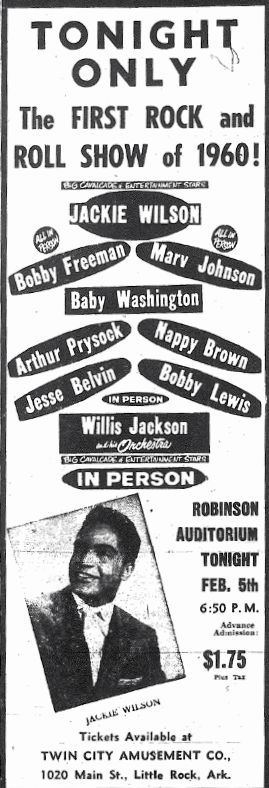
Ark Gazette 60.02.05 (Fri)The name Jesse Belvin is largely forgotten. As a songwriter in the 1950’s he wrote “Earth Angel.” He also had an R&B hit with “Goodnight My Love.”  If he is recalled for anything today, it is tragically for being part of the mythical “27” club of musicians who died at the age 27.

On February 5, 1960, he appeared in a concert at Robinson Auditorium for what was billed as the “First Rock & Roll Concert of 1960.”  The headliner for the concert was Jackie Wilson.  The next morning, Belvin died at age 27 in a car accident outside of Hope on his way to his next concert in Texas.  Also killed in the wreck were Belvin’s wife, the man driving the car, and a couple in another car which Belvin’s car struck.

Many urban legends have sprung up about the concert at Robinson. Some, no doubt, fueled by Little Rock’s racially divided then-recent past in September 1957.  Most of these purport that the concert in which he appeared was the first integrated concert in Little Rock. Most rumors also state that Belvin had received threats leading up to the concert, that a riot took place at the concert or at least was stopped several times by disruptions caused by white agitators, that Belvin and others were run out of town, and that the accident was caused by damage inflicted to his tires before leaving Little Rock.  There are several variations of these purported facts.

While it is true Belvin performed at Robinson Auditorium the night before he died, it was not before a racially mixed audience.  It was not until August 1961 that the first concert took place in Robinson that did not have segregated seating, and that was a one-time only event.  It would not be standard practice at Robinson Auditorium until the 1965 passage of the Civil Rights Act.

Rebecca Miller, in her blog https://jackiewilsonlover.wordpress.com/, goes into great detail debunking many of the supposed “facts” about the February 5, 1960, concert at Robinson.  While the Arkansas Gazette and Arkansas Democrat at the time did not shy away from covering racial issues (each with their own slant), neither paper mentions anything about the discord at the concert.  They do discuss Belvin’s subsequent accident near Hope.  It was apparently caused when the driver of the car containing Belvin and his wife fell asleep at the wheel.

In this day of the internet where it is easy for myths to fester into fact, it is hard to dispel rumors.  What is true is that a life was tragically cut short, and that Jesse Belvin’s last concert was on the stage of Robinson Auditorium.

Little Rock Look Back: John Herndon Hollis – Acting Mayor of Little Rock in 1908

John Herndon HollisOn February 5, 1870, future Little Rock alderman and acting mayor John Herndon Hollis was born shortly before his family moved to what is now Cleveland County. His parents were originally from Georgia and came from prosperous and longtime families there.

The Hollis family came to Arkansas after the Civil War and settled in Union County. A portion of that county was carved off and became Dorsey County (named after a Republican US Senator from Arkansas) but was renamed Cleveland County after Grover Cleveland was elected President. Cleveland was the first Democrat to be elected President in over 20 years. This name change also reflected the political shift in Arkansas from the Reconstruction-led Republican politics to the Democratic Party politics which would dominate for the next century.

John Herndon Hollis was one of six children, and the only one with a middle name. Herndon had been his mother’s maiden name. As one of his brothers described their childhood in Cleveland County, “they all went to country schools in their home neighborhood, worked hard on the farm in the summertime, and were inside their little Methodist Church every time the doors were open.”

Around 1900, Hollis and his new wife Malinda M. “Linda” Taliaferro Hollis (formerly of Rison) moved to Little Rock.  Together the couple had six children. In Little Rock, Hollis worked in the banking industry. For years he worked for People’s Building and Loan Association.

Hollis was first elected to the Little Rock City Council in April 1904. He would serve as one of the Aldermen from the city’s Fourth Ward until April 1918.  This was on the western border of Little Rock at the time. The family lived at 1510 S. Schiller, which is one block east of Central High, though at the time neither the school nor its predecessor (West End Park) existed.  From 1907 until 1913 he also served on the Little Rock School Board.

In April 1908, at the first City Council meeting in the new City Hall, Mayor W. E. Lenon announced his resignation. Because the resignation was effective immediately, there was a vacancy in the office of mayor.  Hollis was selected by his colleagues to serve as acting mayor until a successor could be elected. So from April 1908 through June 1908, Hollis was the City’s chief political and executive leader.

Though he was never formally mayor (and did not resign his position as alderman), since 1908, Hollis’ name has appeared on the list of mayors of Little Rock. The reason seems to be as a sign of respect since there was a vacancy.

There previously had been acting mayors when the mayor would be absent on business or due to illness. But in those instances, the mayor had not resigned. This is the only instance in Little Rock history when a mayor resigned immediately with no successor in place. So John Herndon Hollis holds a unique role in Little Rock history.

Hollis’ wife died in 1920.  He later married Ann Jewell of Little Rock (who was a distant cousin of his first wife). They were married until his death on October 23, 1941.  Ann Hollis lived in Little Rock until her death in 1980.  The Hollis family is entombed in the mausoleum at Mount Holly Cemetery.

Black History Month Spotlight – Dr. Erma Glasco Davis

Photo by Staton Breidenthal for the Arkansas Democrat-Gazette

Photo by Staton Breidenthal for the Arkansas Democrat-Gazette

Erma Lee Glasco Davis was born in Keo, Arkansas and was reared in south central Little Rock, also known as the South End.  She is a product of the Little Rock Public School System, graduating from Dunbar High School in May, 1945.  She received her Bachelor of Science degree from AM&N College (now the University of Arkansas at Pine Bluff).  A year or so after the Central High desegregation crisis of 1957, she and her husband moved to Detroit, Michigan and the Doctor of Philosophy degree from the University of Michigan at Ann Arbor.

Most of Dr. Davis’ professional career was spent in Detroit, Michigan  as a teacher, counselor and administrator.  She retired from an administrative position in the Detroit Public Schools’ Management Academy.  She also taught as an adjunct professor at Marygrove  College in Detroit.  While in Detroit, Dr. Davis has had a wealth of community involvement, serving in leadership positions on boards and committees and in organizations ranging from the NAACP to Alpha Kappa Alpha sorority.  In 1979, she co-chaired the Mayor’s Education Task Force for Detroit’s International Year of the Child event.  In 1987, she won the Spirit of Detroit Award, the city’s highest community-service award.

Dr. Davis is a past national president of the National Dunbar Alumni Association, and is co-author of a book about the school, Paul Laurence Dunbar High School of Little Rock.  She has been instrumental in marrying the goals of the association with those of the Mosaic Templars Cultural Center, the state-funded museum which showcases the history and achievements of black Arkansans.  A fruit of that marriage is the museum’s Dunbar exhibits on the museum’s first floor.  She is passionate about educating people on Dunbar’s role in the state’s history.

In 1990, Dr. Davis moved back to Arkansas form Michigan.  After her return, she quickly busied herself with community work, sitting on the boards of the Central High Museum and the Arkansas Humanities Council; taking two turns as chairman of the board of the Historic Arkansas Museum Foundation; she also chaired the gala for the opening of the Mosaic Templars Cultural Center.  In addition, Dr. Davis worked nearly four years as a founding volunteer for the Clinton Presidential Central.  In 2005, she was appointed by then-Governor Mike Huckabee to the State Review Committee for Historic Preservation, and reappointed by Governor Mike Beebe in 2007.  In 2009, she was inducted into the Arkansas Black Hall of Fame.

For more on Dr. Davis and other inductees into the Arkansas Black Hall of Fame, visit the permanent exhibit at the Mosaic Templars Cultural Center. That museum is an agency of the Department of Arkansas Heritage.