
August 9, 1947 – Little Rock chosen as site for War Memorial Stadium

War Memorial Stadium was approved by the Arkansas General Assembly in March 1947.  The work then began on the finalization of the location.

Four cities were in the running:  Little Rock, North Little Rock, Hot Springs, and West Memphis.  Each of the cities was required to donate the land for the stadium, provide parking for it, and sell local subscriptions equivalent to $250,000 to raise money for it as well.

On May 19, 1947, the Little Rock City Council approved Resolution 1,747 to donate the land for the stadium in Fair Park if Little Rock was selected.  This was not the first mention of a stadium in City records.  In March of 1947, the City Council had set aside land in Fair Park to use for a playground — with the stipulation that if it was eventually needed for a stadium, it would be relinquished for that purpose.

On August 9, 1947, the War Memorial Stadium Commission met in the House Chambers of the Arkansas State Capitol to select the location for the stadium.  West Memphis dropped out prior to the meeting; they had not been able to raise the sufficient local funds.  That left the three remaining cities.  (Cities had until June 24 to file paperwork expressing their interest in applying and were to submit their proposals by August 1.)

Instead of meeting in a usual committee room, the meeting was held in the House Chambers of the State Capitol.  The location for the meeting had been set because a large crowd was expected.  And the attendance did not disappoint.  City government and business leaders from all three cities turned out in full force.

The members of the Commission were Ed Keith, Chairman, Magnolia; Gordon Campbell, Secretary, Little Rock; Ed Gordon, Morrilton; Senator Lee Reaves, Hermitage; Senator Guy “Mutt” Jones, Conway; Dallas Dalton, Arkadelphia; Judge Maupin Cummings, Fayetteville; Dave Laney, Osceola; and Leslie Speck, Frenchman’s Bayou.

For several hours the nine heard proposals from the three cities.  Little Rock’s location was in Fair Park, North Little Rock’s was near its high school, and Hot Springs was on land next to Highway 70 approximately 2.5 miles from downtown.  Finally it was time to vote.  After two rounds of voting, Little Rock was declared the winner on a weighted ballot.

The north shore’s leadership was magnanimous in their defeat.  Hot Springs, however, was far from it.  In the coming days they filed suit against the Stadium Commission alleging flaws in Little Rock’s proposal as well as improprieties by members of the commission.  A preliminary decision sided with the state.  Ultimately, Hot Springs’ relatively new mayor Earl T. Ricks opted to drop the suit.  The Spa City’s business community was concerned that fighting the location might delay construction – and could negatively impact legislative and tourists’ feelings toward Hot Springs.  (And it was entirely possible that the State Police could have been used to “discover” that there was gambling going on in Hot Springs.)

Though ground was broken later in the year, by December 1947, the stadium was still $250,000 shy of funding for the construction.  This was after the state and Little Rock had previously both upped their commitments to $500,000 each.

The building did eventually open on schedule in conjunction with the 1948 Arkansas Razorback football games.

As for Mayor Ricks of Hot Springs, he moved to Little Rock to serve as Adjutant General of the Arkansas National Guard during the governorship of Sid McMath.  He later held leadership positions in the National Guard Bureau in Washington DC.  He died in 1954 at the age of 45.  Among the ways he was memorialized was a National Guard armory in Little Rock, which stood in the shadow of War Memorial Stadium.

Birth of future Razorback football star and LR Mayor Sonney Henson

On July 18, 1928, future Little Rock Mayor Harold E. “Sonney” Henson, Jr. was born in Fayetteville to Harold E Henson Sr. and Dollie Croxdale Henson.  He and his sister Sara Sue grew up in Springdale.

Henson graduated from Springdale High School and was later inducted as one of the first inductees into the Springdale High School Hall of Fame where he participated in the state high school championship in football and basketball. He attended the University of Arkansas in 1945 on an athletic scholarship where he participated in three sports: golf, basketball and football, and graduated in 1949 with a degree in Business Administration.

He was active in ROTC at the university and graduated as a second lieutenant in the U.S. Army. Henson served in Korea as a captain and commander during the Korean conflict. He attained the rank of major as an active member of the Army reserve post his duty in Korea.

Henson’s professional career began with First National Bank of Springdale and soon moved to Little Rock where he served as Vice President at the Worthen Bank on Asher Avenue. In 1962 he was elected to the City of Little Rock Board of Directors.  From January 1965 to December 1966, he served as mayor of Little Rock.  In November 1966, he was unopposed in his bid for a second term on the City Board.  However in October 1967, he resigned from the City Board because he was taking a position with a bank in Joplin, Missouri.

From 1966 to 1972, he served as President of Security National Bank Joplin.  While there, he was a Missouri amateur championship golfer.  Herbert Thomas then asked him to move to Ft. Smith to head up City National Bank (present Bank Corp South) where he served as President and CEO from 1972 to his retirement in 1993 at the age of 65. He continued his service to Bank Corp South as an active board member for several years.

Among his many civic activities throughout his career were the Springdale Junior Chamber of Commerce,  Sparks Regional Medical Center board of directors of Fort Smith, president and active member of the board for the Arkansas Sports Hall of Fame and Razorback Foundation, on the board for the University of Arkansas for Medical Sciences foundation, the Westark area council for Boy Scouts, the Arkansas State Chamber of Commerce, the Small Colleges of Arkansas, Leadership Fort Smith, the Community Rescue Mission and the President of the Arkansas Bankers Association to name a few.  In 1995 he received the meritorious service award by the Arkansas Sports Hall of Honor for his lifelong commitment to Arkansas sports.

Henson was married for 53 years to Helen Garrott Henson. He had four children, 16 grandchildren and one great-grand child.  He died on August 8, 2013, and is buried in Fort Smith.

During All Star Week – Movies in the Park presents THE SANDLOT

Image may contain: text

Baseball players are sometimes referred to as “The Boys of Summer.”  So it seems appropriate that during the MLB All Star week, the Movies in the Park has a movie about baseball in its purest form.

Movies in the Park continues its 15th season tonight with The Sandlot.

When Scottie Smalls moves to a new neighborhood, he manages to make friends with a group of kids who play baseball at the sandlot. Together they go on a series of funny and touching adventures. The boys run into trouble when Smalls borrows a ball from his stepdad that gets hit over a fence.

Families, picnics, and leashed pets are invited to the park to enjoy movies under the stars, but no glass containers. Don’t forget the bug spray! An adult must accompany all children under the age of 18 and an ID is required. Chaperoned youth, sports, church and other groups are welcome!

The First Security Amphitheater will open an hour before film showings (approx. 7:30) and movies with begin at sundown each week (approx. 8:30).

For more information about Movies in the Park and to see which films will feature live performances or other activities before the showings, visit www.rivermarket.info or find us on Facebook at www.facebook.com/lrrivermarket

Women’s World Cup Watch Party today at War Memorial Stadium

Image may contain: stripesThe City of Little Rock and War Memorial Stadium invite the public to watch Team USA take on the Netherlands in the FIFA Women’s World Cup final, today, July 7.
This is a free watch party, and the public is asked to bring blankets and/or lawn chairs to view the game from the field.

No cleats; shoes must be worn.

Concessions will be sold. Gates open at 9:30. The match begins at 10.

The Little Rock Zoo invites persons to stop by the Zoo for lunch and to see the exhibits there following the match.

Film “Swingin’ Timber” will be shown at Mosaic Templars Cultural Center today at 3pm

On Saturday, July 6th at 3 p.m., Mosaic Templars Cultural Center will host a free showing of David D. Dawson’s film “Swingin’ Timber.” David will be in attendance at the screening.

“Swingin’ Timber” is the story of the Claybrook Tigers, a Negro leagues team formed by John C. Claybrook in Claybrook, Arkansas (a town which no longer exists today).

Entrepreneur John C. Claybrook was a farmer and lumberman who built the town of Claybrook around his businesses. He founded the Claybrook Tigers and built their stadium on his farm to try to stop his son from leaving their family businesses. The documentary tells the story of Mr. Claybrook’s town and his team.

Famous Negro Leagues players such as: Theolic “Fireball” Smith , Dan Wilson, Walter Calhoun, John “The Brute” Lyles, Logan “Eggie” Hensley, Alfred “Greyhound” Saylor, Roosevelt “Bill” Tate, W. H. “Big Train” Summerall, and Ted “Double Duty” Radcliffe all played for Claybrook.

National Balloon Race starts in Little Rock on April 29, 1926

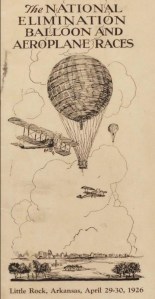
On April 29, 1926, nine hot air balloons took off from Little Rock’s airport (which was actually just an airfield at the time) in a national race to win the Litchfield Trophy.  In addition to the trophy, the winner would be on the American team in an international balloon race in Belgium.

The New York Times coverage noted that the weather conditions were ideal as the balloons took off in five minute intervals between 5:00pm and 5:30pm.  The test balloon (akin to a pace car in a car race) was the Arkansas Gazette‘s Skylark.  It took off at 4:25 and headed in the direction of the northeast, which was the desired direction.

The nine balloons, in order of liftoff were: the US Army from Phillips Field in Maryland; the US Army from McCook Field in Ohio; the Goodyear Southern California; the Detroit; the Goodyear IV (whose pilot Ward T. Van Orman had won the 1924 and 1925 contests); US Army from Scott Field; a balloon piloted by a Danish pilot Svend A. U. Rasmussen; US Army balloon from Langley Field in Virginia; and the Akron National Aeronautic Association balloon.

The pilots carried provisions for 48 hours and were equipped for sea flying.  Each had a radio and loud speaker.  KTHS radio of Hot Springs (a forerunner to today’s KTHV TV station) was broadcasting the location of each balloon.  As they left the Arkansas radio station’s range, there was a network of other stations which would do the same.

It was expected that the race would last between eighteen and thirty-six hours.  The last balloon aloft was Van Orman for the third year.  He lasted approximately 31 hours and landed near Chesapeake Bay.

Though no headcount was given, the New York Times called the viewing audience “the largest crowd ever assembled in Little Rock.”

Many thanks to Brian Lang of the Arkansas Arts Center for giving me the tip on this.

Little Rock Look Back: First Basketball Game in Little Rock

Very few sports can have a definitive “this was the first game in Little Rock” moment. But basketball does.

On April 7, 1893, the Arkansas Gazette ran stories about the final day of horse racing at Clinton Park racetrack (the park stretched roughly from what is today’s Clinton Presidential Park through the East Village to Clinton National Airport), the men who were soon to take office as aldermen met to plan for their upcoming City Council terms, and a preview of a new sport coming to Little Rock.

Less than two years earlier in Springfield, Massachusetts, a YMCA instructor named James Naismith had invented the new game of Basket Ball (then spelled with two words).  The sport caught on in popularity and spread throughout the country through the network of YMCAs.

Now, on April 7, 1893, Little Rock residents would get their first glimpse of the game.  Two hundred men and women gathered at the Little Rock YMCA (located at the northeast corner of Fourth and Main Streets) to see the game, which started at 8:30pm.

The Little Rock YMCA team (which had only formed the night before) took on the Pine Bluff YMCA team.  The Pine Bluff young men had been practicing for six months.  The results of the game reflected that.  At the end, Pine Bluff had scored 70 points and Little Rock had scored 9 points.

Following the game, the Little Rock chapter hosted both teams for refreshments.  Little Rock was scheduled to go to Pine Bluff to play again during the YMCA statewide convention at the end of April.

From those meager beginnings, Little Rock has seen its fair share of basketball triumphs.