
RIP Gertrude Hadley Jeannette

bhm gertrudeA reader pointed out that the April 26, 2018, New York Times had an obituary for Gertrude Hadley Jeannette.  This native Arkansan (and inductee into the Arkansas Black Hall of Fame) died at the age of 103.  Throughout her life she was a trailblazer in the arts but also was a trailblazer in other fields because of her race and her gender.

Here below is from a 2015 feature of her on this blog.

Playwright, producer, director, and actress of the stage and screen, Gertrude Hadley Jeannette, was born in Urbana, on November 28, 1914, to Willis Lawrence Hadley and Salley Gertrude Crawford Hadley. She attended Dunbar High School in Little Rock. Just before her high school graduation, Jeannette decided that she wanted to get married instead of attending Fisk University, as she had previously planned.  She and Joe Jeannette II, a prizefighter and the president of the Harlem Dusters, a motorcycle club, eloped to New York City in 1934.

In New York City, Jeannette learned to drive; in 1935 she became the first woman to get a license to drive a motorcycle. In 1942, because of the shortage of male taxicab drivers caused by the war, Jeannette became the first woman to drive a cab in New York City. During this time, Jeannette decided to further her education; she took bookkeeping classes in the basement of Abyssinian Baptist Church, and speech classes at the American Negro Theatre in order to remedy her speech impediments.

In 1950, she appeared on television in James Weldon Johnson’s Gods Trombone on CBS’s General Electric Hour; she had replaced Pearl Bailey, who was originally cast in that role. As a result, Jeannette continued to work both in the theatre and in film and television. Some of Jeannette’s film credits included ShaftBlack Girl, and Cotton Comes To Harlem.  Her Broadway credits include Lost in the Stars, The Long Dream, Nobody Loves an Albatross, The Amen Corner, Vieux Carre and a revival of The Skin of Our Teeth.  Off Broadway she starred in To Be Young, Gifted and Black.

In 1979, Jeannette founded the H.A.D.L.E.Y. Players (Harlem Artists Development League Especially for You) in the Harlem neighborhood of New York City. The mission of the H.A.D.L.E.Y. Players was to give artists a chance to develop their talents and skills in the theatre, and to enrich the cultural life in Harlem. Jeannette went on to direct, produce, and write her own plays, as well as the works of other playwrights.

Jeannette was presented with several awards for her work and accomplishments. In 1991, Jeannette was honored as a living legend at the National Black Theatre Festival in Winston-Salem, North Carolina, and in 1998, she was honored with the Lionel Hampton Legacy Award. Jeannette was inducted into the Arkansas Black Hall of Fame in 1999, and in 2002, she received the prestigious Paul Robeson Award from the Actor’s Equity Association. Jeanette, though retired, remained active and celebrated member of the New York theater scene well into her nineties.

For more on Gertrude Hadley Jeannette and other inductees into the Arkansas Black Hall of Fame, visit the permanent exhibit at the Mosaic Templars Cultural Center. That museum is an agency of the Department of Arkansas Heritage.
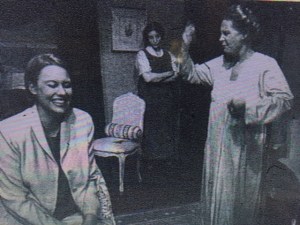
Pulitzers Play Little Rock: THREE TALL WOMEN at the Weekend Theatre

IMG_0277

Photo by Karen E. Segrave

Edward Albee received his third Pulitzer Prize in 1994 for THREE TALL WOMEN.  It not only marked his return to the Pulitzer fold, it was his first critical success in nearly two decades.

In April 2001, the Weekend Theatre presented the play.  Directed by John Haman, the play featured Glenda Hope Fortenbury, Deb Lewis and Sue Diaz as C, B, and A, respectively — the trio of the title.   The relationships between the characters may or may not change in the play.  As with most Albee plays, much is enigmatic.

2018 marks the 100th anniversary of the first Pulitzer Prize for Drama being given. To pay tribute to 100 years of the Pulitzer for Drama, each day this month a different Little Rock production of a Pulitzer Prize winning play will be highlighted.  Many of these titles have been produced numerous times.  This look will veer from high school to national tours in an attempt to give a glimpse into Little Rock’s breadth and depth of theatrical history.

Pulitzers Play Little Rock: ‘NIGHT, MOTHER on Arkansas Rep stage with Oscar winner Mercedes McCambridge

MercedesIt is not often that an Oscar winner has appeared in a play on a Little Rock stage.  But in the spring of 1986, Mercedes McCambridge starred in Marsha Norman’s ‘night, Mother at Arkansas Repertory Theatre.

She had moved to Little Rock a few years prior to live full time to be close to family. From time to time, she and Cliff Baker (the Rep’s founder) would have conversations about potential projects. But it was not until 1986, that the stars aligned.  By this point, she had moved away from Little Rock, but was still back from time to time to visit family.  (In an interview with the Arkansas Gazette, she also praised Fred Poe and noted that he was her travel agent for her many excursions.)

Appearing on stage with McCambridge in Norman’s two-hander was Rep veteran Cathey Crowell Sawyer.

Though noted for her film work, McCambridge had appeared on Broadway several times including opposite Little Rock native Ben Piazza in Who’s Afraid of Virginia Woolf? and receiving a Tony nomination for her work in the play The Love Suicide at Schofield Barracks.

Prior to appearing at the Rep, she had recently toured in the play Agnes of God.  She related to the Gazette that she had been approached to do that play prior to Broadway but did not feel the character she was to play was believable.  When the national tour came about, a conversation with playwright John Pielmeier changed her mind.

Her last Broadway appearance was in Neil Simon’s Pulitzer Prize winning Lost in Yonkers.

2018 marks the 100th anniversary of the first Pulitzer Prize for Drama being given. To pay tribute to 100 years of the Pulitzer for Drama, each day this month a different Little Rock production of a Pulitzer Prize winning play will be highlighted.  Many of these titles have been produced numerous times.  This look will veer from high school to national tours in an attempt to give a glimpse into Little Rock’s breadth and depth of theatrical history.

The Mourning After

Ark Rep ER RE Apr11

Theater or Theatre? (pre-renovation Arkansas Rep signage) – April 2011

On Tuesday night, as I scrolled through a variety of comments about the Rep on websites and social media, I’ve been struck by the deep affection people feel for it.  But it is not a simple “let’s roll up our sleeves,”  to use football parlance, raising the needed $750,000 only gets the Rep back to the line of scrimmage.  It does not win the game.

For the Rep to survive, it must be a sustainable organization.  What does a sustainable Rep look like?  Does it continue to have a contract with Actors Equity?  Does it produce six shows a year?  Does it provide education offerings? Does it share space with other arts organizations? Regardless of the answers to the questions (and many others), what it has to have is a dedicated audience and consistent donor base.

It is not enough to say “we need a live professional theatre in Little Rock.”  There must be a commitment to attending and continually financially supporting it.  As a youth, my ever-wise father frustrated me to no end if I said I did not have time to do something.  He would respond, “You didn’t have time or you did not want to make the time?”  Yes we are busy, but in order for the Rep to survive, we have to make the time to attend it and support it with our dollars.  And it’s not just the Rep that needs our support. It’s the Symphony, the Ballet, exhibits at the Arts Center and Museum of Discovery, Wildwood, the Zoo, and the list goes on.

The subscription model for arts organizations seems to be on its way out.  But theatres still rely on it.  (As do symphonies and opera companies.)  If people are only interested in three of the season shows, or have no idea if they’ll be in town for several shows, or are uncertain about attendance because they don’t know what their obligations will be in six months, they are not likely to subscribe.  For the financial well-being of the Rep, this will need to be examined in looking at the future.  There are a few other models that are out there. It is scary to try something new. But with the Rep in a mode of self-examination, maybe now is the time.

I’ve read a lot over the past year about the last days of the Arkansas Gazette. There were some well-intentioned efforts to keep the paper going. But nothing was financially sustainable. The players finally had to admit they could not make it work.  Emotions gave way to reason.  While I definitely hope this situation plays out differently for the Rep and results in it being a continuing organization, the fundamentals are the same.  Emotion and enthusiasm can only sustain so much.

When the Rep started, Little Rock had two daily newspapers, three locally owned TV stations, and several locally owned large banks as well as savings and loans. The utilities were either locally owned or had local control of their philanthropy.  Plus there was potential funding from locally owned hospitals, major insurance carriers, etc., etc., etc.  AND the number of non-profits seeking dollars from the sources outlined above was significantly smaller than today.  (Between 1976 and 2018, there seems to be an inverse relationship between the available pools of money and the organizations requesting said money.)  In the mid-1970s, the National Endowment for the Arts and the Arkansas Arts Council were both looking to fund theatres, and like Little Rock’s donors had fewer organizations requesting funds.  It was a different day. One that is long in the past.

It is not fiscally prudent for the Rep, or any organization, to rely solely on one or two major funding sources.  This has plagued certain Arkansas arts organizations over the years.  It creates the sense that your contribution doesn’t matter because there is always someone else who will make up the difference.  What happens when that funding source closes? or dies? or changes interests?

A future Rep must have a long-term and deep-seated commitment by a wide swath of patrons in order to survive.  It cannot live on an occasional audience member’s nostalgia for that fun evening six years ago.  It cannot make it on simply ticket sales (even if every show was a sell out). It needs a mid-term and long-term plan for both itself and its audience members.  If there is only a burst of enthusiasm now which peters out in six to sixteen months, we’ll be back where we are now.

If the Rep is our theatre, it is our responsibility to bring it back and support it. Not just tomorrow, but next year and next decade.

A Pause for The Rep

The announcement today that the Arkansas Repertory Theatre was suspending operations was a sad, if not completely unexpected one.

Over the past months, the Rep has been struggling financially.  Theatre is expensive.  Professional theatre has expectations and requirements that make it even more expensive.

For 42 years, the Arkansas Rep has been presenting live theatre in Little Rock. First in an old church in MacArthur Park and then on Main Street in an old department store.  These were the sites of first dates, anniversaries, birthdays, and celebrations.  Sometimes they provided escapes from the stresses of daily life.

There is no argument that Arkansas Rep has contributed enormously to the cultural life of Little Rock and Arkansas.  But that value has not always translated to dollars in the coffers.

And that is the problem.

Musicals tend to be more popular with Little Rock audiences.  They are also much more expensive to produce employing more actors, musicians, more settings.  The additional actors wear more costumes and carry more props.  (Little Rock’s preference for musicals is not unique; most cities are that way.)

I’ve heard it said that a play can sell at about 80% of capacity and clear more money than a musical selling at 95%.   Over the past few years the Rep has programmed more musicals (sometimes three out of six shows on top of a classic play with a large cast). Did that create more excitement in the community?  Yes.  Did it put more money in the Rep’s pockets?  Apparently not.

Over the past year, I’ve heard finger pointing and bemoaning.  Some have said the excitement over shows at Robinson have taken away entertainment dollars from local groups.  Since it reopened Robinson has certainly seen more events — but the past few years have also seen Verizon Arena book a lot more large acts.  This is a bonanza time for the touring industry.  And because it alternates between feast and famine, when it is feast time, operators seize the day.

When the Rep started, there were only two other local theatres programming for general audiences – Murry’s Dinner Playhouse and the Community Theatre of Little Rock.  Now the options also include the Studio Theatre, Weekend Theatre, Argenta Community Theatre, and Benton’s Royal Players.  There are weekly improv performances at the Joint.  Plus programming in Conway.  Last weekend Praeclara presented Into the Woods.  In other words, a whole lot of alternatives for live performances.  Are the other alternatives the same types of theatre (non-profit, union professional theatre) as the Rep?  No.  But they are part of the mix when competing for resources.  That is all a good thing. But it does mean that people have to make choices for their time and money.

The “Next Act” for the Rep will have to take this new environment into account.  It can be a scary but also exciting time to see what happens.

As the Rep’s board reassesses its future, it is important for the Little Rock community to come together to support live, professional theatre in Little Rock.  We must also redouble our efforts to support other cultural institutions.  For people who came to Little Rock after 1980, they do not not remember a time without the Rep, the Symphony, the Arts Center,  the Ballet.  But there were times without them.  We cannot take them for granted.

Over the years, many other cultural anchors in Little Rock have faced uncertain financial futures.   This spring marks 50 years that the Arts Center faced closing its doors if it did not take drastic measures. To keep afloat, It dropped its unsustainable model (very expensive degree granting programs) which eventually gave rise to the establishment of the Museum School, the Children’s Theatre, and a combination of permanent and temporary exhibits.  (When the degree granting program was underway, it basically took over all the spaces for academic purposes.)  In 1968, there was much hand-wringing and uncertainty.  But, as was pointed out in newspaper articles at the time, this decision allowed for it to return to its original mission.  And look what we have today!

Other theatres across the country have taken these steps the Rep took to stop.  Some have restarted.  Most have not. (I don’t have numbers in front of me, this is based on anecdotal memory from about 30 years of reading many national theatre publications).  It is up to us to put the Rep in the “Re Start” category.

I certainly hope this is a Reset for the Rep, not an RIP.

Pulitzers Play Little Rock: DOUBT at the Studio Theatre

TST DoubtIn 2016, the Studio Theatre presented John Patrick Shanley’s Pulitzer Prize winning Doubt. It was not the first theatre in Little Rock to present the play in the 12 years since it had debuted.  But the taut, riveting, and somewhat ambiguous story is one that offers audiences plenty of reasons to return to it.

As the Studio Theatre summarized it:

Did he or didn’t he? Doubt, a Parable, follows the story of the staff at a Catholic school in the Bronx, New York. It begins when Sister James, a young sister who recently started teaching at the school, becomes concerned that the relationship between a priest, Father Flynn and a student may have become inappropriate. Sister James confides this fear to the principal, Sister Aloysius, who becomes determined to find out the truth about what happened and to protect the boy.

Bob Bidewell directed the play. The quartet of actors in the cast were Karen Q. Clark (cast against type), James Norris, Angela Bloodworth-Collier, and Jessica Lawson.  Brandon Nichols was the assistant director and Andrew Jordan designed the lighting.

2018 marks the 100th anniversary of the first Pulitzer Prize for Drama being given. To pay tribute to 100 years of the Pulitzer for Drama, each day this month a different Little Rock production of a Pulitzer Prize winning play will be highlighted.  Many of these titles have been produced numerous times.  This look will veer from high school to national tours in an attempt to give a glimpse into Little Rock’s breadth and depth of theatrical history.

Shake a Spear, or As Will Likes It at 454

Today is the traditionally observed birthday of William Shakespeare. It is known he was born in 1564, which makes this the 454th birthday.

The Arkansas Shakespeare Theatre earlier announced the lineup for the 2018 season.   The dates have now been announced.

The lineup for the June 8-July 8 season, which explores the theme of transformation, includes Shakespeare classics The Winter’s TaleHenry IV, Part One; and a family adaptation of Much Ado About Nothing, as well as Lerner and Loewe’s My Fair Lady. All four 2018 shows feature characters who undergo major changes — some for the better and others, perhaps, for the worst.

The season will open at 7:30 p.m. June 8 with The Winter’s Tale outdoors on the lawn of McAlister Hall on the campus of the University of Central Arkansas. Lerner and Loewe’s My Fair Lady will open in Reynolds Performance Hall on June 15, and Henry IV, Part One, will open on June 22. AST’s family-friendly adaptation of Much Ado About Nothing will open June 28 in Reynolds and will also tour across the state in June and July.

The Winter’s Tale will be directed by Nisi Sturgis, an AST artistic collective member, Conway native and UCA graduate who was a part of the critically acclaimed tour of the Pulitzer Prize-winning Disgraced at the Goodman Theatre, Berkeley Rep and Seattle Rep.

One of Shakespeare’s late romantic plays, it follows the story of King Leontes, who grows jealous of his wife, leading him to make a series of terrible mistakes. “This is a rarely produced Shakespeare gem,” said Rebekah Scallet, AST’s producing artistic director.

Robert Quinlan, who directed A Midsummer Night’s Dream in AST’s 10th anniversary season, will return at the helm of Henry IV, Part One. This adventurous tale is centered on the young Prince Hal, who prefers spending his time in the tavern with his fat and jolly friend Falstaff to time in castle with his father, the king. When rebellion stirs in England, he must make a choice as to where his true loyalties lie.

Scallet will direct My Fair Lady. This multiple Tony Award-winning musical premiered in 1956 and will be given fresh life in this intimate new production. A musical adaptation of George Bernard Shaw’s Pygmalion, My Fair Lady tells the story of Eliza Doolittle, a flower girl who wants to transform her status by changing the way she speaks, and so goes to curmudgeonly speech professor Henry Higgins for assistance.

Enrico Spada will make his directorial debut with AST for the touring Family Shakespeare production of Much Ado About Nothing. With a cast of just eight people telling a reduced version of this classic tale, Much Ado is a romantic comedy with the great Shakespearean couple of Beatrice and Benedick at its center. This hour-long adaptation is perfect for families to enjoy together and will be performed on stage at Reynolds along with stops at Crystal Bridges Museum of American Art in Bentonville, Winthrop Rockefeller Institute on Petit Jean Mountain, Hot Springs Farmer’s Market, The Joint in Argenta and The Griffin in El Dorado, among others.

Audiences will again be seated onstage for the three productions in Reynolds Performance Hall. AST’s 12th season will close on July 8 with a final performance of The Winter’s Tale.

For those who want a Shakespeare fix in the actual winter, the Arkansas Repertory Theatre will present As You Like It from February 6 to 24, 2019.

Containing some of Shakespeare’s most famous speeches, As You Like It is a comedy about love, exile, wit, and disguises all set in the Forest of Arden.  Orlando loves Rosalind. Rosalind loves Orlando. But Rosalind is disguised as Ganymede – who’s a boy! And Phebe loves Ganymede – who’s really Rosalind. Yet Silvius loves Phebe. And Rosalind’s best friend Celia loves Orlando’s brother Oliver. But Oliver hates Orlando. And Touchstone lusts after Audrey. Unfortunately, no one much cares for Jacques.

Celebrate romance as Shakespeare’s timeless comedy takes center stage at The Rep!  Directed by Giovanna Sardelli, it runs from February 6 to 24, 2019, with an opening night of February 8, 2019.