
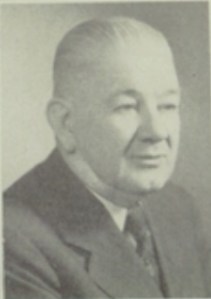
Coach Earl Quigley in the 1940s
While Joseph Taylor Robinson Memorial Auditorium is known today as a performance and meeting venue, in its early days it was also the home to sports. Seventy-eight years ago tonight the first basketball game was played at Robinson.
One of the first regular activities which took place in the lower level exhibition hall was a series of boxing and wrestling matches. Building on the success of this, basketball came to the convention hall in January 1940.
A series of games featuring Little Rock High School and North Little Rock High School were announced by Tiger Coach Earl Quigley to take place from January 11 through February 16, the official opening day for the facility.
At that time, neither high school had a gymnasium; therefore both schools played their basketball games on their school auditorium stages with fans seated in the audience. The convention hall offered a regulation size floor (made of pecan block parquet) with seating for over 1,300 people along the sidelines and in the balcony. The first men’s basketball game in Robinson Auditorium took place between the Little Rock High School Tigers and the North Little Rock High School Wildcats on January 11, 1940.
The Tigers lost the game before a crowd estimated to be 1,300. Earlier in the evening there had been an exhibition between two women’s basketball teams. The cost for admission to the games was 35 cents for the reserved seating and 25 cents for general admission.

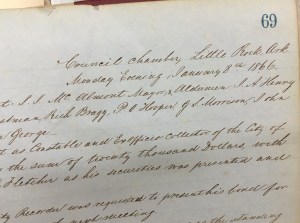 One hundred and fifty two years ago today, Little Rock City Hall resumed functioning after the Civil War. The City government had disbanded in September 1863 after the Battle of Little Rock. From September 1863 through the end of the war (on on through part of Reconstruction), Little Rock was under control of Union forces.
 Future Little Rock Mayor John Gould Fletcher was born on January 6 in 1831. The son of Henry Lewis and Mary Lindsey Fletcher, he later served as a Captain in the Capital Guards during the Civil War. One of his fellow soldiers was Peter Hotze.
 In November 1915, there were public meetings in Little Rock and Pulaski Heights to discuss the issue. As a part of the annexation, Little Rock promised to build a fire station in the area and to install traffic lights, sidewalks and pave more streets.
 On Monday, January 2, 1826, Little Rock voters elected their first Board of Trustees. This five member governing body was authorized by the Arkansas General Assembly in October 1825. The five men getting the most votes were Bernard Smith, Isaac Watkins, James C. Collins, Ezra Owens and Sam C. Roane.
 In the first few decades of Little Rock, municipal elections usually took place on January 1. While occasionally they would take place on another day, it was usually when January 1 fell on a Sunday.
