Back to School Cinema: THE BREAKFAST CLUB

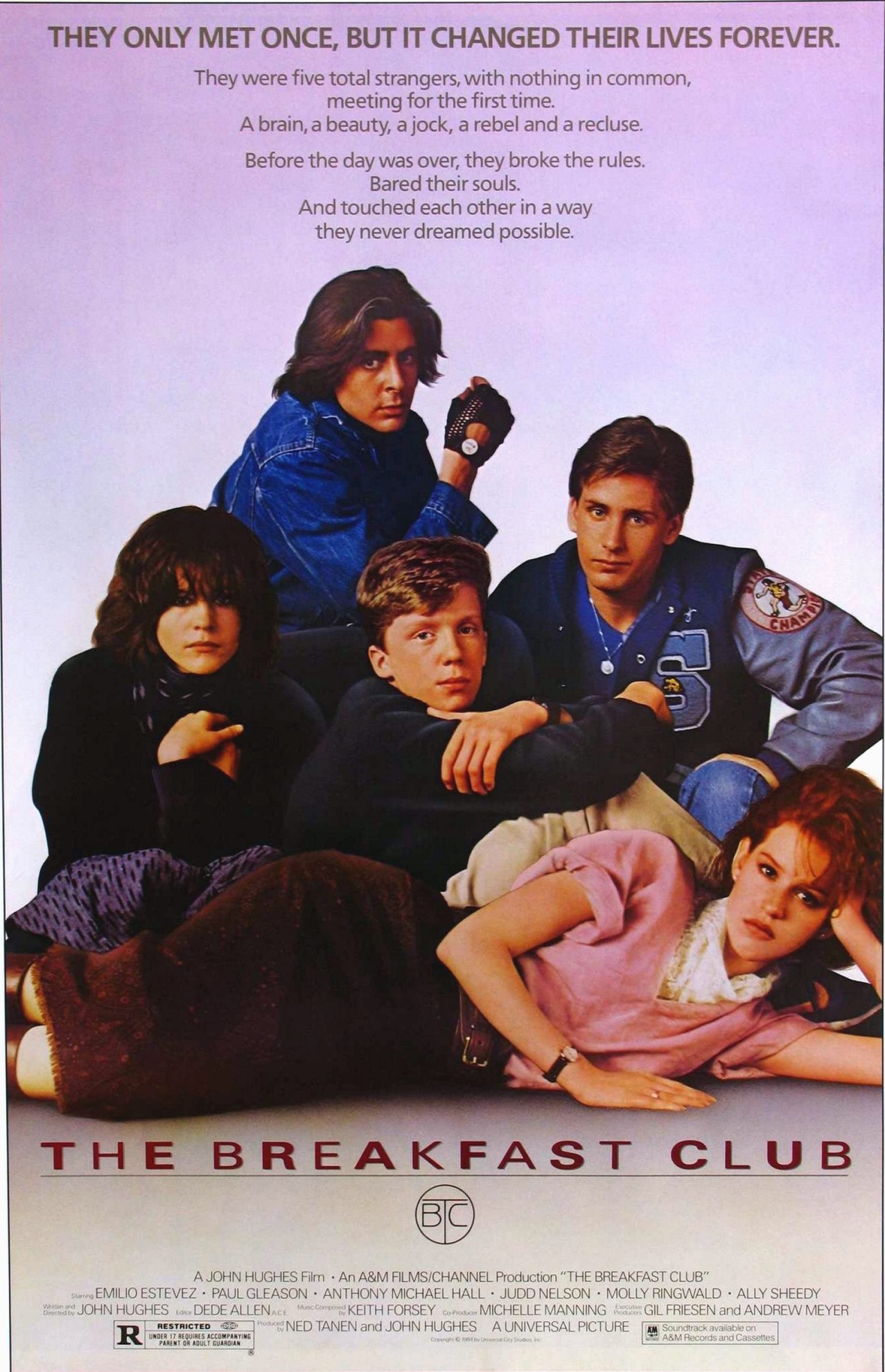
breakfast-club-movie-poster1The Back to School Cinema week ends with what may be the only school film to be set on a Saturday, 1985’s The Breakfast Club.  Written and directed by John Hughes, this Chicago-area high school film both exploits and explodes high school stereotypes.

As the nerd, the jock, the stoner, the loner and the princess, five tackle teen issues during detention in an upscale high school library.  It has to be upscale – it has a Henry Moore sculpture in it.  (It is a copy of Standing Figure Knife Edge which sits in downtown Little Rock.)

It seems like pretty much every Hollywood actor under the age of 25 was considered for one of the five roles in this movie. The lucky five – Judd Nelson, Emilio Estevez, Molly Ringwald, Anthony Michael Hall and Ally Sheedy – helped define their generation of actors. Their work together in this movie and others helped create the brand of the Brat Pack.

Borrowing a concept nearly as old as time, Hughes pits five unlikely strangers against each other in a confined space. While united against Paul Gleason’s sadistic principal, they also grapple with ever-shifting alliances and antagonists.  It is no surprise that each student discovers the others are equally unhappy and uncertain, but that doesn’t lessen the charm and emotional tug of the movie.


See 5 Choreographers’ VISIONS tonight with Ballet Arkansas

visions posterFive new ballet pieces will be premiered tonight in Little Rock as part of Ballet Arkansas’ second VISIONS choreographic competition.

VISIONS began as the vision of Ballet Arkansas’ Artistic Director, Michael Bearden, who wanted to create a event that would give choreographers an opportunity to have their works seen and appreciated by audiences and the dance community, as well as have the opportunity to receive a contract to have their choreography fully produced.

This season, Ballet Arkansas will present Visions Choreographic Competition at the UALR Center for Performing Arts on August 22, 2015 at 7:00 pm.

Thirty-one emerging choreographers from around the country competed for five spots in this year’s competition of which the winner will receive a commission to expand their new work for Ballet Arkansas’ company dancers for our spring mixed repertory show.

This year’s selected choreographers include Boston Ballet’s Boyko Dossev, former Houston Ballet’s Ilya Kozadayev, former Ballet West and Visceral Dance Chicago’s Tom Mattingly, former Pacific Northwest Ballet’s Barry Kerollis and Post: Ballet’s Aidan DeYoung.

A week before the VISIONS Competition, the choreographers drafted their cast of dancers and have a total of 11 rehearsal hours over 5 days to set their choreography on their cast. The night of the competition, the resulting works of choreography are performed for 4 judges, 3 of those judges are professionals in the local and national dance community, with the audience counting as the 4th judge.

The big finale of the competition is the announcement of the VISIONS Winner, who receives a contract with Ballet Arkansas to expand their choreography to have it fully produced for performance in Ballet Arkansas’ spring mixed repertory show, “Under the Lights”, to be held May 20-22 at the Arkansas Repertory Theatre.

Back to School Cinema: FAST TIMES AT RIDGEMONT HIGH

FasttimesEvery so often a film comes along which seems to launch most of the cast into various levels of stardom.  1982’s Fast Times at Ridgemont High is one of those movies.

Amy Heckerling directed Cameron Crowe’s script of life in a California high school.  While Sean Penn may have been the breakout star of the movie for his stoner Spicoli, he was hardly the only actor to make a mark with it.  Judge Reinhold, Jennifer Jason Leigh, and Phoebe Cates all saw their profiles rise due to this film.

Nicolas Cage, Eric Stoltz, Anthony Edwards and Forrest Whitaker, though in minor roles, also appear in the movie.  Others in the cast included Tony Award winners Ray Walston and Brian Backer, Robert Romanus, Scott Thomson, Vincent Schiavelli, Amanda Wyss, D. W. Brown, Taylor Negron and Nancy Wilson (Mrs. Cameron Crowe).

Episodic in nature, this film celebrates and commiserates the challenges of life in high school. It examines classes, dating, and bad jobs.

Reception tonight at Wildwood to mark opening of new Art in the Park exhibit

ww LK-SukanyWildwood Park for the Arts announces Art in the Park – Developed and Less Finished: Maintaining Life with artist L. K. Sukany.

The exhibit will run from August 21 – September 20. Sukany uses developed compositions and less finished paint applications to depict mysterious scenes of figures in interiors maintaining life. These memory-inspired works do not have obvious narratives but are based on a collection of moments in time. The themes of maintenance, celebration, conversation, and leisure use formal elements of figures in interiors and perspective for emphasis. The individual pieces are not intended to portray real life, but to show figures in a shared physical and mental space. Many of the pieces blur the line between depiction and magic realism so that the events can seem weird, magical, or wonderful to a spectator.

A free opening reception will be held on Friday, August 21 from 6 – 8pm. Foods for the reception have been generously provided by Whole Foods Market. Live music for the reception will be provided by Who Knows a Robot and The Damsels in Distress.

Wildwood’s gallery hours are Monday – Friday: 10am-4pm, Saturday and Sunday: 12-4pm.

August Wilson’s TWO TRAINS RUNNING is running in August at the Weekend Theater

twt-Two-Trains-Running_smNext up at the Weekend Theater is August Wilson’s Two Trains Running.  It opens tonight and plays Fridays and Saturdays through September 5.

The play is a story about love, hate, and the struggles that ordinary African Americans faced in a Pittsburgh neighborhood in 1969. The gossip, debates, philosophizing, and storytelling that take place in Memphis’ restaurant reflect the oral tradition of African American culture. Wilson’s characters appear engaged in talk that seems detached from the racial riots, assassinations, and antiwar protest that marked this era and damaged black areas economically. The restaurant and the neighborhood are on the brink of economic development.

Wilson explores their social and psychological manifestations of changing attitudes toward race. Seeking to escape from poverty, racism, and “Jim Crow” laws, many black Americans migrated to northern industrial cities during the early and mid-20th century where Wilson reveals simple truths, hopes and dreams for a community on the brink of change.

The play is directed by Jamie Scott Blakey and Margaret Parker.  The cast features Jermaine McClure, Rodney Ford, Eric Tate, Keith Harper, Kearie Saine, Ronald Coleman and Cherisse Coleman.  

Performances begin at 7:30pm.  The box office opens at 6:30pm. Seating is general admission and begins at 7:00pm.

Little Rock Look Back: First City Auditorium Approved

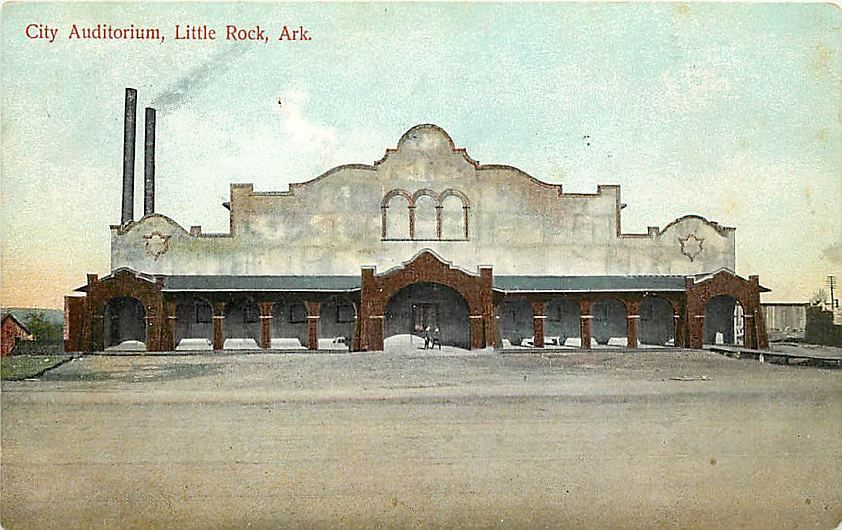
1906 auditoriumOn August 20, 1906, the Little Rock City Council approved plans for the City’s first municipal auditorium.

A week earlier, businessman A. C. Read petitioned the City for the right to construct a skating rink.  The matter was referred to the Street & Fire Committee, the Superintendent of Public Works and Aldermen Louis Volmer and Benjamin S. Thalheimer, who represented the Sixth Ward, in which the structure would be located.

Neither the Gazette nor the Democrat carried a mention of this petition in their coverage of that meeting.  By the next Council meeting a week later, the committee had reported back with a recommendation for approval.  Resolution 288 was adopted giving Mr. Read the right to build the skating rink.  Interestingly, the resolution did not contain the words “skating rink” though the original petition had.  Instead it permitted Mr. Read to construct a building “suitable for purposes as defined” by the City.  The resolution also stated that within three years the building would become property of the City.

Based on photos and postcards, the exterior of the building appears to have been covered in stucco.  It was said to be modeled after San Antonio’s Alamo, but what that really meant was that it was in the Spanish Revival style.  It was shorter and had more entrances than the Texas building did.  The Markham Street façade featured faux windows and a front portico which extended the length of the building only interrupted by three entrance archways. The center one was taller and wider than the eastern and western entrances.  All three, which projected southward from the building, mimicked the outline of the auditorium building.

The building was located on the western half of the City Hall property (and was constructed before City Hall).  In 1912, the new Little Rock Central Fire Station (now the City Hall West Wing) was built between the auditorium and Markham Street.  The auditorium stood until 1920.  During that time it was used as a roller rink, opera house, rifle range, National Guard armory, convention hall, and gymnasium.

Back to School Cinema: HOOSIERS

HoosiersNot just one of the best sports movies ever made, but one of the best movies of any genre, Hoosiers is also a back to school movie.  This 1986 opus embraces the cliches of the underdog sports team, Gene Hackman as a washed up lost soul, and Dennis Hopper as a drunk.  Through all of the reasons this movie could be a failure, it is the exact opposite.

There is an elegant honesty and humility that runs throughout the movie.  Hackman, Hopper and Barbara Hershey trust the script and the situation. This keeps what could be a hackneyed and melodramatic story from losing its honesty.

The actors playing the basketball players were hired more for their basketball ability. With similar haircuts, they sometimes become interchangeable. But instead of being a detriment, instead this becomes one of the assets of the film.  The movie is about a team. While each player has his own story, the more important story is that of the team.

The sepia-tinged cinematography and languid pace of the movie also add to the period feeling. While it doesn’t look like a movie filmed in the 1950s (that would have been in Technicolor or black & white), it seems like it should be a movie filmed in the 1950s.

This movie never fails to induce goosebumps and misty eyes each time I watch it.  I KNOW how it is going to end, and I still get caught up in it.  When Gene Hackman measures the distance between the net and the floor to demystify the enormity of the championship arena, I am reminded of the importance of keeping things in perspective.