
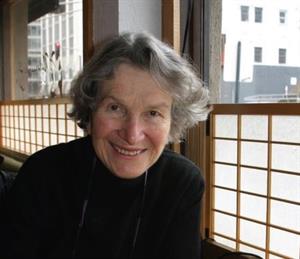
LR Women Making History – June Freeman

June Biber Freeman, born and reared in New Jersey, came to Pine Bluff from the University of Chicago, where she had met and married her husband, Edmond Freeman, a Pine Bluff native.

Long interested in the arts, she was instrumental in establishing the Little Firehouse Community Arts Center. Serving as its unpaid director until, with her continued vision and help, it morphed into the Arts and Science Center for Southeast Arkansas (ASC).  In 1973, she conceived and organized the  Women and the Arts: A Conference on Creativity,  the first of its kind in the region. Governor Dale Bumpers appointed her to the Governor’s Commission on the Status of Women.  In 1975,  Freeman was  hired by  Townsend Wolfe as the Arkansas Arts Center’s Director of State Services, a job  she held for the next five years.

In 1982, she was instrumental in establishing Pine Bluff Sister Cities.   She has served on the Little Rock Arts+Culture Commission as well as the boards of the Arkansas Arts Center, the Mid-American Arts Alliance and the Arkansas Arts Council. (In view of her background in psychology, she has served as a longstanding member of the UAMS Advisory Board of the Psychiatric Research Institute.)

Freeman is the founding director of the non-profit Architecture and Design Network (ADN) which got underway in 2003. Securing the support of the Arkansas Arts Center, the UA Fay Jones School of Architecture and Design (FJSAD) and the central section of the Arkansas chapter of the American Institute of Architects (AIA), Freeman launched a series of free public lectures by distinguished architects.  Retiring as director at the end of 2016, she continues to serve as a board member. She was named an honorary member of the FJSAD Dean’s Circle and, in 2013, was given an Award of Merit by the state Chapter of the AIA at its annual meeting. In 2016 the ADN board named the lecture series for her.

In 2017, she was inducted into the Arkansas Women’s Hall of Fame.  In 1995, she received the Governor’s Arts Award for Outstanding Patron.  In 2018, she became a rare two-time award recipient of a Governor’s Arts Award as she received the Lifetime Achievement Award.

Freeman and her husband, who retired as publisher of the Pine Bluff Commercial, moved to Little Rock in 1995. The couple has four children and six grandchildren.
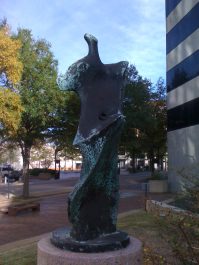
Breakfast with Henry Moore

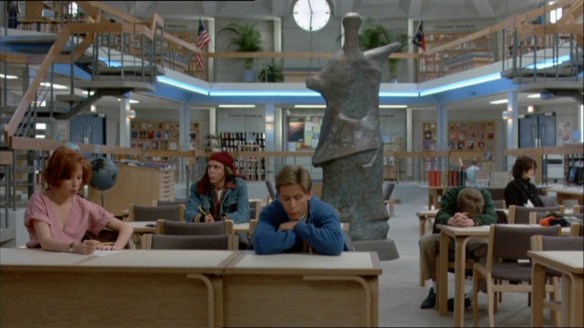
HenryMooreThe John Hughes classic The Breakfast Club takes place on March 24, 1984, a Saturday.  Inside the library of the fictional school is a replica of Henry Moore’s Large Standing Figure: Knife Edge.
Earlier this week, the Little Rock City Board of Directors voted to accept the sculpture from the Metrocentre Improvement District in exchange for land.  The sculpture (which arrived in Little Rock in 1978) will be moved eventually to MacArthur Park to be placed at the entrance of the Arkansas Arts Center once renovations are complete in 2022.

MacArthur Park will mark the third location for the sculpture in Little Rock.  From 1978 to 1999, it stood at the intersection of Main and Capitol Streets as part of the Metrocentre Mall, a pedestrian development.  In anticipation of the last remaining portions of that project were reopened to vehicular traffic, it was moved to Capitol and Louisiana.

The_Breakfast_Club_229

It was not, contrary to what some on the internet may claim, loaned out for the filming of the movie.  The one in The Breakfast Club is either another striking of the sculpture or, more likely, a Papiermâché (or some other material) reproduction.

LR Women Making History – Kaki Hockersmith

In 2015, Kaki Hockersmith was honored at the Governor’s Arts Awards.  She creates art as a designer. In addition, she promotes arts and heritage through her tireless efforts on behalf of numerous cultural institutions.  This award was only one of many recognitions she has received.

In 2010, she was appointed to the President’s Advisory Committee on the Arts for The Kennedy Center.  In that capacity, she serves as a national ambassador for The Kennedy Center. She has also brought programs from The Kennedy Center to Arkansas to help established and emerging arts organizations. She also serves as a commissioner on the cultural committee of UNESCO – the United Nations Educational, Scientific and Cultural Organization.  For the past two years, she and Stephanie S. Streett have led the efforts for FUSION which creates an arts and humanities curriculum for Arkansas teachers.

In 1993, she redesigned the interior of The White House during the Clinton Administration. She was also appointed a member of the Committee for the Preservation of The White House.  Her work on this American landmark was featured in Hillary Clinton’s book An Invitation to the White House: In Celebration of American Culture.

Locally, she has served on the Board of Trustees for the Arkansas Arts Center and the Arkansas Governor’s Mansion Association. She is an active supporter of many cultural organizations in Little Rock.  She and her husband Max Mehlburger open their home to host receptions and fundraisers for numerous cultural institutions and organizations.  In 2014, she was recognized for this support at Ballet Arkansas’ Turning Pointe gala.

Professionally, she has been honored by the national ASID organization as well as the Washington D.C. chapter. Her projects have won 16 regional ASID awards, including seven gold awards.

LR Women Making History – Jeannette Edris Rockefeller

Jeannette Edris Rockefeller only lived in Arkansas for about fifteen years. But her impact on the cultural life of Little Rock and all of Arkansas continues to be felt today.

Born and raised in Seattle, as a young mother she met Winthrop Rockefeller while both were in New York.  He moved to Arkansas in 1953; after their 1956 marriage, she joined him. They split their time between Little Rock and Petit Jean.

In 1959, she was asked to become involved in plans for a new art museum in Little Rock.  She became a tireless advocate and fundraiser for the new Arkansas Arts Center.   In 1960, she assumed the role of president of the Arkansas Arts Center Board of Trustees, a position she held until 1968.  During that time period she oversaw the planning, construction and opening of the building.  She also invited Townsend Wolfe, who she had met when he taught some classes at the Arts Center, to apply to become the museum’s first executive director.

From 1967 to 1971, she was First Lady of Arkansas.  In that capacity, she supervised renovation of the Governor’s Mansion and started the tradition of displaying art on the walls.

Shortly after her 1971 divorce from Rockefeller, she relocated to California.  She continued to be a supporter of the Arts Center.  One of the galleries in the Arts Center is named in her honor.  In addition, one of the sculptures on the lawn of the Arts Center, Standing Red, was dedicated in 1970 in recognition of her service on the Arts Center Board.

LR Women Making History – Charlotte Gadberry

Charlotte Gadberry has long been a supporter of Little Rock’s various cultural institutions. She has both served on boards and consulted with boards in strategic planning.  Her major focus these past few years has been the founding of the ACANSA Arts Festival.
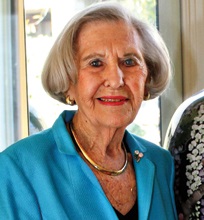
A trip to Charleston, South Carolina, amid it’s Spoleto USA arts festival inspired her to dream that Little Rock could play host to a similar endeavor.  Using her fundraising prowess and connections, she started to raise funds, friends and awareness for this idea.

In September 2013, the inaugural ACANSA Arts Festival was announced for September 2014.  Under her leadership, ACANSA (a name derived from an early Native American variation of what is now called Arkansas) incorporated both local cultural institutions as well as performers brought in for the event.

In the first four years ACANSA has featured theatre, dance, mime, puppetry, instrumental music, choral music, opera, jazz, painting, photography, history, lectures, and gallery tours.  It has worked with the Arkansas Arts Center, Arkansas Repertory Theatre, Arkansas Symphony Orchestra, Ballet Arkansas, Central Arkansas Library System, Mosaic Templars Cultural Center, and Wildwood Park for the Arts as well as numerous galleries and performance venues.

Because of her efforts to found ACANSA and lead it, Charlotte is being honored with an Arkansas Arts Council 2018 Governor’s Arts Award on March 29, 2018.

LR Women Making History – Jeane Hamilton

Photo taken for SOIREE

Jeane Hamilton has nurtured the Arkansas Arts Center for over 60 years.  She was present at the genesis of it and has remained so.  In 2007, she was awarded the Arkansas Arts Council’s Lifetime Achievement Governor’s Arts Award.

Arriving in Little Rock a young wife in 1952, she immediately set about to become involved in her new community as she and her husband James set up a household.  In the mid-1950s, the Junior League of Little Rock tapped her to chair the initiative to create a new art museum for Little Rock.  The two decades old Museum of Fine Arts was threadbare through years of neglect and unfocused programming and collecting.

Hamilton, along with Junior League President Carrie Remmel Dickinson and Vice President Martha McHaney, approached Winthrop Rockefeller (then a relatively new resident) to lead the fundraising effort for the new museum.  He agreed on a few conditions: one was that a base amount had to be raised in Little Rock first, and second that the museum would be for the entire State of Arkansas and not just Little Rock.

Hamilton and her colleagues set about to raise the funds. They raised $645,000 at the same time Little Rock’s business climate was stymied by the aftereffects of the Central High crisis.

Now a lifetime honorary member of the Arkansas Arts Center Board, Hamilton has spent much of her life working on Arkansas Arts Center projects since that visit in 1959.  She has served on the Board, chaired committees, chaired special events, served hot dogs, helped kids paint and danced the night away at countless fundraisers.  She was on the committee which hired Townsend Wolfe as executive director and chief curator.  Jeane has led art tours for the Arts Center to a number of countries over the years.

When she is not at the Arts Center, she is often seen at the Rep, the Symphony or any number of other cultural institutions.  While she enjoys seeing old friends at these events, she also loves to see a room full of strangers – because that means that new people have become engaged in the cultural life of Little Rock.

LR Women Making History – Adolphine Fletcher Terry

Adolphine Fletcher Terry was born on November 3, 1882 to former Little Rock Mayor John Gould Fletcher and his wife Adolphine Krause Fletcher.

Raised in Little Rock, in 1889 she moved into the Albert Pike House on East 7th Street, when her aunt transferred the title to her father. That house would be her primary residence the rest of her life.  Her sister Mary Fletcher Drennan never lived in Arkansas as an adult after marriage. Her brother John Gould Fletcher spent much of his adulthood in Europe before returning to Little Rock and establishing his own house, Johnswood.

At age 15, Adolphine attended Vassar. She later credited that experience as broadening her views on many issues.  After graduating at age 19, she returned to Little Rock.  Her parents both died prior to her 1910 wedding to David D. Terry, which took place at what was then known as the Pike-Fletcher House (and today is known as the Pike-Fletcher-Terry House).

She is perhaps best known today for establishing the Women’s Emergency Committee in 1958 and for her subsequent deeding of the family house to the City for use by the Arkansas Arts Center.  But her entire life was based on civic engagement.

She was instrumental in establishing the first juvenile court system in Arkansas and helped form the first school improvement association in the state. She was long an advocate for libraries, serving 40 years on the Little Rock public library board.  Through her leadership, the library opened its doors to African Americans in the early 1950s. Today a branch of the Central Arkansas Library System (the successor the Little Rock public library) is named after her.  Another branch is named after her Pulitzer Prize winning brother.

Adolphine formed the Little Rock chapter of the American Association of University Women, the Pulaski County tuberculosis association and the Community Chest.

In 1958, when the Little Rock public high schools were closed instead of allowing them to be desegregated again, she called Harry Ashmore the editor of the Gazette and exclaimed, “the men have failed us…it’s time to call out the women.”  With this, she formed the Women’s Emergency Committee to Open Our Schools. This group played a major role in getting the four high schools open the following year.

From 1933 to 1942, David Terry served in the U.S. Congress. During that time, Adolphine alternated her time between Washington DC and Little Rock. But she spent much time in Little Rock raising her five children.

After her husband’s death in 1963, she continued to remain active in civic affairs. In the 1960’s, she and her sister deeded the Pike-Fletcher-Terry House to the City of Little Rock for use by the Arkansas Arts Center upon both their deaths.  Following Adolphine Fletcher Terry’s death in 1976, Mary turned over the title to the City.

Adolphine Fletcher Terry is buried in Mount Holly Cemetery alongside her husband. Three of her children are also buried in that plot.  Her parents and brother are buried in a nearby plot.

Her granddaughters and their families carry on Adolphine Fletcher Terry’s commitment to making Little Rock better.