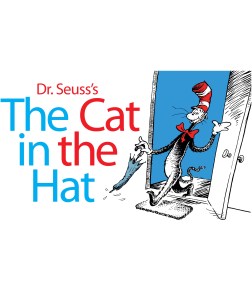
The Cat in the Hat drops in at Arts Center Children’s Theatre

The Arkansas Arts Center Children’s Theatre presents The Cat in the Hat through March 29 with special spring break matinees March 24-27.

“One of the most familiar and beloved picture books of the last half century will erupt with fun on the Children’s Theatre stage,” said Todd Herman, executive director of the Arkansas Arts Center.

“Young audiences and those young at heart will be transported into the world they’ve always imagined while seeing the classic book come to life.”

It’s a rainy day with nothing to do. Sally and her brother are miserable. Bored. Simply dying for fun. Then bump! Something quite unexpected. You guessed it. It’s a cat. In a hat. In fact, it’s the Cat in the Hat, and he’s just in time to show the kids a thing or two about fun. It’s just a matter of know-how, you know. So don’t listen to that fish! Jump in! The water’s fine! Just don’t tell mom!

The cast for The Cat in the Hat includes:

  • Ben Gibson of Little Rock as Boy
  • Sharon Combs of New York, N.Y., as Sally
  • Courtney Bennett of Little Rock as Cat
  • Mark Hansen of Little Rock as Fish
  • Aleigha Morton of Beebe as Kitten 1/Thing 1
  • Lauren Linton of Memphis as Kitten 2/Thing 2

Bradley Anderson is the artistic director and Katie Campbell is the show director. Costumes are designed by Erin Larkin; technical direction by Drew Posey; lighting design by Penelope Poppers; properties and set design by Miranda Young and Rivka Kuperman is the stage manager.

The Arkansas Arts Center Children’s Theatre presenting sponsor is Arkansas Blue Cross and Blue Shield and the season sponsor is Dr. Loren Bartole, ‘Family Footcare’.

Dr. Seuss’ The Cat in the Hat is presented through special arrangement with Music Theatre International (MTI).

Debra Berke discusses “Out of the Ordinary” design this evening 

As the founding partner of the architecture and design firm that bears her name, Deborah Berke oversees a staff of fifty, a skilled team that deals with a diverse portfolio of projects ranging from campus master plans, cultural and arts facilities, university buildings, hotels – Bentonville’s 21c Hotel among them – and custom residences. All projects, large and small, share the Berke imprimatur: a “knowing simplicity”.
An award winning design professional, Berke has been an adjunct professor of Architectural Design at Yale University since 1987. Additionally, she has taught at a number of campuses across the country. In 2005, the Rhode Island School of Design, where she earned a BFA in 1975, awarded her an Honorary Doctor of Fine Arts degree.

Registered as an architect in a dozen states including Arkansas, Berke will talk about creating buildings that are “inevitable though not predictable”. She will describe the relationship between a designer’s vision, life patterns and place.

Berke’s lecture, which is free and open to the public, is made possible through the collaborative effort of Crystal Bridges Museum of American Art and the Architecture and Design Network. For additional information, contact ardenetwork@icloud.com.

Supporters of the Architecture and Design Network include the Arkansas Arts Center, the University of Arkansas Fay Jones School of Architecture, the Central Arkansas section of the Arkansas Chapter of the American Institute of Architects and friends in the community.

March 3, 2015 – 6:00 pm, preceded by a reception at 5:30 p.m. Arkansas Arts Center Lecture Hall

Winslow Homer

OLYMPUS DIGITAL CAMERAWith the snow today, many cultural facilities are closed and events are postponed.

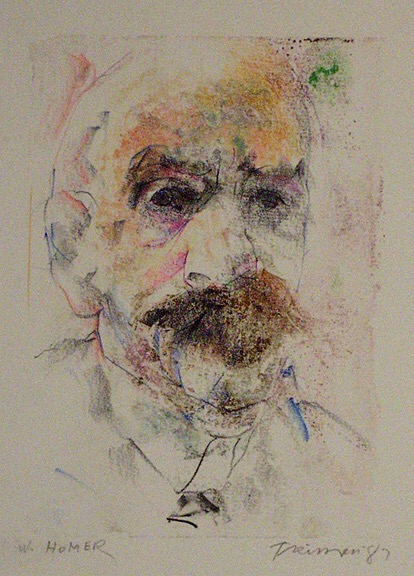
February 24 is the birthday of American realist painter Winslow Homer. While the Arkansas Arts Center doesn’t have any of his pieces in their permanent collection they do have a portrait of him in their collection.

Entitled W. Homer from the Artists Series (#5), this 1987 monotype mixed media on paper is by Joyce Tremain.

The piece was purchased in 1989 by the Arkansas Arts Center Foundation.

Winslow Homer (February 24, 1836 – September 29, 1910) was an American landscape painter and printmaker, best known for his marine subjects. He is considered one of the foremost painters in 19th-century America and a preeminent figure in American art.

Largely self-taught, Homer began his career working as a commercial illustrator. He subsequently took up oil painting and produced major studio works characterized by the weight and density he exploited from the medium. He also worked extensively in watercolor, creating a fluid and prolific oeuvre, primarily chronicling his working vacations.

Black History Month Spotlight – Henri Linton

bhm HenriHenri Linton is a nationally known painter and a well-respected art educator.   Born in Alabama in 1944, he began painting and visiting museums as a young man.  He paid for art supplies by painting signs and shining shoes. After entering a national art contest as a teenager, he won a four-year scholarship to the Columbus College of Art and Design in Ohio. Linton earned a Bachelor of Fine Arts from Boston University and a master’s degree in art from the University of Cincinnati Graduate School of Fine Arts.

In 1969, the chairman of Arkansas AM&N College (later UAPB) art department, John Howard, offered Linton a position on the faculty. With Howard as his mentor, Linton began a career teaching aspiring artists. When Howard retired as chairman in 1980, Linton took the position.

In 1996 and 2000, he was featured in solo shows at the Arkansas Arts Center.  His work is displayed throughout the state, including in public collections at  UAMS, the Winthrop Rockefeller Foundation and the Arkansas Arts Center. He has highlighted some of his works in a book he co-authored, The Art of Henri Linton: Sequences in Time and Space (2003).

Linton also developed UAPB’s University Museum and Cultural Center. Gathering historical photographs, papers, annuals, books, newspaper clippings, tokens, mementos, and a variety of other artifacts, Linton organized, designed, and helped construct all the displays at the museum, which houses Keepers of the Spirit: The L. A. Davis, Sr. Historical Collection, which documents the history of UAPB.

In 2001, Henri Linton was inducted into the Arkansas Black Hall of Fame.  For more on Henri Linton and other inductees into the Arkansas Black Hall of Fame, visit the permanent exhibit at the Mosaic Templars Cultural Center. That museum is an agency of the Department of Arkansas Heritage.

Annual Love Show tonight for Tales from the South at Best Impressions

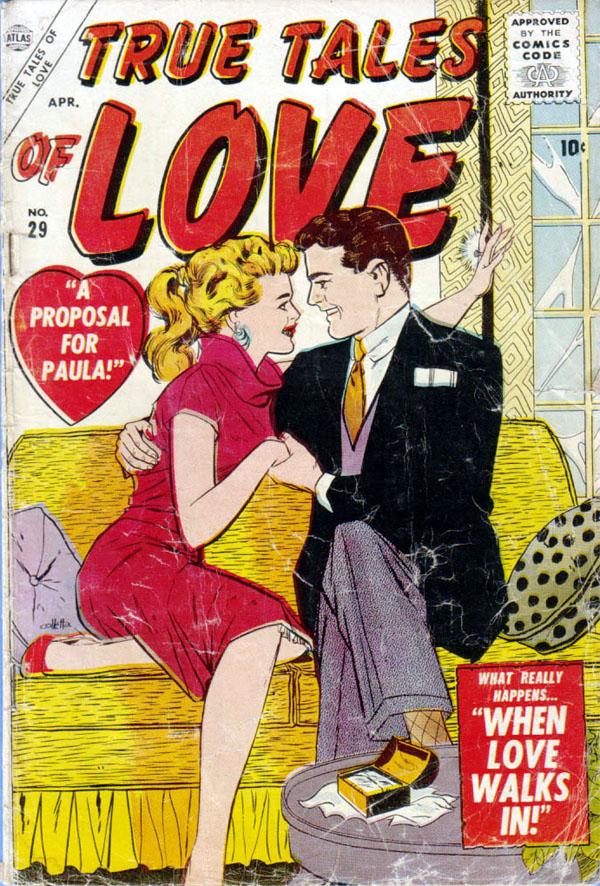
truetalesoflovevol129Since Valentine’s Day is later in the month, tonight’s episode of Tales from the South is the annual Love Episode.

Tonight, Tales originates at Best Impressions at the Arkansas Arts Center. The storytellers for this edition include Kay Fisher and Jessica Horton.

Music is by Amy Garland and blues guitarist Mark Simpson.

“Tales From the South” is a radio show created and produced by Paula Martin Morell, who is also the show’s host. The show is taped live on Tuesday. The night is a cross between a house concert and a reading/show, with incredible food and great company. Tickets must be purchased before the show, as shows are usually standing-room only.

“Tales from the South” is a showcase of writers reading their own true stories. While the show itself is unrehearsed, the literary memoirs have been worked on for weeks leading up to the readings. Stories range from funny to touching, from everyday occurrences to life-altering tragedies.

Dinner is served from 5pm to 6:30pm, the show starts at 7pm.  Admission is $15.  Dinner can be purchased separately.

You MUST purchase your ticket before the show.

Previous episodes of “Tales from the South” air on KUAR Public Radio on Thursdays at 7pm.  This program will air on February 12.

Straw Gets Spun into Gold as RUMPELSTILTSKIN takes stage at Arts Center Children’s Theatre

AACCTrumpThe Arkansas Arts Center Children’s Theatre presents Rumpelstiltskin through February 8, 2015.

“The magical tale of Rumpelstiltskin takes the audience on an action-packed journey that is familiar to so many generations,” said Todd Herman, executive director of the Arkansas Arts Center. “We invite the community to experience the enchantment of this wonderful play.”

Once upon a time, there was a dwarf who tried to take things that just weren’t his. Now, this dwarf lived in a land that was ruled by a king whose greed was as grand as his kingdom. And in that kingdom, there lived a miller whose bragging mouth was nearly as grand as the king’s greed. And it so happened that this miller had a lovely daughter who was kind and good, but one day she did a very bad thing –  she made a promise she could not keep. Now, the king is angry, the miller is frightened, and the dwarf is simply out of control.

Wheels spin and straw flies as the miller’s daughter works madly to make things right again, but the only way she can is by discovering the mean old dwarf’s secret true name. In searching for that, she discovers the only power in the world that will help her. The most magical power of all: love.

This production is adapted for the stage by Keith Smith from the Brothers Grimm.

The cast for Rumpelstiltskin includes:

  • Nate Plummer as Rumpelstiltskin
  • Lauren Linton as The Miller’s Daughter
  • Mark Hansen as The King
  • John Isner as The Miller

Bradley Anderson is the artistic director and Keith Smith is the playwright and set designer for the production. Costumes are designed by Erin Larkin; technical direction by Drew Posey; lighting design by Penelope Poppers; properties design by Miranda Young and Sarah Gasser is the stage manager.

LR Look Back: HAIR flows at Robinson Auditorium

Ad for the original production of HAIR in Little Rock. Note the ticket prices. And that they could be purchased at Moses Music Shops.

Ad for the original production of HAIR in Little Rock. Note the ticket prices. And that they could be purchased at Moses Music Shops.

Forty-three years ago today, on January 18, 1972, the musical Hair settled in for a week-long run at Robinson Auditorium.  The saga to bring the national tour to Little Rock had actually begun eleven months earlier.

In February 1971, a young Little Rock attorney named Phil Kaplan petitioned the Little Rock Board of Censors to see if it would allow a production of Hair to play in the city. He was asking on behalf of a client who was interested in bringing a national tour to Arkansas’ capital city. The show, which had opened on Broadway to great acclaim in April 1968 after an Off Broadway run in 1967, was known for containing a nude scene as well for a script which was fairly liberally sprinkled with four-letter words. The Censors stated they could not offer an opinion without having seen a production.

By July 1971, Kaplan and his client (who by then had been identified as local promoter Jim Porter and his company Southwest Productions) were seeking permission for a January 1972 booking of Hair from the City’s Auditorium Commission which was charged with overseeing operations at Robinson Auditorium. At its July meeting, the Commissioners voted against allowing Hair because of its “brief nude scene” and “bawdy language.”

Kaplan decried the decision. He stated that the body couldn’t “sit in censorship of legitimate theatrical productions.” He noted courts had held that Hair could be produced and that the Auditorium Commission, as an agent for the State, “clearly can’t exercise prior censorship.” He proffered that if the production was obscene it would be a matter for law enforcement not the Auditorium Commission.

The Commission countered that they had an opinion from City Attorney Joseph Kemp stating they had the authority. One of the Commissioners, Mrs. Grady Miller (sister-in-law of the building’s namesake the late Senator Robinson, she had served on the Commission since 1940), expressed her concern that allowing Hair would open the door to other productions such as Oh! Calcutta!

On July 26, 1971, Southwest Productions filed suit against the Auditorium Commission. Four days later there was a hearing before federal Judge G. Thomas Eisele. At that hearing, Auditorium Commission member Lee Rogers read aloud excerpts from the script he found objectionable. Under questioning from Kaplan, a recent touring production of Neil Simon’s Plaza Suite was discussed. That play has adultery as a central theme of one of its acts. Rogers admitted he found the play funny, and that since the adultery did not take place on stage, he did not object to it. Among those testifying in favor of it was Robert Reddington, who was director of performing arts at the Arkansas Arts Center.

Judge Eisele offered a ruling on August 11 which compelled the Auditorium Commission to allow Hair to be performed. Prior to the ruling, some of the Auditorium Commissioners had publicly stated that if they had to allow Hair, they would close it after the first performance on the grounds of obscenity. To combat this, Judge Eisele stated that the Commission had to allow Hair to perform the entire six day engagement it sought.

Upon hearing of the Judge’s ruling, Commissioner Miller offered a succinct, two word response. “Oh, Dear!”

In the end, the production of Hair at Robinson would not be the first performance in the state.  The tour came through Fayetteville for two performances in October 1971 at Barnhill Arena.

On January 18, 1972, Hair played the first of its 8 performances over 6 days at Robinson Auditorium.  In his review the next day, the Arkansas Gazette’s Bill Lewis noted that Hair “threw out all it had to offer” and that Little Rock had survived.

The ads promoting the production carried the tagline “Arkansas will never be the same.”  Tickets (from $2 all the way up to $8.50) could be purchased at Moses Melody Shops both downtown and in “The Mall” (meaning Park Plaza). That business is gone from downtown, but the scion of that family, Jimmy Moses, is actively involved in building downtown through countless projects. His sons are carrying on the family tradition too.

Little Rock was by no means unique in trying to stop productions of Hair.  St. Louis, Birmingham, Los Angeles, Tallahassee, Boston, Atlanta, Charlotte NC, West Palm Beach, Oklahoma City, Mobile and Chattanooga all tried unsuccessfully to stop performances in their public auditoriums.  Despite Judge Eisele’s ruling against the City of Little Rock, members of the Fort Smith City Council also tried to stop a production later in 1972 in that city. This was despite warnings from City staff that there was not legal standing.

Within a few years, the Board of Censors of the City of Little Rock would be dissolved (as similar bodies also were disappearing across the US). Likewise, the Auditorium Commission was discontinued before Hair even opened with its duties being taken over by the Advertising and Promotion Commission and the Convention & Visitors Bureau staff.  This was not connected to the Hair decision; it was, instead, related to expanding convention facilities in Robinson and the new adjacent hotel.  Regardless of the reasons for their demise, both bygone bodies were vestiges of earlier, simpler and differently focused days in Little Rock.