Little Rock Look Back: Founding Fathers of Little Rock

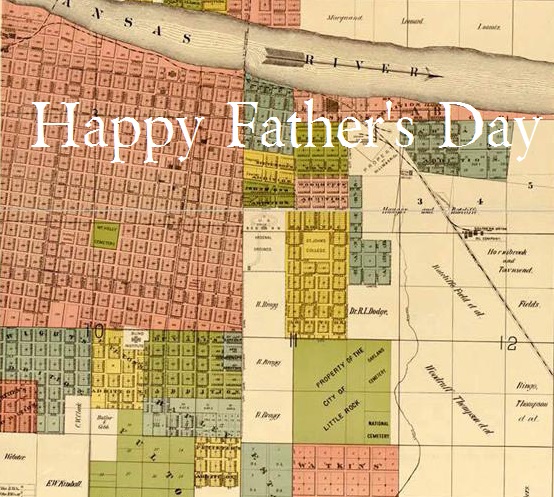
Fathers DayThere are several men who can be considered founding fathers of Little Rock: William Lewis, the first settler, who stayed for a few months in 1814; Roswell Beebe, who acquired most of the land and laid out streets as well as providing land for public buildings and a cemetery; Amos Wheeler, who was the first postmaster and later a land agent; Jesse Brown, who founded the first school and later served as mayor; and William Woodruff, the founder of the Arkansas Gazette.

There are three other men who were not only founding fathers, but also actual fathers to other leaders. They are: Dr. Matthew Cunningham, Major Nicholas Peay and Chester Ashley.

Dr. Cunningham was one of the first residents of Little Rock. He arrived in 1821 and was shortly joined by his family.  Dr. Cunningham would be Little Rock’s first physician. His son Chester was the first child born in Little Rock.  Dr. Cunningham later served as Little Rock’s first mayor from January 1832 to January 1833.  His stepson, Charles P. Bertrand, later served as Mayor of Little Rock from January 1855 to January 1857.  This is the closest Little Rock has ever had to a father and son both serving as Mayor.

Major Nicholas Peay arrived in Little Rock in 1825.  He quickly became engaged in civic affairs and served as a trustee of Little Rock (a precursor to a city council).  In the 1830s, Major Peay served on the Little Rock City Council. In that capacity, he also served as Acting Mayor of Little Rock.  His son, Gordon Neill Peay, would serve as Mayor of Little Rock from 1859 to 1861.  A grandson son, Ashley Peay, was a Little Rock alderman in the 1920s. A great-great-grandson, Joseph B. Hurst, served on the Little Rock City Board from 1967 to 1970.

Chester Ashley never served on the Little Rock council or as mayor.  He was, however, an early leader of Little Rock.  He actually arrived in 1820 and brought his new wife here in late 1821 (a few months after Mrs. Cunningham arrived).  One of Little Rock’s first attorneys, he was instrumental in the settlement of a competing land ownership disputes. In 1844, he was appointed to be one of Arkansas’ U.S. senators. He served in the Senate until his 1848 death.  His son William E. Ashley, served as Little Rock’s mayor from January 1857 to January 1859 and again from January 1861 until September 1863.

With Bertrand, Ashley, Peay and Ashley in the office of Mayor, from January 1855 until September 1863, Little Rock was governed by second generation leaders.

Descendants of the Cunningham and Peay families still reside in Little Rock today.

Tony Awards Week – Trouble with a capital T and that rhymes with…. HAIR?

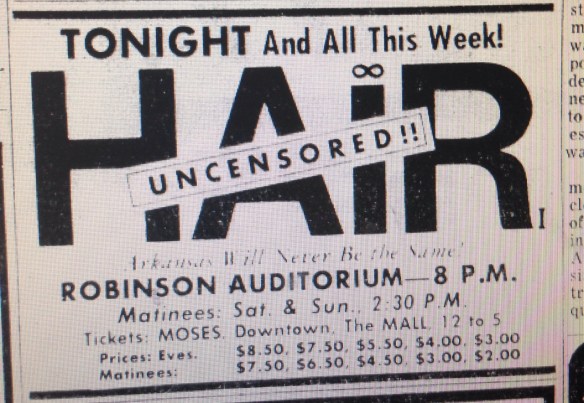
Ad for the original production of HAIR in Little Rock. Note the ticket prices. And that they could be purchased at Moses Music Shops.

Ad for the original production of HAIR in Little Rock. Note the ticket prices. And that they could be purchased at Moses Music Shops.

The Tony winning musical The Music Man may have featured a song about “Trouble in River City” but the Tony nominated musical Hair brought trouble to this “river city” in 1971 and 1972.

In February 1971, a young Little Rock attorney named Phil Kaplan petitioned the Little Rock Board of Censors to see if it would allow a production of Hair to play in the city. He was asking on behalf of a client who was interested in bringing a national tour to Arkansas’ capital city. The show, which had opened on Broadway to great acclaim in April 1968 after an Off Broadway run in 1967, was known for containing a nude scene as well for a script which was fairly liberally sprinkled with four-letter words. The Censors stated they could not offer an opinion without having seen a production.

By July 1971, Kaplan and his client (who by then had been identified as local promoter Jim Porter and his company Southwest Productions) were seeking permission for a January 1972 booking of Hair from the City’s Auditorium Commission which was charged with overseeing operations at Robinson Auditorium. At its July meeting, the Commissioners voted against allowing Hair because of its “brief nude scene” and “bawdy language.”

Kaplan decried the decision. He stated that the body couldn’t “sit in censorship of legitimate theatrical productions.” He noted courts had held that Hair could be produced and that the Auditorium Commission, as an agent for the State, “clearly can’t exercise prior censorship.” He proffered that if the production was obscene it would be a matter for law enforcement not the Auditorium Commission.

The Commission countered that they had an opinion from City Attorney Joseph Kemp stating they had the authority. One of the Commissioners, Mrs. Grady Miller (sister-in-law of the building’s namesake the late Senator Robinson who had served on the Commission since 1939), expressed her concern that allowing Hair would open the door to other productions such as Oh! Calcutta!

On July 26, 1971, Southwest Productions filed suit against the Auditorium Commission. Four days later there was a hearing before Judge G. Thomas Eisele. At that hearing, Auditorium Commission member Lee Rogers read aloud excerpts from the script he found objectionable. Under questioning from Kaplan, a recent touring production of Neil Simon’s Tony winning play Plaza Suite was discussed. That play has adultery as a central theme of one of its acts. Rogers admitted he found the play funny, and that since the adultery did not take place on stage, he did not object to it.

Judge Eisele offered a ruling on August 11 which compelled the Auditorium Commission to allow Hair to be performed. Prior to the ruling, some of the Auditorium Commissioners had publicly stated that if they had to allow Hair they would close it after the first performance on the grounds of obscenity. To combat this, Judge Eisele stated that the Commission had to allow Hair to perform the entire six day engagement it sought.

Upon hearing of the Judge’s ruling, Commissioner Miller offered a succinct, two word response. “Oh, Dear!”

In the end, the production of Hair at Robinson would not be the first performance in the state.  The tour came through Fayetteville for two performances in October 1971. It played Barnhill Arena.

On January 18, 1972, Hair played the first of its 8 performances over 6 days at Robinson Auditorium.  In his review the next day, the Arkansas Gazette’s Bill Lewis noted that Hair “threw out all it had to offer” and that Little Rock had survived.

The ads promoting the production carried the tagline “Arkansas will never be the same.”  Tickets (from $2 all the way up to $8.50) could be purchased at Moses Melody Shops both downtown and in “The Mall” (meaning Park Plaza). That business is gone from downtown, but the scion of that family, Jimmy Moses, is actively involved in building downtown through countless projects. His sons are carrying on the family tradition too.

Little Rock was by no means unique in trying to stop productions of Hair.  St. Louis, Birmingham, Los Angeles, Tallahassee, Boston, Atlanta, Charlotte NC, West Palm Beach, Oklahoma City, Mobile and Chattanooga all tried unsuccessfully to stop performances in their public auditoriums.  Despite Judge Eisele’s ruling against the City of Little Rock, members of the Fort Smith City Council also tried to stop a production later in 1972 in that city. This was despite warnings from City staff that there was not legal standing.

Within a few years, the Board of Censors of the City of Little Rock would be dissolved (as similar bodies also were disappearing across the US). Likewise, the Auditorium Commission was discontinued before Hair even opened with its duties being taken over by the Advertising and Promotion Commission and the Convention & Visitors Bureau staff.  This was not connected to the Hair decision; it was, instead, related to expanding convention facilities in Robinson and the new adjacent hotel.  Regardless of the reasons for their demise, both bygone bodies were vestiges of earlier, simpler and differently focused days in Little Rock.

Over the years, Hair has returned to the Little Rock stage. It has been produced two more times at Robinson Center,  UALR has produced it twice, and the Weekend Theater has also mounted a production.   The most recent visit to Little Rock at Robinson Center, which was the final Broadway show before the building closed for renovations, was based on the 2009 Broadway revival.  That production, was nominated for eight Tony Awards, and captured the Tony for Revival of a Musical.  Several members of the production and creative team are frequent collaborators of Little Rock native Will Trice.

Little Rock Look Back: Cornice placed on Robinson Auditorium

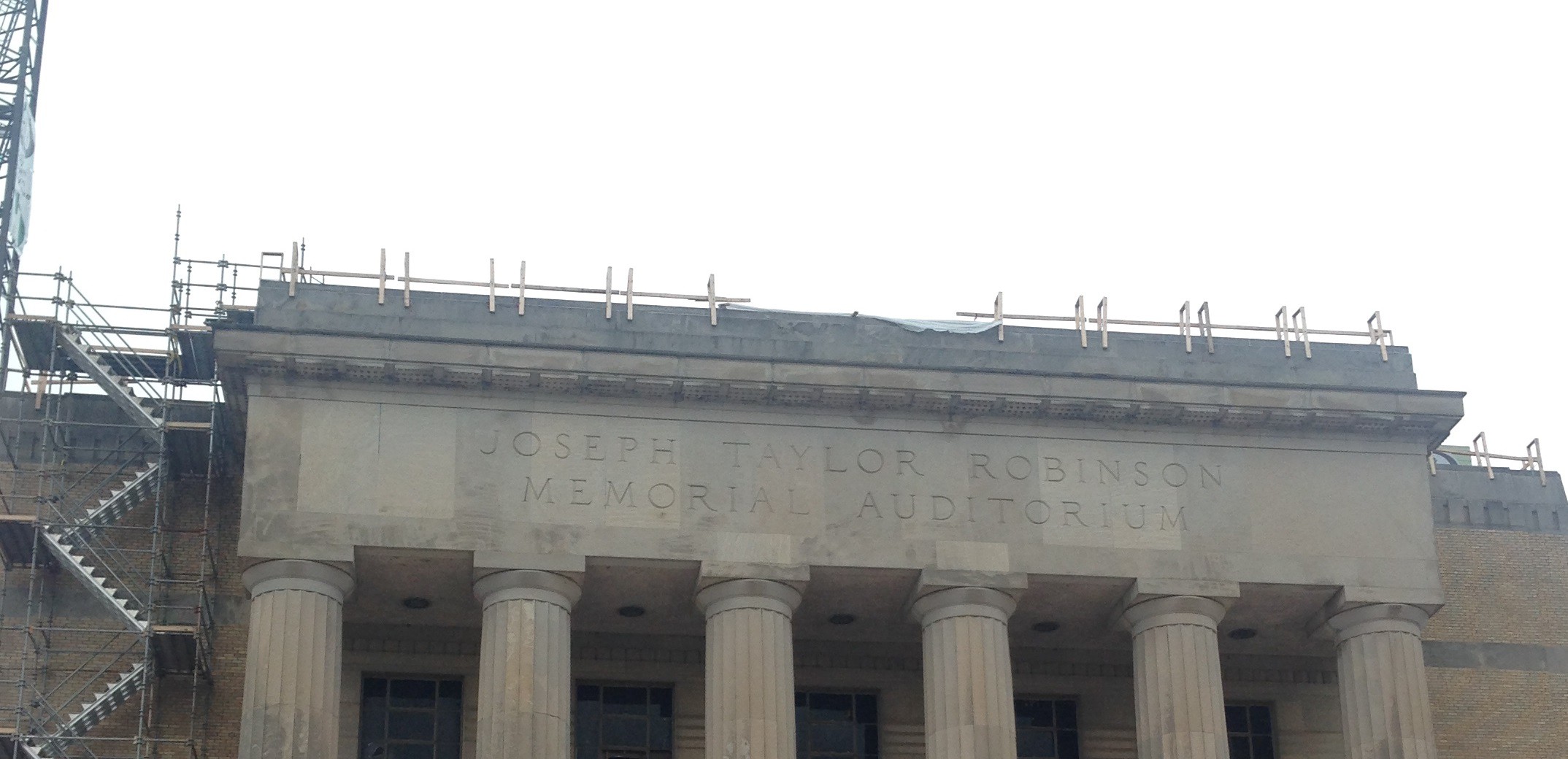
JTR CorniceOn June 1, 1939, the cornice was installed on Robinson Auditorium.  This granite slab noted the name of the building as the Joseph Taylor Robinson Memorial Auditorium.  (It is interesting to note that it used the more modern “u” instead of the classical “v” which was often used in buildings during prior decades – as evidenced by the Pvlaski Covnty Covrt Hovse across the street.)

This was a milestone marking the completion of the front facade of the structure.  Much work would continue on the interior of the structure.  This step in the construction was considered major enough that the Arkansas Gazette mentioned it in a news article.

Today the cornice is again surrounded by construction materials and braces. The front lobby, the cornice and columns are pretty much the only parts of the building not currently under construction as Robinson Center is readied for its second act.  It is scheduled to open in November 2016.

Little Rock Look Back: Dan T. Sprick

SprickFuture Little Rock Mayor Dan T. Sprick was born on May 19, 1902.  He served three terms on the Little Rock City Council (from 1935 to 1941).  In 1945, he was elected Mayor of Little Rock and served one term. During his tenure on the City Council, he was the sole vote against locating Robinson Auditorium at Markham and Broadway.  He had favored another location.

He was not alone, however, in being held in contempt of court and spending part of the day in jail.  On Monday, December 4, a dozen of Little Rock’s aldermen (which included Sprick) reported to the county jail to serve sentences for contempt of court. The previous Monday, the twelve council members had voted against an ordinance which had been ordered by the judge in an improvement district matter. The other aldermen had either voted in the affirmative or had been absent. Because the twelve had refused to change their votes since that meeting, the judge ordered them jailed.

Mrs. C. C. Conner, the only female, was not jailed but was fined $50. The eleven men were held at the jail, though not in cells. In order to get out of jail, the judge gave the aldermen the chance to change their votes. The mayor asked the judge to let them leave the jail to attend the meeting at City Hall, which was nearby. He requested that the city be allowed to maintain “what little dignity remained” by not having the meeting at the jail. The judge relented, and the aldermen were escorted by deputies to the council chambers. After the aldermen changed their votes, the judge suspended the remainder of their sentences.

His tenure as Mayor was relatively quiet. He took office the same month that World War II ended. While in office, the Sprick administration was marked by growth in the city budget and in city positions. As a part of that growth, there were many more new purchases taking place which had prompted extra scrutiny of the City’s purchasing procedures. A thorough investigation toward the end of his tenure found no malfeasance or misfeasance, it did note that the city needed to do a better job of anticipating cash flow. Much of the City’s focus during the Sprick tenure was on growth and keeping up infrastructure needs.

Sprick later served for ten years in the Arkansas State Senate (from 1961 to 1970).  During his tenure in the Senate, Sprick was closely aligned with Gov. Orval Faubus.  When the Little Rock high schools had been closed a year to ensure segregation, Sprick had served on the board of a private school set up by some of the leaders of the segregation movement.

His time in the Senate was also marked by controversy.  He was one of three Senators to opposed Muhammad Ali’s speaking at the University of Arkansas at Fayetteville.  After an Arkansas Gazette editorial lambasted him, Sprick sued the paper for libel. The Gazette settled with him out of court because his health was poor.

Sprick died in January 1972.

Little Rock Look Back: Elvis plays final Robinson Auditorium Show

Photo by Wayne Cranford

Photo by Wayne Cranford

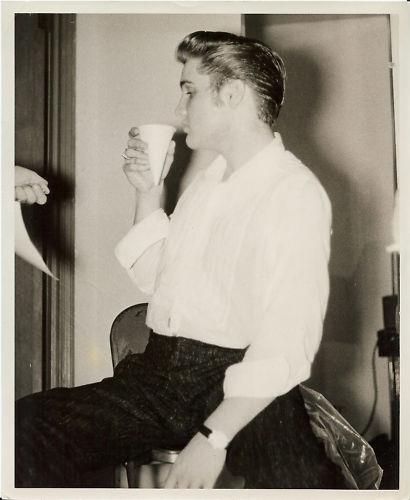
After two visits in 1955 where he was down on the bill, Elvis Presley made his third and final appearance at Robinson Auditorium on May 16, 1956.  This time he was the star and Robinson was packed. The tickets were $1.50 in advance at Walgreens and $2.00 at the box office.  The ads featured 8 great acts in “his” variety show which consisted of the Jordonaires; Rick and Emil Flaim and their orchestra; vocalists Frankie Conners and Jackie Little and comedian-magician Phil Maraquin. A second show was added at 9:30 p.m. to accommodate the ticket demand.

About 30 minutes late, due to a missed flight, Elvis appeared on stage in a purple blazer and started singing “Heartbreak Hotel.”  The crowd rushed the stage. Little Rock police officers were able to control them eventually and get the teenagers back to their seats.  While the crowd was impressed, the police officers were less so.  One of the patrolmen told the Arkansas Gazette reporter: “I wouldn’t know him if I saw him. And I wouldn’t be here unless I was being paid.”

Disc jockey Ray Green recorded the concert that night.  Copies of the concert on CD (which also includes an interview with Presley) are prized possessions of Presley collectors.

The Arkansas Democrat-Gazette has a special section on its website containing quotes from some of the concert attendees.

42nd Annual Territorial Fair at Historic Arkansas Museum today from 10 to 4

hamlogoHistoric Arkansas Museum will host the 42nd Annual Territorial Fair on Saturday, May 9, from 10 a.m. to 4 p.m. This popular annual event is a fun and free opportunity for adults and children of all ages to experience what life was like during Arkansas’s Territorial era. Living history performances, blacksmith demonstrations, historical dances and pioneer games will be happening on the museum’s historic grounds, a preserved and meticulously recreated section of an early downtown Little Rock neighborhood.

Living historians will portray residents of the museum’s historic block. Visitors can witness a raucous card game in the Hinderliter Grog Shop, Little Rock’s oldest surviving structure (c. 1827), or visit a territorial lawyer for a land deed.  In the Print Shop, “Arkansas Gazette” founder William Woodruff will be looking for apprentices and young visitors are encouraged to apply!

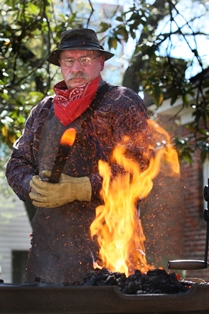
Blacksmith Terr Fair for webHistoric Arkansas Museum’s master bladesmith, Lin Rhea, will provide demonstrations in the Black Smith Shop and visitors can see how cloth was dyed in the Arkansas Territory. Children will have the opportunity to make Mother’s Day cards just in time for Mother’s Day.

The “Early Arkansaw Re-enactors” will interact with guests on the grounds with historically accurate clothing, tools and accessories. The Arkansas Country Dance Society will lead guests in historical dances to tunes that were popular during the territorial era. The Southern Center for Agroecology will be selling a variety of plants and heirloom seeds for Mother’s Day and spring planting. Lunch will be available for purchase from Gammy & Gamp’s “Home Style” Food Truck.

The museum’s seven galleries of Arkansas-made art and artifacts and the Sturgis Children’s Gallery will be open during the Territorial Fair. There is no charge for parking or admission. The Museum Store will be open for Mother’s Day shopping with a variety of unique Arkansas-made gifts and books. From 12 to 2 p.m. in the Museum Store, guests will have the opportunity to meet author Layne Livingston Anderson and buy a signed copy of “Haunted Legends of Arkansasa great book for campfire storytelling.

Currently on exhibit:

  • Suyao Tian: Entangled Beauty
  • Suggin Territory: The Marvelous World of Folklorist Josephine Graham
  • Arkansas Made Gallery
  • We Walk in Two Worlds: The Caddo, Osage and Quapaw in Arkansas (permanent)
  • The Knife Gallery (permanent)

Historic Arkansas Museum is open 9 a.m. – 5 p.m. Monday through Saturday, 1 – 5 p.m. on Sunday. Admission to the galleries and parking are free; admission to the historic grounds is $2.50 for adults, $1 for children under 18, $1.50 for senior citizens. The Historic Arkansas Museum Store is open 10 a.m. – 4:30 p.m. Monday through Saturday, 1 – 4 p.m. on Sunday.

Historic Arkansas Museum is an agency of the Department of Arkansas Heritage, which was created in 1975 to preserve and enhance the heritage of the state of Arkansas. Other agencies of the department are Delta Cultural Center in Helena, Arkansas Arts Council, Arkansas Natural Heritage Commission, Arkansas Historic Preservation Program, Mosaic Templars Cultural Center and Old State House Museum.

Little Rock Look Back: STAR WARS comes to Little Rock

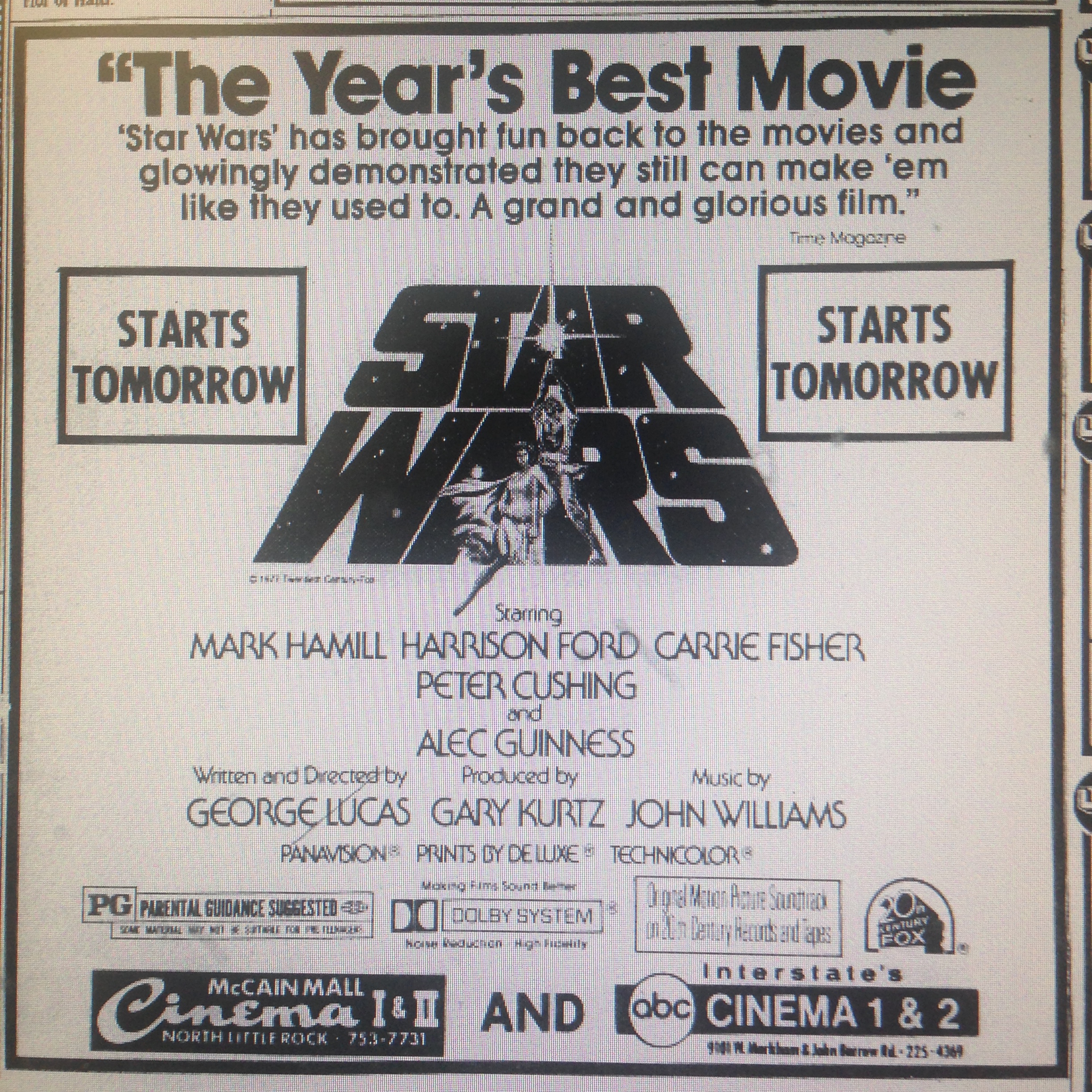
First ad in Arkansas Gazette (June 23, 1977)

First ad in Arkansas Gazette (June 23, 1977)

Today, May the 4th, is Star Wars Day.

The classic film first opened in May 1977 (though after May 4).  It did not reach Little Rock until June 24, 1977.

Given its status as a sleeper hit, it is no surprise that it came into Little Rock largely unnoticed.  In that day, major films opening on a Friday would be heralded the previous Sunday with a substantial advertisement.  The first Star Wars ad ran on Thursday, June 23, 1977, the day before it opened.  By contrast, Herbie Goes to Monte Carlo, which would play at the same theatre, had a large ad on Sunday, June 19.

While Star Wars would seem like the perfect movie for the great UA Cinema 150, it did not play there.  The film playing at the 150 was A Bridge Too Far, which was, at least an action movie.  Star Wars did not even open at a UA theatre.  It opened at the ABC Cinema 1 & 2 (located at Markham and John Barrow) and at the McCain Mall Cinema.  (The ABC Cinema location is now home to discount cellphone and discount clothing businesses; a cinema has returned to McCain Mall, but now in the location of the former MM Cohn’s store.)

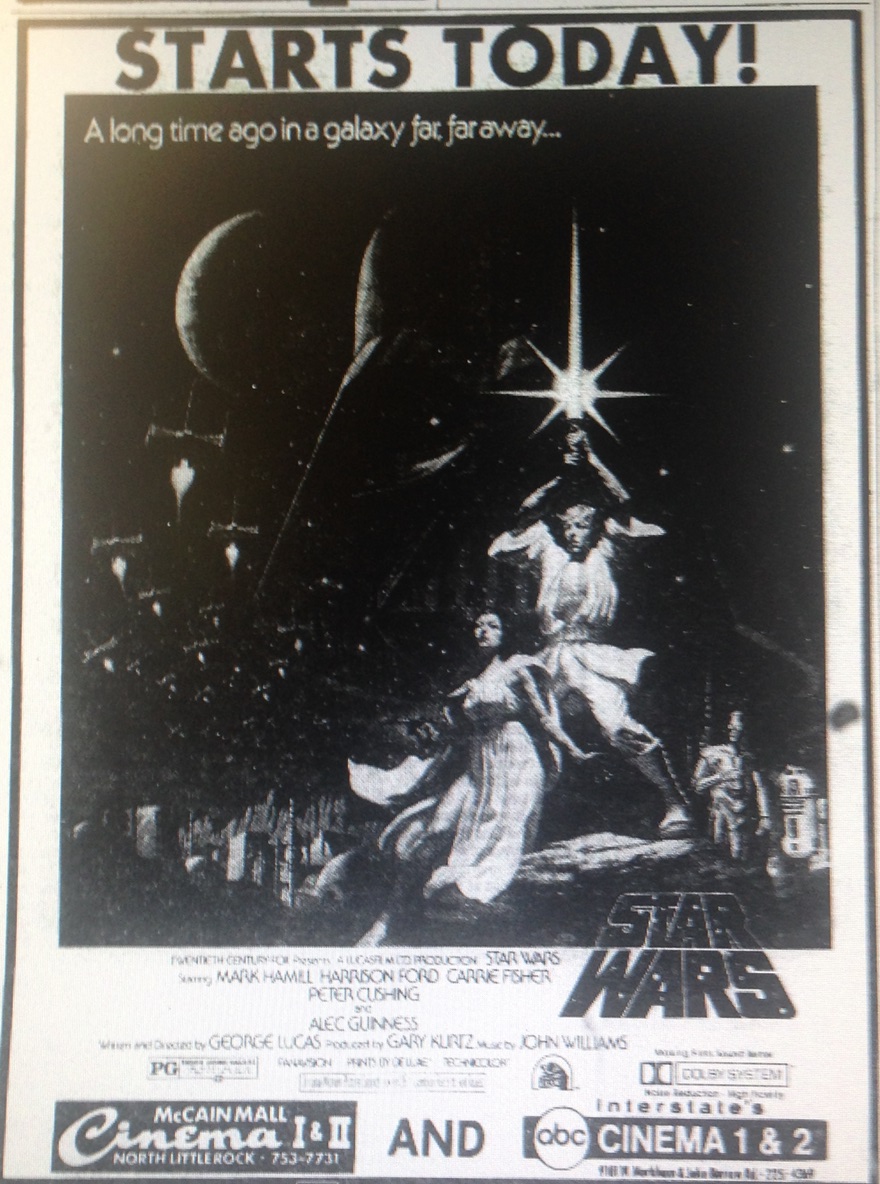
The day it opened, there was a fairly large ad which incorporated the familiar beefcake Luke, Leia in flowing gowns, and Darth Vader mask.  On the Sunday after it opened, there was a slightly smaller ad with the same artwork.  McCain Mall also ran a small add for both Star Wars and Herbie. It noted that Star Wars was a film that management “does not recommend for children.”

IMG_5919