Little Rock Look Back: HAIR comes to LR in 1972

Ad for the original production of HAIR in Little Rock. Note the ticket prices. And that they could be purchased at Moses Music Shops.

Ad for the original production of HAIR in Little Rock. Note the ticket prices, and that they could be purchased at Moses Melody Shops.

It seems fitting that a touring production of Hair is the final Broadway show at Robinson Center Music Hall before it is closed for a two year renovation. The first time the show played at Robinson, it caused quite a stir. To be fair, the actual production in January 1972 did not cause a stir, it was the process leading up to it that was the source of much ado.

In February 1971, a young Little Rock attorney named Phil Kaplan petitioned the Little Rock Board of Censors to see if it would allow a production of Hair to play in the city. He was asking on behalf of a client who was interested in bringing a national tour to Arkansas’ capital city. The show, which had opened on Broadway to great acclaim in April 1968 after an Off Broadway run in 1967, was known for containing a nude scene as well for a script which was fairly liberally sprinkled with four-letter words. The Censors stated they could not offer an opinion without having seen a production.

By July 1971, Kaplan and his client (who by then had been identified as local promoter Jim Porter and his company Southwest Productions) were seeking permission for a January 1972 booking of Hair from the City’s Auditorium Commission which was charged with overseeing operations at Robinson Auditorium. At its July meeting, the Commissioners voted against allowing Hair because of its “brief nude scene” and “bawdy language.”

Kaplan decried the decision. He stated that the body couldn’t “sit in censorship of legitimate theatrical productions.” He noted courts had held that Hair could be produced and that the Auditorium Commission, as an agent for the State, “clearly can’t exercise prior censorship.” He proffered that if the production was obscene it would be a matter for law enforcement not the Auditorium Commission.

The Commission countered that they had an opinion from City Attorney Joseph Kemp stating they had the authority. One of the Commissioners, Mrs. Grady Miller (sister-in-law of the building’s namesake the late Senator Robinson who had served on the Commission since 1939), expressed her concern that allowing Hair would open the door to other productions such as Oh! Calcutta!

On July 26, 1971, Southwest Productions filed suit against the Auditorium Commission. Four days later there was a hearing before Judge G. Thomas Eisele. At that hearing, Auditorium Commission member Lee Rogers read aloud excerpts from the script he found objectionable. Under questioning from Kaplan, a recent touring production of Neil Simon’s Plaza Suite was discussed. That play has adultery as a central theme of one of its acts. Rogers admitted he found the play funny, and that since the adultery did not take place on stage, he did not object to it. Among those testifying in favor of it was Robert Reddington, who was director of performing arts at the Arkansas Arts Center.

Judge Eisele offered a ruling on August 11 which compelled the Auditorium Commission to allow Hair to be performed. Prior to the ruling, some of the Auditorium Commissioners had publicly stated that if they had to allow Hair they would close it after the first performance on the grounds of obscenity. To combat this, Judge Eisele stated that the Commission had to allow Hair to perform the entire six day engagement it sought.

Upon hearing of the Judge’s ruling, Commissioner Miller offered a succinct, two word response. “Oh, Dear!”

In the end, the production of Hair at Robinson would not be the first performance in the state.  The tour came through Fayetteville for two performances in October 1971. It played Barnhill Arena.

On January 18, 1972, Hair played the first of its 8 performances over 6 days at Robinson Auditorium.  In his review the next day, the Arkansas Gazette’s Bill Lewis noted that Hair “threw out all it had to offer” and that Little Rock had survived.

The ads promoting the production carried the tagline “Arkansas will never be the same.”  Tickets (from $2 all the way up to $8.50) could be purchased at Moses Melody Shops both downtown and in “The Mall” (meaning Park Plaza). That business is gone from downtown, but the scion of that family, Jimmy Moses, is actively involved in building downtown through countless projects. His sons are carrying on the family tradition too.

Little Rock was by no means unique in trying to stop productions of Hair.  St. Louis, Birmingham, Los Angeles, Tallahassee, Boston, Atlanta, Charlotte NC, West Palm Beach, Oklahoma City, Mobile and Chattanooga all tried unsuccessfully to stop performances in their public auditoriums.  Despite Judge Eisele’s ruling against the City of Little Rock, members of the Fort Smith City Council also tried to stop a production later in 1972 in that city. This was despite warnings from City staff that there was not legal standing.

Within a few years, the Board of Censors of the City of Little Rock would be dissolved (as similar bodies also were disappearing across the US). Likewise, the Auditorium Commission was discontinued before Hair even opened with its duties being taken over by the Advertising and Promotion Commission and the Convention & Visitors Bureau staff.  This was not connected to the Hair decision; it was, instead, related to expanding convention facilities in Robinson and the new adjacent hotel.  Regardless of the reasons for their demise, both bygone bodies were vestiges of earlier, simpler and differently focused days in Little Rock.

Over the years, Hair has returned to the Little Rock stage.  UALR has produced it at least twice.  The Weekend Theater has also mounted a production. By 2014, Hair is a period piece. For some, a wistful look at their long-gone youth while for others a romanticized time when disparate spirits could band together and change the world.
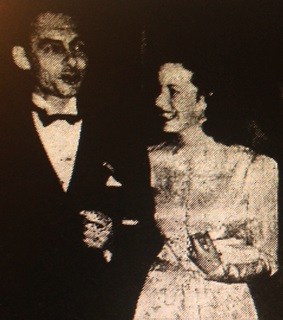
Little Rock Look Back: 1940 Movie Ball at Robinson Auditorium

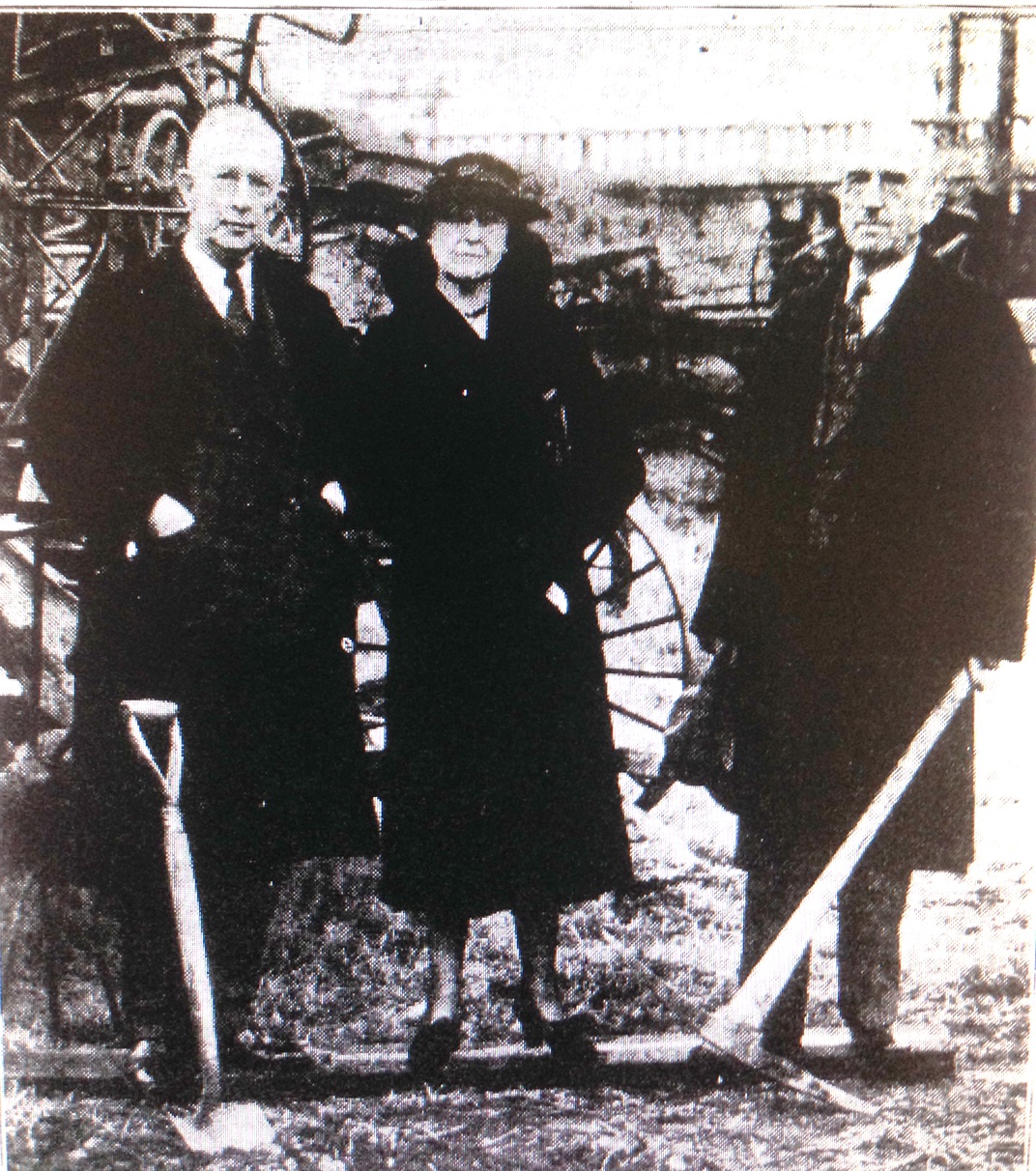
Mayor J V Satterfield escorting actress Maureen O'Hara at the Movie Ball (photo from Arkansas Democrat)

Mayor J V Satterfield escorting actress Maureen O’Hara at the Movie Ball (photo from Arkansas Democrat)

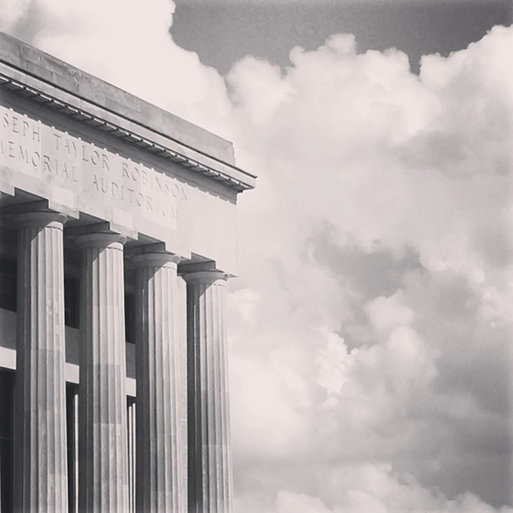
As final preparations were being made for the opening of the Joseph Taylor Robinson Municipal Auditorium in early 1940, a glamorous evening took place in Robinson’s lower level convention hall on February 1.

In conjunction with a meeting of film executives and movie theatre owners sponsored by Robb and Rowley Theaters (which later became the United Artists theatre chain), several Hollywood actors were in Little Rock and headlined a Movie Ball. While in Little Rock, Maureen O’Hara, Phyllis Brooks, Arleen Whelan, Tim Holt and Gene Autry had also made a variety of public appearances.

Mr. Autrey had to miss the ball because he had to return to Hollywood early to attend to business matters. Actress Ilona Massey had also been scheduled to attend the events but was unable due to illness.

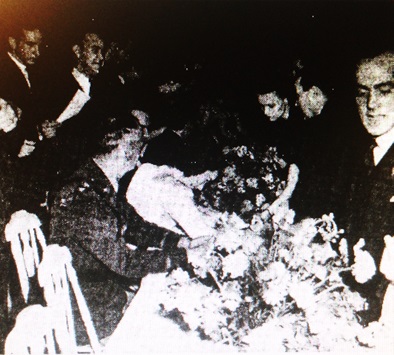
Autograph seekers crowd around the actors at the Movie Ball (photo from Arkansas Gazette)

Autograph seekers crowd around the actors at the Movie Ball (photo from Arkansas Gazette)

The quartet who did appear at the Movie Ball caused quite a scene. Upon their entrance, so many of the attendees crowded around for autographs that the evening’s grand march could not take place (a newspaper headline in the Democrat innocently used the word “orgy” to describe the crowd). After two attempts, Little Rock Mayor J. V. Satterfield (who was escorting Miss O’Hara) and the other members of the Little Rock host delegation led the Hollywood foursome to their reserved table. For quite a while that evening, the table was besieged by autograph seekers.

Though it is unknown as to whether he sought an autograph, photos from the evening showed a very satisfied Mayor Satterfield with Miss O’Hara on his arm. Satterfield family lore joked that Mrs. Satterfield was not a fan of Miss O’Hara’s films after that evening.

The Movie Ball showed Little Rock citizens the value of Robinson Auditorium even before it had been officially dedicated. The film industry meetings had taken place at the Albert Pike Hotel which did not feature a ballroom large enough to host the ball. Without the auditorium’s availability for the gala, organizers might not have chosen Little Rock for the meeting.

With the auditorium’s convention hall not attached to any hotel, it opened up the chance for Little Rock to host more events. This had been one of the key arguments for an auditorium since Mayor W. E. Lenon’s first proposal back in 1904. Having a glamorous event this early in the auditorium’s life validated that contention. After having endured the challenges to open the building, it was a nice lagniappe for the auditorium’s proponents who were present.

The actor Tim Holt would again be connected to Little Rock. In September 1951 he tried to obtain a divorce in Arkansas and stated that he had been a resident of the state for at least six weeks. He also had someone else testify to that fact. In October 1951 the divorce was granted. But later Mr. Holt was charged with perjury and fined $200 for falsely representing his length of residence in Arkansas. Judicial sanctions for his legal team, which included a State Senator, were eventually reviewed by the Arkansas Supreme Court.

Little Rock Look Back: Voters Approve Robinson Auditorim

10.+citylittlerock-2On January 26, 1937, Little Rock voters went to the polls to vote on three different municipal bond issues.  One of them was the construction of a municipal auditorium.

The bonds for the auditorium would be $468,000 in general obligation bonds which would be paid off between 1940 and 1971. This was toward a total cost of $760,000 for the entire project.

The official campaign for the auditorium was sponsored by the Little Rock Forward Committee which was led by W. H. Williams. In campaign advertisements it showed the value of conventions in New York City which was estimated at $100 per convention attendee. Little Rock organizers were estimating a $10 a day expenditure by visitors, which the committee stressed was very conservative. The campaign committee emphasized the importance of acting at that time due to the federal government money involved.

Various committees and organizations endorsed the auditorium project including the Little Rock Chamber of Commerce, Little Rock Federation of Women’s Clubs, and the Young Business Men’s Association.

The thrust of the campaign focused on the economic benefit to Little Rock as well as the fact that the auditorium would be for all citizens. This message was picked up in editorials by both the Democrat and Gazette. In editorials on January 23 and 25, the Democrat opined that the benefits of the auditorium would be distributed among all classes of the citizenry. The next day, both papers ran editorials which touted the economic boon an auditorium would bring through conventions and meetings.

The Democrat’s approach broke down the current value of conventions to Little Rock with, what it termed, the city’s “existing inadequate” facilities. The paper emphasized a conservative estimate of what the added value to Little Rock’s economy would be with the new auditorium.

In expressing support for the auditorium the Gazette stressed the values for local, statewide and national groups. “An auditorium would provide a more convenient and better adapted community center for all kinds of local gathering,” and continued that it would make Little Rock “the logical meeting place for state conventions of every sort.” In discussing the value of state, regional and national meetings the paper stressed that the outside money spent by convention attendees has an impact beyond stores, hotels and restaurants.

Both papers also echoed the importance of the federal government financing to make this possible. The Democrat noted that the Public Works Administration grant and federal low cost loan made this an ideal time.


On January 26, 1937, Little Rock voters approved the auditorium bond by a vote of 1,518 to 519. It passed in each of the city’s 23 precincts. Little Rock Mayor R. E. Overman expressed his pleasure at the outcome of the vote and extended his thanks to the voters.

After the election, a Gazette editorial commented on the low turnout for the special election by commenting that the weather had been nice and there were no other barriers to voting. The editorial writer opined that those not voting in the election must not have been opposed to the endeavor.

Little Rock Look Back: Groundbreaking for Robinson Auditorium

    ARKANSAS DEMOCRAT photo of Mayor Overman, Mrs. Robinson and Mr. Allaire at the groundbreaking. The Broadway Bridge balustrades are visible in the background.

ARKANSAS DEMOCRAT photo of Mayor Overman, Mrs. Robinson and Mr. Allaire at the groundbreaking. The Broadway Bridge balustrades are visible in the background.

On December 24, 1937, at 11:30 a.m., Little Rock Mayor R. E. Overman, Ewilda Gertrude Miller Robinson (the widow of Senator Joseph Taylor Robinson) and  Alexander Allaire of the PWA turned dirt to participate in the brief groundbreaking ceremony for Little Rock’s municipal auditorium.  That morning, the Arkansas Gazette ran a brief story on the upcoming groundbreaking.  The story mentioned that the building would be named in memory of the late beloved Arkansas politician.  This appears to be the first public pronouncement of the Robinson name for this civic structure.

Among others in attendance at the groundbreaking were Mrs. Charles Miller (sister-in-law of Mrs. Robinson), Mr. and Mrs. Grady Miller (brother and sister-in-law of Mrs. Robinson), the mayor’s wife, the three architects (George Wittenberg, Lawson Delony and Eugene John Stern), and D. H. Daugherty and Will Terry of the City’s Board of Public Affairs. 

Construction had to start by January 1, 1938, in order to receive PWA funds.  By breaking ground on December 24, there was over a week to spare.  The site had been selected in late October 1937, and the purchase had not been finalized.  But the PWA did give permission for the City to let a contract for excavation, demolition and filling on the site.

The groundbreaking took place at the corner of Garland and Spring Streets which was on the northeast corner of the block set aside for the auditorium.  Today, Spring Street does not extend north of Markham; the street was closed to make way for the parking structure and what is now the Doubletree Hotel.  Garland Street is basically an alley that runs parallel to Markham north of City Hall, Robinson Auditorium and the Doubletree Hotel.

Approximation of site of Robinson Auditorium groundbreaking

Approximation of site of Robinson Auditorium groundbreaking

QQA Preservation Conversation: Tour of Woodruff House

woodruff houseThe latest Quapaw Quarter Association Preservation Conversation is this evening.  Instead of being at Curran Hall, this one is a tour of the William Woodruff House, located at 1017 East 8th Street. The program will begin at 5pm this evening.  This tour is one of the QQA’s activities for Arkansas Heritage Month.

The William E. Woodruff House was built in 1852-3 and placed on the National Register of Historic Places in 1989. In 2007, the Historic Preservation Alliance of Arkansas place the Woodruff House on its Most Endangered List.

Woodruff was the founder of the Arkansas Gazette. The two and one-half story house sits on three lots just two blocks east of I-30, near the MacArthur Park Historic District and the rapidly developing River Market District. Originally built in the Greek Revival Style, the house has many Colonial Revival elements, dating from an early 20th century remodeling. The footprints of outbuildings are still evident on the property, and the original cistern is located nearby.

The Quapaw Quarter Association’s mission is to promote the preservation of Little Rock’s architectural heritage through advocacy, marketing and education.

Incorporated in 1968, the QQA grew out of an effort to identify and protect significant historic structures in Little Rock during the urban renewal projects of the early 1960s. Throughout its existence, the QQA has been a driving force behind historic preservation in Greater Little Rock.


LR Look Back: Mayor Dan T. Sprick

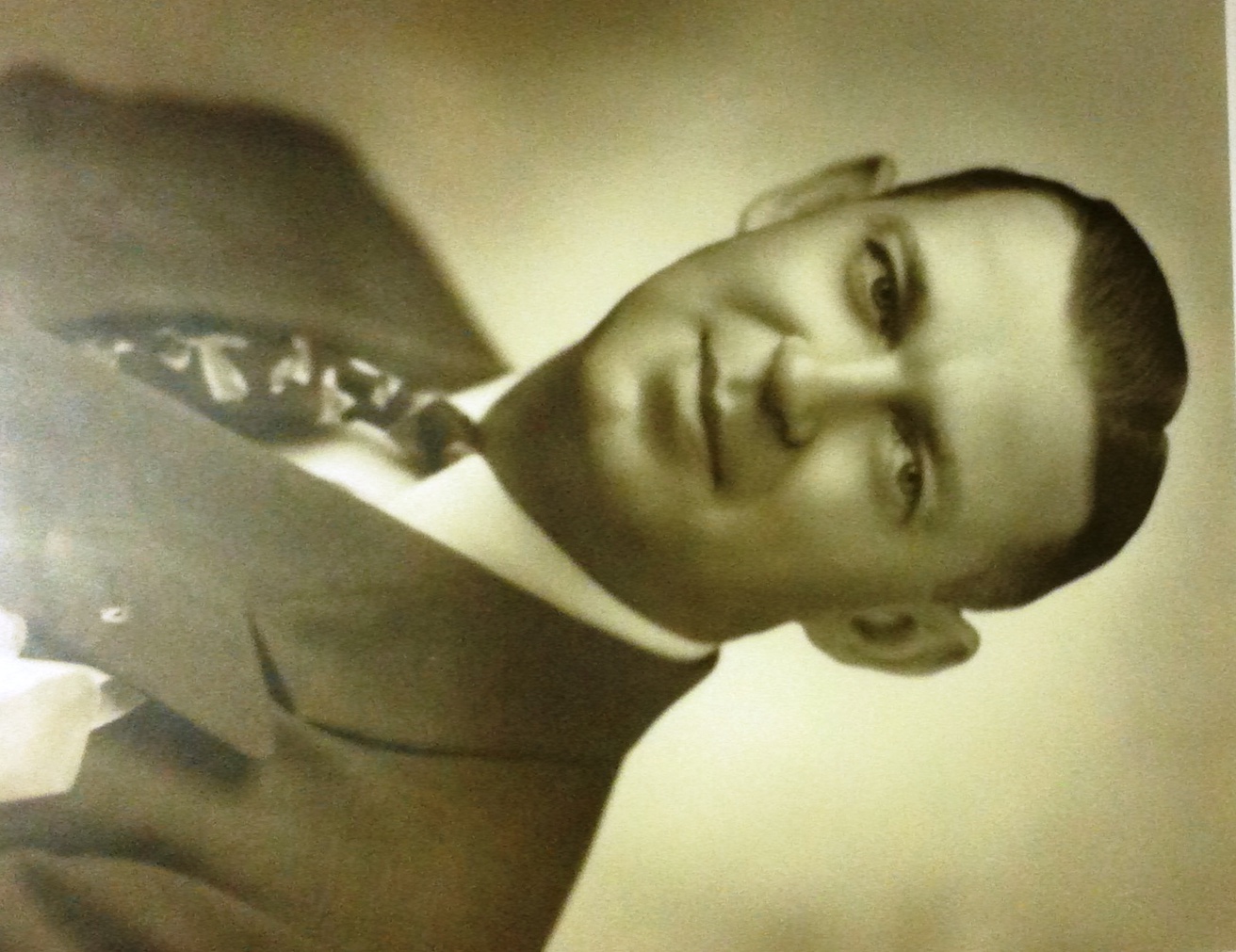
SprickFuture Little Rock Mayor Dan T. Sprick was born on May 19, 1902.  He served three terms on the Little Rock City Council (from 1935 to 1941).  In 1945, he was elected Mayor of Little Rock and served one term.

Sprick later served for ten years in the Arkansas State Senate (from 1961 to 1970).  During his tenure in the Senate, Sprick was closely aligned with Gov. Orval Faubus.  When the Little Rock high schools had been closed a year to ensure segregation, Sprick had served on the board of a private school set up by some of the leaders of the segregation movement.

His time in the Senate was also marked by controversy.  He was one of three Senators to opposed Muhammad Ali’s speaking at the University of Arkansas at Fayetteville.  After an Arkansas Gazette editorial lambasted him, Sprick sued the paper for libel. The Gazette settled with him out of court because his health was poor.

Sprick died in January 1972.


Pulitzer Day at Mount Holly

The Pulitzer Prizes are to be announced today.  Though Mt. Holly Cemetery touts that it is the site of a whole host of elected officials, it is also the only place in Arkansas where two Pulitzer Prize recipients are buried.

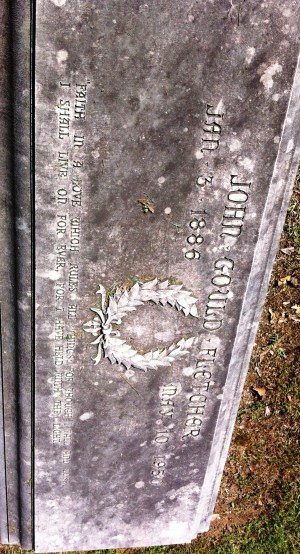
In 1939, John Gould Fletcher became the first Southern poet to win the Pulitzer Prize for Poetry.  He was born into a prominent Little Rock family in 1886.  Fletcher was awarded the prize for his collection Selected Poems which was published by Farrar in 1938.  Two years earlier, he had been commissioned by the Arkansas Gazette to compose an epic poem about the history of Arkansas in conjunction with the state’s centennial.

Fletcher is buried next to his wife, author Charlie May Simon and his parents.  Other relatives are buried nearby in the cemetery.

The other Pulitzer Prize winner buried in Mt. Holly is J. N. Heiskell, the longtime editor of theArkansas Gazette.  It was Heiskell, in fact, who asked Fletcher to compose the poem about Arkansas.  Heiskell served as editor of the Gazette from 1902 through 1972.  He died at the age of 100 in 1972.

Under his leadership, the Gazette earned two Pulitzer Prizes for its coverage of the 1957 desegregation of Little Rock Central High.  One was for Harry Ashmore’s editorial writing and the other was for Public Service.

Heiskell remained in charge of the Gazette until his death in 1972.  He is buried alongside his wife.