THE WAR ROOM documentary screens tonight

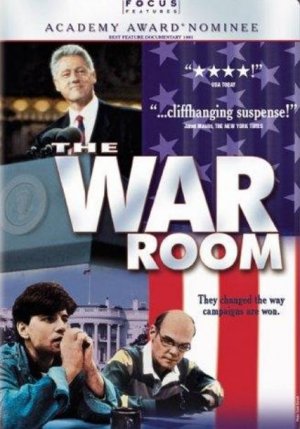
The_War_Room_FilmPosterTonight at 7pm, the Oscar nominated documentary THE WAR ROOM will be shown at the Ron Robinson Theater. The screening is free.

This 1993 American documentary film follows Bill Clinton’s campaign for President of the United States, during the 1992 presidential election.  At the start of the 1992 Democratic primaries, filmmakers D.A. Pennebaker and Chris Hegedus requested permission from the Campaign to film its progression. The Clinton Campaign agreed, and Pennebaker and Hegedus were allowed to film Communications Director George Stephanopoulos as well as Lead Strategist James Carville; they were given limited access to Bill Clinton.

At the start of filming, the film team was embedded with the Clinton Campaign in New Hampshire for that state’s Democratic primary. During the onset of the campaign, the film crew traveled around the state with the Bill Clinton Campaign.

After the surprise Clinton second place finish in the New Hampshire primary, the crew filmed mostly in Little Rock, Arkansas, home to the Clinton campaign’s national headquarters. As the film focused in on Carville and Stephanopoulos, the film crew saw no need to travel outside of Little Rock as both were present in the city for much if not all of the primary and general election campaigns.

Over a time span of four months filming, Pennebaker and Hegedus only shot about 35 hours of film. Essentially, over four months they were only allowed to film less than 2 days of activity in the Clinton War Room.

Though Stephanopoulos and Carville were the film’s main figures, many other prominent figures in the campaign were featured, including Paul Begala, Dee Dee Myers, Mandy Grunwald, Bob Boorstin, Stan Greenberg, Mickey Kantor, Harold Ickes, and Bush deputy campaign manager Mary Matalin, who later married Carville. Clinton campaign manager David Wilhelm was extended an invitation to participate, but declined. Also featured are Election rivals George H. W. Bush, Ross Perot and DNC rival Jerry Brown.
Ernest Green leads event tonight at Clinton School commemorating 100 years since Daisy Bates was born

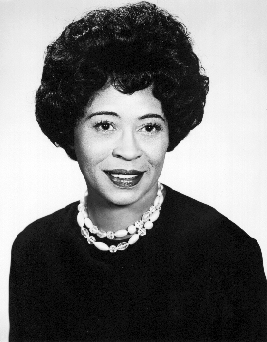
bates daisyDaisy Bates was an American civil rights activist, publisher, journalist, and lecturer who played a leading role in the Little Rock Integration Crisis of 1957. Daisy Bates would be 100 years old on November 11th. To mark the milestone the Clinton School of Public Service is hosting a celebration of Mrs. Bates featuring Ernest Green.

Daisy Lee Gatson Bates and her husband were important figures in the African American community in the capital city of Little Rock.  Realizing her intense involvement and dedication to education and school integration, Daisy was the chosen agent after nine black students were selected to attend and integrate a Little Rock High School.  Bates guided and advised the nine students, known as the Little Rock Nine, when they enrolled in 1957 at Little Rock Central High School. President Clinton presented the Little Rock Nine with the Congressional Gold Medal and spoke at the 40th anniversary of the desegregation while he was in office.  He returned as a speaker for the 50th anniversary and opening of the new museum and historical site in 2007.

Ernest ‘Ernie’ Green was one of the nine African-American students who integrated Central High School in Little Rock and the first of the nine to graduate.  Green is the managing director of public finance for Lehman Brothers in Washington, D.C., has served as the Assistant Secretary of Labor for Employment and Training during President Carter’s administration, Chairman of the African Development Foundation under President Clinton, and Secretary of Education, Richard W. Riley, appointed him Chairman of the Historically Black Colleges and Universities Capital Financing Advisory Board.

The event will take place at 6pm tonight at the Clinton School.

*Reserve your seats by emailing publicprograms@clintonschool.uasys.edu or calling 501-683-5239.

LR Cultural Touchstone: Kay Kelley Arnold

(Photo courtesy of Bill & Hillary Clinton National Airport)

(Photo courtesy of Bill & Hillary Clinton National Airport)

Little Rock’s rich cultural history has been influenced by many outstanding men and women.  This October, during Arts & Humanities Month 2014, the Culture Vulture is looking at 31 outstanding women who have shaped cultural life in Little Rock…and beyond.

Kay Kelley Arnold.  While attending law school, she worked at the Arkansas Arts Council.  As she relayed to Soiree, she helped artists who taught in schools. Through that job, she met many creative people “and developed a love of all types of artistic expression.”  During Bill Clinton’s first term in office as Governor, she was on his staff. In that capacity, she served as his liaison to what is now known as the Department of Arkansas Heritage.  When he left office in January 1981, so did she.

In 1986, Governor Clinton tapped Arnold to lead the Department of Arkansas Heritage.  In addition to supervising six cultural departments, she stepped into the job as plans were being made for Arkansas’ Sesquicentennial. She also oversaw those efforts which were heavily tilted toward artistic and historic events.

During the 1987 Arkansas General Assembly, Arnold led the successful effort for the legislators to approve a real estate transfer tax.  The legislation proved immensely beneficial to historic properties.  She entered the corporate world in 1988 joining Arkansas Power & Light. While serving in various capacities for AP&L and Entergy, Arnold split her time between Little Rock and Washington DC.  She maintained close ties to Little Rock’s cultural community including service on the Arkansas Symphony Orchestra Board.  She served as Chair of the ASO Board at a crucial time in the organization’s history.  In addition, she has served as a member of the Arkansas Natural Heritage Commission.

Arnold has recently completed two terms on the Little Rock Airport Commission.  During her time on that body, the airport purchased and installed several pieces of public art.

Now retired from Entergy, she is often seen around Little Rock enjoying cultural events.

Little Rock Look Back: 57 Years since 1957

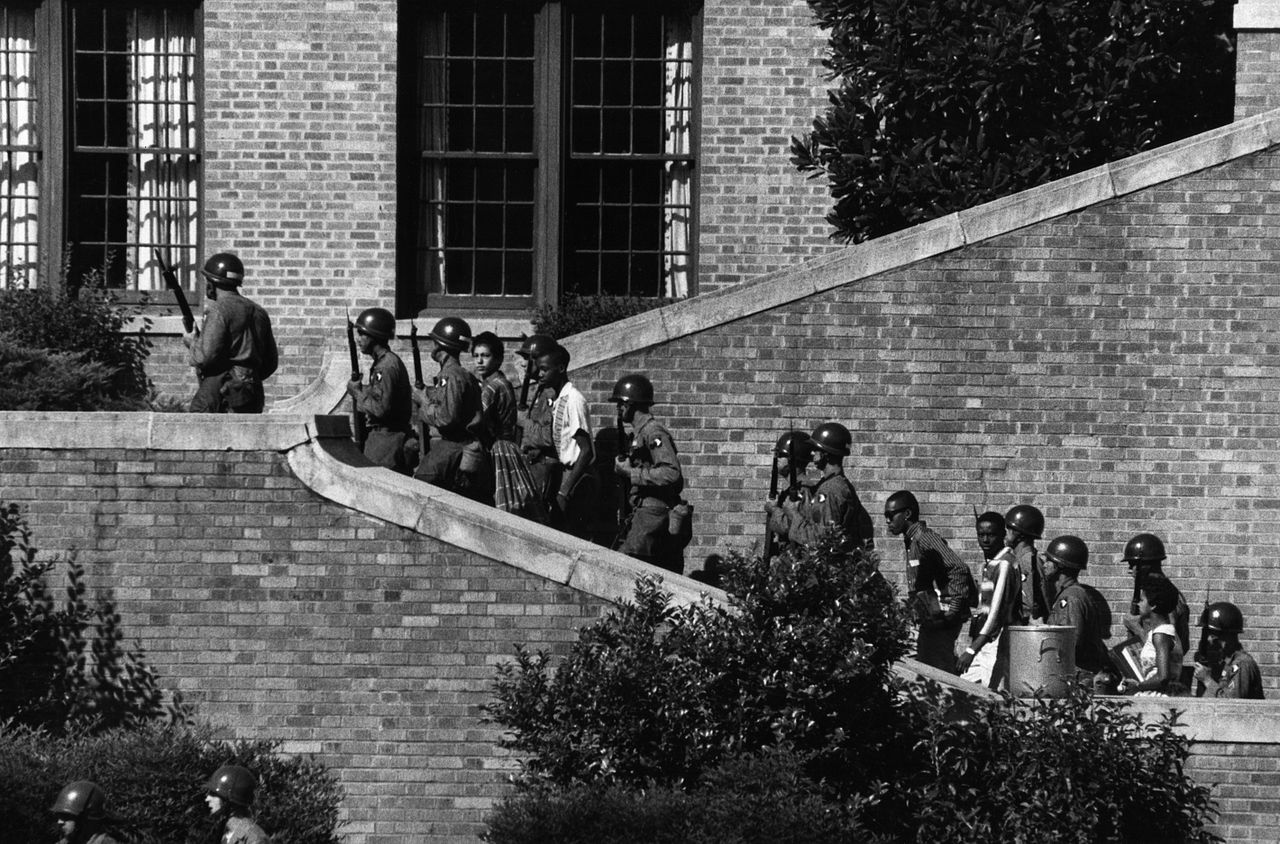
101st_Airborne_at_Little_Rock_Central_HighIt was 57 years ago today that the Little Rock Nine entered Central High School and stayed. On one hand, this brought to the end a nearly month long standoff between segregationists and those who wanted to obey the U.S. Supreme Court’s Brown v. Board decision.

In the bigger picture, the struggle did not end that day.  Throughout the remainder of the school year, the Little Rock Nine were subjected to threats, isolation and hostility.  Outside of the school, while the crowds may had dispersed after September 25, the raw feelings did not subside.

This was evidenced by the fact that the following year the high schools were closed to avoid having them integrated.

But September 25, 1957, was an historic day in the United States. Under guard of members of the 101st Airborne Division of the Army, the Little Rock Nine were escorted into Central High School. This action by President Dwight Eisenhower was the result of the intrusive efforts of Governor Orval Faubus who had used the Arkansas National Guard to keep the nine students out.

The City of Little Rock was largely a bystander in this issue. The form of government was changing from Mayor-Council to City Manager in November 1957. Therefore Mayor Woodrow Mann and the entire City Council were lame ducks. Mann, whose son was a senior at Central, tried to focus on keeping the peace in Little Rock. Most (if not all) of his Council members sided with the Governor.

Congressman Brooks Hays, a Little Rock resident, had tried to broker an agreement between the President and the Governor but was unsuccessful.  Following that, Mayor Mann was in discussions with the White House about the ability of the Little Rock Police Department to maintain order.  Finally, in the interest of public safety, the President federalized the National Guard and removed them. This paved the way for the Army to come in.

Though the school year was not easy, the nine youths who became known worldwide as the Little Rock Nine were finally in school.  They were Minnijean Brown, Elizabeth Eckford, Ernest Green, Thelma Mothershed, Melba Patillo, Gloria Ray, Terrence Roberts, Jefferson Thomas and Carlotta Walls.

In 1997, President Bill Clinton, Governor Mike Huckabee and Mayor Jim Dailey, famously held open the doors of Central High for the Little Rock Nine on the 40th anniversary.  Ten years later, Clinton, Huckabee and Dailey returned joined by current Governor Mike Beebe and Mayor Mark Stodola to host the 50th anniversary events.

Today the school is a National Historic Site, while still functioning as a high school.

Little Rock Look Back: Tom Prince – LR’s 67th Mayor

Mayor PrinceFuture Little Rock Mayor Tom Prince was born on August 13, 1949.  After graduating high school in 1967 (where he was on the state championship golf team), he attended the United States Naval Academy.  He later received his law degree from the University of Arkansas at Little Rock and began practicing law in Little Rock.

In 1984 he ran for the City of Little Rock Board of Directors and was elected.  In January 1985, he was selected by his fellow City Directors to serve as Mayor of Little Rock.  He served as Mayor until January 1987.  During his term in office, Arkansas celebrated its Sesquicentennial. Mayor Prince oversaw the City’s participation in the celebratory activities.  As Mayor he was also a strong advocate for expanding the city’s involvement in quality of life issues through enhanced parks and arts while maintaining a commitment to public safety and public works issues. After the completion of his four year term on the City Board, he did not seek a second term.

City of Little Rock races are non-partisan.  After leaving office, he became involved in Democratic Party politics.  In 1992, he campaigned for Bill Clinton’s presidential bid in Iowa and other Midwest states.  When his law partner, Sheffield Nelson, ran for Governor in 1994 as a Republican, Prince resigned from his Democratic Party positions and worked on the Nelson campaign.  In 1997, he was elected chair of the Pulaski County Republican Committee.  In 1998, he ran for the United States Senate as a Republican.

In 1999, Prince experienced a family tragedy and took a sabbatical from practicing law. In 2000, he moved to St. Louis to become general counsel for a securities firm located there.  Following several years with the securities firm, he joined a St. Louis law firm in private practice.  He remained in private practice in St. Louis through 2012.

A St. Louis Business Journal profile of Prince in 2010 highlighted his interests in single action shooting and in horseback riding.

Little Rock Look Back: Nixon Resigns

RMN WDM

Nixon with Mills

Forty years ago today, Richard M. Nixon resigned as the President of the United States.  Five months earlier, in a press conference in Little Rock, Congressman Wilbur Mills predicted that Nixon would resign.  Mills, still chair of the House Ways & Means Committee, predicted that the resignation might be prompted by errors in his tax returns.  As part of investigations into Nixon resulting from Watergate, the President’s taxes were being reviewed by Congress.

Nixon had been the first Republican President since the Reconstruction era to win Arkansas and gain the state’s electoral votes in 1972.  The 1968 election cycle had seen third-party candidate George Wallace win the state’s votes though Nixon handily won that election too.

Little Rock weighed prominently in Nixon’s earlier career.  He was Vice President when Eisenhower sent the troops into Little Rock to ensure the Little Rock Nine would desegregate Central High School.  In a 1960 Presidential debate, he and Senator Kennedy were asked whether they would have sent in the troops.  Kennedy begrudgingly said that he would have, though he would have wished the situation were different.  Nixon did not really answer the question, but instead used it as an opportunity to point out that Senator Johnson, as Kennedy’s running mate, had actively opposed civil rights legislation at the time.

There are many other connections between Nixon and Little Rock.  During his Presidency he both relied up and clashed with Arkansas’ legislative giants: Mills, Senator J. William Fulbright and Senator John L. McClellan.  Hillary Clinton served on the staff of the House Judiciary Committee as it investigated Nixon.  It would be during Bill Clinton’s presidency that Nixon died.

Little Rock Look Back: Buddy Benafield, LR’s 66th Mayor

BenafieldFuture Little Rock Mayor James Weldon “Buddy” Benafield was born on July 5, 1927 in Coy, Arkansas.  As a child he spent part of his time chopping cotton.  He graduated from England High School and then served in the U.S. Navy.  Following his stint in the military, he enrolled in Arkansas State Teachers College (now the University of Central Arkansas).

After college he returned to England.  From 1967 to 1974 he served as Mayor of England.  While in England, he also worked to establish a hospital there. While he was Mayor, Benafield also served as a legislative aide to Governor Dale Bumpers.

After moving to Little Rock, Benafield served as legislative aide to Governor Frank White.  He had been a donor to former Governor Bill Clinton, who had been defeated by White. Though a staunch Democrat, he remarked to the media at the time that he had been a friend of White’s and never declined a Governor’s request for help.

Long active in Democratic politics, he had served as Secretary of the State Democratic Party.  (One of his daughters, Dawne Benafield Vandiver has carried on the family tradition serving in several leadership positions in the State Democratic Party.  Most recently she was Executive Director of the party.)

In January 1982, Benafield was appointed to fill a vacancy on the Little Rock City Board of Directors. He ran for election to a full term in November 1982 and was reelected in November 1986.  From January 1983 to December 1984, Benafield served as Mayor of Little Rock.

After leaving the Little Rock City Board in January 1991, he has remained engaged in civic matters.  He served a term on the Arkansas Highway and Transportation Commission.  He was first appointed in January 1993 by Gov. Jim Guy Tucker to fill out the remainder of Rodney Slater’s term. Slater had resigned to to take a job in the Clinton Administration in Washington DC.  In 1995, he was reappointed, this time to a full ten year term.  This was only the second time a member of the Highway Commission had been reappointed.

He continues to be involved in farming and a variety of business ventures and has maintained his interest in politics.