Little Rock Look Back: William Ashley – LR’s 22nd & 24th Mayor

W E Ashley signature

On August 6, 1823, future Little Rock Mayor William Eliot Ashley was born in Little Rock.  He would go on to become the first Little Rock Mayor to be born in Little Rock.  Ashley was the son of Mary and Chester Ashley; his father would later serve as a U. S. Senator from Arkansas.  He was the second of the couple’s seven children.

Though he was raised in Little Rock, he did receive some schooling out of state. The State History Commission has correspondence between eleven year old William, studying in New York, and his father. Part of the letter is a request for money.

LR sealOn October 26, 1846, he married Frances Eliza Grafton at Christ Episcopal Church.  They were the first Little Rock residents to be married in that church.  The couple had five children, including triplets.  Only one of the children, Frances (who was one of the triplets) survived to adulthood.

Ashley was first elected Mayor of Little Rock in 1857. After completing a two year term, he was succeeded by Gordon N. Peay (another scion of a prominent Little Rock family).  In 1861, Ashley returned to the office of Mayor.  He was reelected to a third term in 1863.  In September 1863, following the defeat of Confederate troops by the Union forces at the Battle of Little Rock, the City of Little Rock ceased operations.  On September 21, 1863, Little Rock municipal government closed its doors, stopped collection of taxes and disbanded.  Thus Ashley’s third term ended.

In addition to his interest in local government, Ashley was a member of St. John’s College Board and a director of the newly-formed Little Rock Gas Company.

William Elliot Ashley died on August 16, 1868 at the age of 45.  He was buried in Mt. Holly Cemetery (which sat partially on land that had once belonged to his family). His parents, wife and children are all buried in Mt. Holly as well.

Interestingly, for someone who grew up in a prominent family, there does not appear to be a surviving likeness of Mayor Ashley – either in painting or photograph.  Several exist of his parents, but none of him.

Septaquintaquinquecentennial of Christ Church in Little Rock (that means 175 years)

christchurch_scaledThough there have been several churches and institutions in downtown Little Rock for over a century, Christ Episcopal Church has been at Scott and Capital Streets since 1840. That marks probably the longest continuous single use of one location in Little Rock’s history.

Today, the church marks its Septaquintaquinquecentennial.  The first church service was held on March 10, 1839, at Little Rock’s Presbyterian Church, which was then on what is now Second Street. The Rt. Rev. Leonidas Polk, missionary bishop of Arkansas, conducted the service.  After it was concluded, a group met in the home of Senator Chester Ashley and organized Christ Episcopal Church, named after Christ Church in Alexandria, Virginia, of which several of those present had been members.

Among the early members of the church were several future Little Rock Mayors including Lambert J. Reardon, John Wassell, Samuel Webb and Gordon Peay.  Nicholas Peay, Gordon’s father and a member of the church, served on the Little Rock City Council.  Future Little Rock Mayor William Ashley was the first Little Rock resident to be married at Christ Church.

The first sanctuary was constructed in 1840-1841 and was later destroyed by fire in 1873 (most likely due to a lightning strike).  After meeting in a variety of places, a chapel was constructed on the property and served as the church’s primary place of worship while the new sanctuary was being built.  It opened in 1887.  It was in the chapel that future General Douglas MacArthur was baptized as an infant while his family resided in Little Rock.

In 1928, a Parish Hall was built. This was one of the first church buildings in the South which featured a gym and other spaces available for use not just by church members but by the entire city.  It would later serve as the temporary sanctuary of Christ Church.  On October 1, 1938, the second sanctuary burned just as a renovation had been completed.  Though there was no official cause of the fire, it was most likely due to spontaneous combustion of construction materials.

The cornerstone for the third, and current, sanctuary was laid on October 1, 1940.  Construction was completed in 1941.  It was designed by Edwin Cromwell with the unofficial assistance of the then-Rector, Rev. Dr. William Postell Witsell. (Dr. Witsell appreciated architecture and the arts. He was very instrumental in the design of the stained glass windows which hang in the church today.  Charles Witsell, one of the founders of the Witsell, Evans, Rasco firm, is a grandson of Dr. Witsell.) In the 1980s, an addition was built along Scott Street to connect the sanctuary with the Parish Hall.

Along with the revitalization of downtown, Christ Church has been active in implementing innovative programming in a variety of areas including sustainability and the arts. The Rector, Rev. Scott Walters, and Associate Rector, Rev. Dr. Kate Alexander, often pepper their sermons with references to poetry, music (both sacred and secular), writers, artists and even comedians.

The Arts at Christ Church program has brought such varied artists as Mavis Staples, Baltimore Konsort and the Vienna Boys Choir to Little Rock. In 1990, Nichols & Simpson, a Little Rock based organ builder of international renown, constructed a new organ for the Christ Church sanctuary replacing a 1954 organ.  While used in worship, it is also used for a variety of organ recitals throughout the year.  Christ Church has been a sponsor of the Arkansas Literary Festival for the past several years and participates in the 2nd Friday Art Night with a rotating gallery of Arkansas artists. In addition, the Undercroft debuted in late 2013. This intimate music space is located underneath the sanctuary and offers a venue for acoustic music.

To mark the 175th anniversary, Rt. Rev. Larry R. Benfield, the thirteenth Bishop of the Diocese of Arkansas will be conducting an Evensong service this evening.  Prior to being named Bishop, he served as Rector of Christ Church.

Little Rock Look Back: Roswell Beebe

Mayor BeebeOn December 22, 1795, future Little Rock Mayor Roswell Beebe was born in Hinsdale, New York.  His family were wealthy English immigrants.  At seventeen, Beebe went to New Orleans and fought with Andrew Jackson in the 1815 Battle of New Orleans.  He stayed in the Crescent City for the next two decades building successful lumber and brick businesses.

Due to health concerns, he moved north to a drier climate in 1834.  After first stopping in Fulton, Arkansas, he settled in Little Rock in 1835 at the age of forty.  He stayed at the home of Chester Ashley and married Ashley’s sister-in-law, Clarissa Elliott.  He and Clarissa had two children, Roswell and Cora.

For nearly 30 years, Little Rock had a complicated history of deeds, titles and land ownership.  In 1839, Beebe went to Washington DC and received the original patent from President Martin Van Buren.  He then set about clearing up the land and title issues, as well as drawing up a plan for the city and laying off blocks and streets.  Beebe deeded the streets and alleys to the City for a dollar.  He also donated the land on Markham Street for a new State Capitol building (now home of the Old State House Museum).  Along with his brother-in-law Chester Ashley, he donated the land for the establishment of Mount Holly Cemetery.

In 1848, Beebe was elected to the Little Rock City Council.  The following year, he was elected Mayor.  He served as Mayor of Little Rock from April 1849 to February 1850.

While his primary business focus in the 1840s had been real estate, in the 1850s he focused on railroads.  Beebe was named president of the Cairo and Fulton Railroad Company in 1853.

While on a visit to New York, Beebe died on September 27, 1856.  His body was returned to Little Rock, and Roswell Beebe was buried at Mount Holly Cemetery.  The town of Beebe, Arkansas, is named in his honor.

Little Rock Look Back: Mayor William Ashley

W E Ashley signatureOn August 6, 1823, future Little Rock Mayor William Eliot Ashley was born in Little Rock.  He would go on to become the first Little Rock Mayor to be born in Little Rock.  Ashley was the son of Mary and Chester Ashley; his father would later serve as a U. S. Senator from Arkansas.  He was the second of the couple’s seven children.

Though he was raised in Little Rock, he did receive some schooling out of state. The State History Commission has correspondence between eleven year old William, studying in New York, and his father. Part of the letter is a request for money.

LR sealOn October 26, 1846, he married Frances Eliza Grafton at Christ Episcopal Church.  They were the first Little Rock residents to be married in that church.  The couple had five children, including triplets.  Only one of the children, Frances (who was one of the triplets) survived to adulthood.

Ashley was first elected Mayor of Little Rock in 1857. After completing a two year term, he was succeeded by Gordon N. Peay (another scion of a prominent Little Rock family).  In 1861, Ashley returned to the office of Mayor.  He was reelected to a third term in 1863.  In September 1863, following the defeat of Confederate troops by the Union forces at the Battle of Little Rock, the City of Little Rock ceased operations.  On September 21, 1863, Little Rock municipal government closed its doors, stopped collection of taxes and disbanded.  Thus Ashley’s third term ended.

In addition to his interest in local government, Ashley was a member of St. John’s College Board and a director of the newly-formed Little Rock Gas Company.

William Elliot Ashley died on August 16, 1868 at the age of 45.  He was buried in Mt. Holly Cemetery (which sat partially on land that had once belonged to his family). His parents, wife and children are all buried in Mt. Holly as well.

Interestingly, for someone who grew up in a prominent family, there does not appear to be a surviving likeness of Mayor Ashley – either in painting or photograph.  Several exist of his parents, but none of him.
Little Rock History: 180 years of Little Rock

Last week (November 2) marked the 1835 incorporation of Little Rock as a City.  However, today marks the 180th anniversary of Little Rock first being incorporated as a town by the Arkansas Territorial Legislature.

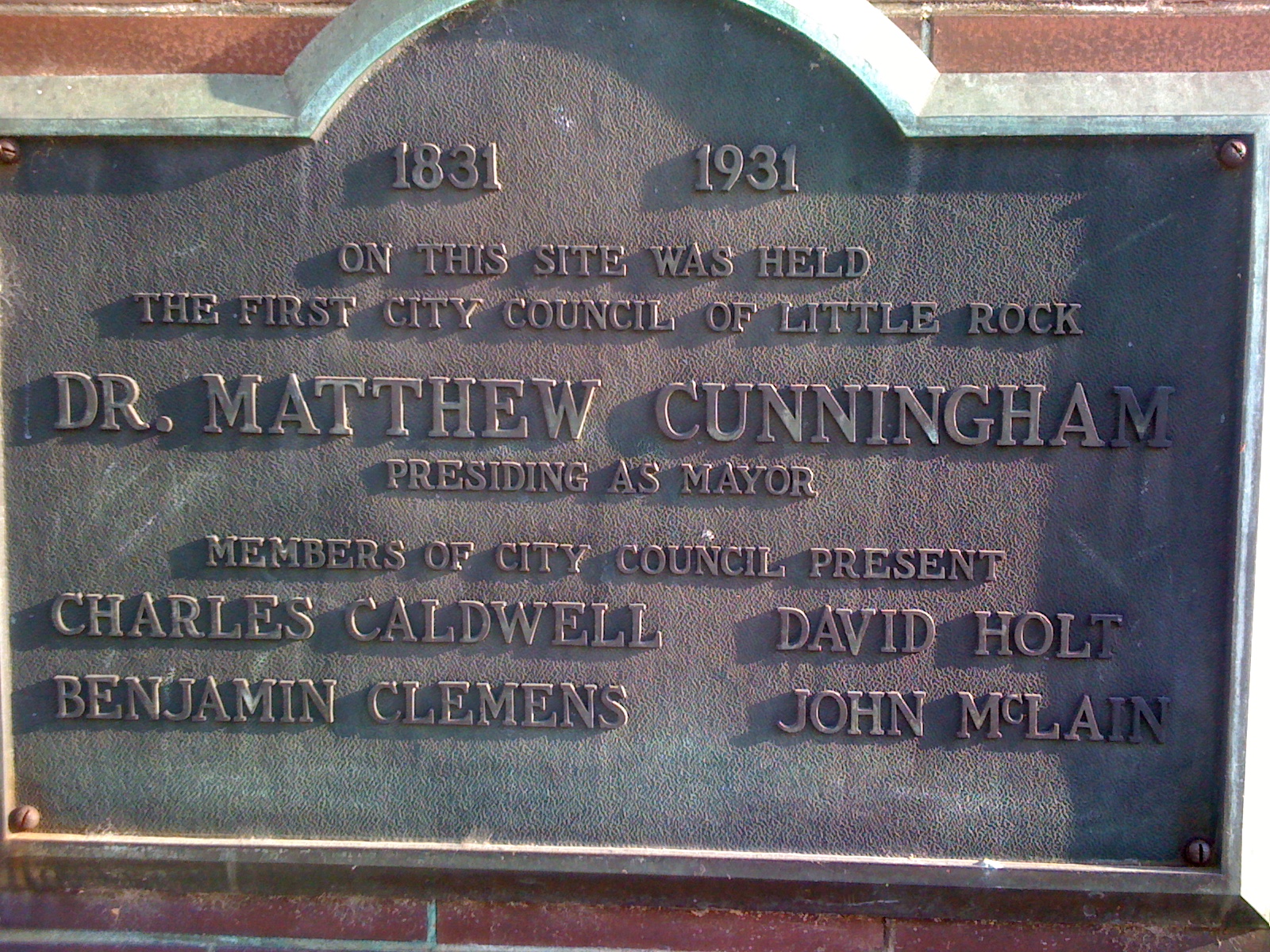
The first Mayor of the Town of Little Rock was Dr. Matthew Cunningham; he was elected January 2, 1832.  The first City Council meeting took place at his house.  In 1931, a plaque was installed at that site to mark the historic event. (Though it implies that the first city council meeting took place in 1831 not 1832.)

Bennett’s Military Supply is now located on the spot at what is now 3rd Street and Main Street.

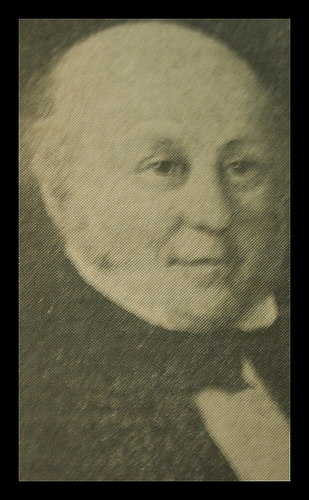
Mayor Cunningham, MD

Prior to serving as the first Mayor, Dr. Cunningham had already made quite a few other “firsts” in Little Rock.  He was the first physician to take up residence in the settlement known as Little Rock arriving in February 1820.  His wife, soon joined and became the first female resident of Little Rock.  She had children from her first marriage, but after arriving in Little Rock, she and Dr. Cunningham had their first child together — Chester Cunningham, who became the first baby born in Little Rock.

Dr. Cunningham, Mrs. Cunningham and Chester Cunningham are buried next to each other in Mount Holly Cemetery.  Interestingly, Dr. Cunningham was involved in a 30 year land ownership dispute with Chester Ashley and Roswell Beebe who also donated the property on which Mount Holly sits.

Graves of Matthew Cunningham, Eliza Cunningham and Chester Cunningham