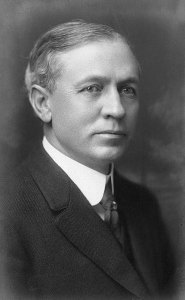
Taylor
Today is primary day in Arkansas. Though City of Little Rock municipal races are non-partisan and won’t be on the ballot until November, that has not always been the case.
Between 1874 and 1957, usually winning the Democratic Primary was tantamount to election. So the municipal general elections were usually boring. (The only exception would be the three elections in which Pratt Remmel was the GOP nominee for mayor facing off against the Democratic nominee.)
The real drama was in the primary races.
The 1911 primary pitted crusading businessman Charles Taylor against a firebrand attorney and Alderman John Tuohey, a grocer. Each of the three tried to position himself as an outsider, though Tuohey was least successful in accomplishing this considering he was an alderman and the candidate of choice of the retiring mayor.
Riffle logged insults at both Taylor and Tuohey. Taylor sought to position himself as not just the candidate of the businessmen. As a progressive, he borrowed Teddy Roosevelt’s Square Deal motto and offered “A Square Deal for Everyone.” A Baptist Sunday School superintendent, he also campaigned against vice. Tuohey offered his own solutions to city issues but was hampered in the campaign by illness.
After the January 12, 1911, primary election day, Tuohey had 1530 votes, Taylor had 1493 and Riffle had 506. Taylor alleged 323 illegal votes were cast and sought the poll tax records to try to prove it. After he saw the poll tax lists, he reduced his charges to 250 illegal votes.
On January 26, Tuohey and Taylor agreed to a new, two-man primary (essentially a run-off) in an attempt to resolve the matter. After that race, Taylor had 1874 votes and Tuohey had 1645. Taylor went on to be elected mayor in April 1911 and would subsequently serve four two-year terms.
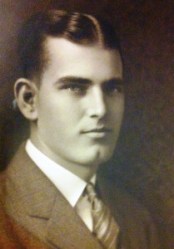
Robinson
When he took office in April 1929 having just turned 29 a few weeks earlier, Mayor Pat L. Robinson seemed to be a rising star in the Democratic Party. Within a few months, however, he found himself at odds with the Little Rock City Council on a variety of issues.
Some of these appear to have been of his own doing, partially due to youthful arrogance, and part of these were probably rooted in entrenched resistance to change. With the onset of the Great Depression six months into his term, the City’s already tight financial shape became even tighter. The aldermen and city clerk gave him no quarter (though some may have wanted to draw and quarter him).

Knowlton
In November 1930, City Clerk Horace Knowlton squared off against Mayor Robinson (no relation to Joe T.) in the Democratic primary. It was a particularly raucous primary with charges and counter-charges of corruption, malfeasance and misfeasance. In describing Mayor Robinson’s handling of the City finances, Mr. Knowlton declared the mayor had undertaken an “orgy of spending.”
The results after the election were Knowlton, 4,537; Robinson, 4,554; and 61 votes for a third candidate. Robinson was declared the nominee. But Knowlton protested and filed suit. There charges of illegal voting and persons whose ballots were not counted. After an exhaustive investigation (over 1,800 pages of testimony were taken), the court found that neither side had willingly engaged in voter fraud or vote tampering. The painstaking analysis further found that Knowlton had received ten more votes than Robinson.
In April 1931, Knowlton won the general election and was sworn in as Little Rock mayor. Robinson continued to pursue the case and appealed to the Arkansas Supreme Court. In June 1931 (in the third month of Knowlton’s mayoral term), the Arkansas Supreme Court upheld the circuit court ruling that Knowlton had indeed won the primary.

Sprick
A little more than a decade later, the state’s high court would again be called on to weigh in on Little Rock’s Democratic primary for mayor. In December 1944, Alderman Sam Wassell and former Alderman Dan Sprick faced off in a particularly nasty race. As World War II was drawing to a close, there were charges leveled which questioned patriotism. With both men having service on the Little Rock City Council, there were also plenty of past votes on both sides which could become fodder for campaigns.

Wassell
The election was on December 5, 1944. Sprick received 3,923 votes and Wassell 3,805. A few days later, Wassell filed suit claiming that there were people who voted who were not on the poll tax rolls and another group of voters who did not live in the ward in which they voted. Sprick countersued making the same charges against Wassell.
The case eventually ended up at the Arkansas Supreme Court, which remanded it back to the lower court. On March 26, 1945, Wassell dropped his case. This was only eight (8) days before the municipal general election.
Two years later, Wassell would challenge Sprick in the primary and be triumphant. Wassell would serve from 1947 until 1951. Sprick would later return to politics and serve a decade in the Arkansas State Senate.
There are many more interesting primary and election stories to tell. Stay tuned…

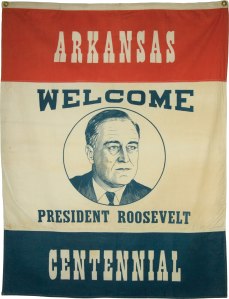 On June 10, 1936, President Franklin D. Roosevelt visited Little Rock as part of a day-long series of appearances in conjunction with the Arkansas Centennial celebration. (The actual statehood dates is June 15.)
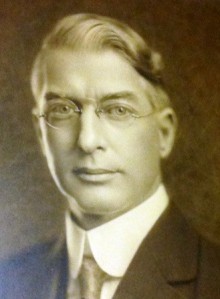 On June 8, 1873, future Little Rock Mayor Ben D. Brickhouse was born in Virginia. He moved to Texas as a child before his family settled in Arkansas.
 The 2018 season of Movies in the Park starts with WONDER WOMAN. The 2017 film starts tonight at sundown at the First Security Amphitheatre in Riverfront Park. Tonight’s sponsor is the Clinton School of Public Service.
 On June 1, 1939, the cornice was installed on Robinson Auditorium. This granite slab noted the name of the building as the Joseph Taylor Robinson Memorial Auditorium. (It is interesting to note that it used the more modern “u” instead of the classical “v” which was often used in buildings during prior decades – as evidenced by the Pvlaski Covnty Covrt Hovse across the street.)
 Today is Memorial Day – a time to pay tribute to the men and women in uniform who died in service to their country.
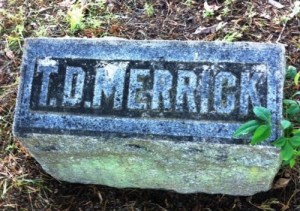 Thomas D. Merrick was born on 23 May, 1814, in Hampden County, Massachusetts. He later moved to Indianapolis IN and Louisville KY before ending up in Little Rock.
 Little Rock Culture Vulture