
Little Rock Look Back: First meeting of Little Rock Board of Trustees

On Monday, January 2, 1826, Little Rock voters elected their first Board of Trustees. This five member governing body was authorized by the Arkansas General Assembly in October 1825.  The five men getting the most votes were Bernard Smith, Isaac Watkins, James C. Collins, Ezra Owens and Sam C. Roane.

The evening of the election, the Board of Trustees held their first meeting.  They chose Mr. Smith (a former US Congressman from New Jersey) as the president.  To serve as the clerk, the men selected Jesse Brown, who was Little Rock’s first school teacher.

In June 1826, Robert Crittenden was appointed to fill out the remainder of Mr. Owens’ term.  The latter had resigned, though media accounts do not indicate why.

Mr. Smith, whose job was as secretary to the governor of Arkansas, would serve on the Board through 1828.  Mr. Watkins served until his murder in December 1827.  Mr. Collins served in 1826 and again in 1828.  Mr. Roane only served in 1826.  Mr. Crittenden served a full term in 1827 and then again in 1830 and 1831.

The Little Rock Board of Trustees was disbanded with the January 1832 election of Little Rock’s first mayor and aldermen.
Little Rock Look Back: Elections on New Year’s Day

M_Cunningham_fIn the first few decades of Little Rock, municipal elections usually took place on January 1.  While occasionally they would take place on another day, it was usually when January 1 fell on a Sunday.

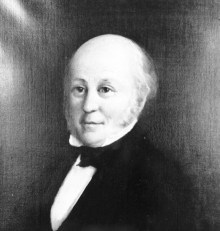
On January 1, 1832, Dr. Matthew Cunningham was elected as Little Rock’s first mayor.  He convened the first Town Council meeting at his house later in January.   (More on that meeting in another post later this month.)

By the 1850s and 1860s, elections were still in January but no longer took place on New Year’s Day.   Municipal elections moved to April with the adoption of the 1874 state constitution.  In the late 1940s, they moved to November to be in line with the federal and state general elections.

Little Rock Look Back: Frederick Kramer

Mayor KramerOn December 29, 1829, future Little Rock Mayor Frederick G. Kramer was born in Halle, Prussia.  In 1848, he immigrated to the United States.  Kramer enlisted in the United States Army and served in the Seventh Infantry until his discharge at Fort Gibson, Indian Territory, in July 1857. After his discharge, Kramer settled in Little Rock, and became a citizen in 1859. He married Adaline Margaret Reichardt, an emigrant from Germany, in 1857. They had six children Louisa, Mattie, Emma, Charles, Fred, and Henry.

From 1869 to 1894, Kramer served on the Little Rock School Board.  He was the first School Board president.  Among his other civic activities were serving as president of the Masonic Mutual Relief Association, a founder of the Mount Holly Cemetery Commission, and a founder of Temple B’nai Israel.  In 1875 he and F. A. Sarasin opened a mercantile business. Kramer later became the president of the Bank of Commerce.

Frederick Kramer was elected Mayor of Little Rock in November 1873.  He served until April 1875, when a new Arkansas Constitution took effect.

From November 1869 through March 1875, the City Council President presided over City Council meetings and signed ordinances, performing many of the duties formerly ascribed to the Mayor.  As such, during his Mayoral tenure from 1873 to 1875, Kramer was the Chief Executive of the City but did not preside over Council Meeting.  When he had served on the City Council, however, Kramer had been elected President of the Council and had presided over Council meetings from October 1871 to May 1872

Kramer was returned to the Mayoralty in April 1881 and served three more terms leaving office in April 1887.  His tenure as an Alderman and as Mayor overlapped with his service on the school board.

A new Little Rock elementary school which opened in 1895 on Sherman Street was named the Fred Kramer Elementary School in his honor.  Though the building’s bell tower was removed in the 1950s, the structure still stands today.  It now houses loft apartments.

Frederick G. Kramer died on September 8, 1896, in Colorado Springs, Colorado.  A few months earlier, he had traveled there with his wife and daughter Emma to recuperate from an illness. He is buried in Oakland Cemetery.

Little Rock Look Back: Robinson Auditorium groundbreaking 80 years ago today


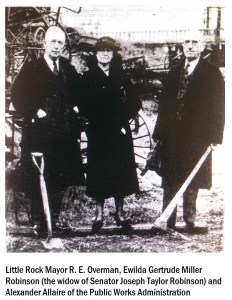
122437 GroundbreakOn December 24, 1937, at 11:30 a.m., Little Rock Mayor R. E. Overman, Ewilda Gertrude Miller Robinson (the widow of Senator Joseph Taylor Robinson) and  Alexander Allaire of the PWA turned dirt to participate in the brief groundbreaking ceremony for Little Rock’s municipal auditorium.  That morning, the Arkansas Gazette ran a brief story on the upcoming groundbreaking.  The story mentioned that the building would be named in memory of the late beloved Arkansas politician.  This appears to be the first public pronouncement of the Robinson name for this civic structure.

Among others in attendance at the groundbreaking were Mrs. Charles Miller (sister-in-law of Mrs. Robinson), Mr. and Mrs. Grady Miller (brother and sister-in-law of Mrs. Robinson), the mayor’s wife, the three architects (George Wittenberg, Lawson Delony and Eugene John Stern), and D. H. Daugherty and Will Terry of the City’s Board of Public Affairs.

Construction had to start by January 1, 1938, in order to receive PWA funds.  By breaking ground on December 24, there was over a week to spare.  The site had been selected in late October 1937, and the purchase had not been finalized.  But the PWA did give permission for the City to let a contract for excavation, demolition and filling on the site.

The groundbreaking took place at the corner of Garland and Spring Streets which was on the northeast corner of the block set aside for the auditorium.  Today, Spring Street does not extend north of Markham; the street was closed to make way for the parking structure and what is now the Doubletree Hotel.  Garland Street is basically an alley that runs parallel to Markham north of City Hall, Robinson Auditorium and the Doubletree Hotel.

Little Rock Look Back: On Dec 4, 1939, a dozen LR aldermen held in contempt of court

The Pulaski County Courthouse where the 12 Little Rock aldermen were arraigned.

On Monday, December 4, 1939, a dozen of Little Rock’s aldermen reported to the county jail to serve sentences for contempt of court.  The previous Monday, the twelve council members had voted against an ordinance which had been ordered by the judge in an improvement district matter.  The remaining aldermen (there were 18 total aldermen at the time) had either voted in the affirmative or had been absent.  Because the twelve had refused to change their votes since that meeting, the judge ordered them jailed.

At the hearing, the judge brought each alderman up one by one. This seemed to be in order to further embarrass the aldermen.  The judge also interviewed Mayor J. V. Satterfield and City Clerk H. C. “Sport” Graham to put on the record that they had counseled the aldermen to obey the judge’s order.

Carolyn Conner, the only female alderman, was not jailed but was fined $50. The eleven men were held at the jail, though not in cells.  Newspaper photos showed the men playing cards in a conference room.  In order to get out of jail, the judge gave the aldermen the chance to change their votes.

Mayor J. V. Satterfield pleaded with the judge to let the aldermen leave the jail to attend the meeting at City Hall, which was nearby.  He requested that the city be allowed to maintain “what little dignity remained” by not having the meeting at the jail.  The judge relented, and the aldermen were escorted by deputies to the council chambers.

After the aldermen changed their votes, the judge suspended the remainder of their sentences.  The sentences were not vacated, they were only suspended.  The judge admonished them that should they attempt to reverse their reversal, he would throw them back in jail.

Happy 186 to Little Rock!

With the stroke of Territorial Governor John Pope’s pen, Little Rock was officially chartered as a town on November 7, 1831. This followed approval by the Arkansas legislature a few days earlier.

As a chartered, officially recognized municipality, the Town of Little Rock was authorized to create a government and to plan for a Mayor and Aldermen to be elected. That election would take place in January 1832 with the initial council meeting later that month.

There are several earlier and later days which could be used to mark Little Rock’s official birth (La Harpe sighting in 1722, first settler in 1812, permanent settlement in 1820, selection of trustees in 1825, chartered as a City in 1835, chartered as a City of First Class in 1875) — but it is November 7, 1831, which has been the officially recognized and accepted date.

In 1931, Little Rock celebrated her centennial with a series of events.  Likewise, in November 1981, Little Rock Mayor Charles Bussey signed and City Clerk Jane Czech attested Resolution 6,687 which recognized the Little Rock sesquicentennial.

Little Rock Look Back: Bill Clinton announces LR as site for his library

Refuse on the site where the Clinton Center would be built

On November 7, 1997, President Bill Clinton announced his intentions to locate his presidential library in Little Rock at the end of a warehouse district.

The Little Rock City Board met in a special meeting that day to rename part of Markham Street, which would lead to the site, as President Clinton Avenue.

While the announcement was met with excitement in many quarters, there were still some skeptics who had a hard time envisioning a presidential library and park in the middle of a wasteland worthy of a T. S. Eliot poem.

There would be many hurdles between the November 1997 announcement to the December 2001 groundbreaking. But for the moment, City of Little Rock leaders, celebrated the achievement.  Then Mayor Jim Dailey had appointed City Director Dean Kumpuris and City employee Bruce T. Moore to lead the City’s efforts.  Moore and Kumpuris worked with Skip Rutherford and others to narrow the potential sites.

In September 1997, the Clintons were in town for the 40th anniversary of the integration of Central High School.  They surprised Kumpuris and Moore with a decision for a Sunday afternoon visit to the warehouse district proposed site. Secret Service would not let the limousine drive in part of the property, so the Clintons, Moore, Kumpuris, and Rutherford walked up a path to the roof of the abandoned Arkansas Book Depository.  It was there that the Clintons could see the Little Rock skyline which would be visible from the library.

Of course by the time the library had opened in November 2004, the Little Rock skyline was different. Spurred on by the library, several new highrises had been constructed in downtown.