Little Rock Look Back: Mayor J.G. Botsford

Botsford GraveOn December 30, 1838, future Little Rock Mayor Jefferson George Botsford was born in Port Huron, Michigan.  He married Charlotte Adelia Henry on June 13, 1867.  She had been born in Massachusetts, but moved to Little Rock with her parents and grandparents.

The couple had seven children: Nellie, Charlotte, Harriett, James, Edward, George and Charles. Nellie, James and Charles died in childhood.

Botsford had served in the Union Army and fought in frontier battles against Indians.  Among his commercial involvements in Little Rock were serving as mail contractor between Little Rock and Baton Rouge, proprietor of Anthony House, organizer of Merchants National Bank and president of the White River Valley & Texas Railroad.

In 1868, Botsford was elected to the Little Rock City Council.  The City Council suspended Mayor A. K. Hartman in February 1870.  Elected in 1869, he was disliked by the aldermen, the press and a portion of the public.  A court order overturned the suspension in June 1870.  In January 1871, Mayor Hartman was again suspended by the Council.  This time, Botsford was declared Mayor.  However Hartman also still claimed the title of Mayor through the remainder of his term in November 1871.

After stepping down as Mayor with the election of Robert Catterson in November 1871, Botsford returned to private life.  He died on October 29, 1915 and is buried at Mount Holly Cemetery.

Little Rock Look Back: Mayor Frederick Kramer

Mayor KramerOn December 29, 1829, future Little Rock Mayor Frederick G. Kramer was born in Halle, Prussia.  In 1848, he immigrated to the United States.  Kramer enlisted in the United States Army and served in the Seventh Infantry until his discharge at Fort Gibson, Indian Territory, in July 1857. After his discharge, Kramer settled in Little Rock, and became a citizen in 1859. He married Adaline Margaret Reichardt, an emigrant from Germany, in 1857. They had six children Louisa, Mattie, Emma, Charles, Fred, and Henry.

From 1869 to 1894, Kramer served on the Little Rock School Board.  He was the first School Board president.  Among his other civic activities were serving as president of the Masonic Mutual Relief Association, a founder of the Mount Holly Cemetery Commission, and a founder of Temple B’nai Israel.  In 1875 he and F. A. Sarasin opened a mercantile business. Kramer later became the president of the Bank of Commerce.

Frederick Kramer was elected Mayor of Little Rock in November 1873.  He served until April 1875, when a new Arkansas Constitution took effect.

From November 1869 through March 1875, the City Council President presided over City Council meetings and signed ordinances, performing many of the duties formerly ascribed to the Mayor.  As such, during his Mayoral tenure from 1873 to 1875, Kramer was the Chief Executive of the City but did not preside over Council Meeting.  When he had served on the City Council, however, Kramer had been elected President of the Council and had presided over Council meetings from October 1871 to May 1872

Kramer was returned to the Mayoralty in April 1881 and served three more terms leaving office in April 1887.  His tenure as an Alderman and as Mayor overlapped with his service on the school board.

A new Little Rock elementary school which opened in 1895 on Sherman Street was named the Fred Kramer Elementary School in his honor.  Though the building’s bell tower was removed in the 1950s, the structure still stands today.  It now houses loft apartments.

Frederick G. Kramer died on September 8, 1896, in Colorado Springs, Colorado.  A few months earlier, he had traveled there with his wife and daughter Emma to recuperate from an illness. He is buried in Oakland Cemetery.

15 Highlights of 2015 – Robinson Center Renovation Tops Out

LRCV 1The Little Rock Convention & Visitors Bureau (LRCVB), members of the Little Rock Advertising and Promotion Commission (LRA&P), local officials, and members of the design and construction teams hosted a topping out ceremony July 1, 2015 at 10:00 AM for the Robinson Center’s new conference facility, signifying a one–‐year milestone in the 28–‐month, $70 million renovation and expansion project.

Following a press conference and ceremonial beam signing held on the western side of the Robinson Center, local media and special guests were given tours of the magnificent ballroom platform and conference center located on Robinson’s north side. This new addition not only provides some of the most dramatic enhancements of the project, but will also provide groups with spectacular views of the Arkansas River and the city’s illuminated bridges.

Along with additional meeting and pre–‐function space situated above its ballroom, the new conference center will also provide a new connection to the DoubleTree Hotel, with an adjoining lobby and additional pre–‐function space.

Robinson Center will reopen in November 2016.  The Arkansas Symphony Orchestra will return its Masterworks and Pops series to Robinson. Ballet Arkansas will perform The Nutcracker there in December 2016.  Celebrity Attractions will bring Broadway back to Robinson (on Broadway, no less) next season as well.  They have already announced The Phantom of the Opera for March 2017.

LRCV 5For more information on the Robinson Center Second Act renovation and expansion project, visit http://www.RobinsonCenterSecondAct.com.

Robinson Construction Facts to Date:

  • Nearly 10,000 tons of material have been recycled, representing 91% of the waste material diverted 1,216 tons of steel has been erected
  • 2,300 cubic yards of concrete has been placed
  • 470 individuals have gone through CDI/Hunt Safety Orientation
  • 73% of the project subcontractors are local

Little Rock Look Back: Groundbreaking for Robinson Auditorium

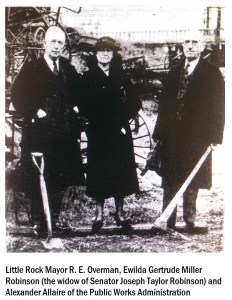
122437 GroundbreakOn December 24, 1937, at 11:30 a.m., Little Rock Mayor R. E. Overman, Ewilda Gertrude Miller Robinson (the widow of Senator Joseph Taylor Robinson) and  Alexander Allaire of the PWA turned dirt to participate in the brief groundbreaking ceremony for Little Rock’s municipal auditorium.  That morning, the Arkansas Gazette ran a brief story on the upcoming groundbreaking.  The story mentioned that the building would be named in memory of the late beloved Arkansas politician.  This appears to be the first public pronouncement of the Robinson name for this civic structure.

Among others in attendance at the groundbreaking were Mrs. Charles Miller (sister-in-law of Mrs. Robinson), Mr. and Mrs. Grady Miller (brother and sister-in-law of Mrs. Robinson), the mayor’s wife, the three architects (George Wittenberg, Lawson Delony and Eugene John Stern), and D. H. Daugherty and Will Terry of the City’s Board of Public Affairs.

Construction had to start by January 1, 1938, in order to receive PWA funds.  By breaking ground on December 24, there was over a week to spare.  The site had been selected in late October 1937, and the purchase had not been finalized.  But the PWA did give permission for the City to let a contract for excavation, demolition and filling on the site.

The groundbreaking took place at the corner of Garland and Spring Streets which was on the northeast corner of the block set aside for the auditorium.  Today, Spring Street does not extend north of Markham; the street was closed to make way for the parking structure and what is now the Doubletree Hotel.  Garland Street is basically an alley that runs parallel to Markham north of City Hall, Robinson Auditorium and the Doubletree Hotel.

Little Rock Look Back: LR Mayor Roswell Beebe

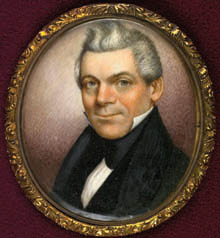
Mayor BeebeOn December 22, 1795, future Little Rock Mayor Roswell Beebe was born in Hinsdale, New York.  His family were wealthy English immigrants.  At seventeen, Beebe went to New Orleans and fought with Andrew Jackson in the 1815 Battle of New Orleans.  He stayed in the Crescent City for the next two decades building successful lumber and brick businesses.

Due to health concerns, he moved north to a drier climate in 1834.  After first stopping in Fulton, Arkansas, he settled in Little Rock in 1835 at the age of forty.  He stayed at the home of Chester Ashley and married Ashley’s sister-in-law, Clarissa Elliott.  He and Clarissa had two children, Roswell and Cora.

For nearly 30 years, Little Rock had a complicated history of deeds, titles and land ownership.  In 1839, Beebe went to Washington DC and received the original patent from President Martin Van Buren.  He then set about clearing up the land and title issues, as well as drawing up a plan for the city and laying off blocks and streets.  Beebe deeded the streets and alleys to the City for a dollar.  He also donated the land on Markham Street for a new State Capitol building (now home of the Old State House Museum).  Along with his brother-in-law Chester Ashley, he donated the land for the establishment of Mount Holly Cemetery.

In 1848, Beebe was elected to the Little Rock City Council.  The following year, he was elected Mayor.  He served as Mayor of Little Rock from April 1849 to February 1850.

While his primary business focus in the 1840s had been real estate, in the 1850s he focused on railroads.  Beebe was named president of the Cairo and Fulton Railroad Company in 1853.

While on a visit to New York, Beebe died on September 27, 1856.  His body was returned to Little Rock, and Roswell Beebe was buried at Mount Holly Cemetery.  The town of Beebe, Arkansas, is named in his honor.
Little Rock Look Back: LR Mayor Charles Bussey

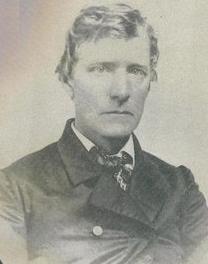
Mayor Bussey BWFuture Little Rock Mayor Charles Bussey was born on December 18 in 1918.  Throughout his life he was a trailblazer.  He was the first African American Sheriff’s Deputy in Pulaski County and expanded the Junior Deputy program into the African American community.

In 1968 he became the first African American elected to the Little Rock City Board of Directors. He was not the first African American to run for the City Board, but he was the first to win a race.  Mr. Bussey sought support not just from the African American community, but from all sectors of Little Rock.  Apparently, while campaigning in 1968, he deliberately went into the Arkansas headquarters of segregationist presidential candidate George Wallace to see about leaving campaign literature.  A hulking man with a broad smile, he shocked the young receptionist. He was undoubtedly the first (and probably last) African American to enter that campaign headquarters.

He served from 1969-1977 and again from 1979 through 1991.  In 1981 he was selected by his fellow City Directors to serve as Little Rock’s Mayor, which made him the first African American Mayor of Little Rock.  He served as Vice Mayor of Little Rock for a total of 8.5 years which is the longest of anyone in the City’s history.

Throughout his lifetime Mayor Bussey championed youth outreach efforts.  He also was active in the Arkansas Municipal League, National League of Cities, West Little Rock Rotary Club, Elks, Shriners and many other organizations.

In 2006 he was posthumously inducted into the Arkansas Black Hall of Fame.  The previous year, 20th Street in Little Rock was renamed in his honor. In 2015 he was included in the Arkansas Civil Rights Heritage Trail.

Little Rock Look Back: Mayor Gordon N. Peay

Mayor PeayOn December 12, 1819, future Little Rock Mayor Gordon Neill Peay was born.  The Peay family arrived in Arkansas from Kentucky in 1825.  They quickly became one of Little Rock’s leading families.  Mayor Peay’s father, Nicholas Peay served on the Little Rock Board of Trustees (which existed before the town was incorporated) and later served on the City Council and was acting mayor.

Godon N. Peay served as mayor of Little Rock from 1859 to 1860.  During the Civil War, Peay served as Captain and later Colonel of the Capital Guard.  He later received a pardon from the federal government.

The Peay family owned the Peay Hotel, Little Rock’s first hotel, and were also co-founders of what became Worthen Bank.  They were also a founding family of Christ Episcopal Church. Mayor Peay later served as Pulaski County Chancery Clerk.

He died on December 14, 1876, and is buried at Mount Holly Cemetery along with many members of his family.  A nephew of his, Ashley Peay, served on the City Council in the 1920s.  Mayor Peay’s great-grandson Joseph Barber Hurst, Sr. served on the Little Rock City Board of Directors from 1967-1971. One of Mr. Hurst’s sons, Howard, was born on Mayor Peay’s birthday.