
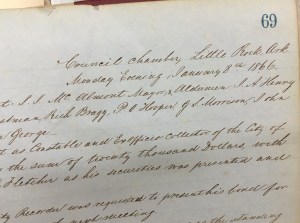
 One hundred and fifty four years ago today (on January 8, 1866), Little Rock City Hall resumed functioning after the Civil War. The City government had disbanded in September 1863 after the Battle of Little Rock. From September 1863 through the end of the war (on on through part of Reconstruction), Little Rock was under control of Union forces.
Following the April 1865 conclusion of the Civil War, plans were made to restart local government in Little Rock. Even though Arkansas would not have Congressional representation in Washington until June 1868 (becoming the second Confederate state after Tennessee), the establishment of local government took place in January 1866. (It was supposed to have started earlier, but the local elections set for November 1865 were cancelled on the day they were originally set to take place.)
The first City Council meeting took place on Monday, January 8, 1866. The council met again on Tuesday, January 9 and Monday, January 15 as they were trying to establish committees and rules for the new government.
The first post-Civil War mayor was Dr. J. J. McAlmont, who was a physician and pharmacist. Following his service as the city’s chief executive, he would later be a co-founder of what is now UAMS. The initial aldermen were I.A. Henry (who had been on the City Council when it ceased in 1863), Henry Ashley, M. H. Eastman, Rick Bragg, Dr. P. O. Hooper, G. S. Morrison, John Collins and Alexander George.
Their first action was to approve the bond of Thomas C. Scott as Constable and City Collector. Vouching for him were S. H. Tucker and future LR mayor John Gould Fletcher. The Recorder was asked to present his bond and the next meeting.
The Mayor then established several committees of the City Council and named his appointments. Among the committees were Finances, Streets, Ordinances, Mount Holly Cemetery, Fire Department and Police.
That meeting and the following two meetings, the City continued to approve motions, resolutions and ordinances to set up the duties and responsibilities of a government.
Ordinance Number 1 established the rates of Licenses for 1866. Among those were:
- $100 for the privilege of selling goods at auction
- $20 for a one-horse wagon, paid quarterly
- $35 for a two-horse wagon, paid quarterly
- $50 for a four-horse wagon, paid quarterly
- $25 to run a cab or bus (which would have been in some horse drawn conveyance), paid quarterly
- $40 a month to sell liquor, wine, ale, beer, etc., by the glass or bottle to be consumed in a store, tavern, shop or store
- $25 each quarter for each billiard table
- $50 each quarter for each ten pin alley
 100 Years Ago
 The Democrat (an afternoon paper) ran an article stating that New Year’s celebrations in DC were somewhat muted, perhaps because of concerns about the health of President Wilson, who had suffered a stroke in October 1919. There was also an article about planning being underway for the 300th anniversary of the Mayflower with events set for England, Holland, and the US.
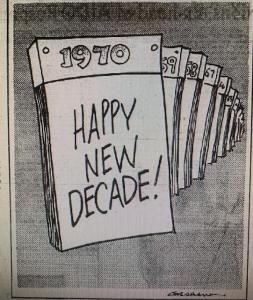 As 1970 dawned, the Gazette and Democrat both carried stories about Vietnam and the Department of Justice seeking a delay in implementation of school desegregation. Locally, it was announced that KATV was purchasing the old Worthen Bank Building at Main and Fourth Streets. The Hogs were getting ready to face Ole Miss in the Sugar Bowl (which the Razorbacks would lose by a score of 27 to 22 to the Archie Manning led Rebels).
 Teamsters Union president Jimmy Hoffa, in the middle of an eight year prison term, had indicated he would share information with authorities in return for President Nixon commuting his sentence. In local crime news, City Hall and the municipal garage behind the building had been broken into. While there had been a failed attempt to pry open the Collector’s office, thieves had apparently only been able to get a small amount of cash by breaking a vending machine in the building.
 Future Little Rock Mayor John Josephus McAlmont was born on this date in 1821 in New York state. (Various reports give his birth date as December 22 — but the family reports December 19 as the date.)
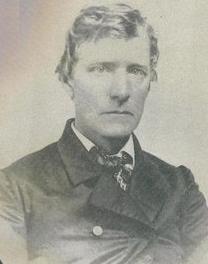 On December 12, 1819, future Little Rock Mayor Gordon Neill Peay was born. The Peay family arrived in Arkansas from Kentucky in 1825. They quickly became one of Little Rock’s leading families.
 On November 23, 1808, future Mayor Charles P. Bertrand was born in New York. He was the son of Pierre and Eliza Wilson Bertrand; his father died in 1809 in an uprising in Haiti and his mother eventually remarried. With her new husband, Dr. Matthew Cunningham, she and the family moved to Little Rock in 1820.
 The Civil War came to an end for Little Rock 156 years ago today (September 10) as Federal troops took control of the city. Unlike some other Southern capitols, there was no long siege or bloody battle.
 On August 6, 1823, future Little Rock Mayor William Eliot Ashley was born in Little Rock. He would go on to become the first Little Rock Mayor to be born in Little Rock. Ashley was the son of Mary and Chester Ashley; his father would later serve as a U. S. Senator from Arkansas. He was the second of the couple’s seven children.
 Little Rock Culture Vulture