2015 In Memoriam – Kula Kumpuris

1515 Kumpuris

In these final days of 2015, we pause to look back at 15 who influenced Little Rock’s cultural scene who left us in 2015.

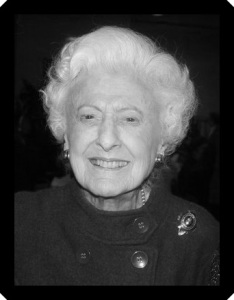
Kula Kumpuris owned every room she entered.  Whether she was holding court at Satellite Café or at the Capital Hotel, her sparkling eyes, generous smile and warm spirit entranced everyone.

She was devoted to her family and friends, always wanting to know the latest achievements or funny stories. Her zest for knowledge also extended to learning from books and keeping up with current events.

Born in Pine Bluff, she retained her girlhood friends throughout her life. She never shed friends, she only added to them through the various stages of life.

In 2006, her sons and daughter and their families established the Frank and Kula Kumpuris Distinguished Lecture Series at the Clinton School of Public Service in honor of Kula and her late husband.  In announcing the gift, son Dean Kumpuris noted that his parents, always believed “that through understanding, teaching and discussion, the world could be a better place, and they taught us that giving back to the community and the world is important and worthwhile. So, we decided that in keeping with our parents’ teachings, the Clinton School of Public Service was a perfect place to give back.”

For many years, Kula would be on the front row at the lecture series with an open mind awaiting the information from the speaker, and an engaging smile.

She was also a fixture at the annual Sculpture at the River Market show and sale. She charmed artists and arts patrons alike. Even as she found it harder to get around in later years, she was still a regular presence at the Arkansas Symphony Orchestra, usually with her friend Jeane Hamilton.

A longtime and active member of the Little Rock Garden Club, Kula Kumpuris cultivated friendships with people from all walks of life as easily as she cultivated plants and flowers.

Little Rock Look Back: Clinton Library Groundbreaking

bill groundbreak14 years ago today the groundbreaking for the Clinton Library took place on December 5, 2001. It was dry and about thirty degrees warmer than the actual opening would be in November 2004.

The former president was joined by then-Mayor Jim Dailey, City Director Dean Kumpuris, then-Assistant City Manager Bruce Moore, contractor Bill Clark, then-Clinton Foundation executives Skip Rutherford & Stephanie Streett, and other dignitaries in turning the dirt. The location for the ceremony is now actually the parking lot for Sturgis Hall – the home of the Clinton School of Public Service and Clinton Foundation offices.

President Clinton was the only member of his family to attend the ceremony, which drew over 400 people. His wife, then the junior Senator from New York, was expecting some important floor votes in Washington DC, and daughter Chelsea was studying in England.

At the ceremony, Clinton joked “We’re going to try to build it in less than it took to build the medieval cathedrals and the Egyptian pyramids, but if I can’t rein in my team it may cost as much!” Of course by then the date was set for November 2004. Coordinating schedules of the current and former Presidents is an intricate act.

Dr. Dean Kumpuris to be honored by Arkansas Arts Council

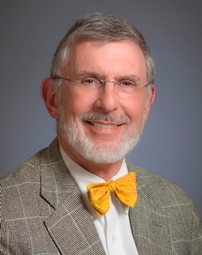
Dean Kumpuris 2014Dean Kumpuris will receive the Governor’s Arts Award for Arts Community Development in early 2016.  The Arkansas Arts Council announced today the recipients for next year’s awards.

Kumpuris is being honored for his three decades of work to improve the cultural and civic life of Little Rock. In particular, he has focused much of his work on the revitalization of downtown, the development of the River Market, and expansion of Riverfront Park.

Through his vision and efforts to place public art downtown, in less than 10 years, nearly 100 sculptures have been installed in the Vogel Schwartz Sculpture Garden, as well as in parks along the Arkansas River and throughout Little Rock. He created the annual fundraiser, Sculpture at the River Market Show and Sale, which attracts thousands of visitors to Little Rock each year and features hundreds of sculptures from internationally recognized artists.

He is a gastroenterologist and has served on the Little Rock City Board of Directors since 1995.  He is also the Chairman of the UALR Board of Visitors and a past member of the Advertising and Promotion Commission.

Little Rock Look Back: Clinton Center Opened 11 Years Ago Today

SkipMany remember November 18, 2004, for the rain and cold wind which greeted visitors to the opening of the William Jefferson Clinton Presidential Center and Park.  In the years which lead up to that day, November 18, 2004, was known simply as “Game Day” for a group of people.  The chief one was Skip Rutherford.

Overseeing the planning for the Clinton Presidential Center and the events surrounding it had been the focus of James L. “Skip” Rutherford for many years. A FOB for decades, he had stayed in Little Rock when so many went to Washington DC in 1993.

He oversaw the planning for the Clinton Library and led the Clinton Foundation.  No detail was too small or insignificant for him to consider. For months leading to the opening he led meetings to help restaurants, hotels, and attractions understand the scope of the opening.

Together with Dean Kumpuris and Bruce Moore on behalf of the City of Little Rock and Stephanie Streett of the Clinton Foundation, he reviewed plans for the Clinton Presidential Park and the streets and neighborhoods around the Clinton Presidential Center.

He used his connections with the business community in Little Rock and throughout the state to discuss the importance of a Presidential Library regardless of one’s personal political affiliations.  He withstood critics who second-guessed everything from the cost, the design, the location, the purpose, and even the anticipated tourism and economic impacts.

Finally the big day had come.  If the weather was not ideal, that was almost inconsequential. It was still the culmination of more than seven years hard work.

However, the opening of the Clinton Presidential Center was not the end of the task. It merely was the move from one phase to another. A few years later, Skip’s role would change as he would leave the Foundation and become the second Dean of the Clinton School of Public Service.

Little Rock Look Back: LR chosen for Clinton Library

ClintonCenterConstruction-48

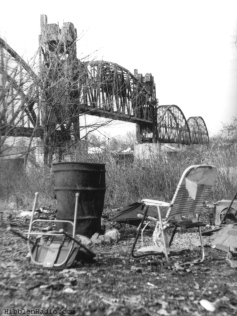
Refuse littered the future site of the Clinton Presidential Center

On November 7, 1997, President Bill Clinton announced his intentions to locate his presidential library in Little Rock at the end of a warehouse district.

The Little Rock City Board met in a special meeting that day to rename part of Markham Street, which would lead to the site, as President Clinton Avenue.

While the announcement was met with excitement in many quarters, there were still some skeptics who had a hard time envisioning a presidential library and park in the middle of a wasteland worthy of a T. S. Eliot poem.

There would be many hurdles between the November 1997 announcement to the December 2001 groundbreaking. But for the moment, City of Little Rock leaders, celebrated the achievement.  Then Mayor Jim Dailey had appointed City Director Dean Kumpuris and City employee Bruce T. Moore to lead the City’s efforts.  Moore and Kumpuris worked with Skip Rutherford and others to narrow the potential sites.

In September 1997, the Clintons were in town for the 40th anniversary of the integration of Central High School.  They surprised Kumpuris and Moore with a decision for a Sunday afternoon visit to the warehouse district proposed site. Secret Service would not let the limousine drive in part of the property, so the Clintons, Moore, Kumpuris, and Rutherford walked up a path to the roof of the abandoned Arkansas Book Depository.  It was there that the Clintons could see the Little Rock skyline which would be visible from the library.

Of course by the time the library had opened in November 2004, the Little Rock skyline was different. Spurred on by the library, several new highrises had been constructed in downtown.

Arts & culture advocate, Dr. Joel Anderson to retire as UALR Chancellor

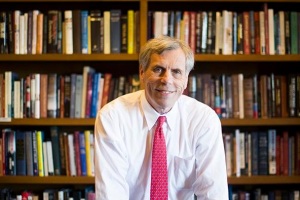
jeasmile-444x668University of Arkansas at Little Rock Chancellor Joel E. Anderson announced today that he will retire following a 13-year tenure as chancellor and a 45-year career at the university. His retirement will be effective June 30, 2016.

Anderson became UALR chancellor in 2003, bringing with him more than 30 years of university and community service. He had previously served UALR as provost and vice chancellor for Academic Affairs and as founding dean of the Graduate School.

Chancellor Anderson’s announcement comes on the heels of a 1.2 percent increase in enrollment at UALR, including a 19 percent increase in first-time college students and a 7.1 percent increase in first-time transfer students.

“It has been a tremendous pleasure to see UALR grow and mature into the excellent, comprehensive university that it has become,” said Chancellor Anderson. “The faculty and staff of UALR deserve more credit than they will ever receive for their tireless efforts to help students achieve the dream of a college education that will enable students to adjust to a changing future and support themselves and their families.”

University of Arkansas System President, Donald R. Bobbitt will form a search committee in the coming weeks with the goal to complete the search by July 1, 2016.

One of the achievements he was most passionate about was the founding in 2011 of the Institute on Race and Ethnicity, a center designed to move Arkansas forward on the broad front of racial and ethnic justice through education, research, dialogue, community events, and reconciliation initiatives.

As professor, dean, provost, and chancellor, Anderson always related success of the university to success of the students UALR served. As chancellor, he launched numerous initiatives to recruit and retain more students and to reach out to underserved student populations. His signature is on more than 26,836 diplomas and the university’s fall-to-fall retention rate is the highest it has ever been.

“Joel is a true gentleman who cares about the university more than himself”, said Dr. Dean Kumpuris, chair of the UALR Board Visitors.  “He has no ego and has sought our advice and support more than he probably had to,” “His primary goal has been to shepherd the university to a better place, which he has done. We are lucky to have had him as a leader for so many years.”

Anderson, who grew up on a farm east of Swifton in northeast Arkansas, received a BA degree in political science from Harding University, an MA degree in international relations from American University, and a Ph.D. in political science from the University of Michigan. He also completed the Institute for Educational Management at Harvard University.

“The university has good momentum. I need time to catch up on a backlog of books and also to see my grandchildren more often,” Anderson said.  “All the while I will watch with pride as UALR grows and changes.”

Highlights of his service as chancellor include:

  • The Windgate Charitable Foundation awarded UALR a grant of $20.3 million for a new Visual Arts and Applied Design center.
  • Since 2003, UALR has purchased the University Plaza shopping center which is now home of KUAR-KLRE Public Radio as well as the current home of the applied design center.

  • As part of the Coleman Creek Greenway project, the Trail of Tears Park was completed in 2011 to recognize the historical significance of the location on the south end of campus where the Choctaw and Chickasaw tribes stopped for water along Coleman Creek.

  • Establishment of a Dance major, the only one in the state, within the Department of Theatre Arts and Dance.
  • Much of the campus’s infrastructure has undergone substantial renovations including the Stella Boyle Smith Concert Hall. Likewise, there has been an added emphasis on the promotion and maintenance of public art on campus.

  • Chancellor Anderson served as a “Scholar in Residence” in 2010 at the Center on Community Philanthropy at the Clinton School for his work on issues of race and ethnicity.

  • Dr. Anderson launched the Institute on Race and Ethnicity in 2011 to move Arkansas forward on the broad front of racial and ethnic justice through education, research, dialogue, community events, and reconciliation initiatives.  One of their projects has been the annual Civil Rights Heritage Trail installation.

  • In 2015, as part of its 40th anniversary celebration, the Winthrop Rockefeller Foundation honored Chancellor Anderson as one of 40 Community Leaders in the categories of community, education, nonprofits, and prosperity.

Sculpture Vulture: National Bow Tie Day

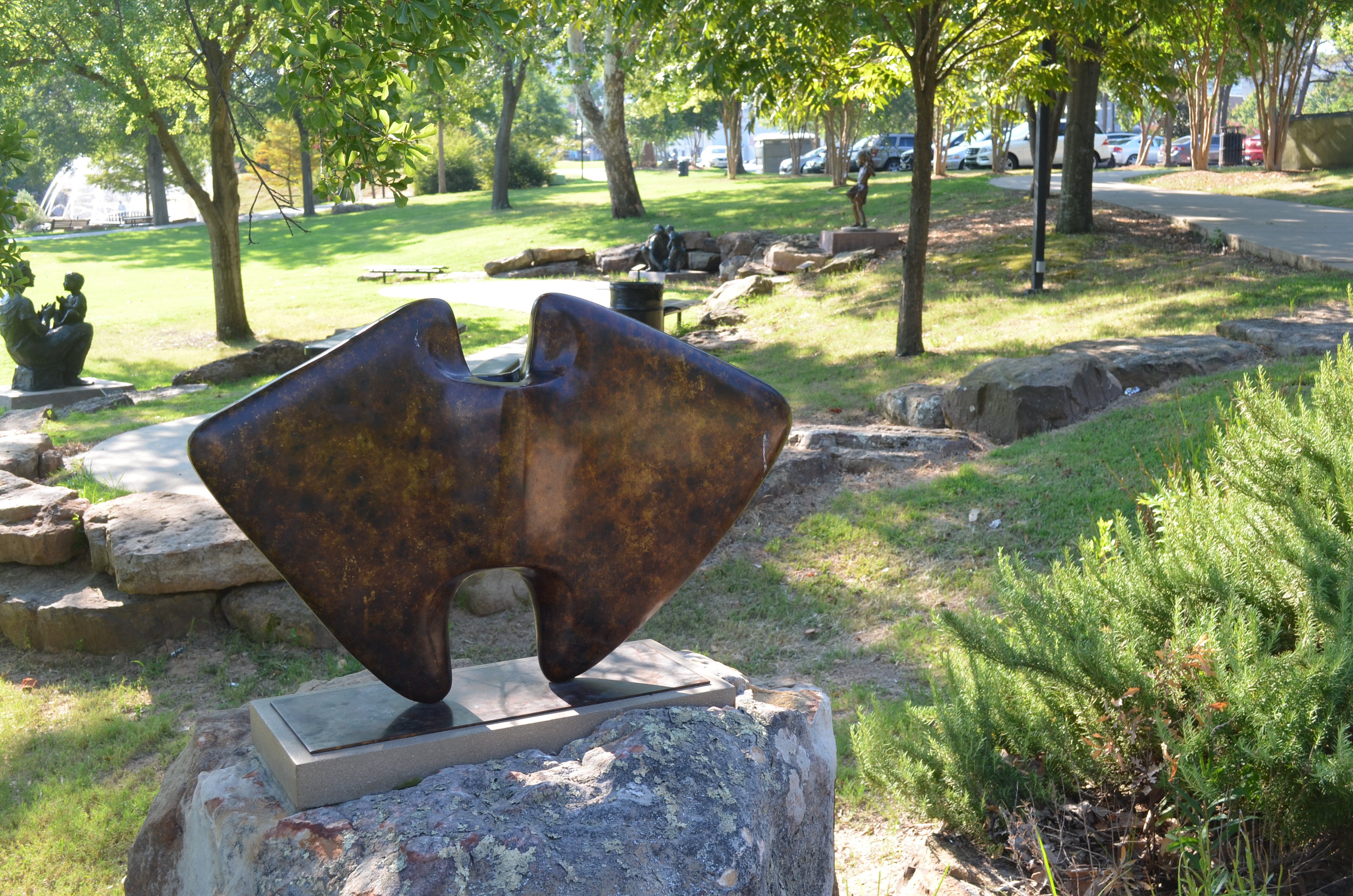
DSC_0701Today is National Bow Tie Day.  Though there is not specifically a sculpture in Little Rock with a bow tie, one of the newest sculptures in Riverfront Park mimics the shape of a bow tie.  Valerie Jean Schafer’s Butterfly Banner evokes not only a butterfly but a bow tie.  However, the imagery goes beyond that.

This is drawn from a visual vocabulary inspired by Native American artifacts from prehistory. While a banner was originally a small stone or wood counterweight for the atlatl (a weapon predating the bow and arrow) this enlarged representation speaks of the beauty of Native American culture beyond the usual stereotypes. The sculpture embraces tradition, as it reveals Native Americans as inhabitants of the Americas far longer than most people believe. At the same time, the simplicity of the form evokes a sense of elegance with a decidedly contemporary feel.

Dean Kumpuris 2014It is fitting that it is located in Riverfront Park. The Trail of Tears went through the park as Native Americans were forcibly moved west.  It serves as a reminder of the heritage of Little Rock. Not all of the City’s past was glorious; but in remembering the past, it helps to look forward to a better future.

It is also appropriate to feature this sculpture today for another reason.  A driving force behind the placement of sculptures in Little Rock is bow tie clad City Director Dr. Dean Kumpuris.