RobinsoNovember: Ribbon Cuttings at Robinson Center

j-v-and-ewilda

In this ARKANSAS GAZETTE photo, Mayor Satterfield looks on as Mrs. Robinson cuts the ribbon to open Robinson Auditorium.

Today (Thursday, November 10) at 10am, the ribbon will be cut on the newly restored Robinson Center.  It seems like a good chance to look back at two prior ribbon cuttings for the building.

The original ribbon cutting was supposed to be outside on the evening of Friday, February 16, 1940.  It was moved indoors due to rain and cold temperatures.  The ribbon was originally to be stretched across the front columns, but instead was stretched across the front curtain.  The white satin ribbon stood out against the royal blue velvet curtains.

Four people participated in the ribbon cutting:  Little Rock Mayor J. V. Satterfield, Mrs. Ewilda Robinson – widow of Senator Robinson, Mrs. Emily Miller – sister-in-law of Senator Robinson and a member of the auditorium commission, and a D. Hodson Lewis of the Little Rock Chamber of Commerce.  Mr. Lewis emceed the brief program, which was was broadcast live on a Little Rock radio station.  It consisted of Mr. Lewis introducing Mayor Satterfield, Mrs. Robinson and Mrs. Miller.  Mrs. Robinson chose not to make remarks.  Mayor Satterfield spoke briefly (a whopping twenty-nine words).  Then Mrs. Robinson cut the ribbon.  It took a couple of tries for her to get the scissors through the fabric on the ribbon.

Following that the building was officially opened.

In the late 1960s, City leaders started making plans for a renovation and expansion of Robinson Auditorium into a convention center.  In September 1973, a second ribbon cutting was held to celebrate the opening of the renovated space.  That ribbon was bright red and stretched from Ashley Street along Markham, wrapped into the side doors, and then back outside across the front of the building.  At the ceremony, Advertising and Promotion Commission Chairman Warren “Bud” Baldwin joked that they were having the longest ribbon and the shortest ceremony.

While the ribbon may have been long, the ceremony was not short.  Well, perhaps by ribbon cutting standards it was short, but it was certainly longer than the 1940 edition.  Among those participating in the ribbon cutting were Governor Dale Bumpers, Little Rock Mayor Bill Walters, and Miss Little Rock Risa McLemore.  The ribbon was cut by Miss McLemore and Ken Johnson of the Central States Shrine Association.  Over 14,000 Shriners were the first large convention in the new space.

RobinsoNovember: Mayor J. V. Satterfield Jr.

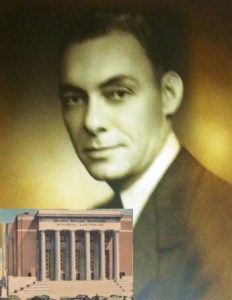
Satterfield AuditUpon taking office as mayor in April 1939, J. V. Satterfield felt he was getting a handle on Little Rock’s precarious financial situation. He would soon discover that it was more unstable than he had imagined.  Included in this was Robinson Auditorium, currently under construction across the street from his office in City Hall.  Mayor Satterfield disclosed that he had voted against the auditorium in 1937 because he felt the finances were not sufficient. But as the mayor, he promised to open the building.

By the summer of 1939, it was becoming apparent that there would not sufficient money to finish the construction.  Even with the issuance of the final round of approved bonds (which had been held back as a reserve), there would not be enough money.  The Mayor and Harvey Couch made plans to go to Washington DC to try to get more money from the federal government.  Mr. Couch was a personal friend of President Roosevelt as well as head of Arkansas Power & Light.  The pair made the trip but returned with no additional money.

At the same time, the Auditorium Commission, which had been appointed by Mayor Overman to oversee the governance of the building, resigned as a group. They said they had been appointed to administer a building, not a construction site. Since it was uncertain as to when the building would open, they stepped down.

Mayor Satterfield was able to negotiate a series of deals to get the necessary work completed for construction of the building to be completed. Part of it involved issuing another round of bonds after the building had been officially opened to finish furnishing the building as well as complete the landscaping.  In January 1940, with a new opening date becoming a stronger possibility, the mayor appointed a new Auditorium Commission.

At the same time, regular events started to take place in the lower level exhibition hall.  There had been a few in November and December, but with a lack of utilities and ongoing construction upstairs in the music hall, those were curtailed.

On February 16, 1940, Joseph Taylor Robinson Memorial Auditorium officially opened. Mayor Satterfield was joined onstage for the ribbon cutting with Senator Robinson’s widow and her sister-in-law, who was a member of the Auditorium Commission.

In April 1940, Little Rock voters approved the final round of bonds which allowed for the building to be finished.

After only two years in office, Mayor Satterfield chose not to seek another term. He left City Hall in April 1941 with finances in order and a new municipal auditorium across the street.

Arkansas Heritage Month – LR Mayor Satterfield oversees opening of Robinson Auditorium

Satterfield AuditUpon taking office as mayor in April 1939, J. V. Satterfield felt he was getting a handle on Little Rock’s precarious financial situation. He would soon discover that it was more unstable than he had imagined.  Included in this was Robinson Auditorium, currently under construction across the street from his office in City Hall.  Mayor Satterfield disclosed that he had voted against the auditorium in 1937 because he felt the finances were not sufficient. But as the mayor, he promised to open the building.

By the summer of 1939, it was becoming apparent that there would not sufficient money to finish the construction.  Even with the issuance of the final round of approved bonds (which had been held back as a reserve), there would not be enough money.  The Mayor and Harvey Couch made plans to go to Washington DC to try to get more money from the federal government.  Mr. Couch was a personal friend of President Roosevelt as well as head of Arkansas Power & Light.  The pair made the trip but returned with no additional money.

At the same time, the Auditorium Commission, which had been appointed by Mayor Overman to oversee the governance of the building, resigned as a group. They said they had been appointed to administer a building, not a construction site. Since it was uncertain as to when the building would open, they stepped down.

Mayor Satterfield was able to negotiate a series of deals to get the necessary work completed for construction of the building to be completed. Part of it involved issuing another round of bonds after the building had been officially opened to finish furnishing the building as well as complete the landscaping.  In January 1940, with a new opening date becoming a stronger possibility, the mayor appointed a new Auditorium Commission.

At the same time, regular events started to take place in the lower level exhibition hall.  There had been a few in November and December, but with a lack of utilities and ongoing construction upstairs in the music hall, those were curtailed.

On February 16, 1940, Joseph Taylor Robinson Memorial Auditorium officially opened. Mayor Satterfield was joined onstage for the ribbon cutting with Senator Robinson’s widow and her sister-in-law, who was a member of the Auditorium Commission.

In April 1940, Little Rock voters approved the final round of bonds which allowed for the building to be finished.

After only two years in office, Mayor Satterfield chose not to seek another term. He left City Hall in April 1941 with finances in order and a new municipal auditorium across the street.

LR Look Back: HAIR flows at Robinson Auditorium in 1972

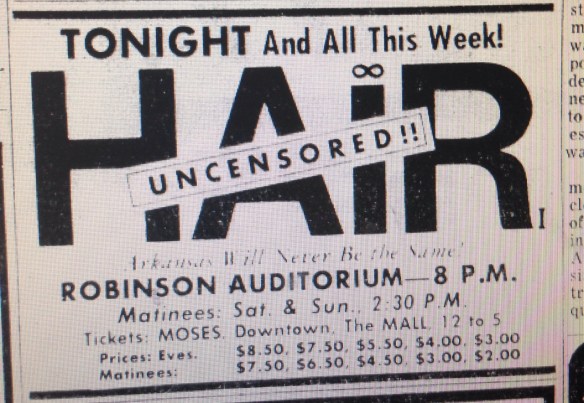
Ad for the original production of HAIR in Little Rock. Note the ticket prices. And that they could be purchased at Moses Music Shops.

Ad for the original production of HAIR in Little Rock. Note the ticket prices. And that they could be purchased at Moses Music Shops.

Forty-four years ago today, on January 18, 1972, the musical Hair settled in for a week-long run at Robinson Auditorium.  The saga to bring the national tour to Little Rock had actually begun eleven months earlier.

In February 1971, a young Little Rock attorney named Phil Kaplan petitioned the Little Rock Board of Censors to see if it would allow a production of Hair to play in the city. He was asking on behalf of a client who was interested in bringing a national tour to Arkansas’ capital city. The show, which had opened on Broadway to great acclaim in April 1968 after an Off Broadway run in 1967, was known for containing a nude scene as well for a script which was fairly liberally sprinkled with four-letter words. The Censors stated they could not offer an opinion without having seen a production.

By July 1971, Kaplan and his client (who by then had been identified as Southwest Productions) were seeking permission for a January 1972 booking of Hair from the City’s Auditorium Commission which was charged with overseeing operations at Robinson Auditorium. At its July meeting, the Commissioners voted against allowing Hair because of its “brief nude scene” and “bawdy language.”

Kaplan decried the decision. He stated that the body couldn’t “sit in censorship of legitimate theatrical productions.” He noted courts had held that Hair  could be produced and that the Auditorium Commission, as an agent for the State, “clearly can’t exercise prior censorship.” He proffered that if the production was obscene it would be a matter for law enforcement not the Auditorium Commission.

The Commission countered that they had an opinion from City Attorney Joseph Kemp stating they had the authority. One of the Commissioners, Mrs. Grady Miller (sister-in-law of the building’s namesake the late Senator Robinson, she had served on the Commission since 1940), expressed her concern that allowing Hair would open the door to other productions such as Oh! Calcutta!

On July 26, 1971, Southwest Productions filed suit against the Auditorium Commission. Four days later there was a hearing before federal Judge G. Thomas Eisele. At that hearing, Auditorium Commission member Lee Rogers read aloud excerpts from the script he found objectionable. Under questioning from Kaplan, a recent touring production of Neil Simon’s Plaza Suite was discussed. That play has adultery as a central theme of one of its acts. Rogers admitted he found the play funny, and that since the adultery did not take place on stage, he did not object to it. Among those testifying in favor of it was Robert Reddington, who was director of performing arts at the Arkansas Arts Center.

Judge Eisele offered a ruling on August 11 which compelled the Auditorium Commission to allow Hair to be performed. Prior to the ruling, some of the Auditorium Commissioners had publicly stated that if they had to allow Hair, they would close it after the first performance on the grounds of obscenity. To combat this, Judge Eisele stated that the Commission had to allow Hair to perform the entire six day engagement it sought.

Upon hearing of the Judge’s ruling, Commissioner Miller offered a succinct, two word response. “Oh, Dear!”

In the end, the production of Hair at Robinson would not be the first performance in the state.  The tour came through Fayetteville for two performances in October 1971 at Barnhill Arena.

On January 18, 1972, Hair played the first of its 8 performances over 6 days at Robinson Auditorium.  In his review the next day, the Arkansas Gazette’s Bill Lewis noted that Hair “threw out all it had to offer” and that Little Rock had survived.

The ads promoting the production carried the tagline “Arkansas will never be the same.”  Tickets (from $2 all the way up to $8.50) could be purchased at Moses Melody Shops both downtown and in “The Mall” (meaning Park Plaza). That business is gone from downtown, but the scion of that family, Jimmy Moses, is actively involved in building downtown through countless projects. His sons are carrying on the family tradition too.

Little Rock was by no means unique in trying to stop productions of Hair.  St. Louis, Birmingham, Los Angeles, Tallahassee, Boston, Atlanta, Charlotte NC, West Palm Beach, Oklahoma City, Mobile and Chattanooga all tried unsuccessfully to stop performances in their public auditoriums.  Despite Judge Eisele’s ruling against the City of Little Rock, members of the Fort Smith City Council also tried to stop a production later in 1972 in that city. This was despite warnings from City staff that there was not legal standing.

Within a few years, the Board of Censors of the City of Little Rock would be dissolved (as similar bodies also were disappearing across the US). Likewise, the Auditorium Commission was discontinued before Hair even opened with its duties being taken over by the Advertising and Promotion Commission and the Convention & Visitors Bureau staff.  This was not connected to the Hair decision; it was, instead, related to expanding convention facilities in Robinson and the new adjacent hotel.  Regardless of the reasons for their demise, both bygone bodies were vestiges of earlier, simpler and differently focused days in Little Rock.

Little Rock Look Back: Judge Eisele rules HAIR must flow at Robinson Auditorium

Ad for the original production of HAIR in Little Rock. Note the ticket prices. And that they could be purchased at Moses Music Shops.

Ad for the original production of HAIR in Little Rock. 

Forty-four years ago today, on August 11, 1971, Nixon appointee Federal Judge G. Thomas Eisele ruled that the musical Hair must be allowed to play in Little Rock in 1972 at Robinson Auditorium.

In February 1971, a young Little Rock attorney named Phil Kaplan petitioned the Little Rock Board of Censors to see if it would allow a production of Hair to play in the city. He was asking on behalf of a client who was interested in bringing a national tour to Arkansas’ capital city. The show, which had opened on Broadway to great acclaim in April 1968 after an Off Broadway run in 1967, was known for containing a nude scene as well for a script which was fairly liberally sprinkled with four-letter words. The Censors stated they could not offer an opinion without having seen a production.

By July 1971, Kaplan and his client (who by then had been identified as local promoter Jim Porter and his company Southwest Productions) were seeking permission for a January 1972 booking of Hair from the City’s Auditorium Commission which was charged with overseeing operations at Robinson Auditorium. At its July meeting, the Commissioners voted against allowing Hair because of its “brief nude scene” and “bawdy language.”

Kaplan decried the decision. He stated that the body couldn’t “sit in censorship of legitimate theatrical productions.” He noted courts had held that Hair could be produced and that the Auditorium Commission, as an agent for the State, “clearly can’t exercise prior censorship.” He proffered that if the production was obscene it would be a matter for law enforcement not the Auditorium Commission.

The Commission countered that they had an opinion from City Attorney Joseph Kemp stating they had the authority. One of the Commissioners, Mrs. Grady Miller (sister-in-law of the building’s eponym, the late Senator Robinson, she had served on the Commission since 1940), expressed her concern that allowing Hair would open the door to other productions such as Oh! Calcutta!

On July 26, 1971, Southwest Productions filed suit against the Auditorium Commission. Four days later there was a hearing before federal Judge G. Thomas Eisele. At that hearing, Auditorium Commission member Lee Rogers read aloud excerpts from the script he found objectionable. Under questioning from Kaplan, a recent touring production of Neil Simon’s Plaza Suite was discussed. That play has adultery as a central theme of one of its acts. Rogers admitted he found the play funny, and that since the adultery did not take place on stage, he did not object to it. Among those testifying in favor of it was Robert Reddington, who was director of performing arts at the Arkansas Arts Center.

Judge Eisele offered a ruling on August 11 which compelled the Auditorium Commission to allow Hair to be performed. Prior to the ruling, some of the Auditorium Commissioners had publicly stated that if they had to allow Hair, they would close it after the first performance on the grounds of obscenity. To combat this, Judge Eisele stated that the Commission had to allow Hair to perform the entire six day engagement it sought.

Upon hearing of the Judge’s ruling, Commissioner Miller offered a succinct, two word response. “Oh, Dear!”

On January 18, 1972, Hair played the first of its 8 performances over 6 days at Robinson Auditorium.  In his review the next day, the Arkansas Gazette’s Bill Lewis noted that Hair “threw out all it had to offer” and that Little Rock had survived.

Little Rock was by no means unique in trying to stop productions of Hair.  St. Louis, Birmingham, Los Angeles, Tallahassee, Boston, Atlanta, Charlotte NC, West Palm Beach, Oklahoma City, Mobile and Chattanooga all tried unsuccessfully to stop performances in their public auditoriums.  Despite Judge Eisele’s ruling against the City of Little Rock, members of the Fort Smith City Council also tried to stop a production later in 1972 in that city. This was despite warnings from City staff that there was not legal standing.

Tony Awards Week – Trouble with a capital T and that rhymes with…. HAIR?

Ad for the original production of HAIR in Little Rock. Note the ticket prices. And that they could be purchased at Moses Music Shops.

Ad for the original production of HAIR in Little Rock. Note the ticket prices. And that they could be purchased at Moses Music Shops.

The Tony winning musical The Music Man may have featured a song about “Trouble in River City” but the Tony nominated musical Hair brought trouble to this “river city” in 1971 and 1972.

In February 1971, a young Little Rock attorney named Phil Kaplan petitioned the Little Rock Board of Censors to see if it would allow a production of Hair to play in the city. He was asking on behalf of a client who was interested in bringing a national tour to Arkansas’ capital city. The show, which had opened on Broadway to great acclaim in April 1968 after an Off Broadway run in 1967, was known for containing a nude scene as well for a script which was fairly liberally sprinkled with four-letter words. The Censors stated they could not offer an opinion without having seen a production.

By July 1971, Kaplan and his client (who by then had been identified as local promoter Jim Porter and his company Southwest Productions) were seeking permission for a January 1972 booking of Hair from the City’s Auditorium Commission which was charged with overseeing operations at Robinson Auditorium. At its July meeting, the Commissioners voted against allowing Hair because of its “brief nude scene” and “bawdy language.”

Kaplan decried the decision. He stated that the body couldn’t “sit in censorship of legitimate theatrical productions.” He noted courts had held that Hair could be produced and that the Auditorium Commission, as an agent for the State, “clearly can’t exercise prior censorship.” He proffered that if the production was obscene it would be a matter for law enforcement not the Auditorium Commission.

The Commission countered that they had an opinion from City Attorney Joseph Kemp stating they had the authority. One of the Commissioners, Mrs. Grady Miller (sister-in-law of the building’s namesake the late Senator Robinson who had served on the Commission since 1939), expressed her concern that allowing Hair would open the door to other productions such as Oh! Calcutta!

On July 26, 1971, Southwest Productions filed suit against the Auditorium Commission. Four days later there was a hearing before Judge G. Thomas Eisele. At that hearing, Auditorium Commission member Lee Rogers read aloud excerpts from the script he found objectionable. Under questioning from Kaplan, a recent touring production of Neil Simon’s Tony winning play Plaza Suite was discussed. That play has adultery as a central theme of one of its acts. Rogers admitted he found the play funny, and that since the adultery did not take place on stage, he did not object to it.

Judge Eisele offered a ruling on August 11 which compelled the Auditorium Commission to allow Hair to be performed. Prior to the ruling, some of the Auditorium Commissioners had publicly stated that if they had to allow Hair they would close it after the first performance on the grounds of obscenity. To combat this, Judge Eisele stated that the Commission had to allow Hair to perform the entire six day engagement it sought.

Upon hearing of the Judge’s ruling, Commissioner Miller offered a succinct, two word response. “Oh, Dear!”

In the end, the production of Hair at Robinson would not be the first performance in the state.  The tour came through Fayetteville for two performances in October 1971. It played Barnhill Arena.

On January 18, 1972, Hair played the first of its 8 performances over 6 days at Robinson Auditorium.  In his review the next day, the Arkansas Gazette’s Bill Lewis noted that Hair “threw out all it had to offer” and that Little Rock had survived.

The ads promoting the production carried the tagline “Arkansas will never be the same.”  Tickets (from $2 all the way up to $8.50) could be purchased at Moses Melody Shops both downtown and in “The Mall” (meaning Park Plaza). That business is gone from downtown, but the scion of that family, Jimmy Moses, is actively involved in building downtown through countless projects. His sons are carrying on the family tradition too.

Little Rock was by no means unique in trying to stop productions of Hair.  St. Louis, Birmingham, Los Angeles, Tallahassee, Boston, Atlanta, Charlotte NC, West Palm Beach, Oklahoma City, Mobile and Chattanooga all tried unsuccessfully to stop performances in their public auditoriums.  Despite Judge Eisele’s ruling against the City of Little Rock, members of the Fort Smith City Council also tried to stop a production later in 1972 in that city. This was despite warnings from City staff that there was not legal standing.

Within a few years, the Board of Censors of the City of Little Rock would be dissolved (as similar bodies also were disappearing across the US). Likewise, the Auditorium Commission was discontinued before Hair even opened with its duties being taken over by the Advertising and Promotion Commission and the Convention & Visitors Bureau staff.  This was not connected to the Hair decision; it was, instead, related to expanding convention facilities in Robinson and the new adjacent hotel.  Regardless of the reasons for their demise, both bygone bodies were vestiges of earlier, simpler and differently focused days in Little Rock.

Over the years, Hair has returned to the Little Rock stage. It has been produced two more times at Robinson Center,  UALR has produced it twice, and the Weekend Theater has also mounted a production.   The most recent visit to Little Rock at Robinson Center, which was the final Broadway show before the building closed for renovations, was based on the 2009 Broadway revival.  That production, was nominated for eight Tony Awards, and captured the Tony for Revival of a Musical.  Several members of the production and creative team are frequent collaborators of Little Rock native Will Trice.

LR Look Back: HAIR flows at Robinson Auditorium

Ad for the original production of HAIR in Little Rock. Note the ticket prices. And that they could be purchased at Moses Music Shops.

Ad for the original production of HAIR in Little Rock. Note the ticket prices. And that they could be purchased at Moses Music Shops.

Forty-three years ago today, on January 18, 1972, the musical Hair settled in for a week-long run at Robinson Auditorium.  The saga to bring the national tour to Little Rock had actually begun eleven months earlier.

In February 1971, a young Little Rock attorney named Phil Kaplan petitioned the Little Rock Board of Censors to see if it would allow a production of Hair to play in the city. He was asking on behalf of a client who was interested in bringing a national tour to Arkansas’ capital city. The show, which had opened on Broadway to great acclaim in April 1968 after an Off Broadway run in 1967, was known for containing a nude scene as well for a script which was fairly liberally sprinkled with four-letter words. The Censors stated they could not offer an opinion without having seen a production.

By July 1971, Kaplan and his client (who by then had been identified as local promoter Jim Porter and his company Southwest Productions) were seeking permission for a January 1972 booking of Hair from the City’s Auditorium Commission which was charged with overseeing operations at Robinson Auditorium. At its July meeting, the Commissioners voted against allowing Hair because of its “brief nude scene” and “bawdy language.”

Kaplan decried the decision. He stated that the body couldn’t “sit in censorship of legitimate theatrical productions.” He noted courts had held that Hair could be produced and that the Auditorium Commission, as an agent for the State, “clearly can’t exercise prior censorship.” He proffered that if the production was obscene it would be a matter for law enforcement not the Auditorium Commission.

The Commission countered that they had an opinion from City Attorney Joseph Kemp stating they had the authority. One of the Commissioners, Mrs. Grady Miller (sister-in-law of the building’s namesake the late Senator Robinson, she had served on the Commission since 1940), expressed her concern that allowing Hair would open the door to other productions such as Oh! Calcutta!

On July 26, 1971, Southwest Productions filed suit against the Auditorium Commission. Four days later there was a hearing before federal Judge G. Thomas Eisele. At that hearing, Auditorium Commission member Lee Rogers read aloud excerpts from the script he found objectionable. Under questioning from Kaplan, a recent touring production of Neil Simon’s Plaza Suite was discussed. That play has adultery as a central theme of one of its acts. Rogers admitted he found the play funny, and that since the adultery did not take place on stage, he did not object to it. Among those testifying in favor of it was Robert Reddington, who was director of performing arts at the Arkansas Arts Center.

Judge Eisele offered a ruling on August 11 which compelled the Auditorium Commission to allow Hair to be performed. Prior to the ruling, some of the Auditorium Commissioners had publicly stated that if they had to allow Hair, they would close it after the first performance on the grounds of obscenity. To combat this, Judge Eisele stated that the Commission had to allow Hair to perform the entire six day engagement it sought.

Upon hearing of the Judge’s ruling, Commissioner Miller offered a succinct, two word response. “Oh, Dear!”

In the end, the production of Hair at Robinson would not be the first performance in the state.  The tour came through Fayetteville for two performances in October 1971 at Barnhill Arena.

On January 18, 1972, Hair played the first of its 8 performances over 6 days at Robinson Auditorium.  In his review the next day, the Arkansas Gazette’s Bill Lewis noted that Hair “threw out all it had to offer” and that Little Rock had survived.

The ads promoting the production carried the tagline “Arkansas will never be the same.”  Tickets (from $2 all the way up to $8.50) could be purchased at Moses Melody Shops both downtown and in “The Mall” (meaning Park Plaza). That business is gone from downtown, but the scion of that family, Jimmy Moses, is actively involved in building downtown through countless projects. His sons are carrying on the family tradition too.

Little Rock was by no means unique in trying to stop productions of Hair.  St. Louis, Birmingham, Los Angeles, Tallahassee, Boston, Atlanta, Charlotte NC, West Palm Beach, Oklahoma City, Mobile and Chattanooga all tried unsuccessfully to stop performances in their public auditoriums.  Despite Judge Eisele’s ruling against the City of Little Rock, members of the Fort Smith City Council also tried to stop a production later in 1972 in that city. This was despite warnings from City staff that there was not legal standing.

Within a few years, the Board of Censors of the City of Little Rock would be dissolved (as similar bodies also were disappearing across the US). Likewise, the Auditorium Commission was discontinued before Hair even opened with its duties being taken over by the Advertising and Promotion Commission and the Convention & Visitors Bureau staff.  This was not connected to the Hair decision; it was, instead, related to expanding convention facilities in Robinson and the new adjacent hotel.  Regardless of the reasons for their demise, both bygone bodies were vestiges of earlier, simpler and differently focused days in Little Rock.