
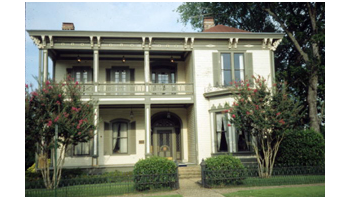
 The monthly architectural history program “Sandwiching in History” visits the White-Baucum House, located at 201 South Izard Street. The program begins at noon today. A historian with the Arkansas Historic Preservation Program delivers a brief lecture about the church before leading guests on a tour.
This Italianate-style house was built in 1869-1870 for Robert J. T. White, then-Arkansas secretary of state, and was enlarged in the mid-1870s by its second owner, businessman George F. Baucum. The White-Baucum House was recently rehabilitated using federal and state tax incentives to serve as office space.
Sandwiching in History is a program of the Arkansas Historic Preservation Program, an agency of the Department of Arkansas Heritage. The AHPP is responsible for identifying, evaluating, registering and preserving the state’s cultural resources. Other DAH agencies are the Arkansas Arts Council, the Delta Cultural Center in Helena, the Old State House Museum, the Mosaic Templars Cultural Center, the Arkansas Natural Heritage Commission and the Historic Arkansas Museum.
 Little Rock Culture Vulture