Turkey Day Football – Dunbar & later Mann take on Jones High

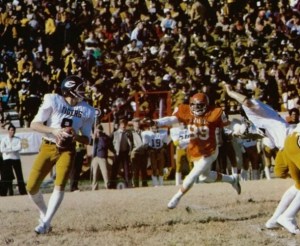
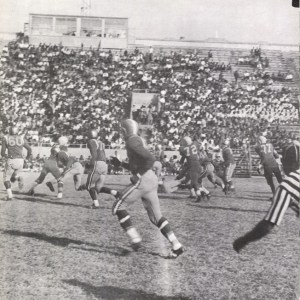
Mann High School takes on Jones High in 1962

Mann High School takes on Jones High in 1962

From the 1930s to the early 1960s, Thanksgiving Day high school football in Arkansas was the time for big rivals to meet.  In addition to Little Rock playing NLR (later morphing into Central playing Hall), many a Thanksgiving Day schedule involved seeing Jonesboro face off against Paragould or El Dorado play Camden. Fayetteville vs. Springdale, Morrilton vs. Conway, Newport vs. Batesville, and DeQueen vs. Texarkana were all longtime traditions.

In these days, football classifications were much more fluid.  It would not be until the 1960s that the Arkansas Activities Association would permanently institute state playoffs in football.  This led to the demise of Thanksgiving Day games throughout the state.  Either the schools were not in the same classification and/or they were in a classification that had playoffs starting in mid-November.  Gone were the days when a regular football season extended from September to Thanksgiving.

The two exceptions to this were the largest classification of schools and the segregated African American schools.  The largest class, which eventually became known as the AAAAA (it had previously been the Big 6, 8, 9–whatever number of schools were in it), had few enough members that they were all in one conference.  A conference championship was tantamount to a state championship.

The African American schools were ignored in athletics as they were in other areas.  While the schools fielded teams and played each other, they did not have playoffs or Arkansas Activities Association recognized championships.  Up through the late 1950s, a mention of their games in the Arkansas Gazette or Arkansas Democrat was rare.

For several years, Little Rock’s Dunbar High School Bearcats took on the Scipio Jones Dragons of North Little Rock on Thanksgiving Day.  Due to the lack of coverage in newspapers, there are few records of these games.  Unfortunately the yearbooks of neither school shed any light. Due to limited budgets which led to thinner yearbooks, the football team usually got one page that was devoted to showing the players and left no room for details about their exploits on the gridiron.

In the 1955-1956 school year, Little Rock opened a new high school for African American students – Horace Mann High School. The Bearcat mascot of Dunbar (now a junior high) became the new Horace Mann mascot.  Mann carried on the tradition of playing Jones on Thanksgiving.

Many seasons the African American LR-NLR football game was the second meeting of the two teams.  They usually played against each other in September and then again on Thanksgiving.  This second game seems to have been as much about ensuring that their students, fans, and alumni had the chance to have a Thanksgiving Day game – just as most white schools throughout the state had.

Due to the lack of African American high schools fielding football teams in Arkansas, often the LR and NLR schools would also play out-of-state teams.  While it was not unusual for Little Rock’s white high school to play teams from other states, this was because of prestige, not necessity.  The same luxury was not afforded African American schools.  In 1963, for instance, Horace Mann played teams from Oklahoma, Tennessee, Louisiana and Texas.  Their in-state rivals that year were segregated schools in North Little Rock, El Dorado, Pine Bluff (two schools), Camden, Hope, Hot Springs and Texarkana. Horace Mann’s travel schedule was much more extensive than either Central or Hall had on a weekly basis.

From 1956 through 1965, Mann and Jones met at Wildcat Stadium. After that season, the Thanksgiving game would alternate between Wildcat and Quigley.  Since the Central v. Hall and NLR v. Catholic matchups were in the morning, the Mann v. Jones games were afternoon affairs.

As the Little Rock School District was gradually integrating its high schools in the 1960s, the Mann vs. Jones game continued.   (Both school districts seemed to be more focused on the “deliberate” part of the Supreme Court directive than on the “speed” aspect.)   With the demise of Jones High in the spring of 1970, the Mann vs. Jones series ended.

Because of the lack of records of the Dunbar games, here is the breakdown only of the Mann games.  In the fourteen Mann vs. Jones games, Horace Mann won ten of the outings, while Jones captured four.  The Bearcats shut out the Dragons twice, while NLR only once blanked LR.  Horace Mann scored 332 points over the fourteen Thanksgiving games to Scipio Jones’s 126 points.


Horace Mann Scipio Jones
1956 14 0
1957 27 13
1958 0 13
1959 40 7
1960 45 0
1961 31 6
1962 31 18
1963 14 20
1964 27 6
1965 51 9
1966 20 7
1967 13 14
1968 19 13
1969 8 19


RobinsoNovember: Art Porter Sr.

bhm art srAs part of the new Robinson Center, nine Little Rockians (Little Rockers?) have been enshrined by having spaces in the building named after them.  One of those is Art Porter Sr.

Arthur Lee (Art) Porter Sr. was a pianist, composer, conductor, and music teacher. His musical interest spanned from jazz to classical and spirituals.

Born on February 8, 1934 in Little Rock, he began his music education at home. He played in church at age eight; played his first recital at twelve; and, by fourteen, hosted a half-hour classical music radio program on KLRA-AM. He earned a bachelor’s degree in music from Arkansas AM&N College (now UAPB) in May 1954. The next year, he married Thelma Pauline Minton. Following his marriage, he pursued graduate study at the University of Illinois, University of Texas and Henderson State University.

He began his teaching career at Mississippi Valley State University in 1954.  When he was drafted into the Army, his musical talents were responsible for him being assigned as a chaplain’s assistant in New York.  In the late 1950s he returned to Little Rock and taught at Horace Mann High School, Parkview High School and Philander Smith College.

He also started playing piano jazz in the evenings. This led to the creation of the Art Porter Trio, which became THE music group for events.  Many musicians who came to Arkansas to perform in Little Rock or Hot Springs would often stop by and join in with Porter as he played.  From 1971 to 1981 he hosted The Minor Key musical showcase on AETN.  His Porterhouse Cuts program was shown in 13 states.

Often encouraged to tour, he instead chose to stay based in Arkansas.  He did, from time time, perform at jazz or music festivals.   He also performed classical piano with the Arkansas Symphony Orchestra, founded the Art Porter Singers, and created a music group featuring his four oldest children.  Though Porter received many honors and awards, he found particular satisfaction in the “Art Porter Bill” enacted by the state legislature, which allowed minors to perform in clubs while under adult supervision. Porter’s children thus were able to perform with him throughout the state. Governor Bill Clinton, at the time a huge fan and friend of Porter, often joined Porter’s group on his saxophone.

In January 1993, Porter and his son Art Porter, Jr., performed at festivities in Washington DC for the Presidential Inauguration of his friend Bill Clinton.  In July 1993, he died of lung cancer.  Today his legacy lives on in the Art Porter Music Education Fund as well as in the lives of the many musicians and fans he touched.  He was posthumously inducted into the Arkansas Black Hall of Fame in 1994.

Turkey Day Football in LR – An Overview

thanks-grid-lrc-lrh102 years ago, Little Rock High School (then located on Scott Street) kicked off a 69-year tradition of playing football on Thanksgiving Day.  (Though the date of Thanksgiving floats anywhere from the 22nd to the 28th, Thanksgiving Day 1914 was on November 26.)

From 1914 until 1933, the Little Rock High School Tigers played a variety of different schools.  Then from 1934 until 1957, they played North Little Rock. From 1958 until 1982, the Little Rock Central Tigers took on the Warriors of Little Rock Hall.

Thanksgiving Day football was a tradition not just for high schools in Little Rock but also all levels throughout the state and country.  The Friday after Thanksgiving, newspapers carried stories and scores for professional, college and high school football.  It was probably the only day of the year to see all three levels of football covered in the paper, and often high school games received the most ink.  This mix of football continued for decades.  In 1969, there were four football games played in Pulaski County on Thanksgiving Day: Little Rock Hall vs. Little Rock Central, Little Rock Catholic vs. North Little Rock, Horace Mann vs. Scipio Jones, and the Arkansas Razorbacks vs. Texas Tech.

By the 1970s, both high school and college football games on Thanksgiving were on the wane.  While college games on Turkey Day have regained some popularity, they are nowhere near approaching the level they once had.  High school football on Thanksgiving disappeared in Arkansas following the 1982 game between Hall and Central.  That rivalry had been the final series on Turkey Day to still be played.

While they lasted, Thanksgiving Day high school football games were civic focal points. They were about bragging rights.  For students who had grown up attending the games, the chance to play or cheer in a Turkey Day classic was a rite of passage.  Alumni home from college or visiting the family for Thanksgiving would descend on the stadium ensuring the largest attendance of the season.

High school football on Thanksgiving Day in Little Rock tells the tale of not just football; it reflects changes in the city and society.  What started out as two small high schools from neighboring cities changed as both schools grew. The addition of a second Little Rock high school reflected the city’s growth.  (Indeed the 1954 Little Rock High School yearbook, in discussing the school’s new designation as Central High, mentions vaguely that the second high school would be built at some yet to be determined location in “west” Little Rock.)

The presence of segregated high schools in separate but unequal football rivalries (lasting nearly two decades after the Supreme Court’s Brown v. Board decision) is an indictment of an unjust parallel education system.  As Little Rock continued to grow and diversify, the two high schools playing on Thanksgiving were no longer always the predominant schools in football – or other activities.  With state championships once again on the line, the last few years of the Hall and Central Thanksgiving rivalry were, in a way, a return to the halcyon days of the early faceoffs (though this time, thankfully, with fully integrated teams). In addition to trading the top spots in football, the two schools were piling accolades. In fact, all three Little Rock public high schools had achieved a stasis that inadvertently rotated areas of excellence academically, athletically and artistically fairly equally among the three.

There were undercurrents at work that hinted at future instabilities to come.  Indeed by 1982, the same year of the final game, Little Rock had filed suit against the North Little Rock and the Pulaski County Special School Districts claiming the schools in those neighboring districts were siphoning off white students from the Little Rock schools. The ensuing realignment of schools and districts would probably have brought an end to Central vs. Hall games even if athletic reclassification had not.

Central is now much larger than Hall, Parkview is a magnet school, two formerly county high schools (and several elementary schools and junior highs) were brought into the LR school district in the late 1980s.  Where once the Little Rock high schools were roughly equal in enrollment, they now are so varied they play in three different classifications.

It is up to the alternative historians to envision what continued Turkey Day classics would have looked like after 1982. Little Rock has grown and diversified. There are six public high schools and five private high schools playing football within the Little Rock city limits each season. With all these competing interests it is unlikely to envision the same citywide level of interest in one football game.

But back in the day…

Black History Month Spotlight – Horace Mann High School

Mann-SignThe new Arkansas Civil Rights History Audio Tour was launched in November 2015. Produced by the City of Little Rock and the University of Arkansas at Little Rock allows the many places and stories of the City’s Civil Rights history to come to life an interactive tour.  This month, during Black History Month, the Culture Vulture looks at some of the stops on this tour which focus on African American history.

Horace Mann Senior High School opened in 1956 as one of two new Little Rock public high schools, after the 1954 U. S. Supreme Court Brown v. Board of Education school desegregation decision. Mann was built in the predominantly black eastern part of Little Rock, while Hall High was in a predominantly affluent and white western area of residence. This plan ensured that, in practical terms, both schools would remain racially segregated. The assignment of an all-black teaching faculty to Mann and an all-white teaching faculty to Hall underscored this intent.

After Mann was built, the school board transferred black students from Dunbar High, the city’s existing segregated black high school, to Mann. Dunbar then became a junior high school. Teachers were divided and reassigned, new principals were named, and the school mascots respectively became the “Dunbar Bobcats” and the “Horace Mann Bearcats.” The schools are now Horace Mann Arts and Science Magnet Middle School and the Dunbar International Studies Magnet Middle School. In 2012, both alumni groups combined to form the National Dunbar Horace Mann Alumni Association.

The app, funded by a generous grant from the Arkansas Humanities Council, was a collaboration among UALR’s Institute on Race and Ethnicity, the City of Little Rock, the Mayor’s Tourism Commission, and KUAR, UALR’s public radio station, with assistance from the Little Rock Convention and Visitors Bureau.

Black History Month Spotlight – Dunbar High School

dunbarimage2The new Arkansas Civil Rights History Audio Tour was launched in November 2015. Produced by the City of Little Rock and the University of Arkansas at Little Rock allows the many places and stories of the City’s Civil Rights history to come to life an interactive tour.  This month, during Black History Month, the Culture Vulture looks at some of the stops on this tour which focus on African American history.

After Little Rock High School (now Central High School) was completed in 1927, the building of Paul Laurence Dunbar High School was completed in 1929.  Money came from the Rosenwald Fund, founded by Julius Rosenwald, president of Sears, Roebuck and Company, and from local black residents.  Local blacks insisted on adding college preparatory classes to the vocational-industrial ones that were offered in black schools at the time. The building, modeled after the white high school, housed grades seven through twelve plus a junior college.  Black students came from all over Arkansas to take advantage of its educational opportunities.

When Horace Mann High School opened as a segregated school in 1956, Dunbar became a junior high school. A Dunbar-Mann Alumni Association, whose members live throughout the country, still helps to support both schools.  In the 1930s, Charlotte Andrews Stephens, the first black public school teacher in Little Rock, was on the faculty at Dunbar, completing seventy years of teaching with the district.  In the 1940s, Sue Cowan Williams, English Department chair, lost her job when she sued the Little Rock School District for equal pay for black and white teachers.

The app, funded by a generous grant from the Arkansas Humanities Council, was a collaboration among UALR’s Institute on Race and Ethnicity, the City of Little Rock, the Mayor’s Tourism Commission, and KUAR, UALR’s public radio station, with assistance from the Little Rock Convention and Visitors Bureau.

Enjoy the holidays and the “Say It Ain’t Say’s” Sweet Potato Pie contest at Mosaic Templars today

MTCCSayJoin the Mosaic Templars Cultural Center for a festive and fun day full of holiday cheer! The fun runs from 2pm util 5pm.

This year’s event will feature the 4th annual “Say It Ain’t Say’s” sweet potato pie contest, in honor of Little Rock’s black Santa, Robert “Say” McIntosh.We’ll have live entertainment by the Gloryland Pastor’s Choir, the Lorenzo Smith Band Camp and the Horace Mann Middle School Dance Ensemble. Activities include a kids’ craft station and the opportunity to browse our current exhibits, “Freedom! Oh, Freedom!” and the 2015 Creativity Arkansas Collection.

Guests and a panel of celebrity judges will determine who has the best sweet potato pie in Central Arkansas. Celebrity judges include Power 92 FM’s Broadway Joe, food and travel writer Kat Robinson, AY magazine food columnist Pamela Smith, and Kelli Marks, owner of Sweet Love Bakery.

Enjoy refreshments provided by RSVP Catering.

This year, a trolley will be available to take guests to two other Department of Arkansas Heritage Museums located in downtown Little Rock: Old State House Museum and Historic Arkansas Museum. The trolley route will also include the Governor’s Mansion Open House.

For more information call 501-683-3620 or email Tameka@arkansasheritage.org.

PIGSKIN TURKEY DAY IN THE ROCK, Part 4 – Horace Mann vs. Scipio Jones

Turkey Day MannFrom the 1930s to the early 1960s, Thanksgiving Day high school football in Arkansas was the time for big rivals to meet.  In addition to Little Rock playing NLR (later morphing into Central playing Hall), many a Thanksgiving Day schedule involved seeing Jonesboro face off against Paragould or El Dorado play Camden. Fayetteville vs. Springdale, Morrilton vs. Conway, Newport vs. Batesville, and DeQueen vs. Texarkana were all longtime traditions.

In these days, football classifications were much more fluid.  It would not be until the 1960s that the Arkansas Activities Association would permanently institute state playoffs in football.  This led to the demise of Thanksgiving Day games throughout the state.  Either the schools were not in the same classification and/or they were in a classification that had playoffs starting in mid-November.  Gone were the days when a regular football season extended from September to Thanksgiving.

The two exceptions to this were the largest classification of schools and the segregated African American schools.  The largest class, which eventually became known as the AAAAA (it had previously been the Big 6, 8, 9–whatever number of schools were in it), had few enough members that they were all in one conference.  A conference championship was tantamount to a state championship.

The African American schools were ignored in athletics as they were in other areas.  While the schools fielded teams and played each other, they did not have playoffs or Arkansas Activities Association recognized championships.  Up through the late 1950s, a mention of their games in the Arkansas Gazette or Arkansas Democrat was rare.

For several years, Little Rock’s Dunbar High School Bearcats took on the Scipio Jones Dragons of North Little Rock on Thanksgiving Day.  Due to the lack of coverage in newspapers, there are few records of these games.  Unfortunately the yearbooks of neither school shed any light. Due to limited budgets which led to thinner yearbooks, the football team usually got one page that was devoted to showing the players and left no room for details about their exploits on the gridiron.

In the 1955-1956 school year, Little Rock opened a new high school for African American students – Horace Mann High School. The Bearcat mascot of Dunbar (now a junior high) became the new Horace Mann mascot.  Mann carried on the tradition of playing Jones on Thanksgiving.

Many seasons the African American LR-NLR football game was the second meeting of the two teams.  They usually played against each other in September and then again on Thanksgiving.  This second game seems to have been as much about ensuring that their students, fans, and alumni had the chance to have a Thanksgiving Day game – just as most white schools throughout the state had.

Due to the lack of African American high schools fielding football teams in Arkansas, often the LR and NLR schools would also play out-of-state teams.  While it was not unusual for Little Rock’s white high school to play teams from other states, this was because of prestige, not necessity.  The same luxury was not afforded African American schools.  In 1963, for instance, Horace Mann played teams from Oklahoma, Tennessee, Louisiana and Texas.  Their in-state rivals that year were segregated schools in North Little Rock, El Dorado, Pine Bluff (two schools), Camden, Hope, Hot Springs and Texarkana. Horace Mann’s travel schedule was much more extensive than either Central or Hall had on a weekly basis.

From 1956 through 1965, Mann and Jones met at Wildcat Stadium. After that season, the Thanksgiving game would alternate between Wildcat and Quigley.  Since the Central v. Hall and NLR v. Catholic matchups were in the morning, the Mann v. Jones games were afternoon affairs.

As the Little Rock School District was gradually integrating its high schools in the 1960s, the Mann vs. Jones game continued.  (North Little Rock was even slower in integrating its high school than LR had been with its high schools. Both seemed to be more focused on the “deliberate” part of the Supreme Court directive than on the “speed” aspect.)   With the demise of Jones High in the spring of 1970, the Mann vs. Jones series ended.

Because of the lack of records of the Dunbar games, here is the breakdown only of the Mann games.  In the fourteen Mann vs. Jones games, Horace Mann won ten of the outings, while Jones captured four.  The Bearcats shut out the Dragons twice, while NLR only once blanked LR.  Horace Mann scored 332 points over the fourteen Thanksgiving games to Scipio Jones’s 126 points.


Horace Mann Scipio Jones

1956

14 0

1957

27

13

1958

0

13

1959

40

7

1960

45

0

1961

31

6

1962

31 18

1963

14

20

1964 27

6

1965 51

9

1966

20 7

1967

13 14
1968 19

13

1969 8

19