LR Women’s History Month – Ruth May Wassell Gibb

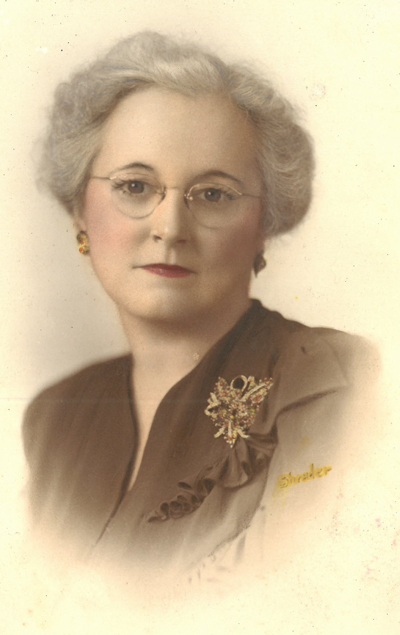
Ruth-May-Wassell-GibbOn August 27, 1944, Ruth May Wassell shattered a bottle on the hull of a new ship and christened it the U.S.S. Little Rock.  Mrs. Wassell, whose husband was Little Rock alderman Sam Wassell, had been designated as the official sponsor for the City of Little Rock by Mayor Charles Moyer.

Ruth May Wassell was more than the wife of a local political leader.  The daughter of Dr. and Mrs. Wiley Singleton May, she moved from Gurdon to Little Rock with her family and graduated from Little Rock High School. She later graduated from Henderson-Brown College and received a law degree from the University of Arkansas.  In 1932, she was admitted to the Arkansas Bar and later was admitted to practice before the Arkansas Supreme Court, one of the first women to receive this designation.

Mrs. Wassell was active in business, serving as president of the Arkansas Lumber Company  and owner of a citrus farm in Texas.  She was also active in civic affairs through involvement with the Arkansas Democratic Women, Boys Club and Second Presbyterian Church.  From 1947 until 1951 she was First Lady of Little Rock when Sam Wassell was elected as Mayor.

Following the December 1954 death of Mayor Wassell, she subsequently married E. W. “Bud” Gibb.  She died in 1964.

Little Rock Look Back: William Marmaduke Kavanaugh

CLR KavanaughOn March 3, 1866, William Marmaduke Kavanaugh was born in Alabama. He later moved with his family to Kentucky before coming to Little Rock as a newspaper reporter.

Kavanaugh served as editor and manager of the Arkansas Gazette before entering politics.  From 1896 until 1900, he served as Pulaski County Sheriff, which at the time also included the duties of tax collector.  From 1900 until 1904, he was County Judge of Pulaski County.  In that capacity he helped wrangle several cities, railroads and trolley lines to create a compromise which lead to the completion of the Third Street Viaduct which connected Little Rock with Pulaski Heights. It is still in use today.

After leaving his post as County Judge, he had a varied career in banking and business interests.

When Senator Jeff Davis died in early January 1913, he left the last few weeks of his term incomplete as well as the new term he was set to start in March 1913.  There was much interest in who would fill the remainder of Davis’ current term, because that person might be the frontrunner to also fill out the new term.  (This was at the time that the U.S. Senators were still selected by state legislatures.) Defeated Governor George Donaghey appointed J. N. Heiskell to fill out the term. But once the Arkansas General Assembly convened in mid-January, they overrode Donaghey’s appointment and replaced Heiskell with Kavanaugh.

Kavanaugh served in the Senate from January 29, 1913 until March 3, 1913.  He was succeeded by Joseph T. Robinson who had only recently taken office as Governor.  Speculation was that Kavanaugh would not want the full six year term, so that he was acceptable choice to all of the politicians jockeying for the full appointment.  From 1912 until 1915, he was an Arkansas member of the Democratic National Committee.

Another interest of Kavanaugh’s was baseball.  He served as president of the Southern Association minor league starting in 1903.  The baseball field in Little Rock situated at West End Park was named Kavanaugh Field in his honor.  It stood until the 1930s when it was replaced by what is now known as Quigley Stadium.  (In 1927, Little Rock High School had opened on the land which had been West End Park.)

Kavanaugh died on February 2, 1915 at the age of 48.  He is buried in Oakland Cemetery.

Prospect Road was renamed Kavanaugh Boulevard in his memory.

Little Rock Look Back: NINE FROM LITTLE ROCK wins Documentary Oscar

AMPAS Nine from LROn April 5, 1965, the Academy Award for Best Documentary, Short Subject went to the film “Nine from Little Rock.”

Narrated by Jefferson Thomas, Charles Guggenheim’s documentary looks at the nine African-American students who enrolled in Little Rock Central High School in 1957. Thomas, one of the students reflects on the state of race relations in the seven years that had elapsed (up to 1964).  The film also focuses on Ernest Green, Elizabeth Eckford and Thelma Mothershed.

Guggenheim both directed and co-wrote the film. The latter credit was shared with Shelby Storck, who also produced the film.   The film had been commissioned by George Stevens, Jr., for the United State Information Agency.

The Oscar that night was Guggenheim’s first of four.  His others would be for: 1968’s “Robert Kennedy Remembered” (Live Action Short), 1989’s “The Johnstown Flood” (Documentary Short) and 1994’s “A Time for Justice” (Documentary Short).  His son Davis Guggenheim won the Oscar for Documentary, Feature for An Inconvenient Truth.

The film was digitally restored by the Motion Picture Preservation Lab for the 50th anniversary of its win for Best Short Documentary at the 1965 Academy Awards.  It is available for purchase on DVD and can also be viewed in its entirety on YouTube

Black History Month Spotlight – TESTAMENT sculpture on State Capitol grounds

Testament 006The new Arkansas Civil Rights History Audio Tour was launched in November 2015. Produced by the City of Little Rock and the University of Arkansas at Little Rock allows the many places and stories of the City’s Civil Rights history to come to life an interactive tour.  This month, during Black History Month, the Culture Vulture looks at some of the stops on this tour which focus on African American history.

In 1957, nine African-American students enrolled at Little Rock’s Central High School, beginning the process of desegregating Little Rock’s public schools and marking a seminal event in America’s civil rights movement. This sculptural grouping was dedicated in August 2005 to honor the courage of those students, known collectively as the Little Rock Nine. Quotations from each of the Nine are featured around the bronze figures, which are the work of artists John and Cathy Deering.

The site for the statues was selected to face the end of the building which contains the Arkansas Governor’s Office.  It was from those windows that then-Governor Orval Faubus would have looked as he was making decisions to deny the Little Rock Nine entry into Little Rock Central. It is out those windows now that any governor since 2005 looks to see the statues.

The app, funded by a generous grant from the Arkansas Humanities Council, was a collaboration among UALR’s Institute on Race and Ethnicity, the City of Little Rock, the Mayor’s Tourism Commission, and KUAR, UALR’s public radio station, with assistance from the Little Rock Convention and Visitors Bureau.

Black History Month Spotlight – Central High School Neighborhood

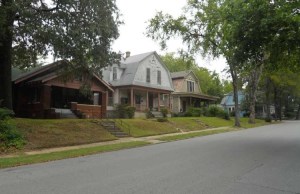
CHS neighborhoodThe new Arkansas Civil Rights History Audio Tour was launched in November 2015. Produced by the City of Little Rock and the University of Arkansas at Little Rock allows the many places and stories of the City’s Civil Rights history to come to life an interactive tour.  This month, during Black History Month, the Culture Vulture looks at some of the stops on this tour which focus on African American history.

The Central High School Neighborhood Historic District developed in the late 1880s, after a streetcar company built West End Park there in 1885. The area was a middle-class, interracial, mixed-use neighborhood with large homes and cottages and several schools and churches. Union and Capitol Hill schools educated the African American residents. St. Bartholomew’s Catholic Church and school served an African American congregation. African American and white residents worked as clergymen, barbers, chauffeurs, mail carriers, clerks, and with the railroad and service industries. The neighborhood was also home to white and black lawyers, doctors, teachers and businessmen.

By 1894, West End Park included a baseball field, becoming home to the city’s first minor league baseball team, the Little Rock Travelers. Negro League teams, including the Little Rock Reds, Cadets, and Greys, also played there. In the late 1920s, the park site was chosen for the new Little Rock High School for white students. Quigley Stadium, the school’s football field, was built in 1936 by the Works Progress Administration (WPA), replacing Kavanaugh Baseball Field. The neighborhood continues to have a vibrant mix of working class blacks and whites.

The app, funded by a generous grant from the Arkansas Humanities Council, was a collaboration among UALR’s Institute on Race and Ethnicity, the City of Little Rock, the Mayor’s Tourism Commission, and KUAR, UALR’s public radio station, with assistance from the Little Rock Convention and Visitors Bureau.

Black History Month Spotlight – Central High School National Historic Site

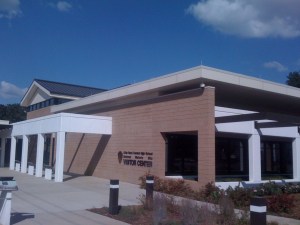
Little Rock 2011 036The new Arkansas Civil Rights History Audio Tour was launched in November 2015. Produced by the City of Little Rock and the University of Arkansas at Little Rock allows the many places and stories of the City’s Civil Rights history to come to life an interactive tour.  This month, during Black History Month, the Culture Vulture looks at some of the stops on this tour which focus on African American history.

In September 1957, Central High School was at the center of international attention when Gov. Orval E. Faubus ordered the National Guard to prevent nine black students from attending. President Dwight D. Eisenhower later federalized the National Guard and sent in federal troops to escort the students to class. The school became a crucial battleground in the struggle for civil rights. Dramatic media images of the conflict seared themselves into public memory.

The Little Rock Central High School National Historic Site and Visitor Center opened in September 2007 to mark the fiftieth anniversary of the school’s desegregation. The interactive displays include interviews with the Little Rock Nine and historic video clips. The Center presents a broad view of civil and human rights struggles in the United States and around the world. Central High School is the only functioning high school in the United States to be located within the boundary of a national historic site.

The app, funded by a generous grant from the Arkansas Humanities Council, was a collaboration among UALR’s Institute on Race and Ethnicity, the City of Little Rock, the Mayor’s Tourism Commission, and KUAR, UALR’s public radio station, with assistance from the Little Rock Convention and Visitors Bureau.

Black History Month Spotlight – Central High School

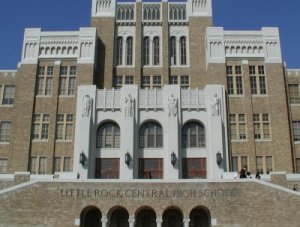
centralentranceThe new Arkansas Civil Rights History Audio Tour was launched in November 2015. Produced by the City of Little Rock and the University of Arkansas at Little Rock allows the many places and stories of the City’s Civil Rights history to come to life an interactive tour.  This month, during Black History Month, the Culture Vulture looks at some of the stops on this tour which focus on African American history.

In September 1957 Little Rock’s Central High School made headlines around the world in a struggle over school desegregation. In its 1954 Brown v. Board of Education decision, the United States Supreme Court declared an end to segregated schools. Little Rock drew up a gradual plan for desegregation starting with Central High. The local branch of the National Association for the Advancement of Colored People opposed the plan on the grounds that it was too slow moving, but the federal courts upheld it. The night before the school was due to desegregate, Gov. Orval Faubus surrounded Central with National Guard soldiers. The next day, black students were denied entry.

Eventually, Faubus was persuaded to remove the soldiers. When nine black students attempted to desegregate the school, a white mob formed outside. The students were removed for their safety. Finally, President Dwight D. Eisenhower sent in federal troops to desegregate the school. Even then, the ordeal of the Little Rock Nine was not over. They suffered numerous attacks inside the school. At the end of the school year Ernest Green, the only senior in the group, became the first black student to graduate from Central in May 1958.

The app, funded by a generous grant from the Arkansas Humanities Council, was a collaboration among UALR’s Institute on Race and Ethnicity, the City of Little Rock, the Mayor’s Tourism Commission, and KUAR, UALR’s public radio station, with assistance from the Little Rock Convention and Visitors Bureau.