Black History Spotlight – Dunbar Historic Neighborhood

DunbarNeighborhoodThe new Arkansas Civil Rights History Audio Tour was launched in November 2015. Produced by the City of Little Rock and the University of Arkansas at Little Rock allows the many places and stories of the City’s Civil Rights history to come to life an interactive tour.  This month, during Black History Month, the Culture Vulture looks at some of the stops on this tour which focus on African American history.

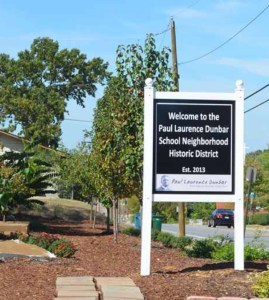
The Paul Laurence Dunbar School Historic District played an important role as the center of Little Rock’s African American community from the mid-1800s to the mid-1900s.  Development began around Wesley Chapel, organized in 1853.

The neighborhood expanded after the Civil War to become home to many African Americans noted for their success in a number of fields, including business, politics, religion, education, law, music, and medicine. Among the historically black institutions that were founded in the neighborhood and remain there today are several churches, including Wesley Chapel United Methodist, Bethel A.M.E., Mount Pleasant Baptist, Mount Zion Baptist, and Union A.M.E.; and two colleges, Arkansas Baptist and Philander Smith.

The existing Dunbar School replaced an older high school that was named for Mifflin Gibbs, a prominent African American lawyer and political leader who lived in the neighborhood.  Today, Gibbs Elementary School continues the recognition of Gibbs.

The app, funded by a generous grant from the Arkansas Humanities Council, was a collaboration among UALR’s Institute on Race and Ethnicity, the City of Little Rock, the Mayor’s Tourism Commission, and KUAR, UALR’s public radio station, with assistance from the Little Rock Convention and Visitors Bureau.

Black History Month Spotlight – Dunbar High School

dunbarimage2The new Arkansas Civil Rights History Audio Tour was launched in November 2015. Produced by the City of Little Rock and the University of Arkansas at Little Rock allows the many places and stories of the City’s Civil Rights history to come to life an interactive tour.  This month, during Black History Month, the Culture Vulture looks at some of the stops on this tour which focus on African American history.

After Little Rock High School (now Central High School) was completed in 1927, the building of Paul Laurence Dunbar High School was completed in 1929.  Money came from the Rosenwald Fund, founded by Julius Rosenwald, president of Sears, Roebuck and Company, and from local black residents.  Local blacks insisted on adding college preparatory classes to the vocational-industrial ones that were offered in black schools at the time. The building, modeled after the white high school, housed grades seven through twelve plus a junior college.  Black students came from all over Arkansas to take advantage of its educational opportunities.

When Horace Mann High School opened as a segregated school in 1956, Dunbar became a junior high school. A Dunbar-Mann Alumni Association, whose members live throughout the country, still helps to support both schools.  In the 1930s, Charlotte Andrews Stephens, the first black public school teacher in Little Rock, was on the faculty at Dunbar, completing seventy years of teaching with the district.  In the 1940s, Sue Cowan Williams, English Department chair, lost her job when she sued the Little Rock School District for equal pay for black and white teachers.

The app, funded by a generous grant from the Arkansas Humanities Council, was a collaboration among UALR’s Institute on Race and Ethnicity, the City of Little Rock, the Mayor’s Tourism Commission, and KUAR, UALR’s public radio station, with assistance from the Little Rock Convention and Visitors Bureau.

PIGSKIN TURKEY DAY IN THE ROCK, Part 1 – The Beginning and the End

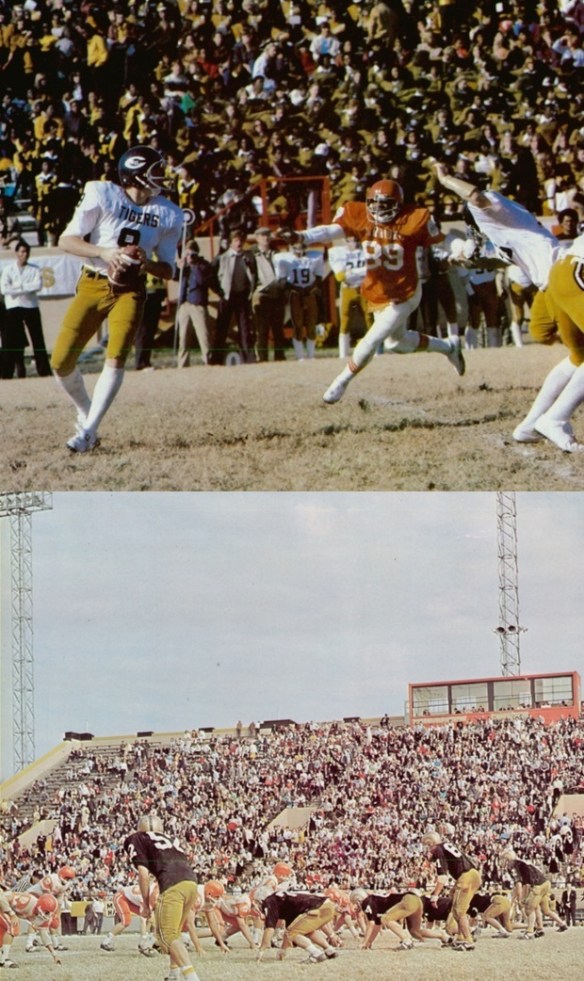
Turkey Day Header101 years ago, Little Rock High School (then located on Scott Street) kicked off a 69-year tradition of playing football on Thanksgiving Day.  (Though the date of Thanksgiving floats anywhere from the 22nd to the 28th, as with this year, Thanksgiving Day 1914 was on November 26.)

From 1914 until 1933, the Little Rock High School Tigers played a variety of different schools.  Then from 1934 until 1957, they played North Little Rock. From 1958 until 1982, the Little Rock Central Tigers took on the Warriors of Little Rock Hall.

Thanksgiving Day football was a tradition not just for high schools in Little Rock but also all levels throughout the state and country.  The Friday after Thanksgiving, newspapers carried stories and scores for professional, college and high school football.  It was probably the only day of the year to see all three levels of football covered in the paper, and often high school games received the most ink.  This mix of football continued for decades.  In 1969, there were four football games played in Pulaski County on Thanksgiving Day: Little Rock Hall vs. Little Rock Central, Little Rock Catholic vs. North Little Rock, Horace Mann vs. Scipio Jones, and the Arkansas Razorbacks vs. Texas Tech.

By the 1970s, both high school and college football games on Thanksgiving were on the wane.  While college games on Turkey Day have regained some popularity, they are nowhere near approaching the level they once had.  High school football on Thanksgiving disappeared in Arkansas following the 1982 game between Hall and Central.  That rivalry had been the final series on Turkey Day to still be played.

While they lasted, Thanksgiving Day high school football games were civic focal points. They were about bragging rights.  For students who had grown up attending the games, the chance to play or cheer in a Turkey Day classic was a rite of passage.  Alumni home from college or visiting the family for Thanksgiving would descend on the stadium ensuring the largest attendance of the season.

High school football on Thanksgiving Day in Little Rock tells the tale of not just football; it reflects changes in the city and society.  What started out as two small high schools from neighboring cities changed as both schools grew. The addition of a second Little Rock high school reflected the city’s growth.  (Indeed the 1954 Little Rock High School yearbook, in discussing the school’s new designation as Central High, mentions vaguely that the second high school would be built at some yet to be determined location in “west” Little Rock.)

The presence of segregated high schools in separate but unequal football rivalries (lasting nearly two decades after the Supreme Court’s Brown v. Board decision) is an indictment of an unjust parallel education system.  As Little Rock continued to grow and diversify, the two high schools playing on Thanksgiving were no longer always the predominant schools in football – or other activities.  With state championships once again on the line, the last few years of the Hall and Central Thanksgiving rivalry were, in a way, a return to the halcyon days of the early faceoffs (though this time, thankfully, with fully integrated teams). In addition to trading the top spots in football, the two schools were piling accolades. In fact, all three Little Rock public high schools had achieved a stasis that inadvertently rotated areas of excellence academically, athletically and artistically fairly equally among the three.

There were undercurrents at work that hinted at future instabilities to come.  Indeed by 1982, the same year of the final game, Little Rock had filed suit against the North Little Rock and the Pulaski County Special School Districts claiming the schools in those neighboring districts were siphoning off white students from the Little Rock schools. The ensuing realignment of schools and districts would probably have brought an end to Central vs. Hall games even if athletic reclassification had not.

Central is now over twice the size of Hall, Parkview is a magnet school, two formerly county high schools (and several elementary schools and junior highs) were brought into the LR school district in the late 1980s.  Where once the Little Rock high schools were roughly equal in enrollment, they now are so varied they play in three different classifications.

It is up to the alternative historians to envision what continued Turkey Day classics would have looked like after 1982. Little Rock has grown and diversified. There are five public high schools and five private high schools playing football within the Little Rock city limits each season. With all these competing interests it is unlikely to envision the same citywide level of interest in one football game.

But back in the day…

Black History Month Spotlight: Gertrude Hadley Jeannette

bhm gertrudePlaywright, producer, director, and actress of the stage and screen, Gertrude Hadley Jeannette, was born in Urbana, on November 28, 1914, to Willis Lawrence Hadley and Salley Gertrude Crawford Hadley. She attended Dunbar High School in Little Rock. Just before her high school graduation, Jeannette decided that she wanted to get married instead of attending Fisk University, as she had previously planned.  She and Joe Jeannette II, a prizefighter and the president of the Harlem Dusters, a motorcycle club, eloped to New York City in 1934.

In New York City, Jeannette learned to drive; in 1935 she became the first woman to get a license to drive a motorcycle. In 1942, because of the shortage of male taxicab drivers caused by the war, Jeannette became the first woman to drive a cab in New York City. During this time, Jeannette decided to further her education; she took bookkeeping classes in the basement of Abyssinian Baptist Church, and speech classes at the American Negro Theatre in order to remedy her speech impediments.

In 1950, she appeared on television in James Weldon Johnson’s Gods Trombone on CBS’s General Electric Hour; she had replaced Pearl Bailey, who was originally cast in that role. As a result, Jeannette continued to work both in the theatre and in film and television. Some of Jeannette’s film credits included ShaftBlack Girl, and Cotton Comes To Harlem.  Her Broadway credits include Lost in the Stars, The Long Dream, Nobody Loves an Albatross, The Amen Corner, Vieux Carre and a revival of The Skin of Our Teeth.  Off Broadway she starred in To Be Young, Gifted and Black.

In 1979, Jeannette founded the H.A.D.L.E.Y. Players (Harlem Artists Development League Especially for You) in the Harlem neighborhood of New York City. The mission of the H.A.D.L.E.Y. Players was to give artists a chance to develop their talents and skills in the theatre, and to enrich the cultural life in Harlem. Jeannette went on to direct, produce, and write her own plays, as well as the works of other playwrights.

Jeannette was presented with several awards for her work and accomplishments. In 1991, Jeannette was honored as a living legend at the National Black Theatre Festival in Winston-Salem, North Carolina, and in 1998, she was honored with the Lionel Hampton Legacy Award. Jeannette was inducted into the Arkansas Black Hall of Fame in 1999, and in 2002, she received the prestigious Paul Robeson Award from the Actor’s Equity Association. Jeanette, though retired, remained active and celebrated member of the New York theater scene well into her nineties.

For more on Gertrude Hadley Jeannette and other inductees into the Arkansas Black Hall of Fame, visit the permanent exhibit at the Mosaic Templars Cultural Center. That museum is an agency of the Department of Arkansas Heritage.

Black History Month Spotlight – Dr. Erma Glasco Davis

Photo by Staton Breidenthal for the Arkansas Democrat-Gazette

Photo by Staton Breidenthal for the Arkansas Democrat-Gazette

Erma Lee Glasco Davis was born in Keo, Arkansas and was reared in south central Little Rock, also known as the South End.  She is a product of the Little Rock Public School System, graduating from Dunbar High School in May, 1945.  She received her Bachelor of Science degree from AM&N College (now the University of Arkansas at Pine Bluff).  A year or so after the Central High desegregation crisis of 1957, she and her husband moved to Detroit, Michigan and the Doctor of Philosophy degree from the University of Michigan at Ann Arbor.

Most of Dr. Davis’ professional career was spent in Detroit, Michigan  as a teacher, counselor and administrator.  She retired from an administrative position in the Detroit Public Schools’ Management Academy.  She also taught as an adjunct professor at Marygrove  College in Detroit.  While in Detroit, Dr. Davis has had a wealth of community involvement, serving in leadership positions on boards and committees and in organizations ranging from the NAACP to Alpha Kappa Alpha sorority.  In 1979, she co-chaired the Mayor’s Education Task Force for Detroit’s International Year of the Child event.  In 1987, she won the Spirit of Detroit Award, the city’s highest community-service award.

Dr. Davis is a past national president of the National Dunbar Alumni Association, and is co-author of a book about the school, Paul Laurence Dunbar High School of Little Rock.  She has been instrumental in marrying the goals of the association with those of the Mosaic Templars Cultural Center, the state-funded museum which showcases the history and achievements of black Arkansans.  A fruit of that marriage is the museum’s Dunbar exhibits on the museum’s first floor.  She is passionate about educating people on Dunbar’s role in the state’s history.

In 1990, Dr. Davis moved back to Arkansas form Michigan.  After her return, she quickly busied herself with community work, sitting on the boards of the Central High Museum and the Arkansas Humanities Council; taking two turns as chairman of the board of the Historic Arkansas Museum Foundation; she also chaired the gala for the opening of the Mosaic Templars Cultural Center.  In addition, Dr. Davis worked nearly four years as a founding volunteer for the Clinton Presidential Central.  In 2005, she was appointed by then-Governor Mike Huckabee to the State Review Committee for Historic Preservation, and reappointed by Governor Mike Beebe in 2007.  In 2009, she was inducted into the Arkansas Black Hall of Fame.

For more on Dr. Davis and other inductees into the Arkansas Black Hall of Fame, visit the permanent exhibit at the Mosaic Templars Cultural Center. That museum is an agency of the Department of Arkansas Heritage.


Black History Month Spotlight – Annie Abrams

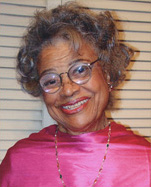
bhm annieThis year during Black History Month, the Culture Vulture will look at 28 cultural leaders who have Little Rock connections and have been inducted into the Arkansas Black Hall of Fame.  Though presented in alphabetical order, up first is a personal friend of the Culture Vulture – Annie Abrams, or as she is affectionately known, Miss Annie.

Annie Mable McDaniel Abrams is a retired educator by trade and civic activist by avocation.  She is included in this list because she is also a historian.  As a writer and preservationist, she has worked to document history and ensure historical properties and neighborhoods will long remain in Little Rock.

Born in Arkadelphia, she moved to Little Rock at age 13 to attend Dunbar Junior High School and High School.  She studied education at Dunbar Junior College and later taught in Marianna. In 1956, she returned to Little Rock to work for the Arkansas Teachers Association.  After her return to the capital city, she married Orville Abrams.  In addition to raising her four children, Miss Annie has helped raise countless others through her advice, support, love, and sometimes strong admonitions.  She also found time to return to school and receive a degree from Philander Smith College.

Among her many accomplishments are leading efforts to rename High Street for Martin Luther King, 14th Street for Daisy L. Gatson Bates and 20th Street for Charles Bussey.  Through her community activities, she had worked closely with both Bates and Bussey.  She was a friend to the Little Rock Nine (who were only a few years younger than she) and to their families. Perhaps, because she has been a personal friend of many Arkansas and national politicians over the past 60 years, it should come as no surprise that she and her husband were also acquainted with Governor Faubus.

Whether a leading political figure or a small child, Miss Annie isn’t afraid to give advice or to share her love.  Once an educator, always an educator, she loves to learn and teach. It is rare for her to miss a speech at the Clinton School or a Political Animals Club meeting.

In recognition of all her efforts she has been recognized with an honorary doctorate from Philander Smith College, the Brooks Hays Award, and an award award from the national Martin Luther King Jr. Commission.  In 2010, she was inducted into the Arkansas Black Hall of Fame.

For more on Annie Abrams and other inductees into the Arkansas Black Hall of Fame, visit the permanent exhibit at the Mosaic Templars Cultural Center. That museum is an agency of the Department of Arkansas Heritage.

Paul Laurence Dunbar School Neighborhood Historic District listed in the National Register of Historic Places.

dunbarimage2

Built as Paul Laurence Dunbar High School, this building is now known as Dunbar Middle School. It is the centerpiece of the Dunbar Neighborhood.

Earlier today, Little Rock Mayor Mark Stodola and Director of the Arkansas Historic Preservation Program Missy McSwain announced the listing of the Paul Laurence Dunbar School Neighborhood Historic District in the National Register of Historic Places and discuss what that means for the City of Little Rock.

This designation is the result of several years of hard work by members of the community.  This National Register listing formally documents the neighborhood’s history, development and contributions to the City of Little Rock.  It also provides an incentive in the form of rehabilitation tax credits for many of the properties within its boundaries.

Paul Laurence Dunbar School Neighborhood Historic District in Little Rock contains buildings dating to 1890. According to the National Register nomination, the district is representative of the evolution of a neighborhood from an integrated working and middle-class neighborhood in the late-nineteenth and early-twentieth century to a predominantly African-American working and middle-class neighborhood in Little Rock by the 1960s. Resources within the District reflect the varied architectural styles prevalent during the late nineteenth and early-to-mid-twentieth centuries. Properties in the district exhibit a broad mix of influences and architectural variants popular during the period, influenced by regional and ethnic traditions.

The National Register of Historic Places is the official list of the Nation’s historic places worthy of preservation. Authorized by the National Historic Preservation Act of 1966, the National Park Service’s National Register of Historic Places is part of a national program to coordinate and support public and private efforts to identify, evaluate, and protect America’s historic and archaeological resources.

Also at the press announcement, Hearne Fine Art unveiled a new sculpture, “Three Rings: Tribute to Isamu Noguchi.”