Little Rock Look Back: Roswell Beebe receives Little Rock land title

Map showing boundaries of original City of Little Rock

Map showing boundaries of original City of Little Rock

On September 25, 1839, businessman Roswell Beebe received title to all of the land in Little Rock.

Starting in the 1810s, there had been much dissension as to who had title to land in what would become Little Rock.  As the settlement developed into a town and city, these disagreements became greater. Often land speculators would sell land to settlers without having the right to do so.

Coming to Little Rock in 1835, Beebe was a witness to the continued uncertainty over land ownership.  In early 1839, he acquired 240 acres which had the only incontestable title in town. This acreage comprised most of Little Rock. He went to Washington DC in 1839 and, on September 25, received the original patent for the town of Little Rock, signed by President Martin Van Buren. It is recorded in the Pulaski county recorder’s office Book L, page 312.

Upon his return, Beebe gave all the people who had bought lots from a certain real estate developer, whom he considered to be fair and honest, title to their land for a dollar. In December 1839, he drew up a plan for Little Rock, laying off blocks and streets. He deeded the streets and alleys to the city for a dollar. He gave the state the title for the land on Markham Street, where the new capitol building (now the Old State House Museum) was located.  He also donated part of the land for Mount Holly Cemetery, the other portion came from his brother-in-law Chester Ashley.

Little Rock Look Back: Mayor John E. Knight

Jno E Knight sigOn September 20, 1816, future Little Rock Mayor John Elliott Knight was born in Newburyport, Massachusetts. In 1843 he married Hannah Donnell in New York, and came to Little Rock that same year.

Knight was editor of the Arkansas Democrat from 1846 to 1850. He was also associated with the Arkansas Gazette and published the short-lived Chronicle. In 1851, Knight served as Mayor of Little Rock. In 1855, he served as a member of the City Council.

In 1858 a song was published entitled “I Am Near to Thee” which featured music by Arkansan Benjamin Scull and lyrics by Knight.  The song was dedicated to Mary Woodruff.

During the Civil War, he served as a Colonel.  During the 1850, 1860 and 1880 census, he was listed as an attorney.

He had one daughter, Elizabeth Knight, who married James S. Pollock, a banker in Little Rock. Knight died in Little Rock, Arkansas, on October 28, 1901, and was buried in Mount Holly Cemetery. Elizabeth Knight Pollock died in 1910.

As an attorney and newspaper editor, John E. Knight collected documents about the settlement of Little Rock. Those papers are now part of a collection at the Arkansas History Commission.  The majority of these papers are from William Russell to Chester Ashley, pertaining to pre-emption claims in and around Little Rock. Other material concerns the 1819-1822 dispute related to the the New Madrid Certificate and pre-emption claims of James Bryant, Stephen F. Austin, and William M. O’Hara.

Little Rock Look Back: Mayor William Ashley

W E Ashley signature

On August 6, 1823, future Little Rock Mayor William Eliot Ashley was born in Little Rock.  He would go on to become the first Little Rock Mayor to be born in Little Rock.  Ashley was the son of Mary and Chester Ashley; his father would later serve as a U. S. Senator from Arkansas.  He was the second of the couple’s seven children.

Though he was raised in Little Rock, he did receive some schooling out of state. The State History Commission has correspondence between eleven year old William, studying in New York, and his father. Part of the letter is a request for money.

On October 26, 1846, he married Frances Eliza Grafton at Christ Episcopal Church.  They were the first Little Rock residents to be married in that church.  The couple had five children, including triplets.  Only one of the children, Frances (who was one of the triplets) survived to adulthood.

Ashley was first elected Mayor of Little Rock in 1857. After completing a two year term, he was succeeded by Gordon N. Peay (another scion of a prominent Little Rock family).  In 1861, Ashley returned to the office of Mayor.  He was reelected to a third term in 1863.  In September 1863, following the defeat of Confederate troops by the Union forces at the Battle of Little Rock, the City of Little Rock ceased operations.  On September 21, 1863, Little Rock municipal government closed its doors, stopped collection of taxes and disbanded.  Thus Ashley’s third term ended.

In addition to his interest in local government, Ashley was a member of St. John’s College Board and a director of the newly-formed Little Rock Gas Company.

William Eliot Ashley died on August 16, 1868, at the age of 45.  He was buried in Mt. Holly Cemetery (which sat partially on land that had once belonged to his family). His parents, wife and children are all buried in Mt. Holly as well.

Interestingly, for someone who grew up in a prominent family, there does not appear to be a surviving likeness of Mayor Ashley – either in painting or photograph.  Several exist of his parents, but none of him.

Little Rock Look Back: Mayor James A. Woodson

IMG_0298On July 14, 1848, future Little Rock Mayor James Alexander Woodson was born in North Carolina.  The son of two prominent eastern families, he and his parents moved to Pine Bluff in 1849.  His father died within two weeks of the family’s arrival in Arkansas.

With the outbreak of the Civil War, he enlisted as a drummer boy in the Ninth Arkansas infantry but was discharged because of his youth. He worked as a clerk at a general store in Pine Bluff. After the Civil War ended, he attended school in Virginia and Maryland before returning Pine Bluff. Upon his return he worked in the steamboat business and eventually started working in railroads. He was instrumental in putting together one of the forerunners of the Missouri Pacific Railroad and worked for them for 18 years.

Woodson moved to Little Rock in March 1881 and continued working for the railroad until 1891.  Working in the mercantile business allowed him more time to be engaged in civic affairs.  In 1895 he was elected mayor.   He handily defeated former mayor W. G. Whipple who was seeking to return to office.

During Mayor Woodson’s tenure, he oversaw renovations of the 1867 Little Rock City Hall (which was located at the time on the north side of Markham between Main Street and Louisiana Street).  He also championed the construction of a city hospital and the first free bridge across the Arkansas River.  Mayor Woodson was reelected in April 1897 and April 1899.

In April 1890, he resigned to take over the Arkansas and Southwestern Railway.  After restoring it to sound financial footing, he later led the Arkansas Asphalt Company.  That company provided the first asphalt for paving Little Rock city streets.

Woodson served as a director of the Little Rock board of trade (forerunner to the Little Rock Regional Chamber of Commerce), director of the Mercantile Trust Company and president of the state board of trade (forerunner of the Arkansas State Chamber of Commerce).

Woodson married Virginia Lanier in 1868.  They had six children, five of whom lived to adulthood.  Mayor Woodson died on October 19, 1908 and is buried in Mount Holly Cemetery.  His wife lived until 1937 and is buried next to him.  Also buried in Mount Holly are their children James Alexander Woodson, Benjamin Morehead Woodson and Gertrude Woodson Hardeman; each of whom died before their mother.  Mrs. Hardeman’s husband and son are also buried in Mount Holly.

In 2013 and 2014, Mayor Woodson was one of the characters portrayed at the annual Parkview High School “Tales from the Crypt” program at Mount Holly.

Some have noted his resemblance to actor Nick Offerman of the show “Parks and Recreation.”  Here is a Six Degrees game to link the two.

  • James Woodson
  • The Woodson community and Woodson Lateral is named for him
  • Growing up in the area, actor Billy Bob Thornton has been to Woodson Lateral
  • Bruce Willis appeared in BANDITS with Thornton.
  • “Friends” featured Willis and Paul Rudd as multi-episode guest stars
  • Rudd appeared in “Parks & Recreation” as a multi-episode guest star
  • Nick Offerman starred in “Parks & Recreation”

Little Rock Look Back: Mayor Matthew Cunningham MD, a man of many firsts

M_Cunningham_fFuture Little Rock Mayor Dr. Matthew Cunningham was born on July 5, 1782, in Pennsylvania. After receiving his medical degree from the University of Pennsylvania, he ended up in New York City.  He also served in the Army during the War of 1812.

It was there he met and married a young widow, Eliza Wilson Bertrand. After a brief stint in St. Louis, Dr. Cunningham was one of the first settlers of Little Rock in February 1820. With his arrival, he became the first physician in Little Rock.

In September 1820, Mrs. Cunningham and her children joined him. She became the first female in the Little Rock settlement. Dr. and Mrs. Cunningham had a son, Chester, who was the first white baby born in Little Rock. (Though not supported by any public records, there is some unsubstantiated thought that one of the African-American slaves they had gave birth to a child before Chester was born.) The Cunninghams had several other children.  One daughter, Matilda, would marry Little Rock businessman Peter Hanger.  (The Hanger Hill neighborhood is named after Peter Hanger.)

In 1831, Dr. Cunningham was elected the first Mayor of Little Rock. He won the race 23 to 15 over Rev. W. W. Stevenson. The first City Council meeting took place at the Cunningham house on the block which is the southwest corner of what is now 3rd and Main Streets. Records are incomplete as to where on the block the Cunningham house was located, but a plaque is on 3rd Street near Main on the side of the Fulk Building which CJRW is now renovating for their future office space.

Dr. Cunningham served one year as Mayor. He lived until June 15, 1851 and is buried at Mount Holly Cemetery. His wife, son, and the Hanger family are buried next to him.

His stepson – Charles P. Bertrand – also served as Mayor of Little Rock.  Descendants of Dr. Cunningham still reside in Little Rock.

Stars & Stripes & Rock

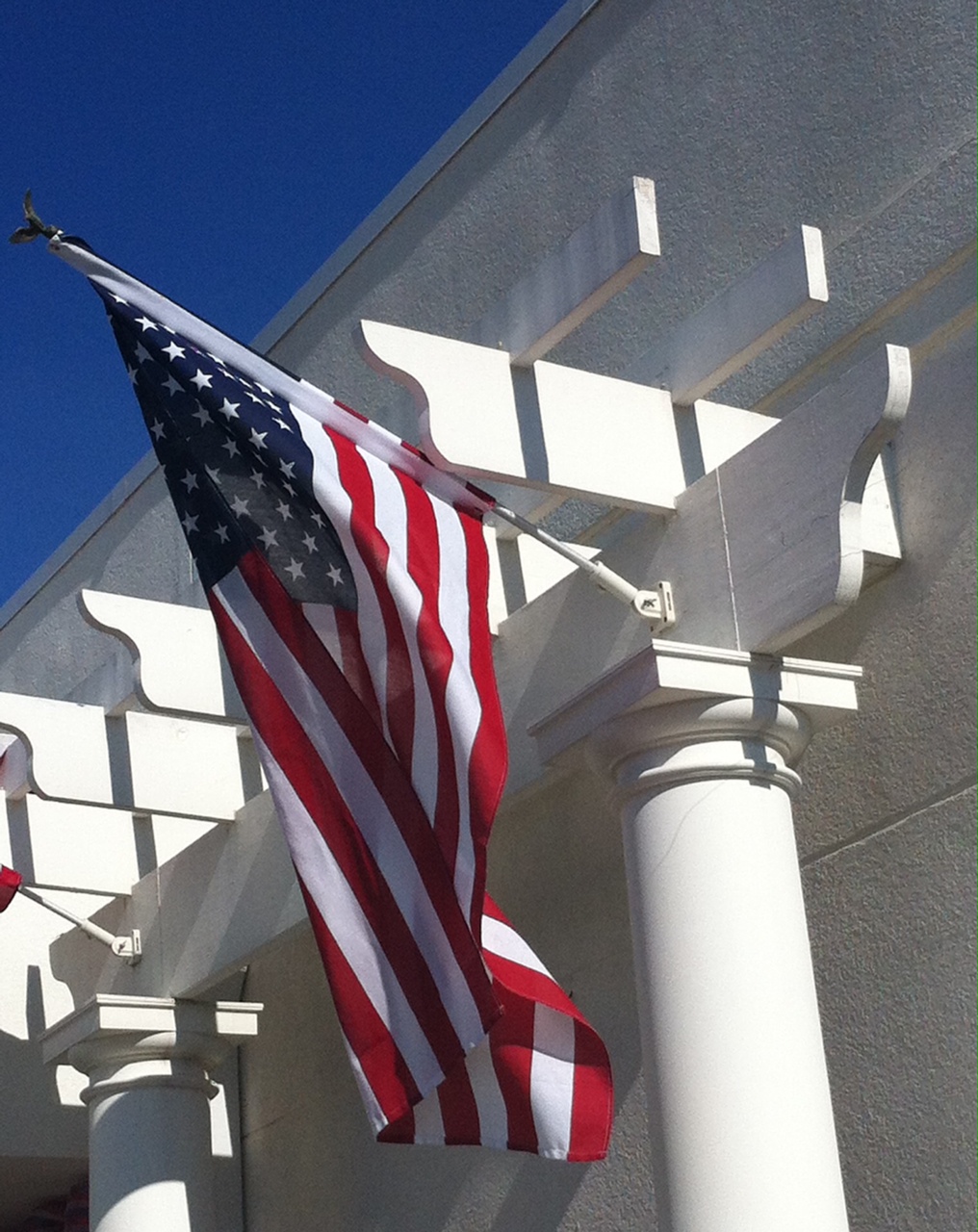
Today is Flag Day.  Here are a few of my favorite photos of the Stars and Stripes taken in Little Rock.

Flag outside of Tipton & Hurst main store in Heights

The red, white and blue stand out against the night sky and limestone of the Arkansas State Capitol.

The stars and stripes unfurled from the balcony of the Capital Hotel.

Flag Day 4

Heritage Month – Mount Holly Cemetery

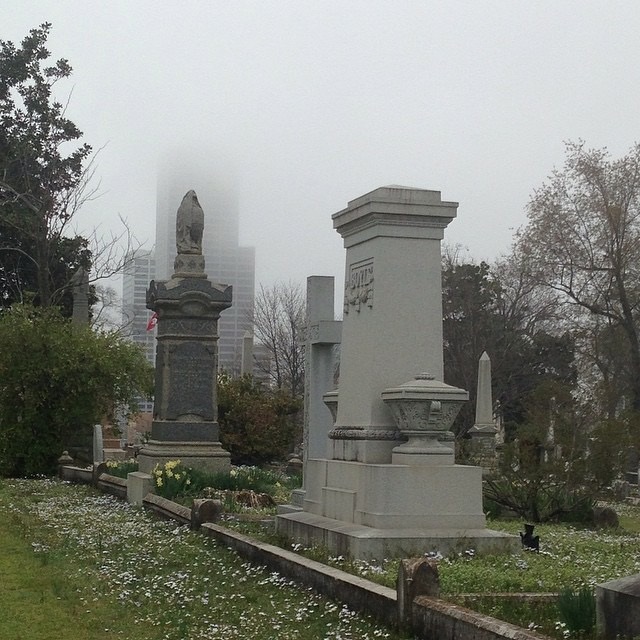
Mount Holly greyMount Holly Cemetery is an area equal to four city blocks of the City of Little Rock.  The main entrance on Broadway is marked by an imposing structure of stone and iron, and the four block square area is enclosed in a stone and iron fence which dates from 1881.

The cemetery has a park-like appearance, generously shaded with tall and stately trees. Many of these trees are so old as to have trunk diameters in excess of 33 inches.  Mount Holly is quaint, imposing, and inspiring. It provides examples of over 170 years of funerary sculptures which range from the simple, traditional, chiseled stones of the middle 19th century to the ornate and grandiose monuments of the 1880-1890 period.  While Mount Holly may be notable for the many dignitaries who reside there, over the years persons of all economic backgrounds and races have been buried there.

After planning for a larger cemetery started in 1839, the first burial took place in 1843.  The land for the cemetery was donated by Chester Ashley and Roswell Beebe, both of whom are buried there.  Veterans of all U.S. wars dating from the War of 1812 are buried in Mount Holly Cemetery.

While today there are no more plots available for burial, there are spots available in the columbarium. A City cemetery, it has been governed by the Mount Holly Cemetery Association since 1915. Later this summer, that organization will celebrate its 100th birthday.

On March 5, 1970, Mount Holly Cemetery was added to the National Register of Historic Places.