Heritage Month – Fordyce House

FordyceThe Fordyce House was built in 1904 for Mr. and Mrs John R. Fordyce.  The house was designed architect Charles L. Thompson in an Egyptian Revival style.  The Egyptian Revival style is rarely seen in houses in the United States,  major features of the style include the porch columns resembling bundles of stalks tied together and flared at the top and the “battered” walls that slant inward as they rise.

The Fordyce ‘s lived in the house until 1920 when it was sold to James Shipton who lived in the house until 1950.  The house has remained a single family home through the years.

It was added to the National Register of Historic Places on August 9, 1975.

Heritage Month – Fones House

FonesThe Fones House, located at 902 West Second, has two areas of significance.  Architecturally, the house is a leading example of the Victorian Italianate style, which is rare in Little Rock.  Secondly, the builder, Daniel G. Fones, was a leading Little Rock businessman.

The two and one-half storey Fones House is constructed of red brick.  The exterior features a bracketed frieze topped by a steep gabled roof with wrought iron cresting, decorative window heads in several different styles and ornately railed balconies.

Daniel Gilbert Fones was born in Decatur, Georgia, on August 19, 1837, the eldest son of Alvan T. and Adelia A. Cone Fones.  Though raised in relatively luxurious surroundings, after his father’s death he was apprenticed as a tinsmith at the age of 15.  In 1855, he came to Pine Bluff, and in 1859, moved to Little Rock.  That year, he formed the Fones Brothers’ partnership which would eventually became known as Fones Brothers’ Hardware and existed until 1987.

At the outbreak of the Civil War, Fones enlisted in the Confederate Army; after the war he returned to Little Rock.  He remained a civic leader throughout the rest of his life.  The Fones House was constructed in 1878 for Fones and his wife.

Fones was president of the Fones Brothers’ Hardware Company, President of the Arkansas Building and Loan Association, Vice President of the Equitable Building and Loan Association, President of the German National Bank and was associated with many other financial enterprises.  He served as an alderman in Little Rock and in 1916 was elected to the Little Rock School Board.

Fones married Texanna Dustan Reaves on May 30, 1867, who died in 1893.  In 1899 he was married to Mrs. James Hennegan Tucker.  Fones, who had no descendants, died May 28, 1916.

The Fones House was added to the National Register of Historic Places on August 19, 1975.

Heritage Month – Curran Hall

Curran HallCurran Hall, sometimes known as the Walters-Curran-Bell House, stands at 615 East Capitol Avenue and is one of the few remaining antebellum properties in Little Rock.  It was built in 1842 and was listed on the National Register of Historic Places on January 1, 1976.

Curran Hall was constructed in the Greek Revival style. The original one-story structure of the house was made with walls three bricks thick, cypress interior and exterior, and solid wood trimming and was settled on a raised foundation. The original interior floor plan was a four-room, central-hall type, although it was later added to by various owners. Each of the four rooms contains its original fireplace and classically designed mantel. The original interior of the house remains relatively undisturbed; however, the two rear additions have been fully transformed. In 1848, a children’s playhouse was constructed at the back of the house. The existing playhouse was reconstructed in the 1960s with materials from various historic houses in Little Rock.

Over the years, Curran Hall has been owned by several important Arkansas families. It changed hands fairly frequently from 1842 until the 1881.  At that point in time, Mary Eliza Bell, the daughter of Gazette founder William E. Woodruff moved in.  Her descendants stayed in the house until 1993.  In 1996, the structure was sold to the City of Little Rock.  The City’s Advertising & Promotion Commission and a private foundation raised money to restore the building.  After six years and $1.4 million, the house was formally opened to the public as the Little Rock Visitor Information Center on May 18, 2002.

In March 2007, the Quapaw Quarter Association took over the management of Curran Hall as the City’s official visitor information center.  The building is open daily for visitors to tour as well as learn about activities throughout the City.

Today, (Sunday, May 10), Curran Hall is one of the featured properties on the 51st Annual Quapaw Quarter Association Spring Tour of Homes.

Heritage Month – Hinderliter House

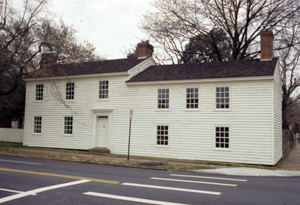
HinderliterThe Hinderliter House is the oldest building still in existence in Little Rock.  It is now part of the Historic Arkansas Museum.

The Hinderliter Grog Shop began as a log structure in 1826-27 by Jesse Hinderliter, a man of German descent. It was his home and business, where he lived with his wife and two slaves until his death in 1834. Popular folklore associates the building with the last meeting of the territorial legislature of 1835. Red oak logs and cypress flooring were used in the grog shop’s construction. The clapboard siding and porch were later additions. Inside, the hand-carved federal mantel in the formal dining room shows that style was important, even in a log house on the frontier.

Many modifications were made to the building over the years.  Work to restore it in the late 1930s and again in the late 1960s removed many of these alterations.

The Hinterliter House and other structures on the Historic Arkansas Museum can be toured daily. They are being showcased today (May 9) as part of HAM’s 42nd Annual Territorial Fair.

The Hinderliter House was added to the National Register of Historic Places on March 5, 1970.

Heritage Month – Corydon Wassell House

Corydon WassellThe Corydon Wassell House is a one-and-one-half story wood framed Victorian cottage.. The 1882 house is located at 2005 South Scott Street, outside both the Governor’s Mansion and MacArthur Park Historic Districts. There are quite a few Victorian cottages in the vicinity, but it was added to the National Register of Historic Places on June 2, 2000, in recognition of it being the birthplace and residence of Dr. Corydon Wassell.

Born in Little Rock on July 4, 1884, Corydon McAlmont Wassell (called “Cory”) was born to Albert and Leona Wassell. A grandson of Little Rock Mayor John Wassell, he graduated from what is now UAMS in 1909. In 1911, he married Mary Irene Yarnell, with whom he would have four children.  In 1914, the couple volunteered to be Episcopal missionaries in China.  He served there until 1927. Following Mary’s death and his remarriage, he and new wife Madeline Edith Day Wassell returned to Arkansas in 1927.

Dr. Wassell resumed his medical practice. Given his experience with malaria in China, he proved to be an asset fighting malaria among Civilian Conservation Corps members in Arkansas. He was subsequently called to active duty in the Navy in 1936 and stationed in Key West.

After the outbreak of World War II, he was stationed in Indonesia. In early 1942, he refused to abandon his patients after the Japanese started invading Indonesia. Instead, he was able to evacuate a dozen severly wounded men over 150 miles to get to a ship. It took ten days for the ship to get to Australia, during which time it was attacked numerous times.  His official Navy Cross citation notes that he disregarded personal safety while caring for others.

He became an instant international hero. During the early days of the war, his heroism was one of the few bright spots. James Hilton wrote a biography of him; President Roosevelt praised him in a fireside chat; Cecil B. DeMille filmed a movie with Gary Cooper playing him.

Dr. Wassell’s first cousin, Sam Wassell, was serving on the Little Rock City Council at the time. He would later serve as Little Rock Mayor.

After retiring from the navy with the rank of rear admiral, Dr. Wassell worked for a time without pay at a charity hospital in Hawaii. He eventually returned to Key West, Florida. Later, he returned to Arkansas to be near family. He died on May 12, 1958, in Little Rock at the age of seventy-four. He is buried at Arlington National Cemetery.

Heritage Month – Chisum House

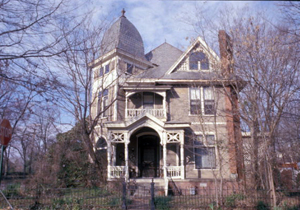
Chisum HouseBuilt in 1894, the Chisum House (located at 1320 Cumberland Street) is a significant example of modified Queen Anne architecture.  It is notable for its architectural oddity in relation to other buildings in Little Rock.  The Chisum House embodies many of the Victorian period characteristics of irregular shape, towers, and multiple gales and bays.  The Chisum House represents the eclectic manner of late nineteenth-century architectural style in America through its use of these characteristics.

The house was built by and has since been associated with families of long social prominence in Little Rock.  Jason Sowell, who built the house, came from a family who had already been leaders in social life in Little Rock for many years; the family had been one of Little Rock’s earliest families.  Jason Sowell’s daughter married into the Chisum family, who were also among the favored social class in Little Rock and were to remain so for many years.

Sowell’s daughter married Oscar Clifton Chisum in 1892.  Chisum was born in Austin, Arkansas, in 1860.  He was associated with a drug firm in Memphis, Tennessee, until he moved to Little Rock in 1892.  Upon moving to Little Rock he assumed the position of Arkansas-Texas representative of a Louisville, Kentucky, hardware firm.

In 1894 Jason Sowell built a house for himself, his daughter, and her husband at 1320 Cumberland Street in Little Rock.  In 1894, Cumberland Street was considered the “elite” section of town, and residence in the area symbolized social and/or financial success.

The Chisums had one son, O. C. Chisum, Jr., who was born June 13, 1899.  He attended the University of Illinois and later was employed with the Internal Revenue Service.  O. C. Chisum, Jr., was the first member of the Arkansas Industrial Board which was created in 1927 by the Arkansas General Assembly.

O. C. Chisum, Sr., lived in the Chisum House until his death in 1924; his son, O. C. Chisum, Jr., lived in the same house until his death in 1937.

The Chisum House is a significant structure in its architectural style.  It has always been one of the most unusual residences in Little Rock.  The aristocratic style of the house reflects the tastes of the man who built it and of the family it housed for many years.

It was added to the National Register of Historic Places on December 4, 1975.

Heritage Month – Choctaw Station

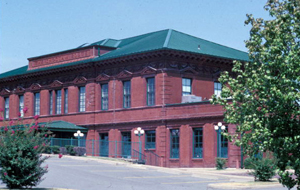
Choctaw StationForty years ago today, on May 6, 1975, Little Rock’s Choctaw Route Station was added to the National Register of Historic Places.

This turn-of-the-century railroad depot is one of the finest examples of railroad, architecture in Arkansas.  This red brick with terra cotta elements building is a two story rectangular structure with one story wings projecting from both the north and south elevations.  A long one story porch covers the passenger loading area along the entire east elevation, with a smaller porch over the entry on the west elevation.

The Choctaw Route Station was built between 1899 and 1901 (records vary) by the Choctaw, Oklahoma and Gulf Railroad.  This railroad amalgamated with many small lines in Oklahoma and extended into Arkansas in the early 1890’s.  Used as a passenger station, the Little Rock terminal building housed two waiting rooms, a baggage room, restaurant and dining room.

When the Choctaw, Oklahoma and Gulf Railroad was sold in 1902, the Choctaw Route Station became the property of the Rock Island Railroad.  Until the mid 1950’s it continued to serve as a passenger station for the Rock Island.  It later served as a warehouse, restaurant and nightclub.

Since 2004, it has been the home to the Clinton School for Public Service as well as Clinton Foundation offices.  Restoration was underwritten by the Roy and Christine Sturgis Foundation. In recognition of this, it is now known as Sturgis Hall.  Former Clinton School Dean David Pryor referred to it as “the little red school house.”

On Earth Day (April 22, 2015), it was announced that Sturgis Hall had received Gold LEED certification from the US Green Building Council.  In August 2009, the Clinton School received a stimulus grant from Governor Mike Beebe to implement sustainable and maintenance practices for reducing the environmental impact of the building. Utility bills costs have already been lowered by $38,000 annually and water usage has been significantly curtailed.

This designation made it the oldest building in Arkansas to be LEED certified and one of the oldest university buildings in the world.  The LEED certification had been a goal of Clinton School Dean Skip Rutherford and Clinton Foundation Executive Director Stephanie Streett.