Heritage Month – Boyle Park

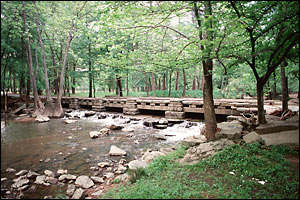
Boyle ParkLocated near the intersection of the western and southwestern neighborhoods of the city of Little Rock, Boyle Park is an approximately 250-acre tract of largely-unimproved woodland donated to the city by Dr. John F. Boyle in 1929. The warranty deed authorizing the transfer of title to the land explicitly stipulated that the park be used for “recreational purposes” only and that should this property ever cease to be used as such the title would revert back to the family and its heirs. At the time of its donation it was only the third public park in the city of Little Rock (the others being MacArthur Park and Allsopp Park).

The park remained largely unimproved until the mid-1930s, when the Civilian Conservation Corps boys arrived (though there seems to be some uncertainty about exactly when the actual construction work began, two different contemporaneous sources reveal that as of the spring of 1935 work had not yet begun, but that by the spring of 1937 work was complete and the unit involved in finishing the work within the park — the 3777th company, originally from West Fork, where they were supposed to be involved in the ongoing construction at Devil’s Den State Park — were wondering where they would be shipped next).

The CCC boys camped at Fair Park (approximately one mile to the northeast) and worked on such improvements to Boyle Park as walls, signage, rest room facilities and a concession building in addition to the resources that survive. Boyle Park forms an historic district that is significant by virtue of its associations with the men that built it, the enrollees of the Civilian Conservation Corps Company 3777, and by virtue of their being outstanding and remarkably intact examples of the Rustic architectural style.

Boyle Park was added to the National Register of Historic Places on September 22, 1995.

Heritage Month – Beal-Burrow Building

Beal BurrowConstructed in 1920, the Beal-Burrow Dry Goods Company Building is believed to have been designed by the architectural firm of Charles Thompson and Thomas Harding (only mechanical drawings are present in the Thompson Archives).

The original owner and user, the Beal-Burrow Company, was founded in 1913 as a wholesale operation and quickly gained prominence on a regional level.  The location of their office and warehouse facilities near the intersection of Main and Markham Streets served to anchor the northern edge of Little Rock’s commercial district.  By 1926, the firm had begun to manufacture work clothes and several floors of this building were devoted to that industry.

In 1955, the Archer Drug Company purchased the building from Berry Dry Goods Company, another wholesale establishment that had earlier bought out the Beal-Burrow partnership.

It is presently part of the Block 2 Development which consists of commercial space on the first floor and loft apartments on upper floors. The Little Rock Tech Park is operating out of space on the first floor of this building.

It was listed on the National Register of Historic Places on June 26, 1995.

Heritage Month – Baer House

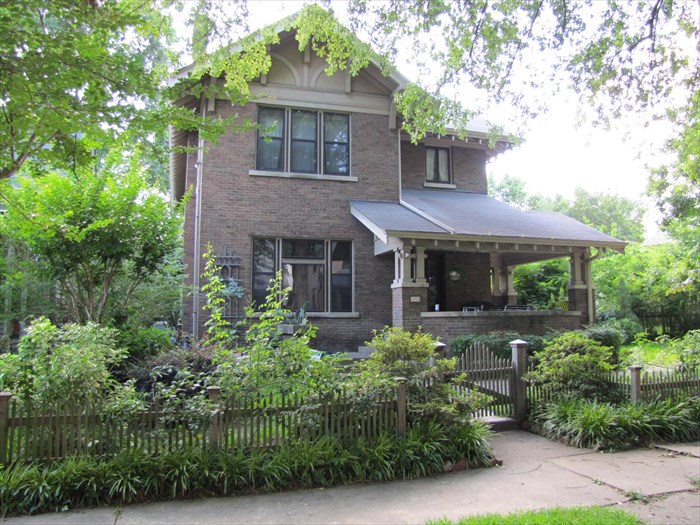
Baer HouseLocated at 1010 Rock Street, the Baer House was designed by the Charles Thompson firm in 1915.

Located in the MacArthur Park Historic District, the house displays a Craftsman Style influence in the abundant use of bracketing and the unusual paired squat box columns resting on brick piers which support the porch, The house has taken an additional historic significance within the district due to the discovery of the original drawings. The Baer House is also an important component of the streetscape and is significant in its representation of the firm’s much used Craftsman design.

It was added to the National Register of Historic Places on June 10, 1975.

Heritage Month – Augustus Garland House

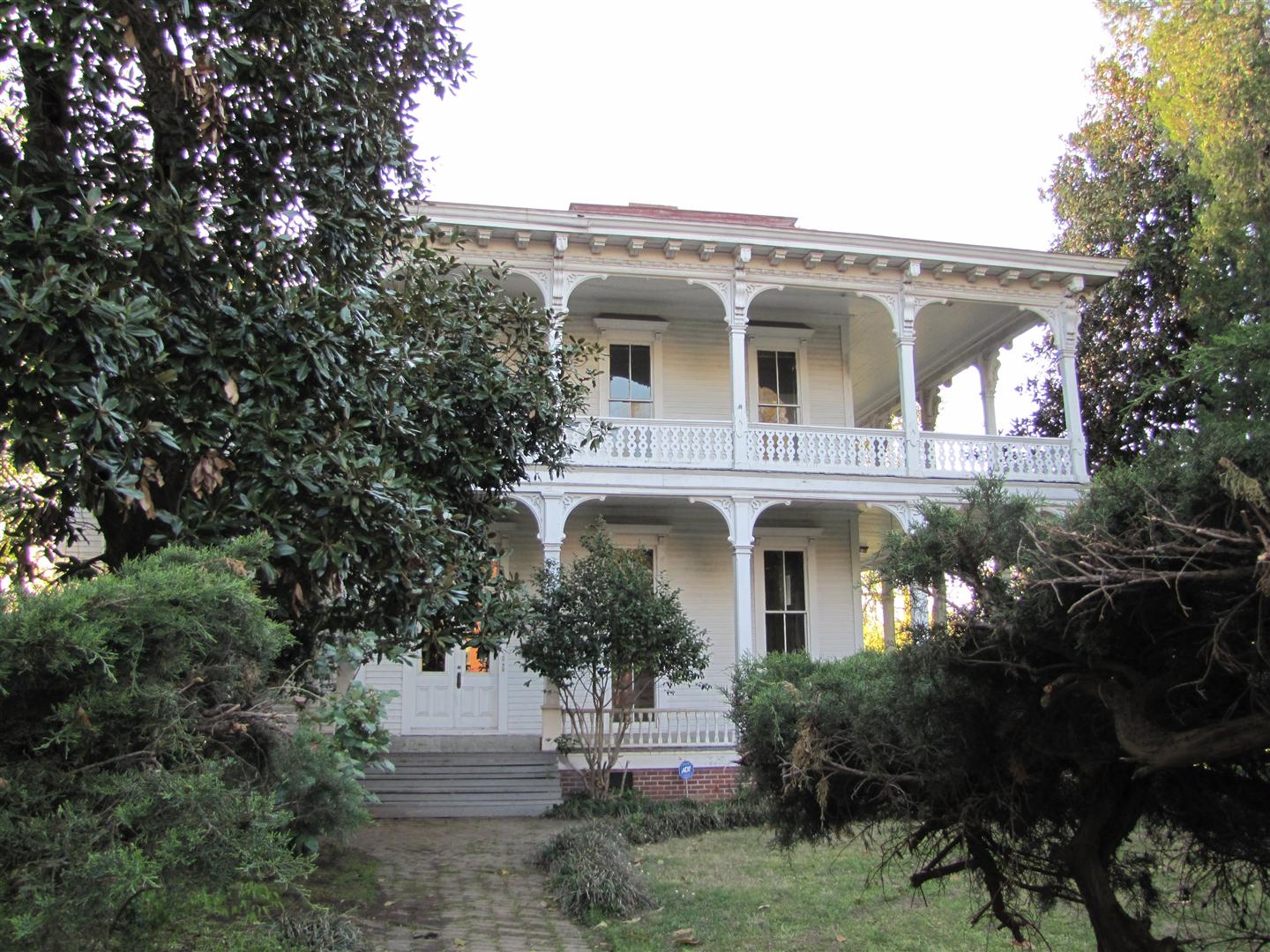
Augustus Garland HouseThe Augustus Garland House, also known as the Garland-Mitchell House, is located at 1404 Scott Street.

Built in 1873, the house has undergone few alterations during the last century. It appears much the same today as when Governor Augustus H. Garland and his family lived there in the 1870’s.  The dominant feature of the house is the two story ell-shaped gallery.

Even though the Garland-Mitchell House has been divided into three separate apartments, the interior still retains its architectural integrity. The wide central hallway which once bisected the entire first floor of the house now terminates at a wall under the stairs which was added in the 1940’s.

Because of the prominent two story porches which are reminiscent of nineteenth century riverboats, the Garland-Mitchell House is locally referred to as “steamboat Gothic” architecture; however, it also has elements of the Italianate Victorian style.

Not only is the building architecturally significant, but as the residence of Augustus Garland, it has other significance.  Augustus Hill Garland was an Arkansas lawyer and politician. He was a senator in both the United States and the Confederate States, served as 11th Governor of Arkansas and as Attorney General under President Cleveland. He was the first Arkansan to serve in the President’s cabinet (and would remain the only one until the Clinton administration). Later, the house served as the residence of Charles Brough while he served as Governor of Arkansas.

It was added to the National Register of Historic Places on June 10, 1975.


Heritage Month – Leiper-Scott House

Leiper ScottMay is Heritage Month in Arkansas.  This month, the Culture Vulture will feature properties on the National Register of Historic Places which are located in Little Rock.  First is the Leiper-Scott House.

The Leiper-Scott House is a one-story structure located at 312 South Pulaski, two blocks east of the State Capitol.

It was built on a lot which slopes abruptly to the rear. Therefore its basement on the rear or west elevation is exposed. The building has a cottage-style plan, combining hip and gable roof form, an asymmetrical front facade, and one floor of usable living space. It is an adaptation of a plan that was popular between 1880 and World War I for modest, low-cost housing.

The Leiper-Scott House is transitional in style, with both Queen Anne and Colonial Revival characteristics. The massing of the building, the steep pitches of the roof and the use of slate infilll in the south elevation pediment are characteristics of the Queen Anne style. Colonial Revival elements include tracery windows, round Roman arches, hipped dormer, Tuscan columns and gable returns.

It was added to the National Register of Historic Places 35 years ago today on May 1, 1980.


LR Cultural Touchstone: Cheryl Griffith Nichols

C NicholsCheryl Griffith Nichols is a historian, with an emphasis on historical structures, who has lived and worked in Arkansas since 1978.

She was born and raised in Indiana and graduated from Hanover College in 1974. After working for three years as the executive director of the Bartholomew County Historical Society in Columbus, Indiana, she enrolled in George Washington University in Washington DC, majoring in American studies with a concentration in historic preservation. While living in Washington, she worked for the National Register of Historic Places.

She moved to Little Rock in 1978, where she married attorney Mark Nichols and completed her Masters degree by writing a thesis on the Pulaski Heights community; the thesis was accepted in 1981. Meanwhile, Nichols became acquainted with Charles Witsell (a prominent Little Rock architect and historic preservation advocate) while he was working with F. Hampton Roy (a Little Rock ophthalmologist, historic preservation advocate and Little Rock City Director) to write a book about the history of Little Rock. Nichols did extensive research for the book, which was published in 1984 by August House as How We Lived: Little Rock as an American City.

Nichols then became a free-lance researcher, operating a business in Little Rock which she called History, Inc. This business did research and documentation of historic structures in Arkansas, mostly but not entirely in Pulaski County. Nichols also worked for the Museum of Science and History (now the Museum of Discovery) in Little Rock, served as the Executive Director of the Quapaw Quarter Association from 1984 through 1987 and again from 1991 through 1997, and wrote several books for the Arkansas Historic Preservation Program (Little Rock: Driving Tour of Three Historic Neighborhoods, 1989; MacArthur Park Historic Tours, 1993, Governor’s Mansion Area, 1993; Historically Black Properties in Little Rock’s Dunbar School Neighborhood, 1999, The Arkansas Designs of E. Fay Jones, 1999, Hillcrest: The History and Architectural Heritage of Little Rock’s Streetcar Suburb, 1999, and Construction of the Military Road Between Little Rock, Arkansas, and Fort Gibson, Oklahoma, 2003.)

She has remained active in historic preservation efforts.  She has served on the board of the Historic Preservation Alliance of Arkansas and the National Trust for Historic Preservation.  She also served on a task force to determine the best use of Curran Hall.  Much of her research has been donated to the Arkansas Studies Institute.

Paul Laurence Dunbar School Neighborhood Historic District listed in the National Register of Historic Places.

dunbarimage2

Built as Paul Laurence Dunbar High School, this building is now known as Dunbar Middle School. It is the centerpiece of the Dunbar Neighborhood.

Earlier today, Little Rock Mayor Mark Stodola and Director of the Arkansas Historic Preservation Program Missy McSwain announced the listing of the Paul Laurence Dunbar School Neighborhood Historic District in the National Register of Historic Places and discuss what that means for the City of Little Rock.

This designation is the result of several years of hard work by members of the community.  This National Register listing formally documents the neighborhood’s history, development and contributions to the City of Little Rock.  It also provides an incentive in the form of rehabilitation tax credits for many of the properties within its boundaries.

Paul Laurence Dunbar School Neighborhood Historic District in Little Rock contains buildings dating to 1890. According to the National Register nomination, the district is representative of the evolution of a neighborhood from an integrated working and middle-class neighborhood in the late-nineteenth and early-twentieth century to a predominantly African-American working and middle-class neighborhood in Little Rock by the 1960s. Resources within the District reflect the varied architectural styles prevalent during the late nineteenth and early-to-mid-twentieth centuries. Properties in the district exhibit a broad mix of influences and architectural variants popular during the period, influenced by regional and ethnic traditions.

The National Register of Historic Places is the official list of the Nation’s historic places worthy of preservation. Authorized by the National Historic Preservation Act of 1966, the National Park Service’s National Register of Historic Places is part of a national program to coordinate and support public and private efforts to identify, evaluate, and protect America’s historic and archaeological resources.

Also at the press announcement, Hearne Fine Art unveiled a new sculpture, “Three Rings: Tribute to Isamu Noguchi.”