Black History Month Spotlight – Arkansas State Capitol

Arkansas birthdayThe new Arkansas Civil Rights History Audio Tour was launched in November 2015. Produced by the City of Little Rock and the University of Arkansas at Little Rock allows the many places and stories of the City’s Civil Rights history to come to life an interactive tour.  This month, during Black History Month, the Culture Vulture looks at some of the stops on this tour which focus on African American history.

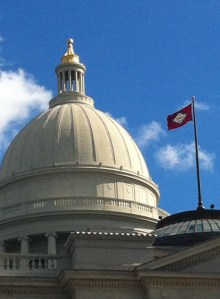
The Arkansas state capitol has been the site of a number of civil rights events over the years. In 1964, Ozell Sutton, a local African American leader, was denied service at the capitol’s basement cafeteria because of his race. The cafeteria then reincorporated as a private members-only club to avoid integration. A number of conflicts occurred when local black students from Philander Smith College and an interracial group of Arkansas Student Nonviolent Coordinating Committee members tried, on several occasions, to desegregate the cafeteria. In 1965, the courts finally ordered the cafeteria to open its doors to blacks and whites on an equal basis.

In 1968, after the assassination of Martin Luther King, Jr., Arkansas governor Winthrop Rockefeller held a memorial service on the capitol steps for the slain civil rights leader—the only southern governor to make such a gesture of reconciliation. His actions are credited with limiting the impact of the violence that rocked other cities in the wake of the King assassination. In 2005, John and Cathy Deering’s “Testament” bronze sculpture of the Little Rock Nine was dedicated on the north side of the building. It was the first civil rights monument erected on the grounds of a southern state capitol.

The app, funded by a generous grant from the Arkansas Humanities Council, was a collaboration among UALR’s Institute on Race and Ethnicity, the City of Little Rock, the Mayor’s Tourism Commission, and KUAR, UALR’s public radio station, with assistance from the Little Rock Convention and Visitors Bureau.

2015 In Memoriam – Ozell Sutton

1515 Sutton

In these final days of 2015, we pause to look back at 15 who influenced Little Rock’s cultural scene who left us in 2015.

Ozell Sutton was a writer and eyewitness to history, while making some of his own too.

Born in Gould, he moved with his family to Little Rock and graduate from Dunbar High School and Philander Smith College. In 1950, he became the Arkansas Democrat‘s first African American reporter.

He was at Central High when the Little a Rock Nine integrated, marched with Dr Martin Luther King Jr. in Washington in 1963 and was with Dr King when he was assassinated in 1968.

He served as an aide to Gov. Winthrop Rockefeller from 1968 to 1970. From 1972 to 2003 he work for the U.S. Department of Justice Community Relations Service in Atlanta. In that capacity he was often on the forefront in efforts to diffuse racially tense situations.

In 1962, he received an honorary doctorate from Philander Smith in recognition of his political activism in the civil rights movement. He was awarded the Distinguished Service Award by the Department of Justice in 1994.  He also was awarded the Medallion of Freedom by the National Association for the Advancement of Colored People (NAACP).

In 2012, he was presented with the Congressional Gold Medal in recognition for his being one of the first African Americans to serve in the Marine Corps. His book “From Yonder to Here:” A Memoir of Dr. Ozell Sutton was published in 2009.  In 2013, he was honored by inclusion on the Arkansas Civil Rights Heritage This designation came for his work in 1963 to desegregate downtown Little Rock’s businesses.

Ozell Sutton was inducted into the Arkansas Black Hall of Fame in 2001.

Black History Month Spotlight: Ozell Sutton

Ozell Sutton has been a writer and eyewitness to history, while making some of his own too.

Born in Gould, he moved with his family to Little Rock and graduate from Dunbar High School and Philander Smith College. In 1950, he became the Arkansas Democrat‘s first African American reporter.

He was at Central High when the Little a Rock Nine integrated, marched with Dr Martin Luther King Jr. in Washington in 1963 and was with Dr King when he was assassinated in 1968.

He served as an aide to Gov. Winthrop Rockefeller from 1968 to 1970. From 1972 to 2003 he work for the U.S. Department of Justice Community Relations Service in Atlanta. In that capacity he was often on the forefront in efforts to diffuse racially tense situations.

In 1962, he received an honorary doctorate from Philander Smith in recognition of his political activism in the civil rights movement. He was awarded the Distinguished Service Award by the Department of Justice in 1994.
He also was awarded the Medallion of Freedom by the National Association for the Advancement of Colored People (NAACP).

In 2012, he was presented with the Congressional Gold Medal in recignition for his being one of the first African Americans to serve in the Marine Corps. His book “From Yonder to Here:” A Memoir of Dr. Ozell Sutton was publiahed in 2009.

Ozell Sutton was inducted into the Arkansas Black Hall of Fame in 2001. For more on Ozell Sutton and the other inductees, visit the exhibit at Mosaic Templars Cultural Center, an agency of the Department of Arkansas Heritage.

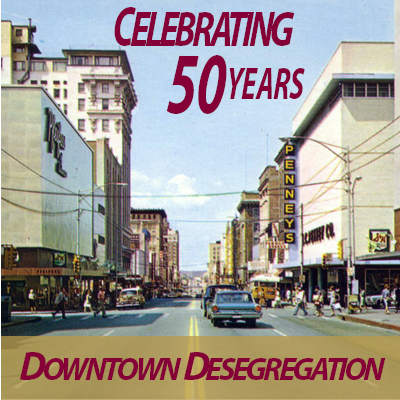
LR Look Back: Fifty Years of Desegregated Downtown Little Rock

widget_2013commerationThe UALR Institute on Race and Ethnicity is partnering with the Little Rock Regional Chamber of Commerce to mark the 50th anniversary of the desegregation of downtown Little Rock businesses from 10:30 a.m. – 2 p.m. Saturday, Sept. 21, 2013, at the Chamber.

This event is part of the Chamber’s 31st Annual Minority Enterprise Development Week and will include a public unveiling of the markers, reception, and the seminar, “Developing Future Leaders: How Strong Mentors Can Increase Diversity in Leadership Positions.”

Eleven  individuals from the Council on Community Affairs, Downtown Negotiating Committee, and Philander Smith College, will be honored with bronze markers placed on the Arkansas Civil Rights Heritage Trail in front of the Chamber. This will mark the third year of the Civil Rights Heritage Commemoration.

In 1963, this diverse group made up of members from COCA, DNC, and students from Philander Smith College worked together to plan a peaceful integration of downtown retail and restaurant establishments. Because of their efforts and others, by the end of 1963 most of the downtown retail businesses and restaurants had integrated.

2013 Arkansas Civil Rights Heritage Trail Honorees
The following individuals will be honored:

    • Dr. Garman P. Freeman, COCA
    • Dr. Morris A. Jackson, COCA
    • William Starr Mitchell, DNC
    • James H. Penick, DNC
    • Arthur Phillips, DNC
    • Rev. Negail Riley, Pastor, Wesley Chapel at Philander Smith College; COCA
    • Bert Strauss, Philander Smith College student; DNC
    • Ozell Sutton, COCA
    • Dr. William H. Townsend, COCA
    • Dr. Evangeline Upshur, COCA
    • B. Finley Vinson, DNC

Public Commemoration Ceremony – 10:30 a.m.
Civil Rights Heritage Markers Unveiling

Reception – 11 a.m.