Pulitzers play Little Rock – Arkansas Rep’s 2013 DEATH OF A SALESMAN

Rep SalesmanOne of the seminal plays of the 20th century, Death of a Salesman explored and exploded the post-war view of the American Dream.  Arthur Miller won his only Pulitzer Prize for this play.
In 2013, Robert Hupp directed a production at the Arkansas Repertory Theatre, where he was Producing Artistic Director at the time. It starred TV and stage actor Robert Walden, who was living in Arkansas then, and Broadway veteran Carolyn Mignini.  Avery Clark (who had starred in several Rep productions), Craig Maravich, William Metzo, Jay E Raphael and Joe Menino were also featured in key roles.

Members of the cast and creative team appeared in a panel as part of the Clinton School Speaker Series.  A video of that panel can be viewed here.

2018 marks the 100th anniversary of the first Pulitzer Prize for Drama being given. To pay tribute to 100 years of the Pulitzer for Drama, each day this month a different Little Rock production of a Pulitzer Prize winning play will be highlighted.  Many of these titles have been produced numerous times.  This look will veer from high school to national tours in an attempt to give a glimpse into Little Rock’s breadth and depth of theatrical history.

Pulitzers play Little Rock – DRIVING MISS DAISY

TWT DMDWith minimal set needs and only three actors, Alfred Uhry’s Driving Miss Daisy has been popular with theatres of all levels since it premiered in 1987.  There have been numerous Little Rock productions over the past thirty years.
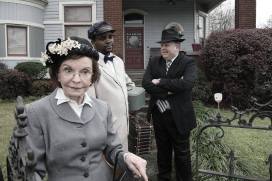
Actress and director Judy Trice starred in the Weekend Theater’s production in 2016.  Her costars were Jermaine McClure and Jay Clark.  The play was directed by Andy Hall (who is currently directing Assassins for the Weekend Theater).  The three actors obviously relished the chance to age several decades over the course of the play and mine Uhry’s script for its humor and humanity.

While many plays may fall out of favor over time, it is likely that Driving Miss Daisy will continue to be performed repeatedly.

2018 marks the 100th anniversary of the first Pulitzer Prize for Drama being given. To pay tribute to 100 years of the Pulitzer for Drama, each day this month a different Little Rock production of a Pulitzer Prize winning play will be highlighted.  Many of these titles have been produced numerous times.  This look will veer from high school to national tours in an attempt to give a glimpse into Little Rock’s breadth and depth of theatrical history.

Pulitzers play Little Rock – OF THEE I SING

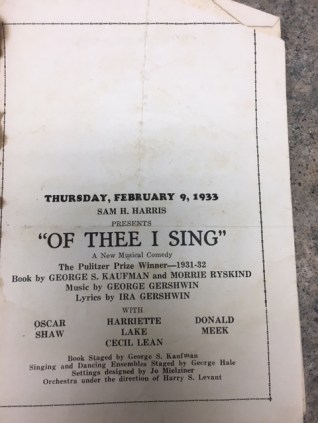
OfTheeISingBefore Robinson Auditorium opened, the stage of Little Rock High School (now Central High) was the prime performance location in Little Rock.  In 1933, it welcomed the national tour of the Pulitzer Prize winning musical Of Thee I Sing.
This was the first musical to win the Pulitzer Prize for Drama.  In fact, because no musical had won the award before, the jury appeared to not know how to handle a composer in a writing category.  Librettists Morris Ryskind and George S. Kaufman and lyricist Ira Gershwin were named as recipients. But composer George Gershwin did not receive the Pulitzer.  (In 1998, he received a posthumous Special Pulitzer.)

The musical, a satire of politics and popular culture, was directed by Mr. Kaufman.  The tour came to Little Rock for one performance on February 9, 1933. The Broadway production had closed less than a month earlier after 441 performances (a very long run at the time).

The tour starred Oscar Shaw (who had played the male lead in the original production of the Gershwins’ Oh Kay!) and Harriette Lake.  She would later change her name to Ann Sothern.  Other main roles were played by Donald Meek and Cecil Lean.   A few months after Little Rock, the tour played a month on Broadway.  Miss Lake continued in her role, but the men were replaced by their original Broadway counterparts.

2018 marks the 100th anniversary of the first Pulitzer Prize for Drama being given. To pay tribute to 100 years of the Pulitzer for Drama, each day this month a different Little Rock production of a Pulitzer Prize winning play will be highlighted.  Many of these titles have been produced numerous times.  This look will veer from high school to national tours in an attempt to give a glimpse into Little Rock’s breadth and depth of theatrical history.

Pulitzers play Little Rock – HARVEY

harveybrown3

Joe E. Brown in HARVEY

2018 marks the 100th anniversary of the first Pulitzer Prize for Drama being given. It went to Jesse Lynch Williams’ Why Marry?  To pay tribute to 100 years of the Pulitzer for Drama, each day this month a different Little Rock production of a Pulitzer Prize winning play.  Many of these titles have been produced numerous times.  This look will veer from high school to national tours in an attempt to give a glimpse into Little Rock’s breadth and depth of theatrical history.

First up – an appropriate on Easter Sunday, a look at Mary Chase’s HARVEY.  Though not the Easter bunny, it does revolve around a rabbit—or does it?

The winner of the 1945 Pulitzer came to Little Rock in 1948 on its national tour.  Comedian Joe E. Brown was playing the leading role when the show came to Robinson Auditorium.  That same year, Brown received a special Tony Award for starring in the Harvey tour.

Rock the Oscars: A SOLDIER’S STORY

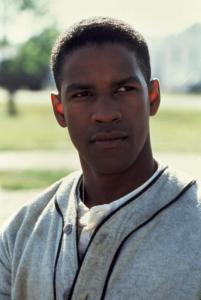
A SOLDIER’S STORY, Denzel Washington, 1984

In September and October of 1983, Norman Jewison and the cast of A Soldier’s Story filmed the movie at various locations in Arkansas.  Little Rock’s Lamar Porter Field was the site for the baseball scenes.  Adolph Caesar would receive an Oscar nomination for his performance in this movie.  Howard Rollins had recently been an Oscar nominee for his performance in Ragtime.  Future Oscar winner Denzel Washington was also featured in the cast.

Based on Charles Fuller’s Pulitzer Prize winning A Soldier’s Play, the movie was directed by Jewison from a script adapted by Fuller.  The film was nominated for three Oscars: Best Picture, Caesar in the Best Supporting Actor category and Fuller in the Best Adapted Screenplay category.

While the movie was filming in Arkansas, Governor Bill Clinton visited the set.  He had also been instrumental in making the Arkansas National Guard and some of the military facilities in the state available.  In addition to filming at Lamar Porter, scenes were shot in Fort Smith and at Fort Chaffee.

Little Rock Look Back: John Gould Fletcher (the politician not the poet)

Future Little Rock Mayor John Gould Fletcher was born on January 6 in 1831. The son of Henry Lewis and Mary Lindsey Fletcher, he later served as a Captain in the Capital Guards during the Civil War. One of his fellow soldiers was Peter Hotze.

Following the war, he and Hotze began a general merchandise store in Little Rock. They were so successful that they eventually dropped the retail trade and dealt only in cotton. Peter Hotze had his office in New York, while Fletcher supervised company operations in Little Rock. In 1878 Fletcher married Miss Adolphine Krause, sister-in-law of Hotze.

John Gould Fletcher was elected Mayor of Little Rock from 1875 to 1881. He was the first Mayor under Arkansas’ new constitution which returned all executive powers to the office of the Mayor (they had been split under a reconstruction constitution). Following his service as Mayor, he served one term as Pulaski County Sheriff. Mayor Fletcher also later served as president of the German National Bank in Little Rock.

Mayor and Mrs. Fletcher had five children, three of whom lived into adulthood. Their son was future Pulitzer Prize winning poet John Gould Fletcher (neither father nor son used the Sr. or Jr. designation). Their two daughters who lived to adulthood were Adolphine Fletcher Terry (whose husband David served in Congress) and Mary Fletcher Drennan.

In 1889, Mayor Fletcher purchased the Pike House in downtown Little Rock. The structure later became known as the Pike-Fletcher-Terry House. It was from this house that Adolphine Fletcher Terry organized the Women’s Emergency Committee which worked to reopen the Little Rock public schools during the 1958-1959 school year.
In the 1960s, sisters Adolphine Fletcher Terry and Mary Fletcher Drennan deeded the house to the City of Little Rock for use by the Arkansas Arts Center. For several decades it served as home to the Arts Center’s contemporary craft collection. It now is used for special events and exhibitions.

Mayor Fletcher died in 1906 and is buried in Mount Holly Cemetery along with various members of his family. Several of his descendants still reside in Little Rock.

Little Rock Look Back: J. N. Heiskell

At the age of 87, J. N. Heiskell in 1960.

John Netherland (J. N.) Heiskell served as editor of the Arkansas Gazette for more than seventy years.  He was usually called “Mr. Heiskell” by all, but a very few confidantes felt confident to call him “Ned.”

Mr. Heiskell is the person most responsible for Robinson Center Music Hall being located at the corner of Markham and Broadway.  As Chair of the Planning Commission and editor of the Arkansas Gazette he had twin bully pulpits to promote this location when those on the City Council (who actually had the final say) were looking at other locations.  He felt the location would help create a cluster of public buildings with its proximity to the county courthouse and to City Hall.  Mr. Heiskell finally succeeded in winning over the mayor and aldermen to his viewpoint.

He was born on November 2, 1872, in Rogersville, Tennessee, to Carrick White Heiskell and Eliza Ayre Netherland Heiskell. He entered the University of Tennessee at Knoxville before his eighteenth birthday and graduated in three years at the head of his class on June 7, 1893.

His early journalism career included jobs with newspapers in Knoxville and Memphis and with the Associated Press in Chicago and Louisville. On June 17, 1902, Heiskell’s family bought controlling interest in the Arkansas Gazette. Heiskell became the editor, and his brother, Fred, became managing editor.

Governor George Donaghey appointed Heiskell to succeed Jeff Davis in the United States Senate after Davis’s death in office. Heiskell served from January 6, 1913, until January 29, 1913, when a successor was chosen by the Arkansas General Assembly.  His tenure is the shortest in the U. S. Senate history.  His first speech on the Senate floor was his farewell.  He was also only the second US Senator to live to be 100.

On June 28, 1910, Heiskell married Wilhelmina Mann, daughter of the nationally prominent architect, George R. Mann. The couple had four children: Elizabeth, Louise, John N. Jr., and Carrick.

In 1907, he joined a successful effort to build the city’s first public library. He served on the library board from that year until his death and was issued the first library card.  He also served on the City’s Planning Commission for decades.  In 1912, he was instrumental in bringing John Nolen to Little Rock to devise a park plan.

In the paper and in his own personal opinions, he crusaded on a variety of progressive causes.  Perhaps the most famous was the Gazette’s stance in the 1957 Central High desegregation crisis.  It was for this effort that the paper received two Pulitzer Prizes.

Although Heiskell stopped going to the office at age ninety-nine, he continued to take an active interest in the newspaper. He began by having a copy of the newspaper delivered to his home by messenger as soon as it came off the press each night. Eventually, he switched to having his secretary call him daily at his home and read the entire newspaper to him. He operated on the premise that “anyone who runs a newspaper needs to know what’s in it, even to the classified ads.”

A few weeks after turning 100, Heiskell died of congestive heart failure brought on by arteriosclerosis on December 28, 1972. He is buried in Little Rock’s Mount Holly Cemetery.  Interestingly, he is buried in the same cemetery as two of his most notable adversaries: Governor Jeff Davis, and segregationist Congressman Dale Alford.

Mr. Heiskell donated his vast papers to UALR. They are part of the Arkansas Studies Institute collection. These papers give insight into not only his career as a journalist, but also his political and civic affairs.  Thankfully he saved much of his paperwork. Without it, much insight into Little Rock in the 20th Century would be lost.
