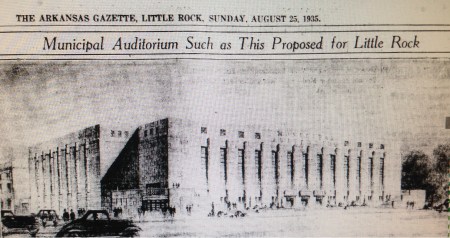
An August 25, 1935, rendering in the ARKANSAS GAZETTE of the proposed Little Rock auditorium at Capitol and Scott Streets.
On August 26, 1935, the City of Little Rock took its first significant step in a decade for the creation of a City auditorium.. Under the leadership of Mayor R. E. Overman, the City Council approved authorization for the City to apply for $1,000,000 from the Federal Emergency Administration of Public Works (PWA) for the construction of an auditorium. The PWA had issued a September 16, 1935, deadline for applications to be received as it sought to spend $4.8 billion in construction projects.
The auditorium plan was announced on Saturday, August 24, 1935. Much preparation had already been undertaken before the project was publicly unveiled. Private presentations hhad taken place, a team of architects had been chosen (Eugene Stern and the firm of Wittenberg & Delony), and a location had been selected.
The auditorium complex was slated for a block bounded by Capitol, Scott, Fourth and Cumberland Streets. The Women’s City Club building on that block would remain with the new structure being built to wrap around two sides of the existing structure. The site was chosen because it was one block east of the Main Street business corridor and near existing meeting locations such as the Boys Club, Albert Pike Hotel, Albert Pike Masonic Lodge and several churches.
As planned by the architects, this structure’s front façade would have run the length of the Capitol Avenue side of the block. The building was proposed to be constructed of concrete, stone and steel. It would have a large hall with a proscenium stage and seating capacity of 4,000 with overflow of an additional 500. The adjoining exhibition hall could seat 3,500 people. The plan called for 150 cars to be parked in the building, and an additional 100 cars to be parked on a surface lot on the site.
Following an August 26 closed door meeting to discuss the project from which members of the public and press were excluded, in open session the City Council voted to pursue the funding for the million dollar auditorium. If approved by the PWA, the funds would be provided in grants and loans, to be paid by over a 35 year period.
The auditorium proposal was filed with the PWA in Washington in September 1935. Throughout the next several months, Mayor Overman and the city were engaged in a series of conversations and negotiations with the PWA for the expansion of both the water system and the sewer system. This diverted attention from pursuing the auditorium immediately. This specific auditorium project stalled. But because the plan had been filed by the September 16 deadline, it allowed the City to make use of PWA funds a few years later which would lead to the construction of Robinson Auditorium.

 Many months behind schedule, it was 76 years ago today that the construction of the Joseph Taylor Robinson Memorial Auditorium was declared “substantially finished.”
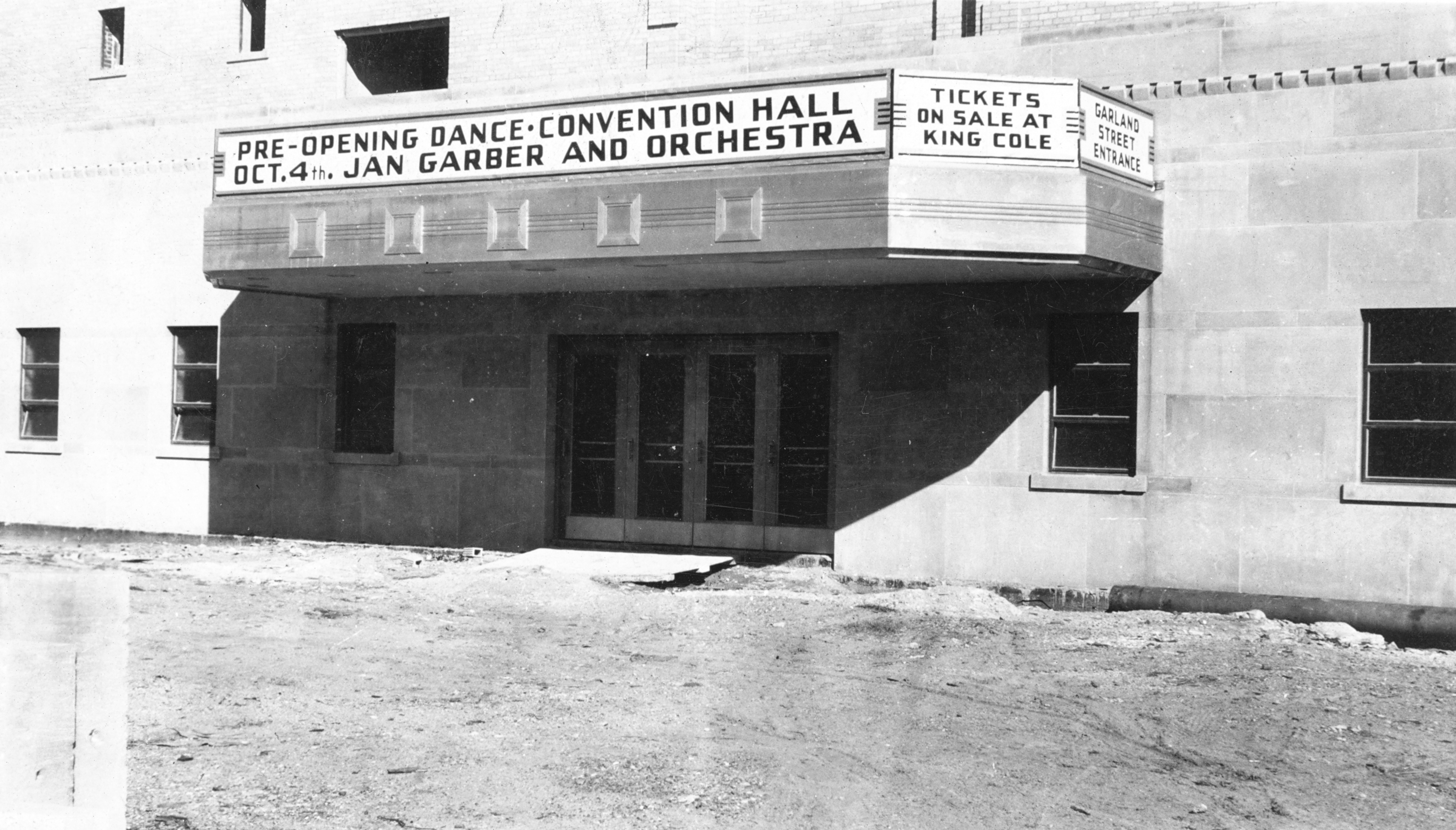
 The first four people to enter the building as paying guests were Mr. and Mrs. Alfred Wilheim, Frances Frazier and Bill Christian. Reports estimated 3,200 people attended and danced to the music of Jan Garber and His Orchestra. By happenstance, Garber and his musicians had also played in Little Rock on January 26, 1937, the date of the election which approved the auditorium bonds. Since Little Rock then did not have a suitable space, that appearance had been on the stage of the high school auditorium.
 Little Rock Culture Vulture