Tartan Day – BRIGADOON appears in Little Rock for the first time in 1951

April 6 is Tartan Day – a chance to pay tribute to the achievements of Scots in the U.S.  It is also a good chance to wear plaid.

On January 17 and 18, 1951, the Broadway musical Brigadoon materialized at Robinson Memorial Auditorium for its first visit to Little Rock.  This musical by Alan Jay Lerner and Frederick Loewe is a Scottish fantasy about a town that materializes for one day every 100 years.

First performed on Broadway in 1947, it was revived at New York City Center in 1950. It was that production that toured in 1951 to Little Rock.  The production was produced by John Yorke (who had worked on the original Broadway production) and brought to Little Rock by Metropolitan Attractions.

The cast was led by future Tony nominee Susan Johnson.  Others in the cast were Elizabeth Early, Robert Busch, Betty Logue and Thaddeus Clancy. All had appeared at City Center, though some in different roles than on the tour.  This touring production featured the original Broadway creative team from 1947 with direction by Robert Lewis, choreography by Agnes de Mille (who won a Tony for it, at the first ceremony), scenery by future Tony winner Oliver Smith, costumes by Tony winner David Ffolkes, lighting by Peggy Clark, and orchestrations by Ted Royal.

Over the years, Brigadoon has resurfaced in Little Rock in community theatre and school productions.  But this was the first time that tartans of the MacLaren, Dalrymple, Brockie and Anderson clans first appeared in Little Rock.

Little Rock Look Back: Voters approve funds for completion of Robinson in 1940

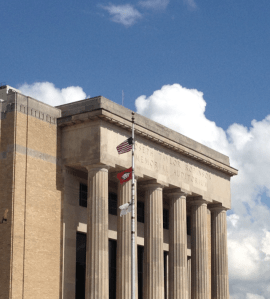
Though Joseph Taylor Robinson Memorial Auditorium opened in February 1940, there was still money that needed to be raised to finish the construction and the building’s furnishing.  Ten days after the auditorium opening, the City Council approved an ordinance to call a special election on April 2, 1940, for the purposes of approving bonds for three separate projects.  One of these was for $30,000 for the completion of the auditorium; the bonds would not require any additional tax levy.

At the same meeting, a letter was read from the Young Men’s Business Association expressing support for the auditorium in the election, which was to be held in conjunction with the annual municipal general election. The Auditorium Commission had previously asked the City Council to consider issuing the bonds to pay for additional equipment for the building.  In their request to the aldermen, the members stressed that due to the current bond structure, these new bonds would not necessitate any tax increase.

The campaign for the new bonds used a similar structure and message as the 1937 election to build the auditorium.  There were newspaper ads by the steering committee (this time simply called the Citizen’s Committee and led by Omar Throgmorton) and support from civic organizations.  One thing very different from the 1937 campaign was the presence of an actual building.  On Sunday, March 31, just two days before the election, there was an open house for the public to explore the edifice.

On April 2, 1940, Little Rock voters approved the new bonds 1,413 to 423.  Every precinct in every ward of the city voted in favor of the new bonds.  Shortly after the election, the bonds were issued.  The auditorium construction which had first been broached in 1904 was now completed in 1940.

Air Conditioning Pulls April Fool Trick during first play at Robinson Center in 1940

On Monday, April 1, 1940, Edward Everett Horton came to Little Rock in the comedy SPRINGTIME FOR HENRY.  This was a play in which he had appeared regularly on tours and in summer stock. He would create productions of it in between film roles from the 1930s to the 1950s.

The play concerned a industrial heir whose dalliances put his family’s business in jeopardy.  It was a boulevard comedy (or a sex comedy—without the sex).  Originally performed on Broadway in 1931, it was written by Benn W. Levy.  He would later serve as a member of Parliament.

By the time Horton arrived in Little Rock, he was an accomplished stage and screen actor.  He was a staple of many Astaire-Rogers films.

The performance at Robinson did not go off without a hitch.  Because it was Springtime for Little Rock, it was warmer outside.  This necessitated the air conditioner being turned on.   The fans rumbling through the vents made such a noise that it was difficult for the audience to hear the actors.  The air cooler was turned off for the remainder of the performance.  In the days after the performance, the Auditorium staff put buffering in the vents in the muffle the noise.

Little Rock Look Back: 1940 Open House gives many first view inside Robinson Auditorium

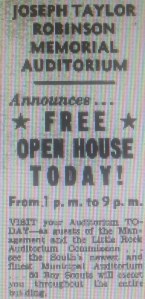
On March 31, 1940, the City of Little Rock and the Auditorium Commission threw open the doors of Joseph Taylor Robinson Memorial Auditorium to the public for an open house.

The building had officially opened in February 1940 (after construction was completed in January), and events had been taking place in the lower level since October 1939. But this was the first time that the public could tour the entire facility from top to bottom.

The event took place on a Sunday from 1pm to 9pm.  Curiously, it took place two days before a special election to approve the bonds to finish the auditorium. Though no one at the time was cynical enough to comment on the connection.

Members of various Little Rock Boy Scout troops led 4,000 visitors on tours of the auditorium.  Visitors were shown all over the building; one scout calculated that the walking tour equated to two miles.  Though most people were from Little Rock, the guest registry indicated visitors from California and Pennsylvania.  Among the last guests to sign the register were Mayor J. V. Satterfield and his family.

The idea for the open house had first been floated in December by Alderman E. W. Gibb after taking a tour of the construction site. He had enthusiastically professed that everyone should be able to tour and see what a magnificent structure it was going to be.  Mayor Satterfield had to tamper the alderman’s enthusiasm. He agreed with Mr. Gibb that it was a fine building but stated that a public open house could not be scheduled for a few weeks because there was still much work to be done.  Mayor Satterfield noted that the seats in the music hall were going to have to be removed and then reinstalled because they needed to be anchored better.

Women Making History: Florence Price

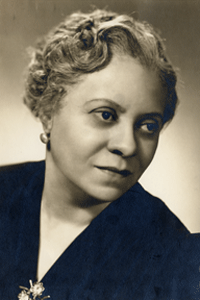
Florence Price was the first African-American female composer to have a symphonic composition performed by a major American symphony orchestra.

In 2016, when Robinson Center reopened, a new atrium was named in her honor. It is adjacent to the ballroom named after her childhood friend Dr. William Grant Still.  Having a space named after Price at Robinson is especially appropriate since one of the first concerts given there in 1940, by contralto Marian Anderson, featured songs written by Price.

Florence Price was born in Little Rock on April 9, 1887, to James H. Smith and Florence Gulliver Smith. Her father was a dentist in Little Rock, while her mother taught piano and worked as a schoolteacher and a businesswoman.

As a child, Florence received musical instruction from her mother, and she published musical pieces while in high school. She attended Capitol Hill School in Little Rock, graduating as valedictorian in 1903. Florence then studied at the New England Conservatory of Music in Boston, Massachusetts, In 1907, she received degrees as an organist and as a piano teacher.

After graduation, Florence returned to Arkansas to teach music. After stints in Cotton Plant, North Little Rock and Atlanta, GA, Smith returned to Little Rock in 1912 to marry attorney Thomas Jewell Price on September 25, 1912. Her husband worked with Scipio Jones.

While in Little Rock, Price established a music studio, taught piano lessons, and wrote short pieces for piano. Despite her credentials, she was denied membership into the Arkansas State Music Teachers Association because of her race.

The Prices moved to Chicago, Illinois, in 1927. There, Price seemed to have more professional opportunity for growth despite the breakdown and eventual dissolution of her marriage. She pursued further musical studies at the American Conservatory of Music and Chicago Musical College and established herself in the Chicago area as a teacher, pianist, and organist. In 1928, G. Schirmer, a major publishing firm, accepted for publication Price’s “At the Cotton Gin.” In 1932, Price won multiple awards in competitions sponsored by the Rodman Wanamaker Foundation for her Piano Sonata in E Minor, a large-scale work in four movements, and her more important work, Symphony in E Minor.

The latter work premiered with the Chicago Symphony Orchestra on June 15, 1933, and the orchestras of Detroit, Michigan; Pittsburgh, Pennsylvania; and Brooklyn, New York, performed subsequent symphonic works by Price. This was the first time a black woman had presented her work on such a stage. In this regard,

Price’s art songs and spiritual arrangements were frequently performed by well-known artists of the day. For example, contralto Marian Anderson featured Price’s spiritual arrangement “My Soul’s Been Anchored in the Lord” in her famous performance on the steps of the Lincoln Memorial in Washington DC on Easter Sunday, April 9, 1939. European orchestras later played Price’s works.

This national and international recognition made her more popular back home, and in 1935, the Alumni Association of Philander Smith College in Little Rock sponsored Price’s return to Arkansas, billing her as “noted musician of Chicago” and presenting her in a concert of her own compositions at Dunbar High School.

In her lifetime, Price composed more than 300 works, ranging from small teaching pieces for piano to large-scale compositions such as symphonies and concertos, as well as instrumental chamber music, vocal compositions, and music for radio. Price died in Chicago on June 3, 1953, while planning a trip to Europe.

Women Making History: Gretchen Hall

Gretchen HallAt the 2019 Governor’s Conference on Tourism, Gretchen Hall was named Tourism Person of the Year.  This is just the latest honor for her.  In 2017, she was the first woman to solely receive the Downtown Little Rock Partnership’s Top of the Rock Award.

As the President and CEO of the Little Rock Convention and Visitor’s Bureau, she leads a staff that not only brings conventions and tourists to Little Rock, but also creates opportunities for local residents to enjoy their city more.

From 2014 to 2016, she actively oversaw the deconstruction and reconstruction of Robinson Center Performance Hall. Taking a New Deal era assembly hall and making it into a state-of-the-art performance facility was not an easy task. Gretchen and her team have worked with the architects, engineers, designers and consultants to make it happen.

Gretchen joined LRCVB in 2001 and worked her way up through the organization.  In May 2011, she was named to her current position.  Since that time, the LRCVB has undertaken numerous efforts to enhance Little Rock including a new amphitheatre in Riverfront Park, enhanced programming at the River Market, and increased financial support of cultural organizations.  She has worked to improve not only the meeting space available for conventions, but also to enhance the dining and lodging scenes in Little Rock.  In addition, she helped lead the effort to see the additional penny of the hotel tax be dedicated to support the Arkansas Arts Center and MacArthur Museum of Arkansas Military History.

The 2019-2020 Arkansas Symphony Orchestra MasterWorks season is announced

The Arkansas Symphony Orchestra (ASO) announced its 2019-2020 Masterworks which includes guest conductors and a concert conducted by Geoffrey Robson, ASO’s Associate Conductor who has been named Interim Artistic Director.

The Stella Boyle Smith Masterworks Series opens Sep. 28-29, 2019, with a concert presented in partnership with ACANSA Arts Festival of the South. Luminary conductor JoAnn Falletta is the first featured guest conductor, and American trio Time for Three is featured in work written for them by former ASO Conductor in Residence Jennifer Higdon. The program also features Ravel’s La Valse and Rimsky-Korsakov’s Scheherazade.

ASO’s casual concert and street party, Beethoven and Blue Jeans, returns Nov. 9-10 and features works by two Arkansas composers: William Grant Still’s Festive Overture and Florence Price’s Piano Concerto in One Movement. Karen Walwyn, a specialist in the piano works of Price, is the featured soloist, and Andrew Grams will conduct the concert.

The Masterworks series ends May 2-3, 2020, featuring music from Fanny Mendelssohn and Schubert along with the return of prestigious cellist, Zuill Bailey, performing Dvorak’s Cello Concerto.

The 2019-2020 season coincides with the 100th anniversary of the passage of the 19th Amendment, guaranteeing and protecting women’s constitutional right to vote. ASO is celebrating by featuring two outstanding women conductors, JoAnn Falletta and Carolyn Kuan, two women soloists, pianist Karen Walwyn and violinist Simone Porter, and by performing works from four women composers: Pulitzer Prize-winner and former ASO Composer in Residence, Jennifer Higdon, an active and popular composer today, Little Rock’s own Florence Price, Lili Boulanger, and Fanny Mendelssohn.

The full Masterworks series includes:

  • JoAnn Falletta and Time for Three, Sep. 28 & 29, 219, with music from Higdon, Ravel, and Rimsky-Korsakov’s Scheherazade.
  • Beethoven & Blue Jeans, Nov. 9 & 10, 2019, ASO’s annual casual concert, featuring works from Arkansas composers Florence Price and William Grant Still and guest conductor Andrew Grams.
  • Copland’s Rodeo, Jan. 25-26, 2020, with guest conductor Carolyn Kuan, and music from Ginastera and Bartok;
  • Sibelius & Debussy, Feb. 29 – Mar. 1, 2020, conducted by Geoffrey Robson, and featuring a multimedia work: In Seven Days: A Concerto for Piano and Moving Image, with pianist Andrius Zlabys.
  • Symphonie Fantastique, Apr. 18-19, 2020, with guest conductor Eric Jacobsen, and violinist Simone Porter performing the Saint-Saens Violin Concerto No. 3 in addition to the titular orchestral showpiece by Berlioz.
  • Zuill Bailey Plays Dvorak, May 2 & 3, 2020, with guest conductor Vladimir Kulenovic.

The concerts will be at Robinson Center Performance Hall.