2015 In Memoriam – Jim Porter

1515 Porter

In these final days of 2015, we pause to look back at 15 who influenced Little Rock’s cultural scene who left us in 2015.

Jim Porter, Jr., spent a lifetime promoting music in Little Rock.  Along the way, he created social change as well.

A native of Little Rock, he graduated from Little Rock High School and the University of Arkansas.  After college, Jim started out in the family businesses and tried to follow a “traditional” path that his father had paved for him. Working in sales and public relations, he became active doing volunteer work.  Jim realized that the “traditional” path was not for him, and while working in the family businesses, he started bringing in top name entertainers, many of them black, to perform in Little Rock. He was not a singer, nor did he play any instrument, but his love for music and all things connected to music led him towards his calling as an agent/manager and promoter of musicians.

As a promoter of national artists and bands, Jim ran into southern racism and segregation. The Central High crisis in 1957 caused many black artists to refuse to come to Little Rock, fearful for their safety. Jim was forced to concentrate more on booking and managing local musicians through what was at the time Arkansas’ only full time booking and talent agency, Consolidated Talent Corporation (later to become Porter Entertainment). During his booking career from the late 50’s until his retirement in 2001, Jim placed talent across Arkansas (and even in Las Vegas) at clubs, hotels, restaurants, and private functions- anywhere that people needed entertainment.

Jim saw first hand the inequities of black musicians in Arkansas, the separate and very unequal accommodations, and the segregated venues. Never giving up promoting national artists, the 60’s led him and his co-investors to bring in such national names (mostly jazz artists) such as Louis Armstrong, Count Basie, Dizzy Gillespie, Al Hirt, Pete Fountain, Woody Herman, the Four Freshman, Dave Brubeck, George Shearing, Harry James and others.

In 1961, he was arrested for integrating a concert at Robinson Auditorium. A white man, he had entered the segregated balcony.  Knowing the challenges of booking acts in a segregated house (indeed Duke Ellington would cancel his booking at Robinson), Porter had tried to get the facility to change its rules.  It was 1966, when Louis Armstrong returned to Little Rock and played before an integrated house that the new rules were here to stay.  In the early 1970s, he helped bring the musical Hair to Little Rock, with the specter of full nudity causing consternation to Robinson Auditorium and some of the citizenry.

Jim was inducted into the Arkansas Entertainers Hall of Fame in 2005, and the Arkansas Jazz Heritage Foundation Hall of Fame in 2006. He was appointed to the Martin Luther King Commission in 2005 and entered politics to serve as a member of the Pulaski County Quorum Court from 1998 until 2006.

Always an entrepreneur, Jim also started MusAd Recording Studio, where commercial jingles were produced and bands could record demo tapes. The Hot Air Balloon Theatre (in the old Center Theatre on Main Street) was the site for G-movies and live entertainment for kids. The Yellow Rocket, an arcade in the “Heights” is still remembered by now middle-aged adults who spent afternoons and weekends feeding money into the game machines and eating snacks. Jim wrote several books, hosted TV shows (“After Five” and “Scene Around”) featuring restaurants, bars, clubs and their patrons and employees. He was featured on a weekly radio show about dining and entertainment, and wrote “Scene Around” columns and a dining and entertainment guide for the Arkansas Democrat.

Little Rock Look Back: Boxing Day look at Robinson Auditorium boxing

Boxer Al Globe lays in the ring after being knocked down by Bob Sikes in this GAZETTE staff photo

Boxer Al Globe lays in the ring after being knocked down by Bob Sikes in this GAZETTE staff photo

Though the origins of the name Boxing Day have nothing to do with pugilism, today’s entry looks at early boxing matches at Robinson Auditorium.

Though the building did not open until February 1940, there were a few preview events in the lower level exhibition hall beginning in October 1939.  (The construction upstairs would not be completed until January 1940.)

Wrestling was a more common sport on the lower level. But from time to time there was boxing.  It appears that the first boxing matches took place on November 9, 1939.

Pine Bluff’s heavyweight Bob Sikes was the star attraction on the main card as he faced off against Chicago’s Al Globe.  The two were fairly evenly matched through the first three rounds. In the fourth round, Globe sent Sikes to the mat, before the latter arose on the seventh count. (He was a bit groggy and could not name the city in which he was boxing.)  Ninety seconds into the fifth round, however, Sikes delivered a knockout punch to Globe.

The warm-up bout featured Carolinian Maxie Doyle against Jimmy Merritt of Oklahoma. After the ref called the match on a TKO in favor of Doyle, the two continued to fight in the ring. It took their seconds to leave the corner and help the ref break it up.  The boxers were threatened with suspension if they continued it any further.

Prior to the Doyle-Merritt bout, Bauxite’s Woody Bell edged out Young Leonard in six rounds. Charley Regan and Bobbie Lee came to a draw after their six.  The first match of the evening featured two African American boxers: Little Rock’s Bill Walker, who earned a decision over North Little Rock’s Herbert Taylor.

Since the heating system was not yet operational at Robinson Auditorium, promoters for the early wrestling and boxing matches touted the fact that a temporary heating system was in place as temperatures started to drop.

Sikes was back at Robinson in another marquee match on February 9, 1940, one week before the official opening of the upstairs Music Hall.  By this time permanent heating and lighting had been connected.

Boxer Bob Sikes, GAZETTE staffer Lou MacDuff and boxer Joe Regan in a GAZETTE staff photo

Boxer Bob Sikes, GAZETTE staffer Lou MacDuff and boxer Joe Regan in a GAZETTE staff photo

The headline bout was Sikes against Joe Regan of Ames, Iowa.  They were scheduled for ten rounds.

Earlier fights on the card were the six-round middleweight match of Gould Nix of Willow meeting Buck Buchanan of Rogers; welterweight Doyle Venable of Dierks vs. Little Rock’s Freddie Richardson; Johnny Allen of Saint Louis meeting Woody Bell of Bauxite; and, in the first match, Kid Tobey of Hot Springs vs. Bill Walker of Little Rock. The latter was a four round bout featuring two African American boxers.

The marquee fight did not go anywhere near as long as ten rounds.  Fifty-four seconds into the second round, Sikes pummeled Regan with a right to the chin, a right to the cheek and a left hook to the head. After that Regan was down for the count. Though at the eight count he did manage to turn over from his back to his stomach and remained in that position until being helped to his corner following the bell.

Earlier in the evening, Nix, Venable, and Bell all won their bouts by decisions of the judges. Walker won the curtain raiser by a knock out in the second round.

It was a capacity crowd for the boxing event at Robinson Auditorium.  Tickets, which were available for purchase at Rube & Scott, Inc. men’s clothing store, ranged from 55 cents for general admission, to $1.10 for reserved seating and ringside seats of $1.65 or @2.20.

15 Highlights of 2015 – Robinson Center Renovation Tops Out

LRCV 1The Little Rock Convention & Visitors Bureau (LRCVB), members of the Little Rock Advertising and Promotion Commission (LRA&P), local officials, and members of the design and construction teams hosted a topping out ceremony July 1, 2015 at 10:00 AM for the Robinson Center’s new conference facility, signifying a one–‐year milestone in the 28–‐month, $70 million renovation and expansion project.

Following a press conference and ceremonial beam signing held on the western side of the Robinson Center, local media and special guests were given tours of the magnificent ballroom platform and conference center located on Robinson’s north side. This new addition not only provides some of the most dramatic enhancements of the project, but will also provide groups with spectacular views of the Arkansas River and the city’s illuminated bridges.

Along with additional meeting and pre–‐function space situated above its ballroom, the new conference center will also provide a new connection to the DoubleTree Hotel, with an adjoining lobby and additional pre–‐function space.

Robinson Center will reopen in November 2016.  The Arkansas Symphony Orchestra will return its Masterworks and Pops series to Robinson. Ballet Arkansas will perform The Nutcracker there in December 2016.  Celebrity Attractions will bring Broadway back to Robinson (on Broadway, no less) next season as well.  They have already announced The Phantom of the Opera for March 2017.

LRCV 5For more information on the Robinson Center Second Act renovation and expansion project, visit http://www.RobinsonCenterSecondAct.com.

Robinson Construction Facts to Date:

  • Nearly 10,000 tons of material have been recycled, representing 91% of the waste material diverted 1,216 tons of steel has been erected
  • 2,300 cubic yards of concrete has been placed
  • 470 individuals have gone through CDI/Hunt Safety Orientation
  • 73% of the project subcontractors are local

Little Rock Look Back: Groundbreaking for Robinson Auditorium

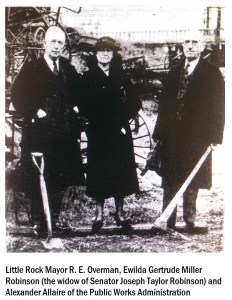
122437 GroundbreakOn December 24, 1937, at 11:30 a.m., Little Rock Mayor R. E. Overman, Ewilda Gertrude Miller Robinson (the widow of Senator Joseph Taylor Robinson) and  Alexander Allaire of the PWA turned dirt to participate in the brief groundbreaking ceremony for Little Rock’s municipal auditorium.  That morning, the Arkansas Gazette ran a brief story on the upcoming groundbreaking.  The story mentioned that the building would be named in memory of the late beloved Arkansas politician.  This appears to be the first public pronouncement of the Robinson name for this civic structure.

Among others in attendance at the groundbreaking were Mrs. Charles Miller (sister-in-law of Mrs. Robinson), Mr. and Mrs. Grady Miller (brother and sister-in-law of Mrs. Robinson), the mayor’s wife, the three architects (George Wittenberg, Lawson Delony and Eugene John Stern), and D. H. Daugherty and Will Terry of the City’s Board of Public Affairs.

Construction had to start by January 1, 1938, in order to receive PWA funds.  By breaking ground on December 24, there was over a week to spare.  The site had been selected in late October 1937, and the purchase had not been finalized.  But the PWA did give permission for the City to let a contract for excavation, demolition and filling on the site.

The groundbreaking took place at the corner of Garland and Spring Streets which was on the northeast corner of the block set aside for the auditorium.  Today, Spring Street does not extend north of Markham; the street was closed to make way for the parking structure and what is now the Doubletree Hotel.  Garland Street is basically an alley that runs parallel to Markham north of City Hall, Robinson Auditorium and the Doubletree Hotel.

Little Rock Look Back: School Children Sing Christmas Carols at Robinson Auditorium

Christmas Carols

Photo from Arkansas Gazette

Right now, music is silenced at Robinson Center.  During the renovation, violins and tubas have been replaced by saws and heavy equipment.

Similarly, 76 years ago, the halls of that building were alive with only the sounds of construction.  But out front, on December 18, 1939, the sounds of Christmas carols filled the air.

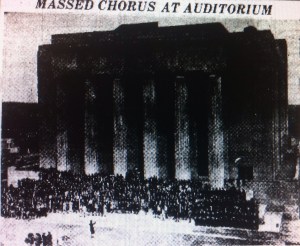
That afternoon, 500 school children from elementary schools were joined by the A Capella Choir of Little Rock High School as they sang Christmas carols on the front steps of the auditorium on a weekday afternoon.  The singers were accompanied by the Little Rock High School Brass Sextet.  The invocation for the event, which was sponsored by the Little Rock Council of Parents and Teachers, was delivered by the Right Reverend Richard Bland Mitchell, the Episcopal Bishop of Arkansas.

A Christmas tree in front of City Hall was lit up as part of the ceremony as well.  Media coverage noted that the audience witnessing the program stood on the front steps of the Pulaski County Courthouse, the side lawn of City Hall and in front of the steps of Robinson Auditorium.  It was also noted that most windows in the nearby government buildings were filled with people watching the ceremony.

Little Rock Look Back: Little Rock votes to Restore Robinson

On Tuesday, Dec. 10, 2013, voters of Little Rock overwhelmingly chose to renovate the historic Joseph Taylor Robinson Memorial Auditorium.

By a vote of 5,183 For and 1,800 Against, Little Rock citizens approved a plan to use a portion of the city’s existing 2 percent restaurant and hotel tax to repay bonds for a renovation of Robinson Center.  The campaign was chaired by businessman Charles Stewart, restaurateur Capi Peck and former LR Mayor Jim Dailey.

Robinson has long been a landmark in central Arkansas. Construction of the Joseph T. Robinson Memorial Auditorium began in 1938 (after a December 1937 groundbreaking under a deadline) and officially opened February 1940. The structure was a PWA (Public Works Administration) project, and is an excellent example of the Art Deco style architecture of the time. The building was added to the National Register of Historic Places in 2007.

The facility is owned by the City of Little Rock and managed by the Little Rock Convention & Visitors Bureau.

The 1940 structure suffered from a wide array of deficiencies, including stage loading and unloading, stage size, acoustical insufficiency, dressing room access and inadequate wing space within the performance hall. Also, structural, mechanical and electrical issues, public circulation and outdated conference center spaces existed within the facility.

Knowing the center is in need of major upgrades if the facility is to continue to serve central Arkansas into the future, the Little Rock Advertising and Promotion Commission (LRA&P) empanelled a Robinson Center Concept Team in October 2011. The group was tasked with evaluating all aspects of the existing facility, researching user needs, proposing conceptual solutions and estimating the cost and construction schedule of the proposed additions and renovations. The concept team was led by Mike Steelman of SCM Architects, PLLC, and included representatives from WD&D Architects, Shuler Shook Theatre Planners, Jaffe-Holden Acoustical Consultants, TME Inc. Mechanical and Electrical Engineers, ECI Inc. Structural Engineers, McClelland Consulting Engineers Inc. Civil Engineers, East Harding Construction, HVS Consulting and Hunt Construction Group.

Additionally, stakeholder and tenant organizations representing the Arkansas Symphony Orchestra, Celebrity Attractions of Tulsa, Oklahoma and the Double Tree Hotel participated in the planning. The concept team findings were presented publicly on June 5, 2012.

On January 17, 2013 the LRA&P announced the selection of Polk Stanley Wilcox Architects, partnered with Ennead Architects, as the architectural and design team for the future renovations. On March 28, 2013 CDI Contractors LLC, partnered with Hunt Construction Group, were selected by LRA&P as the general contractors and construction managers.

On September 23, 2013 the final schematic renderings and cost estimates were presented publicly. The schematic plans depict major interior upgrades within the performance hall including additional volume to create a two-balcony setup, increased lobby space, acoustical improvements, theatrical upgrades, loading dock expansion, a larger stage area, and new dressing room facilities. Additionally, an enhanced modern ballroom and small conference center was unveiled. New technology, mechanical systems, and outdoor plaza spaces were included in the presentation.

Construction would begin on July 1, 2014, with a completion scheduled for November 2016.


Little Rock Look Back: Robinson Auditorium Construction Hits Milestone in 1939

jtrma-bw.jpgMany months behind schedule, it was 76 years ago today that the construction of the Joseph Taylor Robinson Memorial Auditorium was declared “substantially finished.”

On December 8, 1939, the work of the general contractor was complete.  The building’s utilities were all fully connected as the steam line and electric transformer were hooked up.  While the work of the general contractor was through, there was still much work to be done.

Though there were still unfinished portions of the structure, the exterior was complete and finished surfaces had been installed on the interior.  Until the building was officially turned over to the City, the federal Public Works Administration still had to give approval for any uses of the building.

Mayor J. V. Satterfield, Jr. told the press that he wasn’t sure when the City would formally accept the building. The connection of the utilities had used up the remaining funds, so there was uncertainty as to when the final tasks would be completed.

When it was built, Robinson Auditorium was the first municipal auditorium in the south central United States to be air conditioned.  However, the air conditioning unit was not sufficient to cool both the music hall and the convention hall at the same time.  In warm weather months concurrent events would not be able to take place on the two levels.