Little Rock Look Back: Louis Armstrong speaks out

As the Civil Rights movement started taking hold in the mid-1950s, many African American entertainers were vocal in their support.  Louis Armstrong stayed silent.  Until, that is, September 17, 1957.

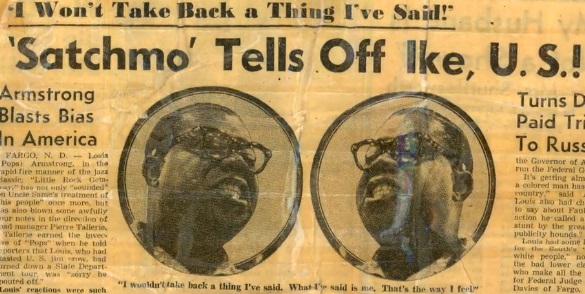
That night, in Grand Forks, North Dakota, Armstrong blasted President Dwight Eisenhower for his lack of action to make Governor Orval Faubus obey the law.  This was in an interview conducted by a 21 year old University of North Dakota journalism student named Larry Lubenow.

Journalist David Margolick wrote about the incident in The New York Times in September 2007 in conjunction with the 50th anniversary of the integration of Little Rock Central High School.  He recounted how the story, written for the Grand Forks Herald, was picked up all over the country.  The entire Margolick piece can be read here.  Margolick tells that when Armstrong was given the chance to back off the comments, he asserted that he meant all of it.

On September 24, 1957, the night that the 101st Airborne was being mobilized to come into Little Rock, Armstrong sent Eisenhower a telegram again criticizing him for lack of action.  He used colorful language which sarcastically spoofed the “Uncle Tom” moniker which some of his critics had bestowed when they felt he was not doing enough for Civil Rights.  The Eisenhower Presidential Library has a copy of that telegram.  The incident between Satchmo and Ike was the basis for two different plays: Terry Teachout’s Satchmo at the Waldorf and Ishmael Reed’s The C Above C Above High C.

Black History Month – Louis Armstrong and Robinson Center

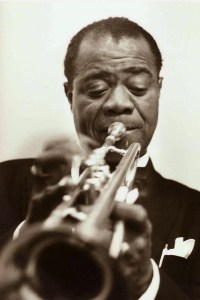
louis-armstrong3Louis Armstrong played Robinson Auditorium several times during his career.  He also played other venues in Little Rock.

As the Civil Rights movement started taking hold in the mid-1950s, many African American entertainers were vocal in their support.  Armstrong stayed silent.  Until, that is, September 17, 1957.  That night, in Grand Forks, North Dakota, he blasted President Dwight Eisenhower for his lack of action to make Governor Orval Faubus obey the law.  This was in an interview conducted by a 21 year old University of North Dakota journalism student named Larry Lubenow.

Journalist David Margolick wrote about the incident in The New York Times in September 2007 in conjunction with the 50th anniversary of the integration of Little Rock Central High School.  He recounted how the story, written for the Grand Forks Herald, was picked up all over the country.  The entire Margolick piece can be read here.  Margolick tells that when Armstrong was given the chance to back off the comments, he asserted that he meant all of it.

On September 24, 1957, the night that the 101st Airborne was being mobilized to come into Little Rock, Armstrong sent Eisenhower a telegram again criticizing him for lack of action.  He used colorful language which sarcastically spoofed the “Uncle Tom” moniker which some of his critics had bestowed when they felt he was not doing enough for Civil Rights.  The Eisenhower Presidential Library has a copy of that telegram.  The incident between Satchmo and Ike was the basis for two different plays: Terry Teachout’s Satchmo at the Waldorf and Ishmael Reed’s The C Above C Above High C.
Armstrong would again play a part in Little Rock’s Civil Rights history.  In September 1966, he played the first major concert in Robinson Auditorium that was before a fully integrated audience.  Since the early 1960s, there had been a few sporadic concerts which had been before integrated audiences. But the policy of the Auditorium Commission remained that the building was to be segregated.  Following the approval of the 1964 Civil Rights Act, public facilities had to be integrated. Louis Armstrong played before a full house at Robinson Auditorium that night.  With Orval Faubus still Arkansas’ governor, Armstrong was not too interested in staying in Little Rock very long. He left town quickly after the concert was concluded.

2017 National Magazine Award nominations include Oxford American

2e6b4_1320267846-oxa_logoThe Oxford American has been nominated for a 2017 National Magazine Award: Zandria F. Robinson’s “Listening for the Country” is a finalist in the Essays and Criticism category.
In her feature essay from the 2016 Southern Music Issue, Robinson writes of her experience planning her father’s funeral in Memphis and wrestling with her complicated memories of their relationship—all while listening to the music her father loved. Written with precise compassion and vivid insight, “Listening for the Country” is an unsparing portrait of a family caught between city and country, love and loss.
This is the Oxford American’s fourteenth National Magazine Award nomination since the magazine’s founding in 1992. The Oxford American has been awarded four National Magazine Awards in its 25 years, most notably for General Excellence in 2016.
Zandria F. Robinson and the Oxford American are nominated alongside four other esteemed writers and publications in the Essays and Criticism category: Michael Chabon for GQ, Andrew Sullivan for New York, Sam Anderson for The New York Times Magazine, and Becca Rothfeld for The Hedgehog Review.

The winners of the 2017 National Magazine Awards will be announced on Tuesday, February 7, in New York City.

2015 In Memoriam – Fred Poe

1515 Poe

In these final days of 2015, we pause to look back at 15 who influenced Little Rock’s cultural scene who left us in 2015.

Fred Poe was a world traveler who spent his lifetime sharing his love of travel with others.

Poe’s first solo trip at age nine on the Rock Island’s “Doodlebug” from Little Rock to El Dorado, Poe visited 168 countries (a country being defined as one which issues its own postage stamps) include such arcane destinations as Tristan da Cunha, the Faroe Islands, Afghanistan’s Wakkan Corridor and Upland Togo. Poe Travel was the first American travel agency to arrange tourist travel to the Peoples’ Republic of China as that nation’s Cultural Revolution wound down with son Tony Poe led an early group of Americans to North Korea. He loved automobile trips and drove in each of the 50 states and every province and territory of Canada save Nunavut which he visited only by air.

After growing up in Little Rock, he graduated from Vanderbilt University where he wrote the college musical comedy. Upon graduation he moved to San Francisco becoming part of the Beatnik subculture and playing ragtime and jazz piano in clubs. Drafted, he served as a translator in Germany in the US Forces and did graduate work at Mainz University in Eastern European History. In 1961, he opened Poe Travel in Little Rock, likely the youngest travel agency owner in the US at the time.  The firm continues today.

Poe was active in the Civil Rights Struggle among other accomplishments having sat-in at the Memphis Airport Restaurant which resulted in its racial integration. He is a member of the ACLU, a former president of the Little Rock SKAL club made up of travel professionals and was a lifetime member of the Country Club of Little Rock. As a travel writer he enjoyed great success in local publications, published at Bicentennial Guide to the USA for the German speaking market and was frequently quoted in such publications as The New York Times, Wall Street Journal, Travel and Leisure, and Conde Nast Traveler.  He was a serious scholar with a fine library on the subject of the Nazi Holocaust and a dedicated art collector with especially significant items from the Russian Avant Garde and 20th Century Austrian schools.

With Jeane Hamilton, he led Arkansas Arts Center patrons on many trips including to China, Egypt and Cuba.  Just weeks before he died, he was in the front row at the Clinton School as Jeane Hamilton and Skip Rutherford discussed her lifetime support of the Arts Center. Jeane often referred to Fred in to fact check when they discussing some of the travel seminars.


Creative Class of 2015: Jay Jennings

jennings_jayAuthor, raconteur, and music aficionado Jay Jennings contributes to Little Rock’s cultural life in a variety of ways as a participant and promoter. He may well know more about author Charles Portis, than the author himself.  When not traveling to discuss or create good literature, he is often found at various Little Rock music venues.

Jennings is a freelance writer whose journalism, book reviews and humor have appeared in many national magazines and newspapers, including the New York Times, the Wall Street Journal, the Los Angeles Times, the Oxford American, and Travel & Leisure. He is a regular contributor to the New York Times Book Review and the San Francisco Chronicle, and is a past chair of the Arkansas Literary Festival.

He began his writing career as a reporter at Sports Illustrated, where he covered college football and basketball, followed by four years as the features editor at Tennis magazine. While at the latter, he edited an anthology of short stories and poetry, Tennis and the Meaning of Life: A Literary Anthology of the Game(Breakaway Books, 1999), which the New Yorker called “a delight—and perhaps a surprise—to those who know and care about literature.” His work has been recognized by The Best American Sports Writing annual and has appeared in the humor anthology Mirth of a Nation: The Best Contemporary Humor. He is a two-time MacDowell Colony fellow in fiction and was awarded a grant in 2008 from the Arkansas Arts Council for a novel-in-progress. Most recently, he edited a collection of Charles Portis’s work, Escape Velocity: A Charles Portis Miscellany, which was published in 2012 by Butler Center Books and in paperback in 2013 by Overlook Press.

Carry the Rock: Race, Football and the Soul of an American City was his first book and was named a 2010 Okra Pick by the Southern Independent Booksellers Alliance.

Little Rock Look Back: Louis Armstrong

SatchmoLouis Armstrong was born on August 4, 1901 in New Orleans.  As he rose to fame, he would play Little Rock numerous times in a variety of venues.

As the Civil Rights movement started taking hold in the mid-1950s, many African American entertainers were vocal in their support.  Armstrong stayed silent.  Until, that is, September 17, 1957.  That night, in Grand Forks, North Dakota, he blasted President Dwight Eisenhower for his lack of action to make Governor Orval Faubus obey the law.  This was in an interview conducted by a 21 year old University of North Dakota journalism student named Larry Lubenow.

Journalist David Margolick wrote about the incident in The New York Times in September 2007 in conjunction with the 50th anniversary of the integration of Little Rock Central High School.  He recounted how the story, written for the Grand Forks Herald, was picked up all over the country.  The entire Margolick piece can be read here.  Margolick tells that when Armstrong was given the chance to back off the comments, he asserted that he meant all of it.

On September 24, 1957, the night that the 101st Airborne was being mobilized to come into Little Rock, Armstrong sent Eisenhower a telegram again criticizing him for lack of action.  He used colorful language which sarcastically spoofed the “Uncle Tom” moniker which some of his critics had bestowed when they felt he was not doing enough for Civil Rights.  The Eisenhower Presidential Library has a copy of that telegram.  The incident between Satchmo and Ike was the basis for two different plays: Terry Teachout’s Satchmo at the Waldorf and Ishmael Reed’s The C Above C Above High C.

Armstrong would again play a part in Little Rock’s Civil Rights history.  In September 1966, he played the first major concert in Robinson Auditorium that was before a fully integrated audience.  Since the early 1960s, there had been a few sporadic concerts which had been before integrated audiences. But the policy of the Auditorium Commission remained that the building was to be segregated.  Following the approval of the 1964 Civil Rights Act, public facilities had to be integrated. Louis Armstrong played before a full house at Robinson Auditorium that night.

Little Rock Look Back: President Truman returns to LR

trumansmallOn July 1, 1952, President Harry S. Truman returned to Little Rock for the last time in his presidency.  He landed at Adams Field. After a short ride to the Missouri Pacific train station, he boarded a train for Newport where he made remarks.  Later that evening, the presidential train arrived at Norfork where Mr. Truman spent the night on the train.

The next morning, he went by car to the Norfork Dam before heading to Bull Shoals Dam where he gave an address.  An outdoor luncheon followed the Bull Shoals address.  After lunch, he got back on the train.  Truman made a whistle stop visit in Batesville before arriving back in Newport.  He boarded a plane in Newport and returned to Washington DC.

Congressmen James W. Trimble and Wilbur D. Mills accompanied the President on the entire trip from and to Washington.  Governor McMath joined the party once they were in Little Rock.  The press corps on the trip included the New York Times, Washington Star, Baltimore Sun, New York Herald-Tribune, Chicago Tribune, Associated Press, CBS Radio, NBC Radio, ABC Radio and NBC Television.  The local press included reporters and photographers from both the Arkansas Gazette and the Arkansas Democrat as well as KLRA Radio and the Memphis Commercial-Appeal.