Now running at The Weekend Theater – Neil LaBute’s THE SHAPE OF THINGS

twt Shape-of-Things-PosterNeil LaBute’s The Shape of Things opened last night at The Weekend Theater.  It continues tonight, October 2 & 3 and 9 & 10.

This modern day retelling of the fall of man challenges our most deeply entrenched ideas about art and love. “In The Shape of Things”, Evelyn, a sexy, aggressive artist, and Adam, a shy, insecure student, become embroiled in an affair after meeting in a museum. Before long, Adam, under Evelyn’s steady influence, goes to unimaginable lengths to meet her approval, and the show veers into the kind of dangerous, seductive territory that LaBute does best.

Directed by Byron Taylor, it stars Ryan Heumier, Katie Choate, Rod T. Watts and Hannah-Leigh Baker.

Curtain time is at 7:30pm. Tickets are $16 for adults and $12 for students and seniors.


August Wilson’s TWO TRAINS RUNNING is running in August at the Weekend Theater

twt-Two-Trains-Running_smNext up at the Weekend Theater is August Wilson’s Two Trains Running.  It opens tonight and plays Fridays and Saturdays through September 5.

The play is a story about love, hate, and the struggles that ordinary African Americans faced in a Pittsburgh neighborhood in 1969. The gossip, debates, philosophizing, and storytelling that take place in Memphis’ restaurant reflect the oral tradition of African American culture. Wilson’s characters appear engaged in talk that seems detached from the racial riots, assassinations, and antiwar protest that marked this era and damaged black areas economically. The restaurant and the neighborhood are on the brink of economic development.

Wilson explores their social and psychological manifestations of changing attitudes toward race. Seeking to escape from poverty, racism, and “Jim Crow” laws, many black Americans migrated to northern industrial cities during the early and mid-20th century where Wilson reveals simple truths, hopes and dreams for a community on the brink of change.

The play is directed by Jamie Scott Blakey and Margaret Parker.  The cast features Jermaine McClure, Rodney Ford, Eric Tate, Keith Harper, Kearie Saine, Ronald Coleman and Cherisse Coleman.  

Performances begin at 7:30pm.  The box office opens at 6:30pm. Seating is general admission and begins at 7:00pm.

Little Rock Look Back: Judge Eisele rules HAIR must flow at Robinson Auditorium

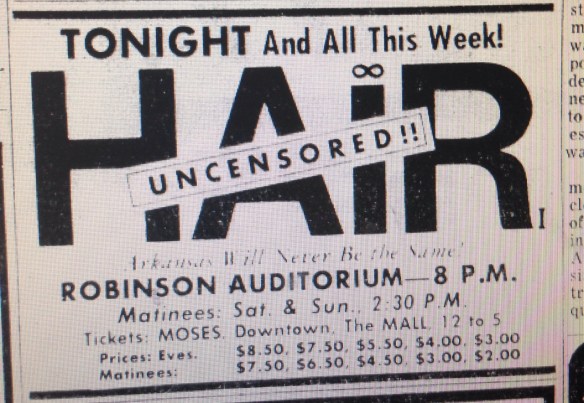
Ad for the original production of HAIR in Little Rock. Note the ticket prices. And that they could be purchased at Moses Music Shops.

Ad for the original production of HAIR in Little Rock. 

Forty-four years ago today, on August 11, 1971, Nixon appointee Federal Judge G. Thomas Eisele ruled that the musical Hair must be allowed to play in Little Rock in 1972 at Robinson Auditorium.

In February 1971, a young Little Rock attorney named Phil Kaplan petitioned the Little Rock Board of Censors to see if it would allow a production of Hair to play in the city. He was asking on behalf of a client who was interested in bringing a national tour to Arkansas’ capital city. The show, which had opened on Broadway to great acclaim in April 1968 after an Off Broadway run in 1967, was known for containing a nude scene as well for a script which was fairly liberally sprinkled with four-letter words. The Censors stated they could not offer an opinion without having seen a production.

By July 1971, Kaplan and his client (who by then had been identified as local promoter Jim Porter and his company Southwest Productions) were seeking permission for a January 1972 booking of Hair from the City’s Auditorium Commission which was charged with overseeing operations at Robinson Auditorium. At its July meeting, the Commissioners voted against allowing Hair because of its “brief nude scene” and “bawdy language.”

Kaplan decried the decision. He stated that the body couldn’t “sit in censorship of legitimate theatrical productions.” He noted courts had held that Hair could be produced and that the Auditorium Commission, as an agent for the State, “clearly can’t exercise prior censorship.” He proffered that if the production was obscene it would be a matter for law enforcement not the Auditorium Commission.

The Commission countered that they had an opinion from City Attorney Joseph Kemp stating they had the authority. One of the Commissioners, Mrs. Grady Miller (sister-in-law of the building’s eponym, the late Senator Robinson, she had served on the Commission since 1940), expressed her concern that allowing Hair would open the door to other productions such as Oh! Calcutta!

On July 26, 1971, Southwest Productions filed suit against the Auditorium Commission. Four days later there was a hearing before federal Judge G. Thomas Eisele. At that hearing, Auditorium Commission member Lee Rogers read aloud excerpts from the script he found objectionable. Under questioning from Kaplan, a recent touring production of Neil Simon’s Plaza Suite was discussed. That play has adultery as a central theme of one of its acts. Rogers admitted he found the play funny, and that since the adultery did not take place on stage, he did not object to it. Among those testifying in favor of it was Robert Reddington, who was director of performing arts at the Arkansas Arts Center.

Judge Eisele offered a ruling on August 11 which compelled the Auditorium Commission to allow Hair to be performed. Prior to the ruling, some of the Auditorium Commissioners had publicly stated that if they had to allow Hair, they would close it after the first performance on the grounds of obscenity. To combat this, Judge Eisele stated that the Commission had to allow Hair to perform the entire six day engagement it sought.

Upon hearing of the Judge’s ruling, Commissioner Miller offered a succinct, two word response. “Oh, Dear!”

On January 18, 1972, Hair played the first of its 8 performances over 6 days at Robinson Auditorium.  In his review the next day, the Arkansas Gazette’s Bill Lewis noted that Hair “threw out all it had to offer” and that Little Rock had survived.

Little Rock was by no means unique in trying to stop productions of Hair.  St. Louis, Birmingham, Los Angeles, Tallahassee, Boston, Atlanta, Charlotte NC, West Palm Beach, Oklahoma City, Mobile and Chattanooga all tried unsuccessfully to stop performances in their public auditoriums.  Despite Judge Eisele’s ruling against the City of Little Rock, members of the Fort Smith City Council also tried to stop a production later in 1972 in that city. This was despite warnings from City staff that there was not legal standing.

Pay a call on THE ADDAMS FAMILY at the Weekend Theater

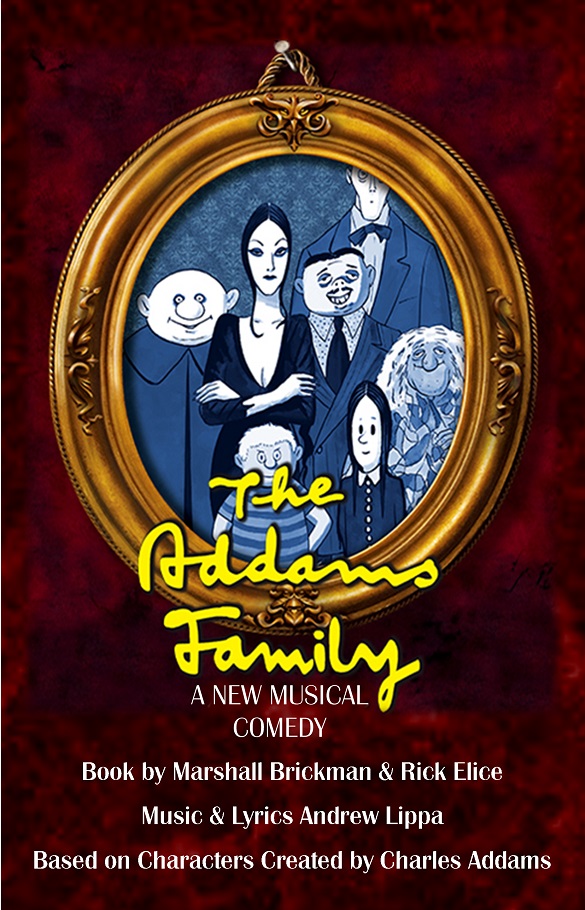
twt-Addams-FamilyCue the finger snaps and help the Weekend Theater kick off their 2015-2016 season with the ghoulishly fun Tony nominated musical The Addams Family.  Based on the Charles Addams cartoons and incorporating aspects of the 1960s TV series, this original musical is by the authors of Jersey Boys and The Wild Party.

Two families with vastly divergent cultures, mores, and expectations collide when the Addams hosts a dinner for Wednesday Addams’ “normal” boyfriend and his parents. Trust and fear, love and truth, acceptance and forgiveness are just a few things on the menu in this magnificently macabre new musical comedy created by Jersey Boys authors, Marshall Brickman & Rick Elice and Drama Desk Award winner, Andrew Lippa (The Wild Party).

The cast is led by Drew Ellis, Claudia Moskova Cremeens, Mackenzie Holtzclaw, Victor Basco, Dahren White, Ryan Whitfield, and Xavier Jones as the Addams household.  The guests are played by James West, Kristin Marts and Ethan Patterson.  Rounding out the cast are Emma Boone, Chloe Clement, Brian Earles, Kelsey Ivory, and Payton Justice.

The production is directed by Tom Crone with music direction by Lori Isner.  The show runs through July 28.  Performances are at 7:30pm on Thursday, Friday and Saturday and at 2:30 on Sunday afternoons.  On Friday, June 19 the curtain time is 8pm.


Tony Awards Week – Trouble with a capital T and that rhymes with…. HAIR?

Ad for the original production of HAIR in Little Rock. Note the ticket prices. And that they could be purchased at Moses Music Shops.

Ad for the original production of HAIR in Little Rock. Note the ticket prices. And that they could be purchased at Moses Music Shops.

The Tony winning musical The Music Man may have featured a song about “Trouble in River City” but the Tony nominated musical Hair brought trouble to this “river city” in 1971 and 1972.

In February 1971, a young Little Rock attorney named Phil Kaplan petitioned the Little Rock Board of Censors to see if it would allow a production of Hair to play in the city. He was asking on behalf of a client who was interested in bringing a national tour to Arkansas’ capital city. The show, which had opened on Broadway to great acclaim in April 1968 after an Off Broadway run in 1967, was known for containing a nude scene as well for a script which was fairly liberally sprinkled with four-letter words. The Censors stated they could not offer an opinion without having seen a production.

By July 1971, Kaplan and his client (who by then had been identified as local promoter Jim Porter and his company Southwest Productions) were seeking permission for a January 1972 booking of Hair from the City’s Auditorium Commission which was charged with overseeing operations at Robinson Auditorium. At its July meeting, the Commissioners voted against allowing Hair because of its “brief nude scene” and “bawdy language.”

Kaplan decried the decision. He stated that the body couldn’t “sit in censorship of legitimate theatrical productions.” He noted courts had held that Hair could be produced and that the Auditorium Commission, as an agent for the State, “clearly can’t exercise prior censorship.” He proffered that if the production was obscene it would be a matter for law enforcement not the Auditorium Commission.

The Commission countered that they had an opinion from City Attorney Joseph Kemp stating they had the authority. One of the Commissioners, Mrs. Grady Miller (sister-in-law of the building’s namesake the late Senator Robinson who had served on the Commission since 1939), expressed her concern that allowing Hair would open the door to other productions such as Oh! Calcutta!

On July 26, 1971, Southwest Productions filed suit against the Auditorium Commission. Four days later there was a hearing before Judge G. Thomas Eisele. At that hearing, Auditorium Commission member Lee Rogers read aloud excerpts from the script he found objectionable. Under questioning from Kaplan, a recent touring production of Neil Simon’s Tony winning play Plaza Suite was discussed. That play has adultery as a central theme of one of its acts. Rogers admitted he found the play funny, and that since the adultery did not take place on stage, he did not object to it.

Judge Eisele offered a ruling on August 11 which compelled the Auditorium Commission to allow Hair to be performed. Prior to the ruling, some of the Auditorium Commissioners had publicly stated that if they had to allow Hair they would close it after the first performance on the grounds of obscenity. To combat this, Judge Eisele stated that the Commission had to allow Hair to perform the entire six day engagement it sought.

Upon hearing of the Judge’s ruling, Commissioner Miller offered a succinct, two word response. “Oh, Dear!”

In the end, the production of Hair at Robinson would not be the first performance in the state.  The tour came through Fayetteville for two performances in October 1971. It played Barnhill Arena.

On January 18, 1972, Hair played the first of its 8 performances over 6 days at Robinson Auditorium.  In his review the next day, the Arkansas Gazette’s Bill Lewis noted that Hair “threw out all it had to offer” and that Little Rock had survived.

The ads promoting the production carried the tagline “Arkansas will never be the same.”  Tickets (from $2 all the way up to $8.50) could be purchased at Moses Melody Shops both downtown and in “The Mall” (meaning Park Plaza). That business is gone from downtown, but the scion of that family, Jimmy Moses, is actively involved in building downtown through countless projects. His sons are carrying on the family tradition too.

Little Rock was by no means unique in trying to stop productions of Hair.  St. Louis, Birmingham, Los Angeles, Tallahassee, Boston, Atlanta, Charlotte NC, West Palm Beach, Oklahoma City, Mobile and Chattanooga all tried unsuccessfully to stop performances in their public auditoriums.  Despite Judge Eisele’s ruling against the City of Little Rock, members of the Fort Smith City Council also tried to stop a production later in 1972 in that city. This was despite warnings from City staff that there was not legal standing.

Within a few years, the Board of Censors of the City of Little Rock would be dissolved (as similar bodies also were disappearing across the US). Likewise, the Auditorium Commission was discontinued before Hair even opened with its duties being taken over by the Advertising and Promotion Commission and the Convention & Visitors Bureau staff.  This was not connected to the Hair decision; it was, instead, related to expanding convention facilities in Robinson and the new adjacent hotel.  Regardless of the reasons for their demise, both bygone bodies were vestiges of earlier, simpler and differently focused days in Little Rock.

Over the years, Hair has returned to the Little Rock stage. It has been produced two more times at Robinson Center,  UALR has produced it twice, and the Weekend Theater has also mounted a production.   The most recent visit to Little Rock at Robinson Center, which was the final Broadway show before the building closed for renovations, was based on the 2009 Broadway revival.  That production, was nominated for eight Tony Awards, and captured the Tony for Revival of a Musical.  Several members of the production and creative team are frequent collaborators of Little Rock native Will Trice.

Award winning THE MEMBER OF THE WEDDING at Weekend Theater

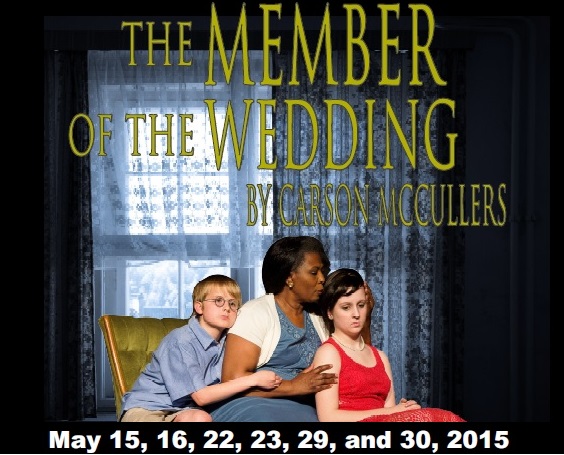
TWT Member WedNext at the Weekend Theater is The Member of the Wedding, Carson McCullers unflinching yet heart-warming look back at the transition from childhood to adulthood.

Winner of the New York Drama Critics’ Circle Award and the Donaldson Award in 1950 for best play, The Member of the Wedding is based on the Carson McCullers multi-award winning novel by the same name. The play set during World War II takes place over a few days in late August, 1945.

It tells the poignant story of 12-year-old tomboy, Frankie Addams, who, like many prepubescents, feels disconnected from everything in the world; in her words, an “unjoined person.” Frankie’s mother has died in childbirth, and her widowed father is a distant, vacuous figure who has no idea of the anxiety his daughter is experiencing. Her closest companions in her small racially divided hometown are the family’s African American housekeeper and surrogate mother to Frankie, Berenice Sadie Brown, and her six-year-old pesky cousin, John Henry West. She has no other friends in her deeply southern birthplace and dreams of going away with her soldier brother and his bride-to-be on their honeymoon in the Alaskan wilderness. Frankie Addams desperately wants to become “joined” with the newlyweds in The Member of the Wedding.

Directed by Margaret Pierson Bates, the production opens tonight and runs through May 30 on Friday and Saturday evenings.

The cast includes Danette Scott Perry, Ellis Golden, Alex Harkins, Barry Clifton, Elizabeth Bartyzal, Peter Emery, Amanda Oxford, Stacy Williams Jr., Eric Tate, Akasha Hull, Allison Filbert, Claire Green, Jeffrey Oakley, Hannah Smith, Nikolai Gordeev, Drew Ellis, Keith Harper, Tommie Tinker, Alexander White, Terry White and Ryan Whitfield.


LR Look Back: HAIR flows at Robinson Auditorium

Ad for the original production of HAIR in Little Rock. Note the ticket prices. And that they could be purchased at Moses Music Shops.

Ad for the original production of HAIR in Little Rock. Note the ticket prices. And that they could be purchased at Moses Music Shops.

Forty-three years ago today, on January 18, 1972, the musical Hair settled in for a week-long run at Robinson Auditorium.  The saga to bring the national tour to Little Rock had actually begun eleven months earlier.

In February 1971, a young Little Rock attorney named Phil Kaplan petitioned the Little Rock Board of Censors to see if it would allow a production of Hair to play in the city. He was asking on behalf of a client who was interested in bringing a national tour to Arkansas’ capital city. The show, which had opened on Broadway to great acclaim in April 1968 after an Off Broadway run in 1967, was known for containing a nude scene as well for a script which was fairly liberally sprinkled with four-letter words. The Censors stated they could not offer an opinion without having seen a production.

By July 1971, Kaplan and his client (who by then had been identified as local promoter Jim Porter and his company Southwest Productions) were seeking permission for a January 1972 booking of Hair from the City’s Auditorium Commission which was charged with overseeing operations at Robinson Auditorium. At its July meeting, the Commissioners voted against allowing Hair because of its “brief nude scene” and “bawdy language.”

Kaplan decried the decision. He stated that the body couldn’t “sit in censorship of legitimate theatrical productions.” He noted courts had held that Hair could be produced and that the Auditorium Commission, as an agent for the State, “clearly can’t exercise prior censorship.” He proffered that if the production was obscene it would be a matter for law enforcement not the Auditorium Commission.

The Commission countered that they had an opinion from City Attorney Joseph Kemp stating they had the authority. One of the Commissioners, Mrs. Grady Miller (sister-in-law of the building’s namesake the late Senator Robinson, she had served on the Commission since 1940), expressed her concern that allowing Hair would open the door to other productions such as Oh! Calcutta!

On July 26, 1971, Southwest Productions filed suit against the Auditorium Commission. Four days later there was a hearing before federal Judge G. Thomas Eisele. At that hearing, Auditorium Commission member Lee Rogers read aloud excerpts from the script he found objectionable. Under questioning from Kaplan, a recent touring production of Neil Simon’s Plaza Suite was discussed. That play has adultery as a central theme of one of its acts. Rogers admitted he found the play funny, and that since the adultery did not take place on stage, he did not object to it. Among those testifying in favor of it was Robert Reddington, who was director of performing arts at the Arkansas Arts Center.

Judge Eisele offered a ruling on August 11 which compelled the Auditorium Commission to allow Hair to be performed. Prior to the ruling, some of the Auditorium Commissioners had publicly stated that if they had to allow Hair, they would close it after the first performance on the grounds of obscenity. To combat this, Judge Eisele stated that the Commission had to allow Hair to perform the entire six day engagement it sought.

Upon hearing of the Judge’s ruling, Commissioner Miller offered a succinct, two word response. “Oh, Dear!”

In the end, the production of Hair at Robinson would not be the first performance in the state.  The tour came through Fayetteville for two performances in October 1971 at Barnhill Arena.

On January 18, 1972, Hair played the first of its 8 performances over 6 days at Robinson Auditorium.  In his review the next day, the Arkansas Gazette’s Bill Lewis noted that Hair “threw out all it had to offer” and that Little Rock had survived.

The ads promoting the production carried the tagline “Arkansas will never be the same.”  Tickets (from $2 all the way up to $8.50) could be purchased at Moses Melody Shops both downtown and in “The Mall” (meaning Park Plaza). That business is gone from downtown, but the scion of that family, Jimmy Moses, is actively involved in building downtown through countless projects. His sons are carrying on the family tradition too.

Little Rock was by no means unique in trying to stop productions of Hair.  St. Louis, Birmingham, Los Angeles, Tallahassee, Boston, Atlanta, Charlotte NC, West Palm Beach, Oklahoma City, Mobile and Chattanooga all tried unsuccessfully to stop performances in their public auditoriums.  Despite Judge Eisele’s ruling against the City of Little Rock, members of the Fort Smith City Council also tried to stop a production later in 1972 in that city. This was despite warnings from City staff that there was not legal standing.

Within a few years, the Board of Censors of the City of Little Rock would be dissolved (as similar bodies also were disappearing across the US). Likewise, the Auditorium Commission was discontinued before Hair even opened with its duties being taken over by the Advertising and Promotion Commission and the Convention & Visitors Bureau staff.  This was not connected to the Hair decision; it was, instead, related to expanding convention facilities in Robinson and the new adjacent hotel.  Regardless of the reasons for their demise, both bygone bodies were vestiges of earlier, simpler and differently focused days in Little Rock.