
Super Bowl Sunday Little Rock Look Back: Copper Bowl

Copper Bowl

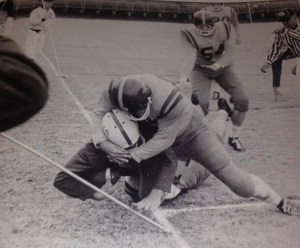
A Little Rock police officer tackles a NLR player in one of the Copper Bowls.

Today is Super Bowl Sunday, so it seems to be a good time to remember the five year series of football games in Little Rock known as the Copper Bowl.

From December 1959 through December 1963, the Little Rock Police Department played the North Little Rock Police Department in a series of football games.  The Copper Bowl games were fundraisers to help the LRPD provide food and presents for needy families during the Christmas season.

The agreement was that the teams would play for five years. The team with the most wins would permanently receive the Copper Bowl trophy.  The LRPD was outfitted with uniforms from Little Rock University and Louisiana State University (thanks to the efforts of Sgt. Harold Zook).  The games were played at Quigley Stadium.

Before the final game on December 1, 1963, the series was tied at 2-2.  The LRPD team won the game and permanently captured the trophy.  Over the five year period several thousand dollars were raised.

Black History Month Spotlight – Lynching of John Carter

John Carter lynch victimThe new Arkansas Civil Rights History Audio Tour was launched in November 2015. Produced by the City of Little Rock and the University of Arkansas at Little Rock allows the many places and stories of the City’s Civil Rights history to come to life an interactive tour.  This month, during Black History Month, the Culture Vulture looks at some of the stops on this tour which focus on African American history.

On May 4, 1927, Little Rock witnessed its worst episode of racial violence in the twentieth century. Thirty-eight year old African American John Carter allegedly “assaulted” two white women on the outskirts of the city. A white mob hunted Carter down, hung him from a telegraph pole, and riddled his dead body with hundreds of bullets. The mob transported Carter’s body downtown and then dragged it through the streets tied to the back of an automobile.

Thousands of white onlookers gathered at West Ninth Street and Broadway, the heart of the black business district. There the mob tore pews from Bethel AME Church, one of the city’s largest and oldest black churches, and threw Carter’s body onto a makeshift funeral pyre. The mob only dispersed when Gov. John E. Martineau sent in Arkansas National Guardsmen because Mayor Charles Moyer, the Chief of Police, and Sheriff “could not be reached.” No charges were ever brought against any of the perpetrators.

During the Jim Crow era, white lynch mobs murdered at least 284 black people in Arkansas, the second highest per capita number of lynchings in any state outside of Mississippi.

The app, funded by a generous grant from the Arkansas Humanities Council, was a collaboration among UALR’s Institute on Race and Ethnicity, the City of Little Rock, the Mayor’s Tourism Commission, and KUAR, UALR’s public radio station, with assistance from the Little Rock Convention and Visitors Bureau.

Pianist to celebrate classic and contemporary in UALR recital Feb. 5

University of Arkansas at Little Rock professor Linda Holzer will perform a piano recital, “Ear-Opener! A Celebration of the Known and the New,” at 7:30 p.m Friday, Feb. 5, in Stella Boyle Smith Concert Hall.

Admission is free and open to the public.

Holzer enjoys presenting concerts that combine familiar repertoire with works that “deserve to be heard more often.”

Accompanied by baritone Ferris Allen, Holzer will open the concert with the premiere of a poignant new work, “Prayers and Blessings,” by composer Gwyneth Walker.

It is a setting of three texts: “Ubi Caritas,” “Lord Make Me an Instrument of Your Peace,” and “Gaelic Blessing.”

“We think this piece is a musical antidote for a turbulent world,” said Holzer.

The remainder of the program will feature solos by Holzer including the majestic piano Sonata in E Minor by celebrated composer and Little Rock native, Florence Price.

She will also perform selections by Scarlatti, Mozart, and Bach.

Holzer, a UALR faculty member since 1995, is an active soloist and chamber musician who has played in 30 states, and most recently, abroad in Melbourne, Australia. She was a featured performer at the Australasian Piano Pedagogy Conference held at the Victoria College of the Arts. An advocate for contemporary music, Holzer was featured in performance and as host on a special KLRE broadcast last summer, “A Celebration of American Music.”

For more information, contact the Music Department at 501.569.3294.

Black History Month Spotlight – Taborian Hall and Dreamland Ballroom

The new Arkansas Civil Rights History Audio Tour was launched in November 2015. Produced by the City of Little Rock and the University of Arkansas at Little Rock allows the many places and stories of the City’s Civil Rights history to come to life an interactive tour.  This month, during Black History Month, the Culture Vulture looks at some of the stops on this tour which focus on African American history.

Completed in 1918, Taborian Hall stands as one of the last reminders of the once-prosperous West Ninth Street African-American business and cultural district. West Ninth Street buildings included offices for black professionals, businesses, hotels, and entertainment venues. In 1916, the Knights and Daughters of Tabor, a fraternal insurance organization, hired local black contractor Simeon Johnson to enlarge an existing building to accommodate their activities, other offices and a ballroom.

During World War I, black soldiers from Camp Pike came to the Negro Soldiers Service Center here. In World War II, Taborian Hall was home to the Ninth Street USO, catering to black soldiers from Camp Robinson. By 1936, Dreamland Ballroom hosted basketball games, boxing matches, concerts and dances.

A regular stop for popular black entertainers on the “Chitlin’ Circuit,” Dreamland hosted Cab Callaway, Count Basie, Duke Ellington, Ella Fitzgerald, Louis Armstrong, B.B. King, Earl “Fatha” Hines and Ray Charles. Arkansas’s own Louis Jordan also performed here. Between the 1960s and 1980s, West Ninth Street declined, and many buildings were demolished. In 1991, Taborian Hall was renovated to house Arkansas Flag and Banner. Once again, Dreamland Ballroom hosts concerts and social events.

The app, funded by a generous grant from the Arkansas Humanities Council, was a collaboration among UALR’s Institute on Race and Ethnicity, the City of Little Rock, the Mayor’s Tourism Commission, and KUAR, UALR’s public radio station, with assistance from the Little Rock Convention and Visitors Bureau.

Black History Month Spotlight – First Missionary Baptist Church

The new Arkansas Civil Rights History Audio Tour was launched in November 2015. Produced by the City of Little Rock and the University of Arkansas at Little Rock allows the many places and stories of the City’s Civil Rights history to come to life an interactive tour.  This month, during Black History Month, the Culture Vulture looks at some of the stops on this tour which focus on African American history.

Established in 1845, First Missionary Baptist Church is one of the oldest black congregations in Arkansas. The first church building was completed by 1847, with the current Gothic Revival building constructed in 1882.

In 1891, more than 600 blacks gathered here to protest the state’s recently enacted Separate Coach Law that required racial separation in passenger cars and separate waiting rooms in train stations. They marched from the church to the then state capitol, now the Old State House., to dispute laws that denied black people their constitutional rights. Historians cite that black boycotts in Little Rock, Pine Bluff, and Hot Springs on May 27, 1903, the first day of the streetcar law, caused a 90 percent drop in black patrons on Little Rock streetcars.

In May 1958, Dr. Martin Luther King, Jr., traveled to Little Rock here to attend the graduation ceremony of Ernest Green, the first African American to graduate from Central High School. In 1963, four months before the famous “I Have a Dream” speech, Dr. King visited Little Rock to provide the First Missionary Baptist Church’s 118th anniversary sermon.

The app, funded by a generous grant from the Arkansas Humanities Council, was a collaboration among UALR’s Institute on Race and Ethnicity, the City of Little Rock, the Mayor’s Tourism Commission, and KUAR, UALR’s public radio station, with assistance from the Little Rock Convention and Visitors Bureau.

Black History Month Spotlight – Mosaic Templars Cultural Center

The new Arkansas Civil Rights History Audio Tour was launched in November 2015. Produced by the City of Little Rock and the University of Arkansas at Little Rock allows the many places and stories of the City’s Civil Rights history to come to life an interactive tour.  This month, during Black History Month, the Culture Vulture looks at some of the stops on this tour which focus on African American history.

The Mosaic Templars Cultural Center and Museum collects, preserves, interprets and celebrates Arkansas’s unique African American political, economic, and social achievement from 1865 to 1950. The Center resides in the footprint of the original Mosaic Templars of America National Headquarters and Annex Buildings.

The permanent museum exhibits depict historic West Ninth Street as a thriving commercial and social hub, focusing on the black entrepreneurship, Templars organization, and the legacy of black legislators. Between 1868 and 1893, eighty-five African Americans served in the Arkansas General Assembly. The majority served in the House, with nine in the Senate. Election laws passed in 1891, together with a poll tax in 1832, ended the election of African Americans to the legislature. No black person served again until the General Assembly in 1973.

In addition to community educational programs, the Center offers a genealogy research room, an art collection created by local talent, and a well-stocked store. The Center’s third floor features a replica of the original Headquarters Building auditorium and the Arkansas Black Hall of Fame galleries.

The Center is a museum of the Department of Arkansas Heritage and admission is free.

The app, funded by a generous grant from the Arkansas Humanities Council, was a collaboration among UALR’s Institute on Race and Ethnicity, the City of Little Rock, the Mayor’s Tourism Commission, and KUAR, UALR’s public radio station, with assistance from the Little Rock Convention and Visitors Bureau.

Black History Month Spotlight – Mosaic Templars of America

The new Arkansas Civil Rights History Audio Tour was launched in November 2015. Produced by the City of Little Rock and the University of Arkansas at Little Rock allows the many places and stories of the City’s Civil Rights history to come to life an interactive tour.  This month, during Black History Month, the Culture Vulture looks at some of the stops on this tour which focus on African American history.

The Mosaic Templars of America was formed as a business in the late 1870s by Arkansas freedmen John E. Bush and Chester W. Keatts to provide insurance and other services to black people, and was incorporated as a fraternal organization in 1882. The Mosaic Templars name was derived from the biblical Moses who led his people out of bondage and relates to black America’s journey out of slavery.

By the 1920s the Templars’ organization extended to 26 states and six Caribbean nations. At the time, as one of the largest black-owned business enterprises in the world, Templars’ holdings included the original insurance company, a building and loan association, a publishing company, a business college, a nursing school and a hospital. For more than 40 years, the Templars Headquarters Building and the adjoining Annex and State Temple buildings on Broadway anchored the city’s black business district on West Ninth Street. Like many businesses, black and white, the Templars did not survive the era of the Great Depression.

Though the original Headquarters building burned in 2005, the Mosaic Templars Cultural Center is modeled on the original design. Exhibits highlight black business and self-achievement from Reconstruction to the 1950s in Arkansas and the nation.

The app, funded by a generous grant from the Arkansas Humanities Council, was a collaboration among UALR’s Institute on Race and Ethnicity, the City of Little Rock, the Mayor’s Tourism Commission, and KUAR, UALR’s public radio station, with assistance from the Little Rock Convention and Visitors Bureau.