Little Rock Look Back: Little Rock City Hall resumes after Civil War

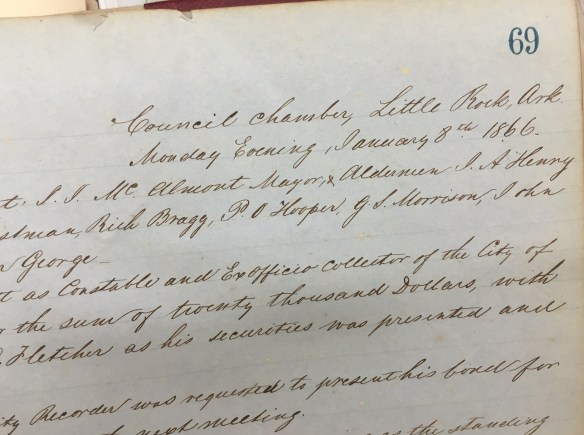
Jan 1866 minsOne hundred and fifty years ago this month, Little Rock City Hall resumed functioning after the Civil War.  The City government had disbanded in September 1863 after the Battle of Little Rock.  From September 1863 through the end of the war (on on through part of Reconstruction), Little Rock was under control of Union forces.

Following the April 1865 conclusion of the Civil War, plans were made to restart local government in Little Rock.  Even though Arkansas would not have Congressional representation in Washington until June 1868 (becoming the second Confederate state after Tennessee), the establishment of local government took place in January 1866.

The first City Council meeting took place on Monday, January 8, 1866. The council met again on Tuesday, January 9 and Monday, January 15 as they were trying to establish committees and rules for the new government.

The first post-Civil War mayor was Dr. J. J. McAlmont, who was a physician and pharmacist. Following his service as the city’s chief executive, he would later be a co-founder of what is now UAMS.  The initial aldermen were I.A. Henry (who had been on the City Council when it ceased in 1863), Henry Ashley, M. H. Eastman, Rick Bragg, P. O. Hooper, G. S. Morrison, John Collins and Alexander George.

Their first action was to approve the bond of Thomas C. Scott as Constable and City Collector.  Vouching for him were S. H. Tucker and John Gould Fletcher.  The Recorder was asked to present his bond and the next meeting.

The Mayor then established several committees of the City Council and named his appointments. Among the committees were Finances, Streets, Ordinances, Mount Holly Cemetery, Fire Department and Police.

That meeting and the following two meetings, the City continued to approve motions, resolutions and ordinances to set up the duties and responsibilities of a government.

Ordinance Number 1 established the rates of Licenses for 1866.  Among those were:

  • $100 for the privilege of selling goods at auction
  • $20 for a one-horse wagon, paid quarterly
  • $35 for a two-horse wagon, paid quarterly
  • $50 for a four-horse wagon, paid quarterly
  • $25 to run a cab or bus (which would have been in some horse drawn conveyance), paid quarterly
  • $40 a month to sell liquor, wine, ale, beer, etc., by the glass or bottle to be consumed in a store, tavern, shop or store
  • $25 each quarter for each billiard table
  • $50 each quarter for each ten pin alley


Heritage Month – Corydon Wassell House

Corydon WassellThe Corydon Wassell House is a one-and-one-half story wood framed Victorian cottage.. The 1882 house is located at 2005 South Scott Street, outside both the Governor’s Mansion and MacArthur Park Historic Districts. There are quite a few Victorian cottages in the vicinity, but it was added to the National Register of Historic Places on June 2, 2000, in recognition of it being the birthplace and residence of Dr. Corydon Wassell.

Born in Little Rock on July 4, 1884, Corydon McAlmont Wassell (called “Cory”) was born to Albert and Leona Wassell. A grandson of Little Rock Mayor John Wassell, he graduated from what is now UAMS in 1909. In 1911, he married Mary Irene Yarnell, with whom he would have four children.  In 1914, the couple volunteered to be Episcopal missionaries in China.  He served there until 1927. Following Mary’s death and his remarriage, he and new wife Madeline Edith Day Wassell returned to Arkansas in 1927.

Dr. Wassell resumed his medical practice. Given his experience with malaria in China, he proved to be an asset fighting malaria among Civilian Conservation Corps members in Arkansas. He was subsequently called to active duty in the Navy in 1936 and stationed in Key West.

After the outbreak of World War II, he was stationed in Indonesia. In early 1942, he refused to abandon his patients after the Japanese started invading Indonesia. Instead, he was able to evacuate a dozen severly wounded men over 150 miles to get to a ship. It took ten days for the ship to get to Australia, during which time it was attacked numerous times.  His official Navy Cross citation notes that he disregarded personal safety while caring for others.

He became an instant international hero. During the early days of the war, his heroism was one of the few bright spots. James Hilton wrote a biography of him; President Roosevelt praised him in a fireside chat; Cecil B. DeMille filmed a movie with Gary Cooper playing him.

Dr. Wassell’s first cousin, Sam Wassell, was serving on the Little Rock City Council at the time. He would later serve as Little Rock Mayor.

After retiring from the navy with the rank of rear admiral, Dr. Wassell worked for a time without pay at a charity hospital in Hawaii. He eventually returned to Key West, Florida. Later, he returned to Arkansas to be near family. He died on May 12, 1958, in Little Rock at the age of seventy-four. He is buried at Arlington National Cemetery.

Music for Double Reeds in free ASO concert this afternoon at UAMS.

aso_2-colorThe Ruth Allen UAMS Series takes place from time to time at UAMS and is free.  This afternoon at 4:30pm will be the latest concert in the series.

The musicians today will be music for double reeds!

TAYLOR Bach Goes North
BOZZA Shepherds of Provence
DIETZE Variations on a Hungarian Folksong
RATHBUN Two Marches
BACH Three Part Inventions No. 8, No. 13, and No. 15
BROUGHTON Music for Oboes
RUNNING Quodlibet
TAYLOR Bach Goes to Sea

As always, the concert is free and everyone is invited. It should be a nice way to start the holiday season. We look forward to seeing you there.

Here are the directions for the concert:

From Markham, turn south onto Hooper St.
Follow signs to Parking Lot 1.
Enter the lot, which goes underground.
Take the elevator to the “top” of the parking Lot 1, which immediately adjoins the back side of the lobby.
The Music Room is at the west end of the lobby, behind the grand piano.

Black History Month Spotlight – Henri Linton

bhm HenriHenri Linton is a nationally known painter and a well-respected art educator.   Born in Alabama in 1944, he began painting and visiting museums as a young man.  He paid for art supplies by painting signs and shining shoes. After entering a national art contest as a teenager, he won a four-year scholarship to the Columbus College of Art and Design in Ohio. Linton earned a Bachelor of Fine Arts from Boston University and a master’s degree in art from the University of Cincinnati Graduate School of Fine Arts.

In 1969, the chairman of Arkansas AM&N College (later UAPB) art department, John Howard, offered Linton a position on the faculty. With Howard as his mentor, Linton began a career teaching aspiring artists. When Howard retired as chairman in 1980, Linton took the position.

In 1996 and 2000, he was featured in solo shows at the Arkansas Arts Center.  His work is displayed throughout the state, including in public collections at  UAMS, the Winthrop Rockefeller Foundation and the Arkansas Arts Center. He has highlighted some of his works in a book he co-authored, The Art of Henri Linton: Sequences in Time and Space (2003).

Linton also developed UAPB’s University Museum and Cultural Center. Gathering historical photographs, papers, annuals, books, newspaper clippings, tokens, mementos, and a variety of other artifacts, Linton organized, designed, and helped construct all the displays at the museum, which houses Keepers of the Spirit: The L. A. Davis, Sr. Historical Collection, which documents the history of UAPB.

In 2001, Henri Linton was inducted into the Arkansas Black Hall of Fame.  For more on Henri Linton and other inductees into the Arkansas Black Hall of Fame, visit the permanent exhibit at the Mosaic Templars Cultural Center. That museum is an agency of the Department of Arkansas Heritage.

Little Rock Look Back: Dr. John J. McAlmont, LR’s 25th Mayor and a founder of UAMS

McAlmontJohnJ_fFuture Little Rock Mayor John Josephus McAlmont was born on this date in 1821 in New York state. (Various reports give his birth date as December 22 — but the family reports December 19 as the date.)

After studying medicine in Pennsylvania and Ohio, he arrived in Little Rock in March 1850 with his family.  After practicing medicine in nearby Benton, he returned to Little Rock in 1852.  In addition to being a physician, he was a pharmacist.

During the Civil War, he relocated his family out of Little Rock (to a spot where the present day community of McAlmont bears his name).  Following the war, he moved them back to the City.  In 1866 he was elected Mayor of Little Rock, the first elected Mayor since local government resumed following the Civil War.

In October 1879, he and seven other physicians founded the Arkansas Industrial University Medical Department in Little Rock. This institution has grown into the University of Arkansas for Medical Sciences.  He served on the faculty of the medical school for several years.

Dr. McAlmont died in September 1896.  He is buried at Mount Holly Cemetery.  In addition to the McAlmont community bearing his name, there is a McAlmont street in downtown Little Rock which was named in his memory.

FREE Arkansas Symphony concert today at UAMS

ASO_revThe Ruth Allen UAMS Series takes place from time to time at UAMS and is free.  This afternoon at 4:30pm will be the latest concert in the series.

The musicians today will be Violin/Harp duo: Drew Irvin, Co-Concert Master of the Arkansas Symphony Orchestra and Alisa Coffey, Principal Harp of the ASO.

Bela Bartok: Rumanian Folk Dances
Camille Saint Saens: Fantasie for Violin and Harp, Op. 24
Arvo Pärt: Spiegel im Spiegel
Gaetano Donizetti: Larghetto and Allegro for Violin and Harp
Vittorio Monti: Czardas
Jules Massenat: Meditation from Thais

As always, the concert is free and everyone is invited. It should be a nice way to start the holiday season. We look forward to seeing you there.

Here are the directions for the concert:

From Markham, turn south onto Hooper St.
Follow signs to Parking Lot 1.
Enter the lot, which goes underground.
Take the elevator to the “top” of the parking Lot 1, which immediately adjoins the back side of the lobby.
The Music Room is at the west end of the lobby, behind the grand piano.

Healthcare Pioneers focus of this year’s Civil Rights Heritage Trail

crht-banner-2014-thru-banner32Drs. Thomas A. Bruce, M. Joycelyn Elders, Henry Foster Jr., Edith Irby Jones, and Billy Ray Thomas, and five posthumous honorees will be recognized for their efforts to provide quality healthcare to all citizens at 2 p.m. Friday, Oct. 24, in the Little Rock River Market District at the entrance of the St. Vincent Medical Mile.

Posthumous honors will be bestowed upon Drs. Cleon A. Flowers Sr., Samuel Lee Kountz, and John Marshall Robinson; registered nurse Lena Lowe Jordan; and scientist and educator Phillip Leon Rayford, Ph.D., during the fourth annual Arkansas Civil Rights Heritage Trail Commemoration.

Commemorative markers will be added to the Heritage Trail in honor of pioneers in health care, individuals who were either first of their race to graduate from medical school, or who have shared their professional talents generously in ways that have championed racial equity in Arkansas.

“This year, the Institute turned to healthcare because even though it is a profession by which African Americans in particular have been grossly underrepresented and underserved, Arkansas has a rich tradition of producing some of the nation’s best and brightest medical professionals,” said Dr. Michael R. Twyman, director of the UALR Institute on Race and Ethnicity.

The Institute is partnering with the University of Arkansas for Medical Sciences Center for Diversity Affairs to honor these healthcare professionals. The center specializes in encouraging young persons of color to seek careers in health and STEM professions.

“I am honored to be recognized with such accomplished people,” said Thomas, vice chancellor for diversity affairs at the University of Arkansas for Medical Sciences. “It is also a very humbling experience because many of the other honorees are also my mentors.”

Like Thomas, the other nine honorees have made significant contributions toward social and racial equity in Arkansas – most of whom received their professional education and training during the the Civil Rights Movement era, during a time of deep civil unrest in the country and state.

“It is not lost on us that this year marks the 60th anniversary of the Brown vs. Board of Education court decision that prohibited public institutions from discriminating on the basis of race,” said Twyman.

“Access to quality education and healthcare have become the predominant civil rights issues of our time,” he added.

Learn more about each honoree at  arkansascivilrightsheritage.org supported in part by a grant from the Arkansas Humanities Council and the National Endowment for the Humanities.

In addition to the Center for Diversity Affairs at UAMS, the Central Arkansas Planning and Development District; East Harding Inc.; Arkansas Medical, Dental, and Pharmaceutical Association; Just Communities of Arkansas; the Little Rock Alumnae Chapter of Delta Sigma Theta Sorority, Inc.; and the Little Rock Alumni Chapter of Kappa Alpha Psi Fraternity, Inc. are sponsors for the event.


About the Civil Rights Heritage Trail

The Arkansas Civil Rights Heritage Trail was created in 2011 to acknowledge the sacrifices and achievements made by those who have fought for racial justice in the state. The Heritage Trail begins at the Old State House and currently stretches to the front of the Little Rock Regional Chamber of Commerce. As commemorative bronze markers are added each year, it will continue toward the William J. Clinton Presidential Center and beyond.     


About the UALR Institute on Race and Ethnicity

The UALR Institute on Race and Ethnicity was founded in July 2011. With a vision to make Arkansas the best state in the country for promoting and celebrating racial and ethnic diversity, the Institute conducts research, promotes scholarship and provides programs that address racial inequities. It does so by facilitating open and honest dialogue aimed at empowering communities and informing public policy to achieve more equitable outcomes.