On Walking/Walking On steps out for UALR Theatre Arts & Dance season

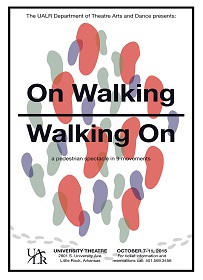
7.8.15-3The University of Arkansas at Little Rock’s first theater production of the 2015-16 season will take an in-depth look at an ordinary activity  — walking — starting at 8 p.m. Wednesday, Oct. 7, in the University Theatre.

“On Walking/Walking On” is an ensemble-based, devised performance on the activity, theme, and significance of walking using improvisation, storytelling, music, and comedy.

Performances run from Oct. 7 to Oct. 11. Wednesday through Saturday shows are at 8 p.m., and the Sunday show will commence at 2:30 p.m.

Ticket prices are $10 for the public and $5 for UALR students, employees, and seniors.

For more information or advance tickets, call the Box Office at 501.569.3456. Tickets will also be available the day of each show one hour before show time.

“This piece is about walking as an activity, walking as a fundamental means of experiencing the world, walking as metaphor,” said Dr. Lawrence D. Smith, director and assistant professor of theatre.

Walking is a commonplace and universal experience, Smith said.  “We seldom really pay attention to it; however, walking informs language and how we think about life.”

“On Walking/Walking On” is a point of departure, a short journey, a number of entrances, crosses, and exits; arrivals, climbs, descents, circles, and returns; the end of a journey, coming full circle, starting anew.

The cast members are UALR students Emily Bruner, Gabrielle Confer, Keaton Duersch, Corrie Green, Katherine Greer, Yannick Ibanez, Dustin Rhodes, Mike Vowell, Cory Watson, Priscilla Webb, and William Wofford.

Upcoming US Supreme Court session topic of Clinton School & UALR Bowen Law talk at noon today

us supreme courtIn partnership with UALR William H. Bowen School of Law, the Clinton School Speaker Series presents “Landmark Decisions: What’s on the Docket Next” today at noon.

Every year on the first Monday in October the United States Supreme Court begins its new term. Last term’s same sex marriage and Obamacare decisions are the latest examples of how the Court’s decisions change the way we live. Associate Dean Theresa Beiner and Dean Emeritus John DiPippa at the University of Arkansas at Little Rock Bowen School of Law will discuss last year’s United States Supreme Court term and its blockbuster cases. They will also highlight the important cases on the Court’s docket and their significance.

It will take place at Sturgis Hall.

*Reserve your seats by emailing publicprograms@clintonschool.uasys.edu or calling (501) 683-5239.

Arts & culture advocate, Dr. Joel Anderson to retire as UALR Chancellor

jeasmile-444x668University of Arkansas at Little Rock Chancellor Joel E. Anderson announced today that he will retire following a 13-year tenure as chancellor and a 45-year career at the university. His retirement will be effective June 30, 2016.

Anderson became UALR chancellor in 2003, bringing with him more than 30 years of university and community service. He had previously served UALR as provost and vice chancellor for Academic Affairs and as founding dean of the Graduate School.

Chancellor Anderson’s announcement comes on the heels of a 1.2 percent increase in enrollment at UALR, including a 19 percent increase in first-time college students and a 7.1 percent increase in first-time transfer students.

“It has been a tremendous pleasure to see UALR grow and mature into the excellent, comprehensive university that it has become,” said Chancellor Anderson. “The faculty and staff of UALR deserve more credit than they will ever receive for their tireless efforts to help students achieve the dream of a college education that will enable students to adjust to a changing future and support themselves and their families.”

University of Arkansas System President, Donald R. Bobbitt will form a search committee in the coming weeks with the goal to complete the search by July 1, 2016.

One of the achievements he was most passionate about was the founding in 2011 of the Institute on Race and Ethnicity, a center designed to move Arkansas forward on the broad front of racial and ethnic justice through education, research, dialogue, community events, and reconciliation initiatives.

As professor, dean, provost, and chancellor, Anderson always related success of the university to success of the students UALR served. As chancellor, he launched numerous initiatives to recruit and retain more students and to reach out to underserved student populations. His signature is on more than 26,836 diplomas and the university’s fall-to-fall retention rate is the highest it has ever been.

“Joel is a true gentleman who cares about the university more than himself”, said Dr. Dean Kumpuris, chair of the UALR Board Visitors.  “He has no ego and has sought our advice and support more than he probably had to,” “His primary goal has been to shepherd the university to a better place, which he has done. We are lucky to have had him as a leader for so many years.”

Anderson, who grew up on a farm east of Swifton in northeast Arkansas, received a BA degree in political science from Harding University, an MA degree in international relations from American University, and a Ph.D. in political science from the University of Michigan. He also completed the Institute for Educational Management at Harvard University.

“The university has good momentum. I need time to catch up on a backlog of books and also to see my grandchildren more often,” Anderson said.  “All the while I will watch with pride as UALR grows and changes.”

Highlights of his service as chancellor include:

  • The Windgate Charitable Foundation awarded UALR a grant of $20.3 million for a new Visual Arts and Applied Design center.
  • Since 2003, UALR has purchased the University Plaza shopping center which is now home of KUAR-KLRE Public Radio as well as the current home of the applied design center.

  • As part of the Coleman Creek Greenway project, the Trail of Tears Park was completed in 2011 to recognize the historical significance of the location on the south end of campus where the Choctaw and Chickasaw tribes stopped for water along Coleman Creek.

  • Establishment of a Dance major, the only one in the state, within the Department of Theatre Arts and Dance.
  • Much of the campus’s infrastructure has undergone substantial renovations including the Stella Boyle Smith Concert Hall. Likewise, there has been an added emphasis on the promotion and maintenance of public art on campus.

  • Chancellor Anderson served as a “Scholar in Residence” in 2010 at the Center on Community Philanthropy at the Clinton School for his work on issues of race and ethnicity.

  • Dr. Anderson launched the Institute on Race and Ethnicity in 2011 to move Arkansas forward on the broad front of racial and ethnic justice through education, research, dialogue, community events, and reconciliation initiatives.  One of their projects has been the annual Civil Rights Heritage Trail installation.

  • In 2015, as part of its 40th anniversary celebration, the Winthrop Rockefeller Foundation honored Chancellor Anderson as one of 40 Community Leaders in the categories of community, education, nonprofits, and prosperity.

Book on Ancient Greece, Macedonia by UALR History Professor Dr. Edward Anson published

anson ualr historyInternationally renowned scholar and University of Arkansas at Little Rock history professor Dr. Edward Anson had a second edition of his book, “Eumenes of Cardia: A Greek Among Macedonians,” released this summer.

Published by Brill Academic, the book is extensively revised from his 2004 edition, with new cuneiform material and a bibliography that includes 80 new entries.

“It has been a decade since the first edition, and much new research has been added since the original,” Anson said.

Eumenes of Cardia was a royal secretary who became a major contender for power after the death of Alexander the Great and was close to securing control of the Asian remnants of Alexander’s empire. Anson’s book argues that, despite traditional telling, Eumenes’ defeat and death were not caused by the fact that he had Greek rather than Macedonian origins.

The book may be purchased at Brill Academic and Barnes and Noble. The UALR Ottenheimer library also holds a copy.

Additionally, Anson had three chapters published in books this summer:

• “Alexander at the Beas” in “East and West in the Empire of Alexander: Essays in Honour of Brian Bosworth” by Oxford University Press
• “‘Shock and Awe’ à la Alexander the Great” in “The Many Faces of War” by Oxford University Press
• “Counter-Insurgency: The Lessons of Alexander the Great” in “Greece, Macedon, and Persia: Studies in Social, Political and Military History, A Festschrift honoring Waldemar Heckel” by Oxbow Books

Anson has published more than 50 encyclopedia articles, 14 book chapters, and more than 30 peer-reviewed articles.

His recently published books, “Alexander the Great: Themes and Issues” and “Alexander’s Heirs: The Age of the Diadochi,” was called “essential for all college and university libraries” by the American Library Association.

Anson is renowned for his work and study of fourth century B.C. Greek history. He is acclaimed by scholars all over the world for his area of specialization in the era of Alexander the Great and his successors.

His degrees include a Ph.D. from the University of Virginia and a B.A. from Drake University.

Dr. Clea Hupp to lead UALR History Department

C-HuppDr. Clea Hupp has been named as the new Chair of the UALR History Department.

Clea E. Hupp is an Associate Professor of History. She joined the UALR History Department in 2006 and received her Ph.D. at the University of Arkansas, Fayetteville in 2004.

Clea Hupp specializes in the history of the Modern Middle East and U.S. – Middle Eastern relations. Dr. Hupp received grants from numerous institutions including the John F. Kennedy Foundation, the Lyndon Johnson Foundation, the Society for Historians of American Foreign Relations, and the American Center of Oriental Research. Her latest book was recently published from I. B. Tauris and is entitled “The United States and Jordan: Middle East Diplomacy during the Cold War.” She has traveled extensively in the Middle East and she speaks both Arabic and French.

She has made numerous presentations both in Arkansas and throughout the US on Middle East relations.  In addition to her book, her publications include:

“Strike at Samu: Covert Diplomacy and Shifting Alliances Prior to the Six Day War,” Diplomatic History January,2008.

“Supporting the Brave Young King: The Suez Crisis and Eisenhower’s New Approach to Jordan, 1953-1958” in Reassessing Suez 2008.

“Balancing Act: Jordan and the United States during the Johnson Administration,” Canadian Journal of History 2006.

Dr. Hupp serves on the Board of Directors of Ballet Arkansas. She is also an active supporter of many arts organizations in Little Rock.

Nativity Scenes from the Americas on exhibit at UALR

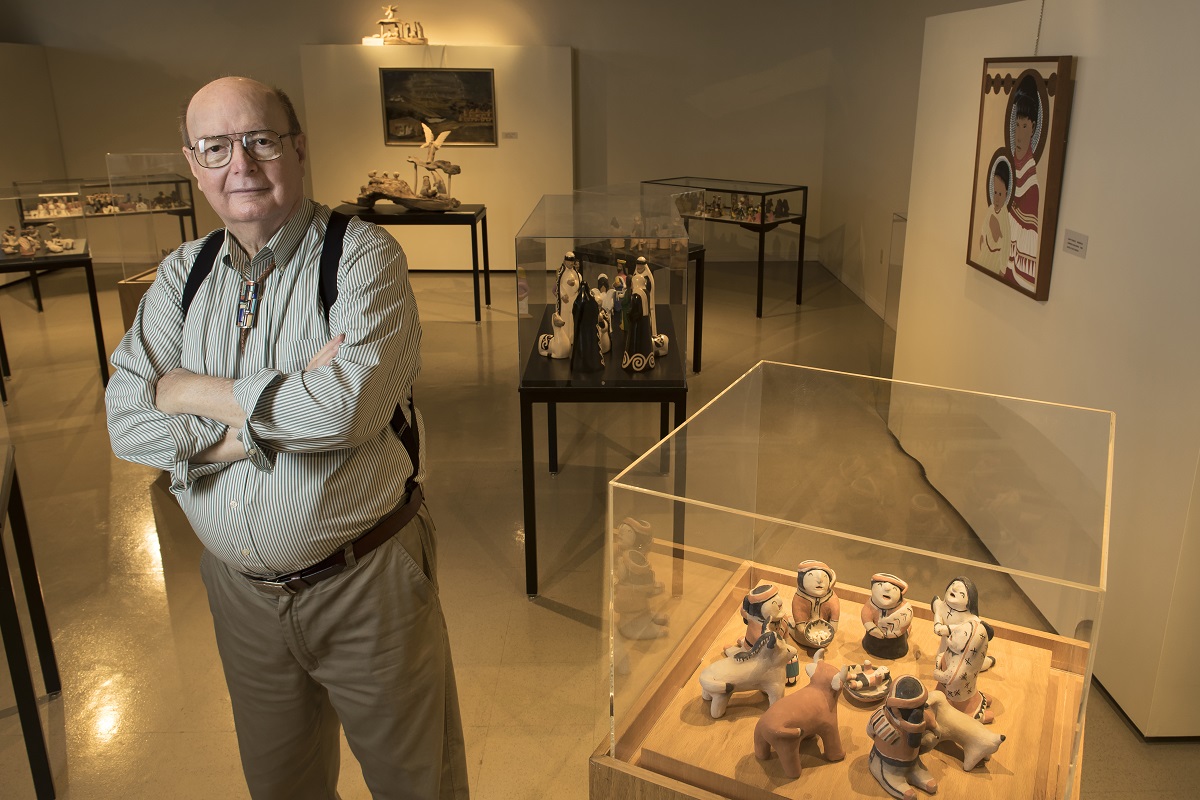
Dr. Bill Wiggins at UALR's Sequoyah National Research Center on Wednesday, August 5, 2015.

Dr. Bill Wiggins at UALR’s Sequoyah National Research Center on Wednesday, August 5, 2015.

Christmas is four months from today – yet you can see a variety of Nativity scenes at UALR.

Dr. J.W. “Bill” Wiggins took a different route with his Nativity scene collection. Essentially, if he ran across something native-arts related that he liked during his travels, he bought it.

“As I started to collect Nativities, it quickly became a folk art collection,” Wiggins said.

Figures and paintings Wiggins accumulated during the past four decades found a home in his “Nativities from the Americas” exhibit, available for viewing 8 a.m. to 5 p.m. weekdays through Oct. 9 at the University of Arkansas at Little Rock Sequoyah National Research Center.

The exhibit features about 45 Nativity scenes, mainly crafted by Native American, Mexican and South American artists, although there also are some from other parts of the world.

Wiggins is fascinated with how different cultures view Christianity and the story of the birth of Jesus Christ. Most of the artists represented in his collection incorporate their culture into the imagery.

That means, for example, visitors might see a buffalo or an eagle among the Nativity animals in some displays, and they’ll have a chance to view the figures presented in different mediums — from wood to clay, to even mud.

Wiggins said the Nativity collection is one of his most popular and most-requested exhibits. It was last on display in 2011, and Wiggins’ collection has grown since then.

One of the reasons for the exhibit’s popularity is that so many families decorate with Nativity sets of their own, Wiggins said, and the exhibit lets people see different interpretations of that venerated tradition.

Visitors to Wiggins’ exhibit shouldn’t expect to find Nativity scenes similar to those that annually line department store shelves. His collection features unique artistic perspectives such as a display that uses characters from other American holidays to symbolically represent the birth in Bethlehem.

Wiggins enjoys meeting the artists as he adds to his collection, and he tries not to miss an opportunity to discuss the displays with guests.

“I’m always interested in people’s reaction,” Wiggins said. “And what they see and what they don’t see is interesting.”

The Sequoyah National Research Center is home to one of the largest collections of Native American expression in the world. Its mission is to acquire and preserve the written and visual ideas of Native North Americans.

For more information, visit its website: http://ualr.edu/sequoyah/

Historian Dr. John Kirk is new director of UALR Institute on Race and Ethnicity

JohnKirk_history1aDr. John A. Kirk has been named the new director of the University of Arkansas at Little Rock’s Institute on Race and Ethnicity.  A native of Great Britain, he has garnered international acclaim for his research and writings on race and the civil rights movement — with a particular focus on Little Rock.

Kirk has been a member of the Chancellor’s Committee on Race and Ethnicity since he arrived at the university more than five years ago and has been involved with the institute since its inception about four years ago.

“I have a deep personal and professional commitment to the pursuit of racial and ethnic justice, and I think that should be the primary reason anyone takes on the job of director of UALR’s Institute on Race and Ethnicity — it is at the very heart of what the institute does,” Kirk said.

Kirk plans to connect with and engage as many students, faculty, and community members as possible in achieving the goals of the institute, which include:

  • Raising awareness of race and ethnicity issues
  • Providing research-based information and policy recommendations
  • Building bridges and seeking reconciliation through interracial and interethnic dialogue
  • Engaging students
  • Serving as a clearinghouse for on- and off-campus initiatives related to race and ethnicity
  • Holding UALR accountable for becoming a more diverse and multi-ethnic community.

For the past 25 years, Kirk has researched and written about issues of race and ethnicity in the United States, especially in Little Rock and Arkansas. He’s the author of numerous books, including “Race and Ethnicity in Arkansas: New Perspectives,” “Martin Luther King, Jr. and the Civil Rights Movement,” and “Beyond Little Rock: The Origins and Legacies of the Central High Crisis.” He also recently partnered with the BBC on its Martin Luther King Jr. web display that serves as an information resource for an international audience.

In announcing Kirk’s appointment, UALR Chancellor Joel E. Anderson noted the professor’s knowledge and passion for civil rights-related topics were ideal fits for the institute’s leadership role.

“It is a rare opportunity to work with someone who grew up in Great Britain but whose knowledge of Arkansas civil rights history is probably greater than anyone else’s in Arkansas or the United States,” Anderson said.  “Dr. John Kirk is a well-known resource in our community for his expertise on the many ways race has shaped our city and state. I am confident that under his leadership the UALR Institute on Race and Ethnicity will continue to grow in influence and will help shape a better future for the people of Arkansas.”

Kirk replaces Dr. Michael R. Twyman, who resigned in July to take a position at the Indiana Black Expo organization.

With Kirk’s new director responsibilities, he will remain the Donaghey Distinguished Professor of History  but no longer will serve as the UALR History Department chair.

“I am excited by the challenges and opportunities that the director’s job brings with it,” Kirk said. “I particularly look forward to getting to know more about and working with students, faculty, and community members who are learning, teaching, researching and serving on issues of race and ethnicity.”