Little Rock Look Back: LR Mayor Harold “Sonney” Henson

On July 18, 1928, future Little Rock Mayor Harold E. “Sonney” Henson, Jr. was born in Fayetteville to Harold E Henson Sr. and Dollie Croxdale Henson.  He and his sister Sara Sue grew up in Springdale.

Henson graduated from Springdale High School and was later inducted as one of the first inductees into the Springdale High School Hall of Fame where he participated in the state high school championship in football and basketball. He attended the University of Arkansas in 1945 on an athletic scholarship where he participated in three sports, golf, basketball and football, and graduated in 1949 with a degree in Business Administration.

He was active in ROTC at the university and graduated as a second lieutenant in the U.S. Army. Henson served in Korea as a captain and commander during the Korean conflict. He attained the rank of major as an active member of the Army reserve post his duty in Korea.

Henson’s professional career began with First National Bank of Springdale and soon moved to Little Rock where he served as Vice President at the Worthen Bank on Asher Avenue. In 1962 he was elected to the City of Little Rock Board of Directors.  From January 1965 to December 1966, he served as mayor of Little Rock.  In November 1966, he was unopposed in his bid for a second term on the City Board.  However in October 1967, he resigned from the City Board because he was taking a position with a bank in Joplin, Missouri.

From 1966 to 1972, he served as President of Security National Bank Joplin.  While there, he was a Missouri amateur championship golfer.  Herbert Thomas then asked him to move to Ft. Smith to head up City National Bank (present Bank Corp South) where he served as President and CEO from 1972 to his retirement in 1993 at the age of 65. He continued his service to Bank Corp South as an active board member for several years.

Among his many civic activities throughout his career were the Springdale Junior Chamber of Commerce,  Sparks Regional Medical Center board of directors of Fort Smith, president and active member of the board for the Arkansas Sports Hall of Fame and Razorback Foundation, on the board for the University of Arkansas for Medical Sciences foundation, the Westark area council for Boy Scouts, the Arkansas State Chamber of Commerce, the Small Colleges of Arkansas, Leadership Fort Smith, the Community Rescue Mission and the President of the Arkansas Bankers Association to name a few.  In 1995 he received the meritorious service award by the Arkansas Sports Hall of Honor for his lifelong commitment to Arkansas sports.

Henson was married for 53 years to Helen Garrott Henson. He had four children, 16 grandchildren and one great-grand child.

More Recognition for Little Rock’s Creative Corridor

PrintA plan to transform four neglected blocks of Main Street in downtown Little Rock into an arts district has earned yet more international recognition.  The University of Arkansas Community Design Center and Marlon Blackwell Architect’s plan The Creative Corridor: A Main Street Revitalization for Little Rock has won Honorable Mention in Urban Design (Concept) of the International Awards 2015 sponsored by Architecture Podium.

The Creative Corridor retrofits a four-block segment of downtown Main Street through economic development catalyzed by the cultural arts rather than Main Street’s traditional retail base.  The goal is to structure an identity for the Creative Corridor rooted in a mixed-use work-live environment but sensitive to the historical context. The incremental approach employs three developmental phases to transform the corridor space into a downtown node. Planning and design for the Creative Corridor was funded by a 2011 Our Town grant from the National Endowment for the Arts.

“This is yet another in a growing line of international, national and regional recognition for the Creative Corridor.  It is a testament to the outstanding design team at the UofA Community Design Center and Marlon Blackwell Architect. I am grateful for their efforts on this project,” said Mayor Mark Stodola.

“I am also appreciative of the outstanding local effort to take this plan and execute it,” Mayor Stodola continued.  “I look forward to seeing the excitement of the arts organizations up and down Main Street with their creative talent literally spilling out on to the sidewalks.”

The Creative Corridor features elements such as marquees, green and low impact development elements, and an art installation made from street lamps of different eras from city neighborhoods.

The Creative Corridor has also received other honors, including a 2014 Honor Award from the American Institute of Architects, 2013 American Architecture Award from The Chicago Athenaeum: Museum of Architecture and Design and The European Centre for Architecture Art Design and Urban Studies. It also won a Charter Award in the Neighborhood, District and Corridor category in the 2013 Charter Awards, sponsored by the Congress for the New Urbanism, and it was short-listed for the 2013 World Architecture Festival Awards in the Future Projects – Masterplanning category.

On September 14, at 3:00pm, a ribbon cutting will take place on the Creative Corridor.

Little Rock Look Back: Dan T. Sprick

SprickFuture Little Rock Mayor Dan T. Sprick was born on May 19, 1902.  He served three terms on the Little Rock City Council (from 1935 to 1941).  In 1945, he was elected Mayor of Little Rock and served one term. During his tenure on the City Council, he was the sole vote against locating Robinson Auditorium at Markham and Broadway.  He had favored another location.

He was not alone, however, in being held in contempt of court and spending part of the day in jail.  On Monday, December 4, a dozen of Little Rock’s aldermen (which included Sprick) reported to the county jail to serve sentences for contempt of court. The previous Monday, the twelve council members had voted against an ordinance which had been ordered by the judge in an improvement district matter. The other aldermen had either voted in the affirmative or had been absent. Because the twelve had refused to change their votes since that meeting, the judge ordered them jailed.

Mrs. C. C. Conner, the only female, was not jailed but was fined $50. The eleven men were held at the jail, though not in cells. In order to get out of jail, the judge gave the aldermen the chance to change their votes. The mayor asked the judge to let them leave the jail to attend the meeting at City Hall, which was nearby. He requested that the city be allowed to maintain “what little dignity remained” by not having the meeting at the jail. The judge relented, and the aldermen were escorted by deputies to the council chambers. After the aldermen changed their votes, the judge suspended the remainder of their sentences.

His tenure as Mayor was relatively quiet. He took office the same month that World War II ended. While in office, the Sprick administration was marked by growth in the city budget and in city positions. As a part of that growth, there were many more new purchases taking place which had prompted extra scrutiny of the City’s purchasing procedures. A thorough investigation toward the end of his tenure found no malfeasance or misfeasance, it did note that the city needed to do a better job of anticipating cash flow. Much of the City’s focus during the Sprick tenure was on growth and keeping up infrastructure needs.

Sprick later served for ten years in the Arkansas State Senate (from 1961 to 1970).  During his tenure in the Senate, Sprick was closely aligned with Gov. Orval Faubus.  When the Little Rock high schools had been closed a year to ensure segregation, Sprick had served on the board of a private school set up by some of the leaders of the segregation movement.

His time in the Senate was also marked by controversy.  He was one of three Senators to opposed Muhammad Ali’s speaking at the University of Arkansas at Fayetteville.  After an Arkansas Gazette editorial lambasted him, Sprick sued the paper for libel. The Gazette settled with him out of court because his health was poor.

Sprick died in January 1972.

Happy Birthday Mayor Stodola

colr_mayor_mark_stodolaToday, May 18, is the birthday of current Little Rock Mayor Mark Stodola.

Mark Stodola was elected as Mayor for the City of Little Rock, beginning his term in January 2007 and re-elected in 2010 and 2014.  Mayor Stodola has been key in promoting the revitalization of Little Rock’s Main Street, resulting in the City having been awarded a “Greening of America’s Capitals Grant” from the Environmental Protection Agency and an “Our Town Grant” from the National Endowment for the Arts for the creation of an Arts District in the heart of the downtown core.  The UA’s Community Design Center, which includes faculty and staff members from the school, won a 2014 Honor Award from the American Institute of Architects for its work on the Creative Corridor, on which it collaborated with Marlon Blackwell Architect of Fayetteville.

Prior to becoming Mayor, he served as a senior partner in the Little Rock Law Firm Catlett & Stodola, PLC.  While at that firm, he served as General Counsel to the Little Rock Airport Commission.   Having previously served the City of Little Rock as its City Attorney for six (6) years, he was elected as Prosecuting Attorney for the 6th District in 1990 and was re-elected again in 1992 and 1994.   Mayor Stodola is Past President of the Arkansas Prosecuting Attorneys Association and the Arkansas City Attorneys Association, as well as Past Chair of the Municipal Operations Section of the International Municipal Lawyers Association.  In addition, he is a member of various State, regional and national legal and professional associations.

Mayor Stodola is a graduate of Leadership Greater Little Rock, and served as Chair of Class 16 for that program. In addition, he is a member of the Heights Neighborhood Association and serves as Co-Chair of the Downtown Partnership’s Main Street Task Force.  Mayor Stodola has served on the Board of the Arkansas Repertory Theatre (for which he was the attorney who incorporated the Rep) and is Past-President of the Quapaw Quarter Association and the Historic Preservation Alliance of Arkansas.  He has worked with the Big Brothers/Big Sisters Program and is currently a member of the Rotary Club of Little Rock.

Mayor Stodola graduated from the University of Iowa with a double major in Political Science and Journalism, and received his law degree from the University of Arkansas School of Law in Fayetteville.  Mayor Stodola is married to Jo Ellen and has three (3) children:  a daughter, Allison; and twin sons, Robert and John Mark.

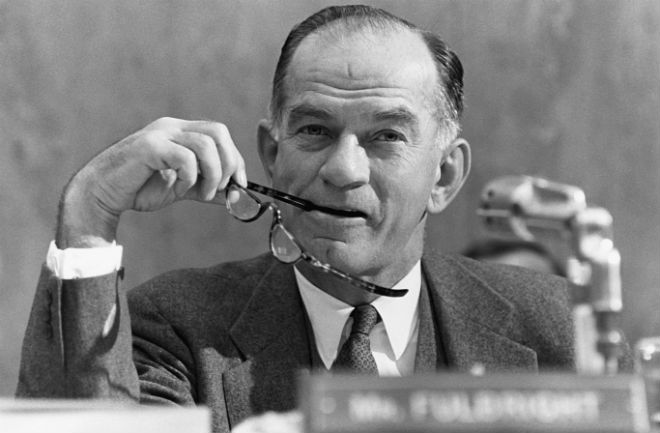
J. William Fulbright’s domestic, international politics is focus of Old State House Brown Bag Lunch Lecture today

Today at noon at the Old State House Museum, the next installment of their regular “Brown Bag Lunch Lecture” will take place.  

This edition features Micah Roberts discussing “Fulbright’s Balancing Act: How Domestic and International Politics Converged in 1959.”

Senator J. William Fulbright’s 1959 “Face the Nation” interview is used to assess how the Arkansas senator prioritized the Civil Rights agenda in Arkansas with his ambitions as a Cold War statesman. Response letters from Arkansans following the interview and also used to assess the importance of domestic vs. international politics for Arkansans.

Micah Roberts is a graduate student at the University of Arkansas where he studies United States foreign relations and politics during the Cold War, with special attention devoted to the Eisenhower-Khrushchev relationship and their use of personal and public diplomacy.

The Old State House is an agency of the Department of Arkansas Heritage.


Black History Month Spotlight – E. Lynn Harris

bhm lynnE. Lynn Harris was born in Flint, Michigan and raised, along with three sisters, in Little Rock. A graduate of Hall High School, he attended the University of Arkansas at Fayetteville where he was the school’s first black yearbook editor, the first black male Razorbacks cheerleader, and the president of his fraternity. He graduated with honors with a degree in journalism.

Harris sold computers for IBM, Hewlett-Packard, and AT&T for 13 years while living in Dallas, Washington, D.C. and Atlanta. He finally quit his sales job to write his first novel, Invisible Life, and, failing to find a publisher, he published it himself in 1991 and sold it mostly at black-owned bookstores, beauty salons, and book clubs before he was “discovered” by Anchor Books. Anchor published Invisible Life as a trade paperback in 1994, and thus his career as an author was “officially” launched.

Invisible Life was followed by Just As I Am (1994), And This Too Shall Pass (1996), If This World Were Mine (1997), and Abide With Me (1999), all published by Doubleday. All of Harris’s books were bestsellers. Harris’s sixth novel, Not A Day Goes By (July 2000) debuted at #2 on the New York Times bestseller list and was a #1 Publishers Weekly bestseller for two consecutive weeks. His seventh novel, Any Way the Wind Blows (July 2001), also debuted at #2 on the New York Times bestseller list. His other books included What Becomes Of The Brokenhearted – A Memoir (2003); I Say a Little Prayer (2006); Just Too Good To Be True (2008); Basketball Jones (2009); Mama Dearest (2009) (posthumously released) and In My Father’s House (2010) (posthumously released).

In 1999, the University of Arkansas honored Harris with a Citation of Distinguished Alumni for outstanding professional achievement, and in October 2000, he was inducted into the Arkansas Black Hall of Fame.  He died in July 2009 while in California for meetings. An autopsy determined it was due to heart disease.

For more on E. Lynn Harris and other inductees into the Arkansas Black Hall of Fame, visit the permanent exhibit at the Mosaic Templars Cultural Center. That museum is an agency of the Department of Arkansas Heritage.


LR Look Back: HAIR flows at Robinson Auditorium

Ad for the original production of HAIR in Little Rock. Note the ticket prices. And that they could be purchased at Moses Music Shops.

Ad for the original production of HAIR in Little Rock. Note the ticket prices. And that they could be purchased at Moses Music Shops.

Forty-three years ago today, on January 18, 1972, the musical Hair settled in for a week-long run at Robinson Auditorium.  The saga to bring the national tour to Little Rock had actually begun eleven months earlier.

In February 1971, a young Little Rock attorney named Phil Kaplan petitioned the Little Rock Board of Censors to see if it would allow a production of Hair to play in the city. He was asking on behalf of a client who was interested in bringing a national tour to Arkansas’ capital city. The show, which had opened on Broadway to great acclaim in April 1968 after an Off Broadway run in 1967, was known for containing a nude scene as well for a script which was fairly liberally sprinkled with four-letter words. The Censors stated they could not offer an opinion without having seen a production.

By July 1971, Kaplan and his client (who by then had been identified as local promoter Jim Porter and his company Southwest Productions) were seeking permission for a January 1972 booking of Hair from the City’s Auditorium Commission which was charged with overseeing operations at Robinson Auditorium. At its July meeting, the Commissioners voted against allowing Hair because of its “brief nude scene” and “bawdy language.”

Kaplan decried the decision. He stated that the body couldn’t “sit in censorship of legitimate theatrical productions.” He noted courts had held that Hair could be produced and that the Auditorium Commission, as an agent for the State, “clearly can’t exercise prior censorship.” He proffered that if the production was obscene it would be a matter for law enforcement not the Auditorium Commission.

The Commission countered that they had an opinion from City Attorney Joseph Kemp stating they had the authority. One of the Commissioners, Mrs. Grady Miller (sister-in-law of the building’s namesake the late Senator Robinson, she had served on the Commission since 1940), expressed her concern that allowing Hair would open the door to other productions such as Oh! Calcutta!

On July 26, 1971, Southwest Productions filed suit against the Auditorium Commission. Four days later there was a hearing before federal Judge G. Thomas Eisele. At that hearing, Auditorium Commission member Lee Rogers read aloud excerpts from the script he found objectionable. Under questioning from Kaplan, a recent touring production of Neil Simon’s Plaza Suite was discussed. That play has adultery as a central theme of one of its acts. Rogers admitted he found the play funny, and that since the adultery did not take place on stage, he did not object to it. Among those testifying in favor of it was Robert Reddington, who was director of performing arts at the Arkansas Arts Center.

Judge Eisele offered a ruling on August 11 which compelled the Auditorium Commission to allow Hair to be performed. Prior to the ruling, some of the Auditorium Commissioners had publicly stated that if they had to allow Hair, they would close it after the first performance on the grounds of obscenity. To combat this, Judge Eisele stated that the Commission had to allow Hair to perform the entire six day engagement it sought.

Upon hearing of the Judge’s ruling, Commissioner Miller offered a succinct, two word response. “Oh, Dear!”

In the end, the production of Hair at Robinson would not be the first performance in the state.  The tour came through Fayetteville for two performances in October 1971 at Barnhill Arena.

On January 18, 1972, Hair played the first of its 8 performances over 6 days at Robinson Auditorium.  In his review the next day, the Arkansas Gazette’s Bill Lewis noted that Hair “threw out all it had to offer” and that Little Rock had survived.

The ads promoting the production carried the tagline “Arkansas will never be the same.”  Tickets (from $2 all the way up to $8.50) could be purchased at Moses Melody Shops both downtown and in “The Mall” (meaning Park Plaza). That business is gone from downtown, but the scion of that family, Jimmy Moses, is actively involved in building downtown through countless projects. His sons are carrying on the family tradition too.

Little Rock was by no means unique in trying to stop productions of Hair.  St. Louis, Birmingham, Los Angeles, Tallahassee, Boston, Atlanta, Charlotte NC, West Palm Beach, Oklahoma City, Mobile and Chattanooga all tried unsuccessfully to stop performances in their public auditoriums.  Despite Judge Eisele’s ruling against the City of Little Rock, members of the Fort Smith City Council also tried to stop a production later in 1972 in that city. This was despite warnings from City staff that there was not legal standing.

Within a few years, the Board of Censors of the City of Little Rock would be dissolved (as similar bodies also were disappearing across the US). Likewise, the Auditorium Commission was discontinued before Hair even opened with its duties being taken over by the Advertising and Promotion Commission and the Convention & Visitors Bureau staff.  This was not connected to the Hair decision; it was, instead, related to expanding convention facilities in Robinson and the new adjacent hotel.  Regardless of the reasons for their demise, both bygone bodies were vestiges of earlier, simpler and differently focused days in Little Rock.