
Women Making History – The Mount Holly Cemetery Association

Instead of featuring one woman, today’s entry focuses on scores of women. The Mount Holly Cemetery Association has been protecting, preserving, and promoting Mount Holly Cemetery for over 100 years. The organization was empowered with these roles by the Little Rock City Council at a time when women still did not have the right to vote.

The Mount Holly Cemetery is a treasure trove of history, architecture and horticulture on the edge of downtown Little Rock.  It was established in 1843 when Chester Ashley and Roswell Beebe donated the land to the city of Little Rock. Feeling the town fathers were not giving the cemetery the attention it deserved, a group of Little Rock businessmen formed a cemetery commission on March 20, 1877. Charter members of the commission were J. H. Haney, Fay Hempstead, James Austin Henry, Philo O. Hooper, and Frederick Kramer. However the private group of men did no better in maintaining the cemetery.

In 1914, a contingent of the town’s women became critical of the cemetery’s unkempt appearance and took over the reins from the men. Following adoption of City Ordinance No. 2199 in June 1915, the ladies’ Mount Holly Cemetery Association was incorporated on July 20, 1915. (It should be noted this action by the women came at a time when women did not have the right to vote.)

The Mount Holly Cemetery Association grew out of a meeting which took place on June 9, 1914 at the home of Mrs. A. H. Scott. Thirty-six women gathered for the purpose of improving the cemetery.

An executive committee was formed, and the women started working on improvements to the cemetery. Though first viewed by some men as an auxiliary to the Cemetery Commission, it quickly became apparent that the women were in no mood to take a back seat in matters pertaining to Mount Holly.

The first executive board (from June 1914 to July 1915) included Mrs. A. H. Scott, Mrs. B. S. Johnson, Mrs. George Thornburgh, Mrs. Moorhead Wright, Mrs. H. M. Bennett, Mrs. George Worthen, Mrs. W. E. Green, Mrs. George Stratman, Miss Louise Gibson and Miss Clara Hotze.

The July 1915 incorporators were Mrs. Scott as well as Julia E. Bennett, Eva C. Shields, Rosa M. Miller, Ruby P. Ratcliffe and Marguerite R. English. Mrs. Bennett, known affectionately as “Scrap” would serve as the first president, and Miss Miller was the first secretary.

Over the years the Association has undertaken countless projects large (construction of a mausoleum) and small (signs on the lanes) to improve Mount Holly Cemetery for its residents and for visitors.

In 1993, the Association published a history of the first 150 years of the cemetery.  More recently, they launched the annual RIP (Rest in Perpetuity) picnic held the last Sunday in April on the grounds.  They have also published a cookbook–Recipes in Perpetuity.

Today, the Mount Holly Cemetery Association is still going strong!
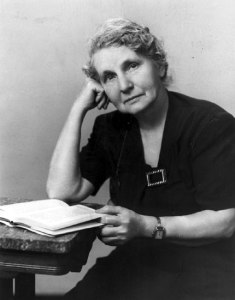
Women Making History: Bernie Babcock

Julia Burnelle “Bernie” Smade Babcock was an author and museum founder.  When her husband died, leaving her with five children, she starting writing for money. She published several temperance novels and later wrote for the Arkansas Democrat.  She also published a magazine, wrote plays which were performed in New York, and authored a poetry anthology.

She later became recognized as an expert on Abraham Lincoln and wrote several books about him, as well as other historical figures.  For her writing skills, she became the first Arkansas woman to be included in Who’s Who in America.

In 1927, after professional curmudgeon H. L. Mencken wrote derisively of Arkansas, she decided to start a museum. The Museum of Natural History and Antiquities was first located in a Main Street storefront.  In 1929, she “gave the City of Little Rock a Christmas present” by giving the museum to the city.  It was relocated to the unfinished third floor of City Hall, with her as its employee. After being closed during part of the Great Depression, she relocated the museum to the Arsenal Building and reopened it as the Museum of Natural History.  She was involved in the efforts to rename City Park in honor of Douglas MacArthur (who had been born there) and welcomed him when he came to Little Rock in 1952.

Following her retirement in 1953, she moved to Petit Jean Mountain where she wrote and painted.

After more name changes and a relocation, her museum is now known as the Museum of Discovery and is an anchor in the River Market district.

Women Making History – Dr. Sybil Jordan Hampton

Dr. Sybil Jordan Hampton made history as the first African American student to attend each high school year at and graduate from Little Rock Central High School.  But her impact on history exceeds that and extends into classrooms throughout Arkansas.

After a career which took her from elementary classrooms to corporate boardrooms, Dr. Hampton returned to Little Rock in 1996 to become the President of the Winthrop Rockefeller Foundation.  In that capacity, she oversaw many opportunities to broaden the ways the arts and humanities were used in classrooms and outside of classrooms.  Dr. Hampton led the WRF until her retirement in 2006.  Through her vision and leadership, many tens of thousands of dollars of support went to cultural institutions and organizations during her decade at the helm.

In the mid-2000s, following the unexpected death of the Arkansas Symphony Orchestra’s executive director, Dr. Hampton served as acting executive director of the ASO while a national search could be conducted.  She had long been a supporter of the ASO and other cultural institutions as a patron.

During the Central High Integration 60th Anniversary, Dr. Hampton served as emcee of the Commemoration Ceremony.  A few months later, she received one of the LRCH Tiger Foundation’s first Award of Excellence. She has also been honored by inclusion in the Arkansas Civil Rights Heritage Trail and the Arkansas Black Hall of Fame.

She continues to be involved with Little Rock’s cultural life through her involvement in the Mount Holly Cemetery Association. She is a tireless advocate for this living museum of Little Rock’s past.

Last year, she was was interviewed by The HistoryMakers.  Recently, she was featured at Robinson Center when the public radio program “The Moth” recorded a show there.  L


Women Making History – Josephine Pankey

Josephine Pankey was a real estate developer at a time that few women or few African American men were engaged in that profession. The fact that she was an African American woman who was developing real estate made her efforts even more remarkable.

Born in Cleveland OH in 1869, she was educated at Oberlin College.  She moved to Arkansas to serve as a teacher for the African Methodist Episcopal church, first in DeValls Bluff and later in Pine Bluff.  While in the former, she married Eugene Harris.  After three years, the couple divorced.

In Pine Bluff, she met Samuel Pankey, a widowed postal worker with seven children. They married in 1904 and moved to Little Rock soon after because they felt it offered opportunities for their interest in real estate development.

Because of Little Rock’s restrictive Jim Crow era covenants which limited where African Americans could live or own property, Josephine Pankey decided to buy and develop land outside of the city limits.  In 1907, she purchased 80 acres approximately 13 miles west of Little Rock for $400.  Over the next several years, she purchased several more parcels of land which she platted and developed.  Working with Worthen Bank, she started arranging loans for her buyers.

In addition, she established schools and libraries for African Americans in Little Rock.    She was also active in the USO and YWCA.  In the 1950s, the Pulaski County Special School District built a school on land she donated in the community which bore her name.

Though her husband died in 1937, Josephine Pankey continued her real estate development until 1947, when she officially retired.   She died in 1954 and is buried at Oakland-Fraternal Historic Cemetery.

The community which bears her name still exists, though now it is within the Little Rock city limits.  A police substation and community center bears her name.  In 2017, she was honored with inclusion in the UA Little Rock Anderson Institute on Race & Ethnicity Civil Rights Heritage Trail.

Women Making History – Nancy Rousseau

Though not a graduate of Little Rock Central High School, Nancy Rousseau is a Central High Tiger through and through.

She has been principal of Little Rock Central High School since the summer of 2002. Born in New York, she graduated high school in Tenafly, New Jersey.  After attending Ohio University, she graduated from Adelphi University with a degree in English education.  Her first job was teaching in Port Washington, NY, where she won the “New Teacher of the Year” award.  After teaching in Midwest City, Oklahoma, she arrived in Little Rock in 1976.

From 1976 until 1986, she taught English at Pulaski Academy.  After receiving her master’s degree in educational administration from the University of Arkansas at Little Rock, she was hired by the Little Rock School District as an Assistant Principal at Central High School.  From 1991 until 1998, she served in that capacity. During that time, she worked on the planning for the 40th anniversary of the integration of Central High by the Little Rock Nine.

In 1998, she became principal of Pulaski Heights Junior High School.  She led the school’s transition from a junior high to a middle school.  When the position of Central High School principal became open in 2002, she applied for the job.

Since returning to Central as its principal, Mrs. Rousseau has been a very visible champion of the school, its students, faculty and alumni.  She served as co-chair for the Central High Integration 50th Anniversary Commission.  During her tenure, the school’s physical plant has been upgrade and much of the historic façade and interior has been restored.  A Central High Alumni Association and a Tiger Foundation have been formed.  Through their effort, the arts, academics and athletics have been enhanced.

Mrs. Rousseau also participated in the planning for the 60th anniversary of the school’s integration.  She is one of a very few who worked on the 40th, 50th and 60th anniversaries.

Women Making History – Kathy Webb

While Kathy Webb has had many titles over her career in public service, Advocate for Others probably encompasses all of them.
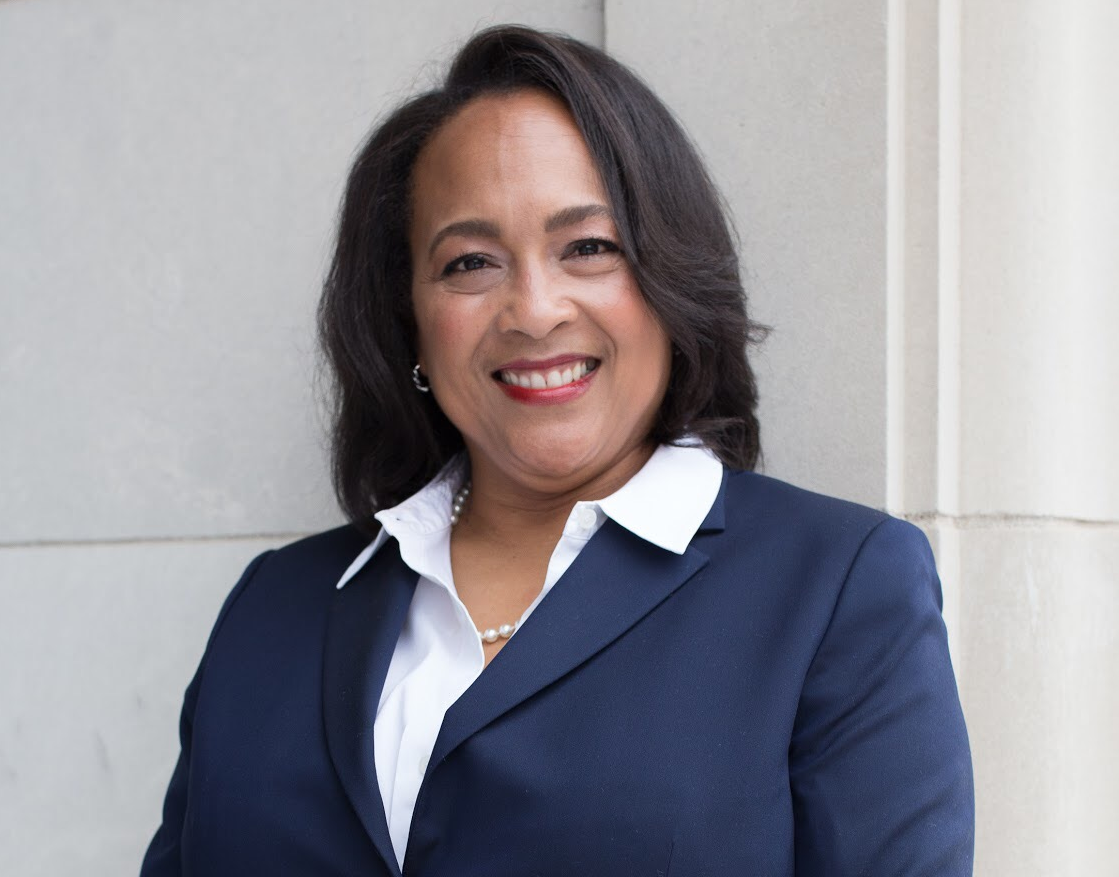
One of the most important committees at the Arkansas General Assembly is the Joint Budget Committee.  It is chaired by a senator and a representative.  In 2011 and 2012, as a state representative, Kathy Webb became the first woman to chair the committee.  

Considering that the first woman to be sworn in to the Arkansas General Assembly (Erle Chambers) was from Little Rock, and the first woman to chair a standing committee of the General Assembly (Myra Jones) was from Little Rock, it is fitting that the first woman to chair Joint Budget was also from Little Rock.

While women had been chairing committees for two decades, no female had ever led this committee.  During her tenure, Rep. Webb received praise from people in both houses and both parties for her leadership.  She served in the Arkansas General Assembly from 2007 until 2012.  During that time, she was also named the most effective legislator by Talk Business

Now, she continues her public service in her second four-year term on the City of Little Rock Board of Directors.  She served as Little Rock’s vice mayor in 2017 and 2018. Director Webb grew up in Arkansas and graduated from Little Rock Hall High. She earned a degree from Randolph-Macon Woman’s College and attended graduate school at the University of Central Arkansas. She has also participated in the Senior Executives in State and Local Government program at the John F. Kennedy School of Government at Harvard University.

After working in political advocacy in Washington D.C. and throughout the U.S. for several years, she spent over 20 years in the restaurant industry in Illinois, Tennessee, and Arkansas.

Her community involvement includes service on the UAMS College of Medicine Board of Visitors, Arkansas Hospice, and First United Methodist Church of Little Rock. She was the founding president of the Chicago-area affiliate of Susan G. Komen for the Cure.

Director Webb has been honored by the Arkansas Kids Count Coalition, Just Communities of Arkansas, Arkansas Judicial Council, National Association of Women Business Owners, Sierra Club, Arkansas AIDS Foundation, Arkansas Chapter of the National Association of Social Workers, Pulaski County CASA, Interfaith Alliance for Worker Justice, Arkansas AARP, Arkansas Hospitality Association, Arkansas Municipal League, Hendrix College and Black Methodists for Social Renewal.

She is the Executive Director of the Arkansas Hunger Relief Alliance. The Alliance is the statewide umbrella organization for Feeding America food banks, food pantries and agencies and hunger activists and the education and advocacy clearinghouse on hunger issues in Arkansas. Earlier in 2019, it was named Non-Profit of the Year at the Arkansas Business of the Year Awards.

Women Making History – Terri Hollingsworth

On January 1, 2019, Terri Hollingsworth was sworn in as Circuit/County Clerk for Pulaski County.  She is the first African American female to hold the position (and, indeed the first African American of either gender to do so).

Ms. Hollingsworth has worked in management positions in both the public and private sectors and nonprofit organizations. She has served on all levels of government and began her career working for the City of Little Rock as a city planner and later as the economic development administrator. Ms. Hollingsworth has also worked for Arkansas Secretary of State Sharon Priest and was tapped to be the Director of the State Board of Election Commissioners. She managed the board’s daily operations and $3.2 million budget, monitored and effectively communicated the state’s position on election legislation, conducted statewide poll worker training, and was the liaison and primary contact to legislators.

Ms. Hollingsworth served as the Chief Administrative Officer at the Delta Regional Authority (DRA) and oversaw the daily operations of the federal agency, supervision of staff and operational management of board members, elected officials and stakeholders. Terri remains an active member of the Delta Leadership Network which supports the DRA’s work in eight states and the efforts of the Delta Leadership Institute. Before her election, Ms. Hollingsworth served as a senior advisor for business strategy at Peter Damon Group, a national strategic public affairs, business development and event management services firm.

Ms. Hollingsworth is a member of Jack and Jill of America, Inc., Links, Inc., Delta Sigma Theta Sorority, Inc, and is on the board of Audubon Arkansas. A graduate of Howard University in Washington D.C., she earned a Master of Business Administration from the University of Arkansas at Little Rock.