Paul Laurence Dunbar School Neighborhood Historic District listed in the National Register of Historic Places.

dunbarimage2

Built as Paul Laurence Dunbar High School, this building is now known as Dunbar Middle School. It is the centerpiece of the Dunbar Neighborhood.

Earlier today, Little Rock Mayor Mark Stodola and Director of the Arkansas Historic Preservation Program Missy McSwain announced the listing of the Paul Laurence Dunbar School Neighborhood Historic District in the National Register of Historic Places and discuss what that means for the City of Little Rock.

This designation is the result of several years of hard work by members of the community.  This National Register listing formally documents the neighborhood’s history, development and contributions to the City of Little Rock.  It also provides an incentive in the form of rehabilitation tax credits for many of the properties within its boundaries.

Paul Laurence Dunbar School Neighborhood Historic District in Little Rock contains buildings dating to 1890. According to the National Register nomination, the district is representative of the evolution of a neighborhood from an integrated working and middle-class neighborhood in the late-nineteenth and early-twentieth century to a predominantly African-American working and middle-class neighborhood in Little Rock by the 1960s. Resources within the District reflect the varied architectural styles prevalent during the late nineteenth and early-to-mid-twentieth centuries. Properties in the district exhibit a broad mix of influences and architectural variants popular during the period, influenced by regional and ethnic traditions.

The National Register of Historic Places is the official list of the Nation’s historic places worthy of preservation. Authorized by the National Historic Preservation Act of 1966, the National Park Service’s National Register of Historic Places is part of a national program to coordinate and support public and private efforts to identify, evaluate, and protect America’s historic and archaeological resources.

Also at the press announcement, Hearne Fine Art unveiled a new sculpture, “Three Rings: Tribute to Isamu Noguchi.”


Community Theatre of Little Rock announces 2014-2015 season

ctlrThe Community Theatre of Little Rock has recently announced their 59th Season, which has been given the theme “The Sinners and Saints Season.”

The season kicks off on August 22 with a one weekend only series of one acts.  Directed by Liz Turner, Lisa Luyet, Mark Troillett and Chris Boggs, the one acts are: “The Actor’s Nightmare” by Christopher Durang, “Private Wars” by James McLure, “Ways and Means” by Noel Coward and “30 Minutes to Charlie” by Nick Zagone.

In October, N. Richard Nash’s classic play The Rainmaker will be performed from October 3 through 19.  For the holidays the musical Nuncrackers: The Nunsense Christmas Musical by Dan Goggins will take the stage from November 28 through December 20.  The backstage thriller Rehearsal for Murder kicks off 2015 from February 13 through March 1.

A new play will be premiered.  Written and directed by S. Christopher Boggs, The Winning Numbers will play from April 24 through 26.  The season will conclude with the musical Sister Act from June 5 through 28.

The Community Theatre of Little Rock now performs at the new Studio Theatre in downtown Little Rock.

Little Rock Look Back: William G. Whipple – LR’s 34th Mayor

whippleOn August 4, 1834, future Little Rock Mayor William G. Whipple was born in Connecticut.  He attended school in Massachusetts and graduated from Wesleyan University. After studying law at Albany Law School, he moved to Milwaukee, Wisconsin.

In 1868, Whipple moved to Little Rock following the 1866 death of his first wife in Wisconsin. Long active in Republican politics, he quickly became involved in Little Rock’s political and social life.  Shortly after his arrival he was appointed United States Attorney and served three years.

In 1870, he married Mary S. Dodge, daughter of former mayor Roderick Lathrop Dodge MD.  They had one son Durand, who followed his father into the legal profession. The Whipples were active members of Trinity Episcopal Cathedral.

In 1887, Whipple was elected Mayor of Little Rock and was re-elected two years later.  Whipple’s mayoral administration introduced electric lighting to the city beginning on September 1, 1887, paved many streets with granite and macadam, created sixty miles of new brick and concrete sidewalks, and introduced a steam dummy railway.

In 1892, he ran for Governor of Arkansas as the Republican nominee but was unsuccessful.  In 1895, he sought a third term for Mayor but was defeated by James A. Woodson.

From 1897 to 1900, he served as register of the US Land Office in Arkansas.  Whipple, who had long practiced law, was appointed United States Attorney for the Eastern District of Arkansas in 1900.  He served in that capacity until 1913.

In July 1914, Mayor Whipple died.  He is buried at Oakland Cemetery in Little Rock.

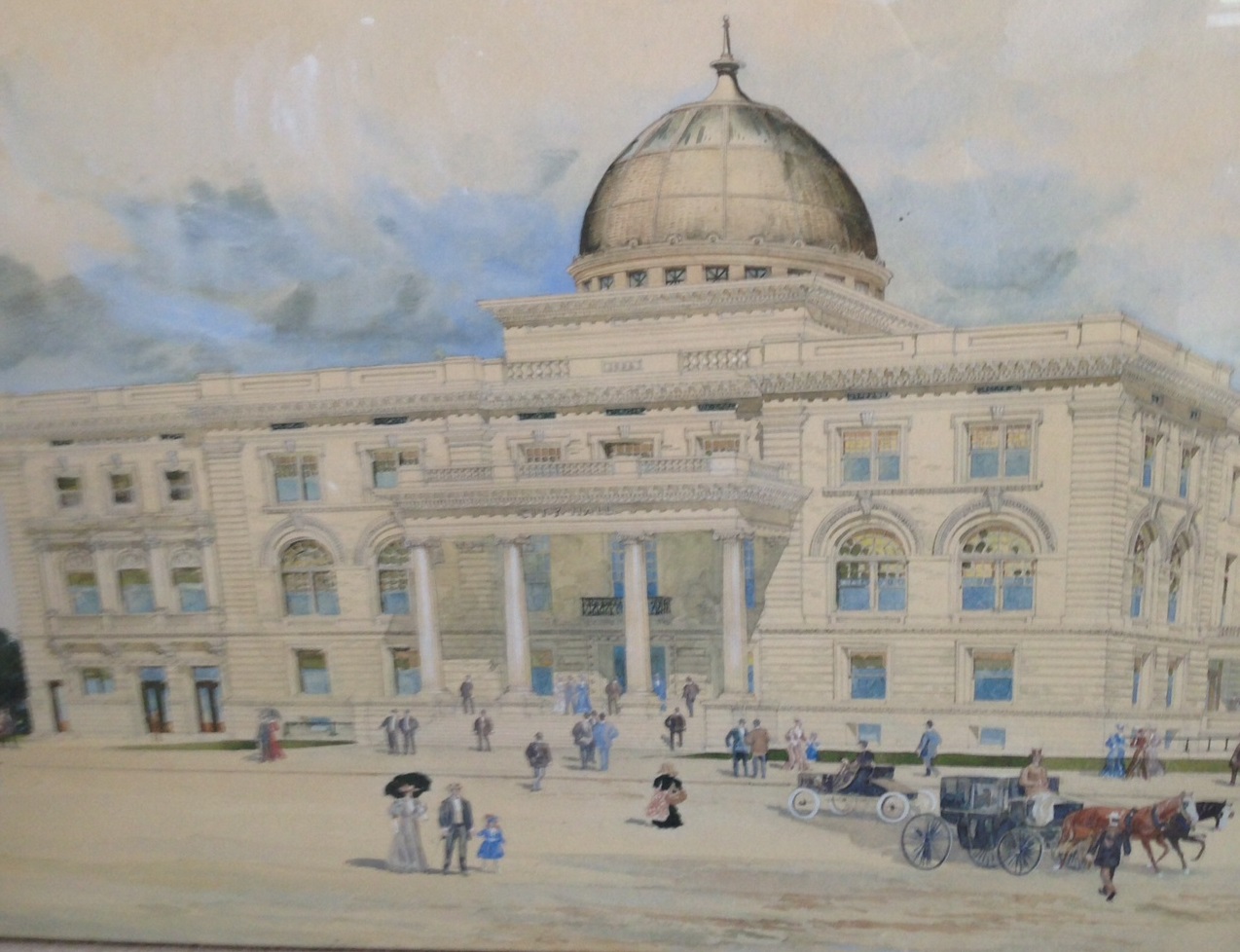
Little Rock Look Back: Would Little Rock get a new City Hall and Auditorium in 1906?

The 1906 plans for City Hall with the Municipal Auditorium on the left portion.

The 1906 plans for City Hall with the Municipal Auditorium on the left portion.

Last week: Little Rock Mayor Warren E. Lenon had been advocating for a new City Hall a municipal auditorium since shortly after taking office in April 1903. After plans were approved in July 1906, a group of citizens, led by Arkansas Gazette publisher J. N. Heiskell, filed suit to stop the City.

The closing arguments in the trial against plans for a new City Hall and auditorium complex had been heard on Monday, July 30.  The case was heard by Chancery Judge J. C. Hart.  Serving as an advisor to Chancellor Hart throughout the trial (though with no official legal standing) was Pulaski County Circuit Court Judge Robert J. Lea.  To accommodate the expected large attendance, the trial had been moved into his courtroom which was larger than Chancellor Hart’s.

On Friday, August 3, Pulaski County Chancery Judge J. C. Hart issued an injunction to keep the City from signing a contract for the construction of a city hall, jail and auditorium.  Chancellor Hart concurred with the plaintiffs that Arkansas’ constitution and laws dictated all taxation must be for public purposes.  He found there was nothing in Arkansas case law which defined an auditorium to be used for conventions as a public purpose.

As had been the case throughout the trial, the tone of the coverage of the decision differed greatly in the city’s two daily papers.  The subheading in the Democrat noted that the plaintiffs would be liable for any losses to the municipal government’s coffers due to a delay in commencing the construction if Little Rock eventually prevailed.  That fact is not mentioned by the Gazette.  Both papers did make note that Judge Lea agreed with the Chancellor’s decision.

For now, it looked as if the City of Little Rock would be stuck in the 1867 City Hall on Markham between Main and Louisiana.  Mr. Heiskell and his compatriots waited to see if the City would appeal the decision.

While August would be a quiet month publicly, work would go on behind the scenes.  More on that, in the future.

Jazz, Funk and Soul Tonight as Art Porter Music Education Week Wraps Up

Art Porter weekThe Art Porter Music Education Work of Art Jazz Week ends tonight with a concert at the Cabe Theatre at Wildwood Park for the Arts.

The evening starts at 8pm and features Jazz, Funk, Soul composed of Jeff Lorber, Paul Jackson, Jr., and Everette Harp as well as the APME Scholarship Award Presentation with musical performances by Dizzy 7 Band and Lexington Porter.

Jeff Lorber is famous for launching the career of Kenny G and his productions and collaborations with such greats as Dave Koz, Janet Jackson, Lalah Hathaway and Miles Davis. He is one of the most sought after producers and performers in Jazz!

Los Angeles session guitarist Paul Jackson, Jr. was one of the most prolific players in R&B during the ’70s and ’80s.  He has supported artists ranging from Michael Jackson  to the Temptations, Whitney Houston, Patti LaBelle, Chicago, Elton John, Dave Koz, Al Jarreau,  and many others.

Everette Harp has recorded and shared the stage with such musical giants as Aretha Franklin, Luther Vandross, Billy Joel and Patti LaBelle. A hit maker in his own right, Jazziz magazine hails his “amazing virtuosity” and Jazz Times calls him “a rare talent.”

Since Jazz Funk Soul began touring in 2013, the popularity of the group and the audience’s enthusiasm has been tremendous. This new album was created to satisfy the demand from their growing audience.

The Dizzy 7 plays music that ranges from Motown to Big Band, Latin to Dixie. It features a full rhythm section, a three-man horn section, and female and male vocalists. Dizzy 7 is composed of accomplished musicians who love what they do.

Alex Bugnon Headlines A Work of Art Concert at Sway

ab_homepageA Work of Art – the Art Porter Music Education Jazz Week continues tonight with two concerts by Alex Bugnon taking place at Sway.  Shows take place at 7pm and 9pm.

He is a jazz pianist and composer from Montreux, Switzerland.  Bugnon studied at the Paris Conservatory and the Mozart Academy in Salzburg. At age nineteen, he moved to the U.S. and attended the Berklee School of Music.

His recording career began with his 1989 debut album “Love Season” which reached the pop charts and the Top 40 of the R&B charts as did his follow-up “Head Over Heels.”  Bugnon toured with “Gospel Leviticus” in the Deep South. He has won two Soul Train Music Awards.

For more information or to purchase tickets, visit the Art Porter Music Education website.