Les Miz “Between Stage and Screen” Tonight

replesmizNext month, Les Miserables returns to Arkansas Rep.  In conjunction with that, the Between Stage and Screen series returns for this month’s installment.

The monthly series showcases films which share connections with productions currently on stage at the Arkansas Repertory Theatre.

Tonight’s film is Les Miserables.  Members of The Rep’s creative team will discuss one of the most popular musicals in Broadway history and compare and contrast the audience’s emotional connection to the story of Les Miserables on screen and on the stage. Between Stage and Screen is FREE and open to the public. The event takes place at Laman Library, 2801 Orange Street.

The program begins tonight at 6pm with a discussion of the Rep’s production led by members of the Rep’s staff.  Following that, at 6:30, the film will be screened.

The Rep’s production, directed by Robert Hupp, begins performances on March 5 and runs through April 6.  Opening night is March 7.

Violinist Jennifer Stumm highlights Chamber Music Society of LR concert tonight

jennifer-main-photoViolinist Jennifer Stumm will be the featured artist tonight at the Chamber Music Society of Little Rock concert.  The event will take place at 7:30 at Trinity United Methodist Church.  Tickets are $25 and can be purchased at the Chamber Music Society website.

Hailed by The Washington Post for the “opal-like beauty” and “phosphorescent energy” of her playing, and First Prize Winner of the Concert Artists Guild Competition, violist Jennifer Stumm is internationally recognized as a musical innovator and dynamic advocate for her instrument.  She was honored to be invited to give a TEDx presentation at the 2011 Aldeburgh Festival, which she entitled An Imperfect Instrument, and through a unique mixture of talk and performance, Ms. Stumm offers a compelling meditation on the viola’s capacity for emotion– and for making beautiful music.  The subsequent video of her presentation was selected as an ‘Editor’s Pick’ of all talks on Ted.com.

Ms. Stumm’s debut recording for Naxos’ Laureate Series is a CD of works by Italian composer/violist Alessandro Rolla (1757-1841), who played a crucial role in the development of the viola as an important concert instrument.  Joined by pianist Connie Shih and violinist Liza Ferschtman, the CD was just released to critical acclaim: “…a very polished and suave violist.  She plays dead in tune, and her bowing is supple and lively.” (American Record Guide).  In 2007-08, Jennifer Stumm also embarked on a series of exciting collaborations for the BBC, including Britten’s Lachrymae in Scotland and a festival of Russian music at the acclaimed Sage Gateshead in Newcastle, all for broadcast.  Previous broadcasts of her performances have been heard on the BBC as well as the Dutch, Irish and German National Radio Networks.

Recent appearances of note include debuts at Weill Recital Hall at Carnegie Hall, the famed “Grachten” Festival in Amsterdam, the Kennedy Center (on the Washington Performing Arts Society series), the Ravinia Festival’s Rising Stars Series, New York’s Merkin Concert Hall and the River to River Festival’s Summer Stars series and Chicago’s Dame Myra Hess series, as well as appearances at Wigmore Hall in London, the International Viola Congress (in Montreal and Arizona) and the Kilkenny Festival in Ireland.

A great proponent of chamber music, Jennifer Stumm was violist of the acclaimed London-based Aronowitz Ensemble, resident New Generation Artists at the BBC, and is a regular participant at the International Musicians Seminar at Prussia Cove, both in Cornwall, England and on tour.  Her collaborative partners have included members of the Beaux Arts Trio, Guarneri, Vermeer and Alban Berg Quartets, the period ensemble L’Archibudelli and pianist Christopher O’Riley.  She performs regularly at prominent festivals such as Marlboro, Verbier, Spoleto and Aldeburgh.

A native of Atlanta, Jennifer Stumm is currently International Chair of Viola Studies at the Royal College of Music, London.  She began viola studies at the age of eight and now devotes time to master classes and educational outreach with the hope that younger musicians will be similarly encouraged. Her principal teacher in Atlanta was Marilyn Seelman. Ms. Stumm holds a Bachelors of Music degree from the Curtis Institute as a student of Karen Tuttle and pursued interests in astronomy and politics at the University of Pennsylvania at the same time. Ms. Stumm also earned a Masters of Music degree at The Juilliard School. Currently, she divides her time between musical commitments in the US and Europe, where her recent mentors have been violist Nobuko Imai and cellist Steven Isserlis.

Little Rock Look Back: HAIR comes to LR in 1972

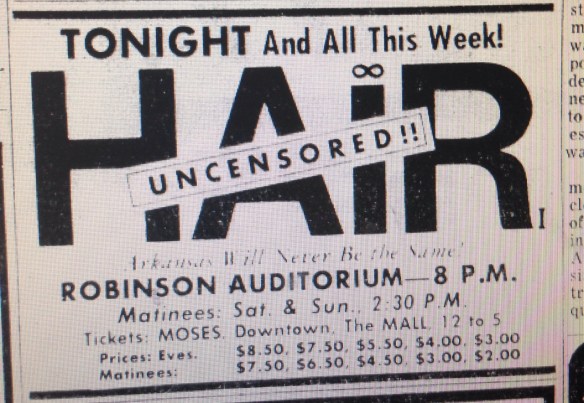
Ad for the original production of HAIR in Little Rock. Note the ticket prices. And that they could be purchased at Moses Music Shops.

Ad for the original production of HAIR in Little Rock. Note the ticket prices, and that they could be purchased at Moses Melody Shops.

It seems fitting that a touring production of Hair is the final Broadway show at Robinson Center Music Hall before it is closed for a two year renovation. The first time the show played at Robinson, it caused quite a stir. To be fair, the actual production in January 1972 did not cause a stir, it was the process leading up to it that was the source of much ado.

In February 1971, a young Little Rock attorney named Phil Kaplan petitioned the Little Rock Board of Censors to see if it would allow a production of Hair to play in the city. He was asking on behalf of a client who was interested in bringing a national tour to Arkansas’ capital city. The show, which had opened on Broadway to great acclaim in April 1968 after an Off Broadway run in 1967, was known for containing a nude scene as well for a script which was fairly liberally sprinkled with four-letter words. The Censors stated they could not offer an opinion without having seen a production.

By July 1971, Kaplan and his client (who by then had been identified as local promoter Jim Porter and his company Southwest Productions) were seeking permission for a January 1972 booking of Hair from the City’s Auditorium Commission which was charged with overseeing operations at Robinson Auditorium. At its July meeting, the Commissioners voted against allowing Hair because of its “brief nude scene” and “bawdy language.”

Kaplan decried the decision. He stated that the body couldn’t “sit in censorship of legitimate theatrical productions.” He noted courts had held that Hair could be produced and that the Auditorium Commission, as an agent for the State, “clearly can’t exercise prior censorship.” He proffered that if the production was obscene it would be a matter for law enforcement not the Auditorium Commission.

The Commission countered that they had an opinion from City Attorney Joseph Kemp stating they had the authority. One of the Commissioners, Mrs. Grady Miller (sister-in-law of the building’s namesake the late Senator Robinson who had served on the Commission since 1939), expressed her concern that allowing Hair would open the door to other productions such as Oh! Calcutta!

On July 26, 1971, Southwest Productions filed suit against the Auditorium Commission. Four days later there was a hearing before Judge G. Thomas Eisele. At that hearing, Auditorium Commission member Lee Rogers read aloud excerpts from the script he found objectionable. Under questioning from Kaplan, a recent touring production of Neil Simon’s Plaza Suite was discussed. That play has adultery as a central theme of one of its acts. Rogers admitted he found the play funny, and that since the adultery did not take place on stage, he did not object to it. Among those testifying in favor of it was Robert Reddington, who was director of performing arts at the Arkansas Arts Center.

Judge Eisele offered a ruling on August 11 which compelled the Auditorium Commission to allow Hair to be performed. Prior to the ruling, some of the Auditorium Commissioners had publicly stated that if they had to allow Hair they would close it after the first performance on the grounds of obscenity. To combat this, Judge Eisele stated that the Commission had to allow Hair to perform the entire six day engagement it sought.

Upon hearing of the Judge’s ruling, Commissioner Miller offered a succinct, two word response. “Oh, Dear!”

In the end, the production of Hair at Robinson would not be the first performance in the state.  The tour came through Fayetteville for two performances in October 1971. It played Barnhill Arena.

On January 18, 1972, Hair played the first of its 8 performances over 6 days at Robinson Auditorium.  In his review the next day, the Arkansas Gazette’s Bill Lewis noted that Hair “threw out all it had to offer” and that Little Rock had survived.

The ads promoting the production carried the tagline “Arkansas will never be the same.”  Tickets (from $2 all the way up to $8.50) could be purchased at Moses Melody Shops both downtown and in “The Mall” (meaning Park Plaza). That business is gone from downtown, but the scion of that family, Jimmy Moses, is actively involved in building downtown through countless projects. His sons are carrying on the family tradition too.

Little Rock was by no means unique in trying to stop productions of Hair.  St. Louis, Birmingham, Los Angeles, Tallahassee, Boston, Atlanta, Charlotte NC, West Palm Beach, Oklahoma City, Mobile and Chattanooga all tried unsuccessfully to stop performances in their public auditoriums.  Despite Judge Eisele’s ruling against the City of Little Rock, members of the Fort Smith City Council also tried to stop a production later in 1972 in that city. This was despite warnings from City staff that there was not legal standing.

Within a few years, the Board of Censors of the City of Little Rock would be dissolved (as similar bodies also were disappearing across the US). Likewise, the Auditorium Commission was discontinued before Hair even opened with its duties being taken over by the Advertising and Promotion Commission and the Convention & Visitors Bureau staff.  This was not connected to the Hair decision; it was, instead, related to expanding convention facilities in Robinson and the new adjacent hotel.  Regardless of the reasons for their demise, both bygone bodies were vestiges of earlier, simpler and differently focused days in Little Rock.

Over the years, Hair has returned to the Little Rock stage.  UALR has produced it at least twice.  The Weekend Theater has also mounted a production. By 2014, Hair is a period piece. For some, a wistful look at their long-gone youth while for others a romanticized time when disparate spirits could band together and change the world.

HAIR returns to Robinson Center

hairAs the last Broadway series tour before Robinson Center’s renovation, Celebrity Attractions brings the musical Hair back to Little Rock.

HAIR – the Broadway musical live on stage, is at once both a joyous celebration of youth and a poignant journey through a tumultuous 1960s America! This exuberant musical about a group of teenagers searching for truth, peace and love in a Vietnam War era America has struck a resonant chord with audiences of all ages.

The themes and struggles in HAIR, although from another era, seem vital and relevant today. THe long list of chart-topping hit songs include “Aquarius,” “Let the Sun Shine In,” “Good Morning, Starshine,” “Frank Mills” and “Easy to be Hard,” became anthems of counter-culture and the sexual revolution and continue to have a profound impact on audiences.

HAIR tells the story of the “tribe,” a group of politically active hippies of the “Age of Aquarius,” living a bohemian life in New York City and fighting against conscription into the Vietnam War. They struggle to balance their lives, loves and the sexual revolution with their rebellion against the war and their conservative parents and society.

The performances begin at 7:30pm at Robinson Center Music Hall tonight, tomorrow and Thursday evenings.

Interestingly, the Aquarius Zodiac sign runs through February 19, so two of the three performances in Little Rock will TRULY be in the “Age of Aquarius.”

Spies and Pets Among Features at Clinton Presidential Center

Clinton LibraryToday is not Presidents’ Day. No such holiday exists within Federal or Arkansas governments.  However, a good way to celebrate the observation of George Washington’s Birthday (Federal holiday for today) would be to visit the Presidential Library of one of his successors – Bill Clinton.  Visiting that facility is also a good way to mark the Arkansas holiday of Daisy Gatson Bates Day since she and President Clinton were friends.

The Clinton Presidential Center features numerous permanent and temporary exhibits.  Two of the current temporary exhibits are:

Spies, Traitors, and Saboteurs: Fear and Freedom in America -Created by the International Spy Museum in Washington, DC, Spies, Traitors & Saboteurs: Fear and Freedom in America dramatically illustrates the challenge of securing our nation without compromising the civil liberties upon which it was founded.
Through artifacts, multimedia elements, and interactive exhibits, visitors can uncover stories of espionage, treason, and deception in the United States from 1776 to today.
Visitors can discover little-known accounts of foreign agents, militias, and radicals, and learn how responses to domestic attacks have driven counterintelligence measures that continue to affect our everyday lives.

This exhibit is designed to be viewed by families and schools, although the content is most appropriate for children ages 11 and up.

Presidential Pets. Socks. Buddy. Barney. Bo. The Clinton Center will debut a new temporary display, “Presidential Pets,” on Saturday, Feb. 1, 2014. “Presidential Pets” is a tribute to the presidential pets that helped make the White House a home.
From snakes to chocolate Labs, these famous pets provide an enjoyable look at presidential history. The display will include items from President George W. Bush, President Clinton, President George Bush, President Ford, President Nixon, President Johnson, and more.

Both exhibits run through April 27, 2014.

Little Rock Look Back: Grand Opening of Robinson Auditorium

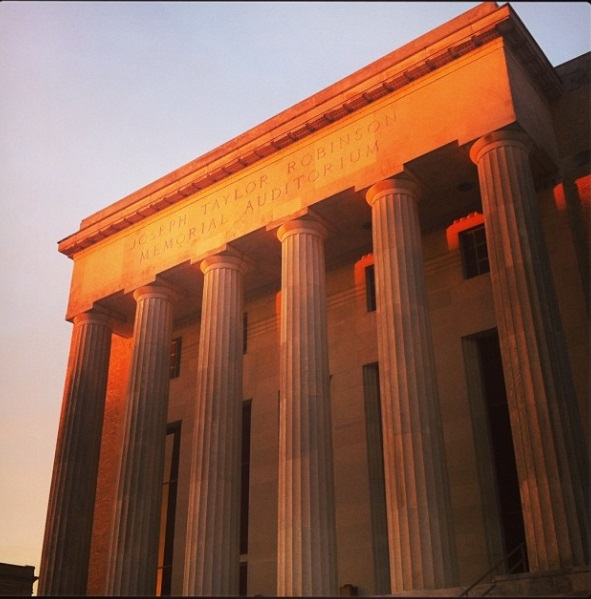
auditoriumduskOn February 16, 1940, after three years of planning and construction, the Joseph Taylor Robinson Memorial Auditorium officially opened. It was a cold, rainy night, but those in attendance did not care.

Searchlights painting arcs in the sky greeted attendees. They were borrowed from the Arkansas National Guard. Newspaper accounts noted that only a few of the men who attended were in tuxedos, most were simply in suits. The work to get the building opened had been so harried, that it was discovered there was not an Arkansas Flag to fly in front of the building. Mayor Satterfield found one at the last minute courtesy of the Arkansas Department of the Spanish War Veterans.

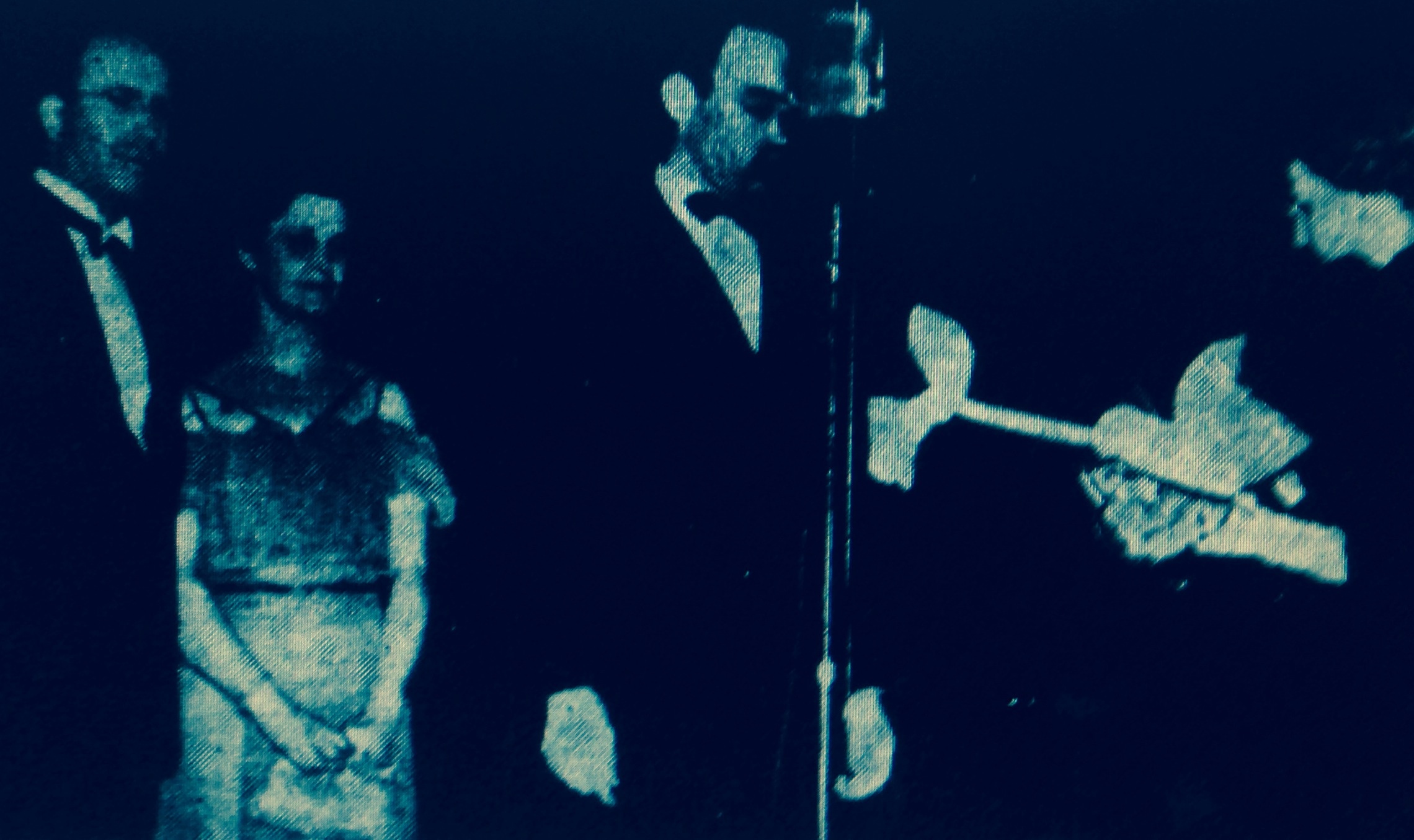
The weather delayed arrivals, so the program started fifteen minutes late. Following a performance of Sibelius’ Finlandia by the fledgling Arkansas State Symphony Orchestra, Mayor J. V. Satterfield, Mrs. Joseph T. Robinson, Mrs. Grady Miller (the Senator’s sister-in-law and a member of the Auditorium Commission) and D. Hodson Lewis of the Chamber of Commerce participated in a brief ribbon cutting ceremony. Mrs Robinson cut the ribbon on her second attempt (once again proving that nothing connected with getting the building open was easy).

The ceremony was originally set to be outside of the building but was moved indoors due to the inclement weather. The ribbon cutting took place on the stage with the ribbon stretched out in front of the curtain. The opening remarks were broadcast on radio station KGHI.

Though he had previously discussed how he had voted against the auditorium in 1937 before entering public life, the mayor’s remarks that evening were appropriately gracious, statesmanlike and a testament to the effort he had invested to get it open upon becoming mayor. “We hope you have a very pleasant evening and hope further that it will be the first in a long series which you will enjoy in this, your auditorium.”

Tickets for the event, advertised as being tax exempt, were at four different pricing levels: $2.50, $2.00, $1.50 and $1.00.

The estimated attendance was 1700. Following the ribbon cutting, the main performance took place. The headliner for the grand opening was the San Francisco Opera Ballet accompanied by the new Arkansas State Symphony Orchestra (not related to the current Arkansas Symphony Orchestra). The featured soloist with the ballet was Zoe Dell Lantis who was billed as “The Most Photographed Miss at the San Francisco World’s Fair.”

At the same time that the gala was going on upstairs in the music hall, a high school basketball double-header was taking place in the downstairs convention hall. North Little Rock lost to Beebe in the first game, while the Little Rock High School Tigers upset Pine Bluff in the marquee game.

20140215-172047.jpg

Little Rock Look Back: John Wassell, Little Rock’s 27th Mayor

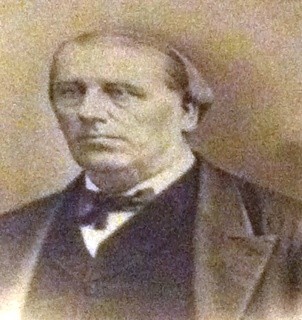
JWassellFuture Little Rock Mayor John Wassell was born on February 15, 1813 in Kidderminster, England.

In 1829, he came to the United States.  He learned carpentry and construction in Ohio and ended up in Little Rock.  One of his jobs was as the finishing contractor on the State Capitol building, now known as the Old State House.

He later gave up carpentry and became an attorney.  (It is said that he did so after becoming embroiled in a legal dispute arising from one of his construction jobs.) Wassell also served as a judge.

In 1868, he was appointed Mayor of Little Rock by President Andrew Johnson.  He is Little Rock’s only Mayor to have served through a military appointment.  Mayor Wassell died in January 1881 and is buried at Mt. Holly Cemetery along with his wife and other family members.  One of his grandsons, Samuel M. Wassell also served as Mayor of Little Rock.