Little Rock Look Back: George Washington

The Washington Inaugural Bible

Washington1George Washington was born on February 22, 1732, in Westmoreland, Virginia. He is one of only two American Presidents to not have any authority over the land now known as Little Rock. Washington never ventured west of the Mississippi River, so never visited Arkansas.

As the first President and Father of his Country, he has many things named after him. In Little Rock, Washington Street is named in his honor.

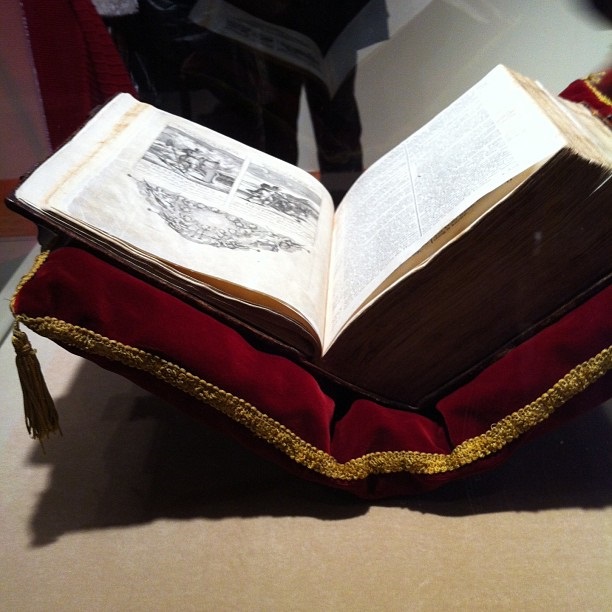
Recently, two Little Rock museums highlighted George Washington artifacts. Historic Arkansas Museum displayed the Washington family Bible for several months. At the start of that time, they also showcased the Bible on which Washington swore his first oath as President (the inaugural inaugural?).

A few months later, the Clinton Presidential Center featured Washington’s personal annotated copy of the 1789 “Acts Passed at a Congress of the United States of America.” This artifact had been purchased by the Mount Vernon Ladies Association in 2012.

Piano recital this afternoon by UALR Music Professor Dr. Linda Holzer

Piano recitalDr. Linda Holzer, professor of music at UALR, will hold​ a piano recital at 3 p.m. Sunday, Feb. 22, in the Stella Boyle Smith Concert Hall in UALR’s Fine Arts Building.

Admission is free and open to the public. For more information, contact the UALR Department of Music at 501.569.3264​

The music will present something for everyone, from the jazz stylings of Bill Evans piano solo “Peace Piece” to a poetic masterpiece, “Sonata Op. 109,” by Beethoven​,​ to three selections by award-winning U.S. composers.

For one the three selections, Dr. Holzer will perform “Love Twitters” by Augusta Read Thomas.

She will be joined by Arkansas Symphony Orchestra’s English horn player, Beth Wheeler, for John Steinmetz’s Suite from an “Imaginary Opera.” The program will conclude with Lowell Liebermann’s “Sonata for Flute and Piano,” featuring guest artist Diane McVinney of the ASO.

An active soloist and chamber musician, Holzer has delivered performances in 29 states, including the John F. Kennedy Center for the Performing Arts in New York, the New Orleans Center for Creative Arts, and New York Public Radio Station WNYC-FM.

She has performed at Qingdao University in mainland China, the Chinese University of Hong Kong, and the Palffy Palace in Bratislava, Slovakia. An advocate for contemporary music, Holzer has participated in numerous premieres, and her concert recordings have been broadcast internationally.

She has served as chair of the Committee on the Pedagogy Student for the 2007 and 2009 National Conference on Keyboard Pedagogy in Chicago and is an active member of the Network of Music Career Development Officers.

She is a founding member of the duo Mariposa with violinist Sandra McDonald, assistant concertmaster of the Arkansas Symphony Orchestra. Holzer was also named College Teacher of the Year by the Arkansas State Music Teachers Association in 2001.

Holzer is a native of Chicago and holds degrees in piano performance from Northwestern University, the University of North Carolina at Chapel Hill, and Florida State University.

Black History Month Spotlight: O.C. Smith

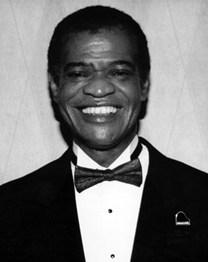
bhm o cThe life of O. C. Smith, according to one biography, ‘has had the flow and tempo of a hit song that finds its audience and never lets go.” His million-seller song “Little Green Apples” won a Grammy nomination.

Smith also is known for the hits “Hickory Holler’s Tramp” and “Daddy’s Little Man,” and is remembered for singing the themes from the motion pictures “The Learning Tree”and “Shaft’s Big Score.” Songs such as “Help Me Make It Through the Night,” “For the Good Times,” “That’s Life,” “Don’t Misunderstand,” “Dreams Come True” and “What “Cha Gonna Do” are all contributions to the music world from Smith.

Smith’s story begins in the small community of Mansfield, LA. At age 10, his parents, both teachers, relocated to Little Rock. After his parents divorced, Smith and his mother moved to Los Angeles.

Smith later returned to Louisiana to attended Southern University at Baton Rouge, majoring in psychology. He served the Air Force and Special Services as an entertainer on military bases all over the world.

After his stint with Uncle Sam, Smith settled in New York and began his singing career, working in clubs in the winter and at the legendary “Borsch Belt” hotels in the Catskill Mountains in the summer. He eventually signed on with Count Basie and toured with him for three years. He left Basie for a solo career that got a boost with the hit “Little Green Apples.”

At the height of his music career, Smith began studying Religious Science and subsequently became a minister. In 1985, he founded the City of Angels Church of Religious Science, where he practiced for 16 years. One of his last recordings, “Save The Last Dance For Me” reached the number one position on the Rhythm n’ Beach Top 40 chart.

He died on November 23, 2001.  In 1996, Smith was inducted into the Arkansas Black Hall of Fame.  For more on O.C. Smith and other inductees into the Arkansas Black Hall of Fame, visit the permanent exhibit at the Mosaic Templars Cultural Center. That museum is an agency of the Department of Arkansas Heritage.

Integration of Little Rock’s Junior Highs topic of panel today

Seven students who desegregated Little Rock’s junior high schools will discuss their experiences for the first time from 9 a.m. to noon Saturday, Feb. 21, at the Little Rock Central High School National Historic Site.

Laverne before and after

Dr. LaVerne Bell-Tolliver, first African American to attend Forest Heights Middle School in 1961 and currently an assistant professor in the UALR School of Social Work.

During the event, titled ”Phase II: The Desegregation of Little Rock Public Schools,” the former students will discuss their roles in the desegregation process in the early 1960s.  Between 1961 and 1962, 25 black students enrolled at junior high schools throughout Little Rock that had previously been closed to them.

Dr. LaVerne Bell-Tolliver, Judge Kathleen Bell, Henry Rodgers, Wilbunette Walls Randolph, Glenda Wilson, Dr. Kenneth Jones, and Judge Joyce Williams Warren will participate in the panel discussion to share their stories.  For many of them, this will be the first time they will discuss their experiences publicly.

The panel will be moderated by Rhonda Stewart, local history and genealogy expert at The Butler Center for Arkansas Studies.  Dr. John A. Kirk, George W. Donaghey Distinguished Professor of History and chair of the UALR Department of History, will provide an overview of the history of school desegregation in the area including the landmark Brown vs Board of Education decision and 1958, a so-called “lost year” when all schools in the district were closed in order to block integration.

In addition to the presentations and discussions, copies of historic documents and artifacts from the era will be on display for public viewing.

The program in sponsored in part by the Little Rock Central High School National Historic Site Visitors’ Center, the Central Arkansas Chapter of the National Association of Black Social Workers, and a grant from the Arkansas Humanities Council’s African American Heritage Fund.

Black History Month Spotlight: Henry Shead

bhm shedHenry Wallace Shead, Sr., better known as “Shed” was born in Fordyce, Arkansas, on March 31, 1941.  He was raised in Little Rock, the son of a reverend, Henry Arthur Shead.  At the tender age of six, Henry was introduced to the keyboards by his mother, Willie LeBethel, who immediately recognized his natural talent. Henry’s mother saw to it that her son had piano lessons, while his father’s church provided the place for his early public performances.

At the start of his career, he performed regularly on a local American Bandstand-type TV show called Center Stage. He also became a fixture at the Little Rock Country Club. He made his mark playing in intimate settings as a solo artist, dazzling listeners with his absolute mastery of the piano, singing in that slightly raspy, yet smooth sounding baritone voice. Shead was awarded a scholarship to the University of Arkansas at Pine Bluff, and majored in music while entertaining around the area. Henry met his wife, Jeanette Mazique, while attending college in Pine Bluff. They married in January of 1964 and had four children.

He became a high school choral director and music teacher, all the while continuing to work in local nightspots like the Drummer‘s Club in Little Rock. In 1971, he moved to Los Angeles where he made his acting debut appearing with Henry Fonda, Richard Dreyfuss and Jane Alexander in William Saroyan’s The Time of Your Life. He wrote and arranged music for stage plays and television, sang the title song for a United Artist film, did studio work on a Johnny Mathis album, and recorded for the Liberty/United Artists and Cream labels.

Shed created national radio jingles and appeared on network television with Dinah Shore, Johnny Carson and Jerry Lewis. He has also performed at parties for the Rockefellers, Pearl Bailey, The Carpenters, President Lyndon Johnson, President Bill Clinton, Henry Mancini, Sergio Mendes, hotelier Peter Morton, Ed McMahon and Barbra Streisand.

In Las Vegas, the city where he lived since 1974, Shed entertained at most of the major hotels, with long engagements at the Aladdin, Stardust, Hacienda, MGM Grand, Caesar’s Palace and Sahara. In 1977, the Henry Shead Band with Denise Clemente was voted Las Vegas’ Best Lounge Act of the Year. His last long-term run was at AJ’s Steakhouse at the Hard Rock Hotel & Casino, retiring in 2007. In October 2006, he was inducted into the Arkansas Black Hall of Fame.

He died on October 5, 2012 in Las Vegas and is buried in Forest Lawn Cemetery in Hollywood CA.

For more on Henry Shead and other inductees into the Arkansas Black Hall of Fame, visit the permanent exhibit at the Mosaic Templars Cultural Center. That museum is an agency of the Department of Arkansas Heritage.


Little Rock Look Back: Elvis plays first shows at Robinson Auditorium

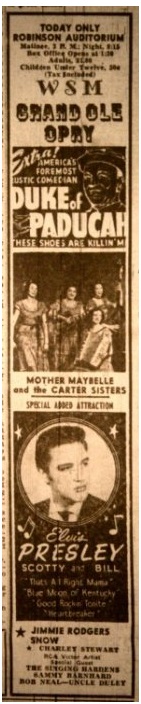
eap feb 55 adSixty years ago today, on February 20, 1955, Elvis Presley made his first appearance on stage in Little Rock. He performed at Joseph Taylor Robinson Memorial Auditorium.

He was billed as “an added attraction” to a Grand Ole Opry Show headlined by the Duke of Paducah.  Others on the bill included Mother Maybelle and the Carter Sisters, Jimmie Rodgers Snow, Charlie Stewart, the Singing Hardens, Sammy Barnhart, Bob Neal, Uncle Dudley and Smilin’ Mac Cyclone. (It is interesting to note that at least some of the advance tickets billed it as The Elvis Presley Show, though the newspaper ads billed the Duke of Paducah as the headliner.)

This concert was part of a weeklong tour of Arkansas and Louisiana.  There were two shows that day – one at 3p.m. and the other at 8:15p.m.  Tickets on the day of the concert were $1.00 for adults and fifty cents for children.  Advanced tickets had sold for 75 cents at Walgreens.

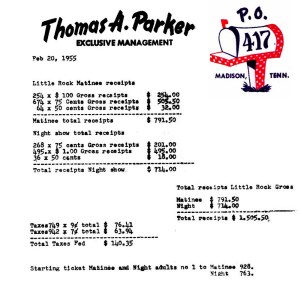
eap receits 05-little.rock_.feb_.55The night before, Elvis played the Louisiana Hayride in Shreveport.  Following his Little Rock appearance (for which he and his band were paid $350 instead of their usual $200), they played in Camden, Hope, and Pine Bluff.

eap 02-little.rock_It is believed that Elvis’ parents attended this concert in Little Rock. Gladys Presley was a big fan of the Duke of Paducah. Elvis apparently also wanted his parents to meet with Colonel Tom Parker, who would become inexorably linked with Elvis’ career.
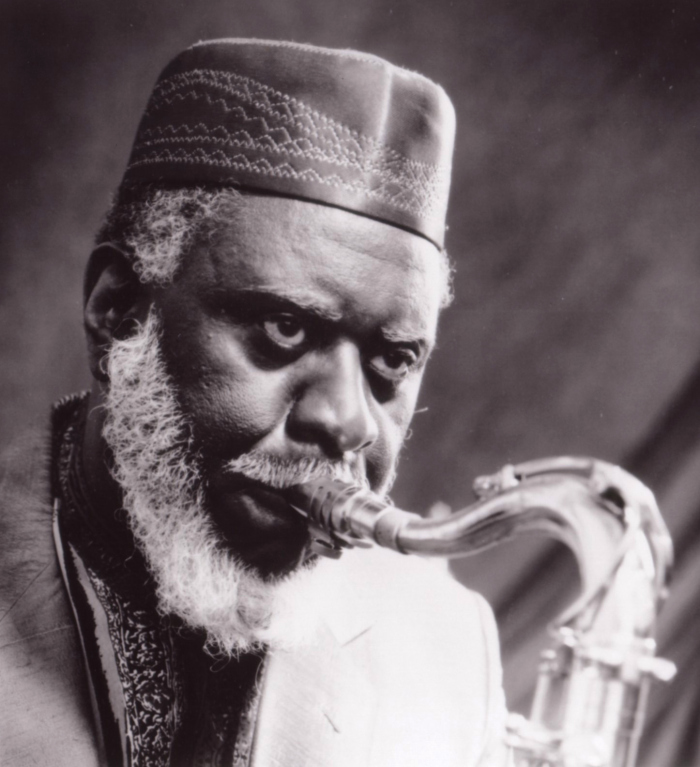
Black History Month Spotlight: Pharoah Sanders

bhm pharoahPharoah Sanders (his given name, Ferrell Sanders) was born into a musical family. Sanders’ early favorites included Harold Land, James Moody, Sonny Rollins, Charlie Parker, and John Coltrane. Known in the San Francisco Bay Area as “Little Rock,” Sanders soon began playing bebop, rhythm & blues, and free jazz with many of the region’s finest musicians, including fellow saxophonists Dewey Redman and Sonny Simmons, as well as pianist Ed Kelly and drummer Smiley Winters. In 1961, Sanders moved to New York, where he struggled. Unable to make a living with his music, Sanders took to pawning his horn, working non-musical jobs, and sometimes sleeping on the subway. During this period he played with a number of free jazz luminaries, including Sun Ra, Don Cherry, and Billy Higgins.

In 1964, Coltrane asked Sanders to sit in with his band. The following year, Sanders was playing regularly with the Coltrane group. Coltrane’s ensembles with Sanders were some of the most controversial in the history of jazz. Their music represents a near total desertion of traditional jazz concepts, like swing and functional harmony, in favor of a teeming, irregularly structured, organic mixture of sound for sound’s sake. Strength was a necessity in that band, and as Coltrane realized, Sanders had it in abundance.

Sanders made his first record as a leader in 1964. After John Coltrane’s death in 1967, Sanders worked briefly with his widow, Alice Coltrane. From the late ’60s, he worked primarily as a leader of his own ensembles.

In the decades after his first recordings with Coltrane, Sanders developed into a more well-rounded artist, capable of playing convincingly in a variety of contexts, from free to mainstream. Some of his best work is his most accessible. As a mature artist, Sanders discovered a hard-edged lyricism that has served him well.

In 2004, he was inducted into the Arkansas Black Hall of Fame.  That night, he headlined a concert in Little Rock as a fundraiser for the Hall of Fame.  For more on Pharoah Sanders and other inductees into the Arkansas Black Hall of Fame, visit the permanent exhibit at the Mosaic Templars Cultural Center. That museum is an agency of the Department of Arkansas Heritage.