Four Percussionists; 60 Instruments – Tonight at UALR

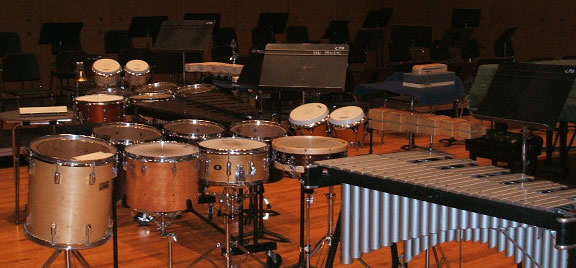
percussionThe University of Arkansas at Little Rock Percussion Ensemble will host a concert at 7:30 p.m. Tuesday, April 28, in the University Theatre of the Center for Performing Arts that will include a daring performance of over 60 instruments.
The concert is free and open to the public.

Presented by the UALR Department of Music and under the direction of Conductor and Founder Charles Law, the show will include a performance of Bahrah for percussion quartet by Brandon Hendrix, Sands of Africa by Eric Harper, and Chopin’s Prelude No. 20 transcribed by Kevin Lepper.

A rendition of Bella by Carlos Santana arranged for mallets by Oliver Molina and Trinidad Blue Basin traditional arranged by Lisa Rogers will follow.

The finale will feature a performance of John Cage’s Third Construction for Percussion. This challenging work by Cage features over 60 instruments performed by four musicians creating a landscape of rhythm and sounds including shakers and twenty cans.

Celebrating more than 20 years, the UALR Percussion Ensemble is a high-energy group performing throughout the Midwest and South in concerts and clinics for students of all ages.

The ensemble has performed at the University of Missouri, University of Georgia, University of New Orleans, Mobile Alabama Concerts in the Park, Chicago Public Schools, Silver Dollar City, and Little Rock World Fest.

They explore a wide range of repertoire representing the most current and recognized composers of the time in percussion. The group has used music to reach out to inner-city and at-risk youth with the International House of Blues Foundation in New Orleans and the House of Blues Club.

Little Rock Look Back: James Monroe

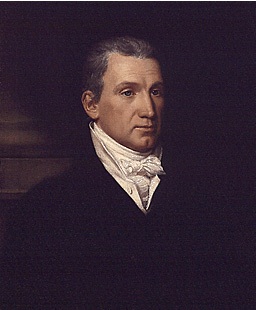
Jamesmonroe-npgalleryOn April 28, 1758, future U.S. President James Monroe was born in Virginia.  It was during his Presidency that Arkansas was surveyed and platted. Little Rock was also officially settled during the Monroe Presidency.  The Quapaw Line was drawn during his presidency. This document was the first official document to use the name “Little Rock” to describe this settlement.

Monroe was the last president who was a Founding Father.  A soldier in the Revolutionary War, he studied law under Thomas Jefferson and served as a delegate in the Continental Congress.  Although he felt the new Constitution gave too much power to a central government, Monroe served in the first US Senate before serving as Governor of Virginia.  As a diplomat, he helped negotiate the Louisiana Purchase.

He was easily elected president in 1816.  During his first term in office, the US acquired Florida from the Spanish and jointly occupied Oregon with the British. He was the first president to preside over land from the Atlantic to the Pacific.  Because of successes abroad (including the Monroe Doctrine) and domestically, the Monroe Presidency was known as the “Era of Good Feeling.”

Following his retirement in 1825, Monroe was plagued by financial difficulties. He died in New York City on July 4, 1831.

Monroe Street in Little Rock is named after him.

Little Rock Look Back: Major Nicholas Peay

LR sealOn April 28, 1784, in Virginia, future Little Rock Alderman (and acting Mayor) Major Nicholas Peay was born the eleventh of at least thirteen children.  (His gravestone lists a May date for his birth, but other records indicate April 28, 1784.) A veteran of the War of 1812 and the Indian Wars, he later moved to Kentucky (where he met and married his wife, Juliet Neill, in 1814) before settling in Arkansas on September 18, 1825.  At the time, they were the ninth family to set up residence in Little Rock.

After arriving in Little Rock, he bought the Little Rock Tavern. This started a fifty year tradition of his family owning taverns and hotels in Little Rock. In 1828, he was appointed Assistant Postmaster of Little Rock.  From 1825 to 1831, Little Rock residents were allowed to elect five Trustees prior to the formal incorporation. Major Peay was one of those who served on the Board of Trustees.

He later served on the Little Rock City Council, and in 1839 served for seven months as Acting Mayor due to the prolonged absence of Mayor Jesse Brown.  In 1841, his friend Gen. Zachary Taylor, paid a visit to Little Rock and stayed with him on the General’s way to Fort Smith.

Nicholas and Juliet Peay had at least eleven children, though only five appeared to have lived until adulthood. One of those, Gordon Neill Peay, served as Little Rock’s 23rd Mayor from 1859 to 1861. Other descendants of Nicholas Peay who followed him into public service include his grandson Ashley Peay, who was an Alderman in the 1920s (son of John Coleman Peay) and great-great-grandson Joseph B. Hurst (a great-grandson of Mayor Peay), who was a City Director from 1967 to 1970. In addition, Hurst’s daughter-in-law, Stacy Hurst served three terms on the City Board from 2003 to 2014; she is now Director of the Department of Arkansas Heritage.

Major Peay’s egg-nog recipe has been passed down for generations. It is the inspiration for the Historic Arkansas Museum yearly Nog-Off.  This past year, museum director Bill Worthen and his daughter were the sixth and seventh generation of the family to make Peay’s egg-nog. The Worthens are descended from Mayor Peay’s son who was also named Gordon Neill Peay.

Major Nicholas Peay is buried with his wife and many other family members in Mount Holly Cemetery.

Little Rock Look Back: Mayor Sam Wassell

S WassellOn this date in 1883, future Little Rock Mayor Sam M. Wassell was born.  His grandfather John W. Wassell had been appointed Mayor of Little Rock in 1868.  He is the only Little Rock Mayor to be a grandson of another Little Rock Mayor.

Sam Wassell served on the Little Rock City Council from 1928 through 1934 and again from 1940 through 1946.  He is one of the few 20th Century Little Rock Mayors who previously served on the City Council.

Wassell was an attorney.  He practiced law privately and also served as an Assistant US Attorney.  In 1930, he ran unsuccessfully for the Democratic nomination for the US Congress representing the 5th Congressional District, which at the time included Little Rock.

Wassell ran for Mayor in 1947 and was unopposed in the general election.  He was unopposed in his bid for re-election in 1949.  During his second term, President Harry S. Truman visited Little Rock.  In 1951, he sought a third term as Mayor.  No Little Rock Mayor had sought a third consecutive term since 1923.  Though he received the Democratic nomination, the Republican party nominated Pratt Remmel who defeated Wassell by a 2 to 1 margin.

With a new USS Little Rock under construction, it is interesting to note that Mrs. Sam Wassell christened the previous USS Little Rock in 1944.  At the time, she was a City Councilor’s wife.

Mayor Wassell died on December 23, 1954 and is buried at Roselawn Cemetery in Little Rock.

Seersucker Social at Old State House Museum tonight

OSH SeersuckerThe Fourth Annual Seersucker Social takes place tonight at the Old State House Museum from 6pm to 9pm.

This year’s edition is sponsored by Little Rock Soiree. The Seersucker Social is the signature event of the Old State House 1836 Club.  The evening promises plenty of lawn games, hors d’oeuvres, mint juleps and live music by the Big Steel River Band.

This year, all proceeds will benefit the School Bus Fund to bring K-12 students from all over Arkansas to the Old State House Museum.

Tickets are $40. 21+ only. For more information, contact brooke@arkansasheritage.org

The Old State House Museum is an agency of the Department of Arkansas Heritage.

Little Rock Look Back: Ulysses S. Grant

US_Grant_f

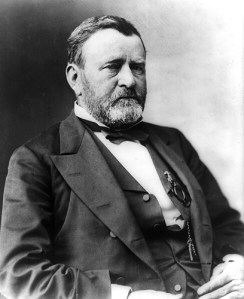
On April 27, 1822, future US President Ulysses S. Grant was born.  His birth name of Hiram Ulysses Grant. There are various stories as to the reason for the change, but was is not in dispute is that as an adult his name was Ulysses Simpson Grant.  Simpson was his mother’s maiden name.

After leadership in the Mexican-American War, Grant retired from the Army. He rejoined after the Civil War broke out.  After success in Kentucky, Tennessee and the Siege of Vicksburg, President Lincoln promoted Grant to Commanding General of the US.  After the war ended, he led the Army’s efforts during Reconstruction.

Elected president in 1868 and reelected in 1872, Grant stabilized the nation during the turbulent Reconstruction period.  As President, he continued Reconstruction efforts as well as oversaw efforts to reduce frontier violence (though the Great Sioux War did take place during his presidency).  He restored relations with Great Britain and avoided war with Spain, but was unsuccessful in annexing the Dominican Republic. While he staved off immediate problems from the Panic of 1873, the country still fell into a five year economic depression.

Out of the White House for four years, he sought a return in 1880. He was not successful in obtaining the GOP nomination.  Likely in an effort to build support for his Presidential quest, he embarked on a nationwide tour.  On April 15, 1880, he spoke in Little Rock. It was his first visit to Arkansas either as a soldier or a politician.  He spoke at Concordia Hall (now part of the CALS campus) and stayed at the Capital Hotel during this visit. Though he had not visited previously, Grant did become the first Republican Presidential candidate to win Arkansas’ electoral votes in 1868; he repeated this feat in 1872. It would be 100 years later, with Nixon’s second term, that Arkansas would cast her electoral votes for the GOP nominee.

General Grant died on July 23, 1885.  Grant Street in Little Rock is named for him.

Dinosaurs Abound at Clinton Center now through October

Clinton Dinos

Photo by the Clinton Presidential Center

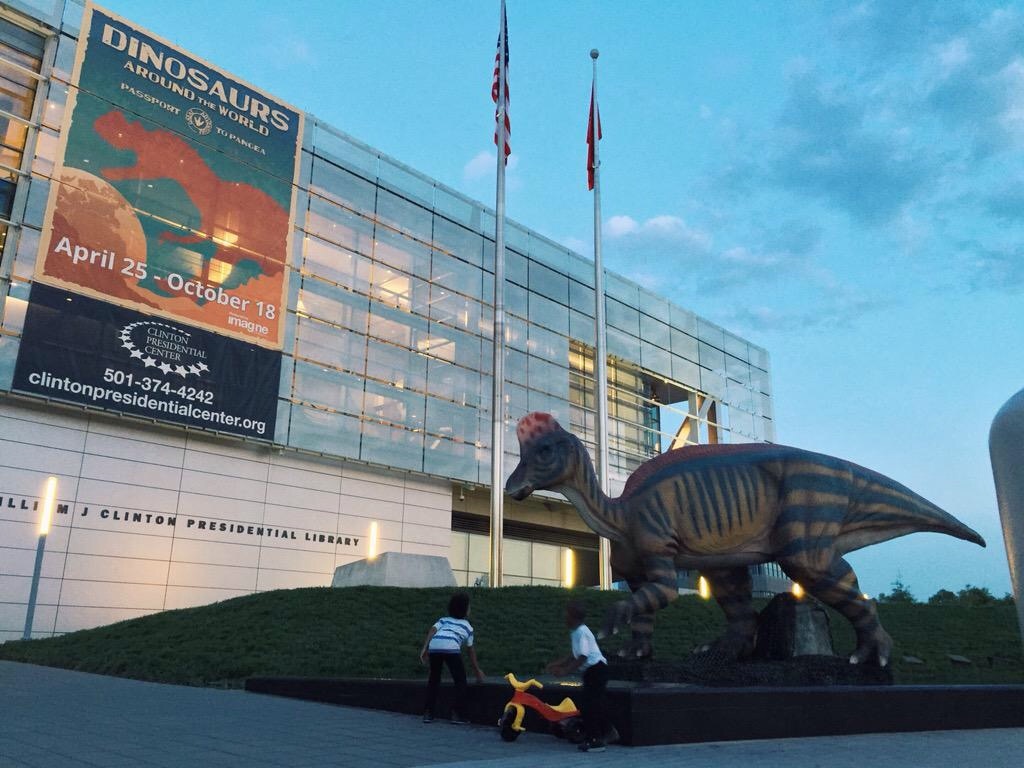
The Clinton Presidential Center presents Dinosaurs Around the World through October 18.

Dinosaurs Around the World takes you back in time on a dinosaur adventure and a tour of an Earth very different from today – a time before the continents as we know them existed, when lush landscapes covered Africa and greenery was the norm in Antarctica! With 13 life-sized animatronics, a multi-layered narrative, fossils, authentic casts, cutting-edge research and immersive design elements, you’ll experience the Age of Reptiles as it comes to life!
Dinosaurs Around the World invites you to grab your prehistoric passport to Pangea and discover how continental splits driven by plate tectonics, land bridges revealed after sea level fluctuations, and new landforms created by volcanic activity allowed dinosaurs to disperse to all corners of the globe. These left each of the seven continents with its own unique selection of these giant reptiles. During their 172 million year reign, dinosaurs adapted into a variety of forms including enormous long-necked herbivores, the mighty T. rex, and more.
“We are thrilled to host the global premiere of Dinosaurs Around the World and look forward to sharing this interactive and scientific exhibit with our visitors,” said Stephanie S. Streett, executive director of the Clinton Foundation. “Our summer exhibits are highly anticipated by the community because they are specifically designed to appeal to the entire family.”
In addition to advanced animatronics, Dinosaurs Around the World also features information about the geologic time scale, geology, geography, and climatology. The exhibition questions how the dinosaurs lived on each continent, how they interacted with each other, how geography impacted their behavior and diets, and what the continents were really like at the time.
The exhibit also features an area that chronicles the accomplishments of four U.S. Presidents who worked to preserve the fossil-rich areas in North America where dinosaurs once roamed. Exhibit artifacts include items from the administrations of Presidents Bill Clinton, Dwight D. Eisenhower, Franklin D. Roosevelt, and Harry S. Truman. This display includes a dinosaur skull replica on loan from the Grand Staircase-Escalante National Monument, an area that President Clinton designated as a national monument in 1996.
Dr. Gregory M. Erickson, a world-renowned dinosaur paleontologist, is the Senior Scientific Advisor for Dinosaurs Around the World. Dr. Erickson received his Bachelor of Science degree from the University of Washington, a Master’s degree from Montana State University, and a Ph. D. in Integrative Biology from the University of California, Berkeley and conducted post-doctoral research at Stanford University and Brown University before joining the faculty at Florida State University in Tallahassee. Dr. Erickson is currently the curator for the Florida State University Museum and holds research appointments with the American Museum of Natural History in New York, The Field Museum in Chicago, and University of Alaska’s Museum of the North in Fairbanks. Dr. Erickson is working with Imagine Exhibitions as an advisor, writer, and editor of the paleontology copy for the Company’s Dinosaurs Around the World exhibition.
Dinosaurs Around the World is open daily to the public from 9 a.m. to 5 p.m., Monday through Saturday, and 1 to 5 p.m. on Sunday, through October 18, 2015. Tickets are available to purchase at the Clinton Center.