Tonight at the Clinton School – Jeremy Haft speaks about Unmade in China

uacs haft bookUnmade in China by Jeremy Haft, Thursday, February 11 at 6pm.

Jeremy Haft, author and adjunct professor at Georgetown University who lectures in both the Walsh School of Foreign Service and the McDonough School of Business, has spent two decades starting and building companies in China across sectors of the economy. In his book Unmade in China: The Hidden Truth about China’s Economic Miracle, Haft explores the hidden world of China’s intricate supply chains and tells the story of systemic risk in Chinese manufacturing and what this means for the United States.

If you look carefully at how things are actually made in China – from shirts to toys, apple juice to oil rigs – you see a reality that contradicts every widely-held notion about the world’s so-called economic powerhouse. From the inside looking out, China is not a manufacturing juggernaut. It’s a Lilliputian. Nor is it a killer of American jobs. It’s a huge job creator. Rising China is importing goods from America in such volume that millions of U.S. jobs are sustained through Chinese trade and investment.

In Unmade in China, entrepreneur and Georgetown University business professor Jeremy Haft lifts the lid on the hidden world of China’s intricate supply chains. Informed by years of experience building new companies in China, Haft’s unique, insider’s view reveals a startling picture of an economy which struggles to make baby formula safely, much less a nuclear power plant. Using firm-level data and recent case studies, Unmade in China tells the story of systemic risk in Chinese manufacturing and why this is both really bad and really good news for America.

He has also authored other books covering China’s economy, including All the Tea in China: How to Buy, Sell, and Make Money on the Mainland, which presents best practices for importing, exporting, and doing business in China.

Black History Month Spotlight – Dunbar High School

dunbarimage2The new Arkansas Civil Rights History Audio Tour was launched in November 2015. Produced by the City of Little Rock and the University of Arkansas at Little Rock allows the many places and stories of the City’s Civil Rights history to come to life an interactive tour.  This month, during Black History Month, the Culture Vulture looks at some of the stops on this tour which focus on African American history.

After Little Rock High School (now Central High School) was completed in 1927, the building of Paul Laurence Dunbar High School was completed in 1929.  Money came from the Rosenwald Fund, founded by Julius Rosenwald, president of Sears, Roebuck and Company, and from local black residents.  Local blacks insisted on adding college preparatory classes to the vocational-industrial ones that were offered in black schools at the time. The building, modeled after the white high school, housed grades seven through twelve plus a junior college.  Black students came from all over Arkansas to take advantage of its educational opportunities.

When Horace Mann High School opened as a segregated school in 1956, Dunbar became a junior high school. A Dunbar-Mann Alumni Association, whose members live throughout the country, still helps to support both schools.  In the 1930s, Charlotte Andrews Stephens, the first black public school teacher in Little Rock, was on the faculty at Dunbar, completing seventy years of teaching with the district.  In the 1940s, Sue Cowan Williams, English Department chair, lost her job when she sued the Little Rock School District for equal pay for black and white teachers.

The app, funded by a generous grant from the Arkansas Humanities Council, was a collaboration among UALR’s Institute on Race and Ethnicity, the City of Little Rock, the Mayor’s Tourism Commission, and KUAR, UALR’s public radio station, with assistance from the Little Rock Convention and Visitors Bureau.

2016 Arkansas Literary Festival dates and lineup announced

ALF 2016_textPrestigious award-winners, screenwriters, comedians, an expert witness, artists, and a Pulitzer Prize-winning poet are among the diverse roster of presenters who will be providing sessions at the thirteenth annual Arkansas Literary Festival, April 14-17, 2016. The Central Arkansas Library System’s Main Library campus and many other Little Rock venues are the sites for a stimulating mix of sessions, panels, special events, performances, workshops, presentations, opportunities to meet authors, book sales, and book signings. Most events are free and open to the public.
     The Arkansas Literary Festival, the premier gathering of readers and writers in Arkansas, will include more than 80 presenters including featured authors from approximately 24 different states and guests hailing from Canada, England, Russia, and Singapore. Each year, several of the attending authors have not visited Little Rock, Arkansas, or even the South.
     Presenters come from a wide range of backgrounds including: journalist, documentary filmmaker, economist, editor, microbiologist, national bank examiner, essayist, photographer, sports reporter, psychological examiner, musician, actress, reporter, and professor. One is co-producing Keanu Reeves’ new television show and writing an adaptation of his own book for Warner Bros. and Bradley Cooper.
     Special events for adults during the Festival include a cocktail reception with the authors, a tour of the Governor’s Mansion gardens with a wine and cheese reception, an escape room, and Readers’ Map of Arkansas launch party. Panels and sessions include genres and topics such as literary fiction, barbecue, Monopoly, female rocket scientists, travel, graphic novels, science fiction, classic literature, and a story told in playing cards.
     Children’s special events include a session by Nikki Grimes, activity hour, concert by the Kinders, and the play How the Camel Got His Hump. based on Rudyard Kipling’s Just So Stories. Festival sessions for children will take place at both the Hillary Rodham Clinton Children’s Library and Learning Center, 4800 10th Street, and the Youth Services Department at the Main Library, 100 Rock Street. Special events for teens include North Little Rock High School Readers Theater, a teen poetry competition, and a panel with three authors of books for young adults.
     Through the Writers In The Schools (WITS) initiative, the Festival will provide presentations by several authors for central Arkansas elementary, middle, and senior high schools and area colleges.
     Author! Author!, a cocktail reception with the authors, will be Friday, April 15, at 7 p.m. Tickets are $25 in advance and $40 at the door, and go on sale at ArkansasLiteraryFestival.org beginning Monday, March 15.
     This year’s Festival authors have won an impressive number and variety of distinguished awards and fellowships including: Pulitzer Prize, James Beard Award, PEN/Hemingway Award, Hugo Award, Coretta Scott King Award, Will Eisner Comic Industry Award, National Book Foundation “5 Under 35” Honoree, Coretta Scott King Illustrator Award, Dashiell Hammett Prize, Barnes & Noble Discover Great New Writers Selection, National Endowment for the Arts Fellowship, Fulbright Fellowship, Guggenheim Fellowship, Houghton Mifflen Literary Fellowship, Arkansas Arts Council Fellowship.
     The work of this year’s Festival authors has been featured in notable publications including: New York Times, Details, McSweeney’s Quarterly, Forbes, the Paris Review, theHuffington Post, Women’s Health, Gourmet Magazine, the New Republic, the Los Angeles Times, Smithsonian, the Daily Telegraph UK, VICE, the New Yorker, Harper’s, the Atlantic, Slate, Time, Popular Science, Salon, the Best American Travel Writing, Outside Magazine, Esquire, USA Today, Reader’s Digest, Best American Essays, Best American Short Stories, Penthouse, the Nation, Best American Poetry, the Washington Post, Town & Country, the Economist, the Christian Science Monitor, National Geographic, the Wall Street Journal, Bloomberg BusinessWeek, Rolling Stone, GQ, Sports Illustrated, and Vogue
     The Literary Festival is presented by the Central Arkansas Library System. Sponsors include Arkansas Humanities Council, Friends of Central Arkansas Library System (FOCAL), Clinton Presidential Center, Fred K. Darragh Jr. Foundation, KUAR FM 89.1, ProSmartPrinting.com, Rebsamen Fund, Arkansas Democrat-Gazette, Arkansas Times, Gibbs Elementary School, Hendrix-Murphy Foundation Programs in Literature and Language, MacArthur Museum of Arkansas Military History, Museum of Discovery, Otter Creek Elementary School, UALR Department of English, Windstream, Arkansas Library Association, Christ Episcopal Church, East Harding Construction, Hampton Inn, Hemingway-Pfeiffer Museum and Educational Center, Henderson State University, Hendrix College Project Pericles Program, University of Arkansas Clinton School of Public Service, Witt Stephens Jr. Central Arkansas Nature Center, Greater Little Rock Council of Garden Clubs, Capital Hotel, City of Little Rock, Et Alia Press, Consulate General of Israel to the Southwest, Literacy Action of Central Arkansas, Mayor Mark Stodola, Mollie Savage Memorial/CALS, North Little Rock High School, Plum Street Publishers, Inc., Pyramid Art Books & Custom Framing/Hearne Fine Art, Sibling Rivalry Press, Stickyz Rock ‘N’ Roll Chicken Shack, UALR Department of Rhetoric and Writing, and Whole Hog. The Arkansas Literary Festival is supported in part by funds from the Arkansas Humanities Council and the National Endowment for the Humanities.
     The Festival’s mission is to encourage the development of a more literate populace. A group of dedicated volunteers assists Festival Coordinator Brad Mooy with planning the Festival. Committee chairs include Kevin Brockmeier, Talent Committee; Susan Santa Cruz, Festival Guides; and Amy Bradley-Hole, Moderators.
     Visit the Festival Facebook and Twitter pages to get the latest news about the Festival. For more information about the 2016 Arkansas Literary Festival, visit ArkansasLiteraryFestival.org, or contact Brad Mooy at bmooy@cals.org or 918-3098. For information on volunteering at the Festival, contact Angela Delaney at adelaney@cals.org or 918-3095.

Arts+History Election Results – By The Numbers

Feb9electionlogoThe Culture Vulture loves crunching numbers almost as much as attending cultural events.

Here are some thoughts about the results from the February 9 MacArthur Park Bond election.  These bonds will pay for improvements to the Arkansas Arts Center, MacArthur Museum of Arkansas Military History and MacArthur Park.  Excess revenues from the bonds will be available for the Little Rock Zoo, Museum of Discovery, other Little Rock parks and other Little Rock cultural institutions.

There were 7,990 votes cast in the special election.  This was 6.61% of the electorate.  By comparison, there were 4,462 ballots cast in the July 2015 Central Arkansas Library System special election and 6,995 ballots cast in the December 2013 Robinson Center special election.  The latter election brought 6.14% of voters to the polls.

Comparing early and absentee voters to election day voters:

  • Robinson (December 2013) – 871 or 12.45% of all ballots cast
  • CALS (July 2015) – 750 or 16.81% of all ballots cast
  • MacArthur Park (February 2016) – 1,171 or 14.66% of all ballots cast

The top ten precincts for voter participation on February 9:

107 – LRFD Station #10 —– 23.66%
106 – LRFD Station #10 —– 22.85%
109 – Pulaski Heights Presbyterian —–  18.17%
91 – Cammack Village City Hall —– 17.43%
108 – Woodlawn Baptist —– 17.33%
90 – Second Presbyterian —– 15.86%
112 – Pulaski Heights Presbyterian —– 15.00%
96 –  St. Mark’s Episcopal —– 13.42%
70 – Pleasant Valley CoC —–  12.58%
92 – St. Paul UMC —–  12.27%

While most of these are in the midtown area of Little Rock, some are in the western portion of Little Rock.  They tend to have the highest percentage of voter turnout in primary, general and special elections regardless of what or who is on the ballot.


The top 10 precincts for number of voters were:
109 – Pulaski Heights Presbyterian —– 497
106 – LRFD Station #10 —– 351
107 – LRFD Station #10 —– 308
90 – Second Presbyterian —– 260
71 – Pulaski Academy —– 252
108 – Woodlawn Baptist —– 238
114 – Arkansas Arts Center —– 230
88 – St. James UMC —– 223
95 – Grace Presbyterian —– 211
68 – Chenal Valley Church —– 204

These results spread from downtown to midtown to west Little Rock and are fairly evenly distributed.


There were twelve precincts in which over 90% of the voters cast ballots in favor of the bonds.  Precinct 61 at Pilgrim Rest Baptist Church was 100% in favor of it. But there was only one ballot cast.  Of the remaining eleven precincts in which more than one vote was cast, here are the rankings by percentage:

112 – Pulaski Heights Presbyterian —– 96.97
118 – Dunbar Recreation Center —– 95.83
114 – Arkansas Arts Center —– 95.65
109 – Pulaski Heights Presbyterian —– 94.77
107 – LRFD Station #10 —– 94.16
108 – Woodlawn Baptist  —– 92.86
79 – Henderson UMC —– 92.59
128 – St. John Vision Center —– 92.37
90 – Second Presbyterian —– 91.54
110 – Woodlawn Baptist  —– 91.3
135 – Pilgrim Rest Baptist —– 91.18

Again, they are fairly evenly distributed from downtown to midtown to west Little Rock.

Sessions at South on Main features The Salty Dogs tonight

IMG_6086Next for the South on Main February Sessions, curated by Amy Garland, The Salty Dogs take to the South on Main stage!

The Salty Dogs are a four piece band that enjoys playing and recording original country music. The Little Rock based band has released 3 full-length studio albums including their current EP – Too old to fight. The band was formed in 2003 and was named the “Best Original Band in Arkansas” by the Arkansas Times. Since then, the band has played countless shows sharing the stage with such likes of Junior Brown, Hank Williams, Jr., Old Crow Medicine Show, The Gourds, Pete Anderson, David Rawlings, Robert Earl Keen, Kinky Friedman, Kelly Willis and many more.

The band’s music has been featured on TLC‘s hit TV show, Trading Spaces, on the award winning Sundance Channel hit show, Rectify, and most recently the motion picture release, Valley Inn. 

Sessions with The Salty Dogs starts at 8:30 pm on Wednesday, February 10.

Black History Month Spotlight – Arkansas Baptist College

The new Arkansas Civil Rights History Audio Tour was launched in November 2015. Produced by the City of Little Rock and the University of Arkansas at Little Rock allows the many places and stories of the City’s Civil Rights history to come to life an interactive tour.  This month, during Black History Month, the Culture Vulture looks at some of the stops on this tour which focus on African American history.
 

Arkansas Baptist College, established in 1884 by Rev. E. C. Morris and the National Baptist Convention, trained black students to become ministers and teachers. One of the earliest historically black colleges in the state, Arkansas Baptist College was first hosted by neighborhood churches, including Mt. Zion Baptist. In 1885, the College finally settled at what is now 16th and Dr. Martin Luther King, Jr., Drive.

Reverend Joseph A. Booker was appointed president of Arkansas Baptist College in 1887 and served for nearly forty years. Born into slavery, Booker was later educated at Nashville Institute in Tennessee. He not only scored early success for the college but also won acclaim as editor of Baptist Vanguard, a weekly publication produced on campus. Noted as a staunch opponent of Jim Crow segregation laws in Little Rock, Booker fought the Separate Coach Law of 1891.

In 2006, the College launched the African American Leadership Institute and in 2015 the Scott Ford Center for Entrepreneurship and Community Development. Dr. Fitzgerald Hill has directed the resurgence of Arkansas Baptist College, securing federal grants and recruiting more students.

The app, funded by a generous grant from the Arkansas Humanities Council, was a collaboration among UALR’s Institute on Race and Ethnicity, the City of Little Rock, the Mayor’s Tourism Commission, and KUAR, UALR’s public radio station, with assistance from the Little Rock Convention and Visitors Bureau

Black History Month Spotlight – Philander Smith College

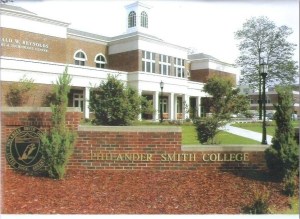
reynoldslibraryphilandersmithThe new Arkansas Civil Rights History Audio Tour was launched in November 2015. Produced by the City of Little Rock and the University of Arkansas at Little Rock allows the many places and stories of the City’s Civil Rights history to come to life an interactive tour.  This month, during Black History Month, the Culture Vulture looks at some of the stops on this tour which focus on African American history.

Philander Smith College is Little Rock’s oldest historically black educational institution. It was established in 1877 as Walden Seminary, by the African Methodist Episcopal Church to educate ministers. Its name changed after an endowment in 1882 by the widow of Illinois philanthropist Philander Smith. Wesley Chapel has always been associated with the college’s activities. The enslaved William Wallace Andrews founded Wesley in 1854 on land donated by his owner, U.S. Senator Chester Ashley. In 1864, parishioners celebrated their freedom with a “Parade of Emancipation.”

Pastors at Wesley included Rev. J. C. Crenchaw, president of the Little Rock NAACP, and Rev. Negail Riley, leader of the Black United Fund. In the 1960’s, Philander Smith students participated in “sit-ins” at downtown lunch counters.

Noted alumni include Dr. Joycelyn Elders, former U.S. surgeon general; professional athletes Elijah Pitts of the Green Bay Packers; Hubert “Geese” Ausbie of the Harlem Globetrotters; and Milton Pitts Crenchaw, a Tuskeegee Airman; James Hal Cone, a pioneer of black liberation theology; Lottie Shackelford, former Mayor of Little Rock; Al Bell, founder of Stax Records and former president of Motown Records; and Stephanie Flowers, Arkansas State Senator.

The app, funded by a generous grant from the Arkansas Humanities Council, was a collaboration among UALR’s Institute on Race and Ethnicity, the City of Little Rock, the Mayor’s Tourism Commission, and KUAR, UALR’s public radio station, with assistance from the Little Rock Convention and Visitors Bureau