“The Good Story: Inspiring Leadership” is focus of Clinton School program this evening

uacs hafreyLeigh Hafrey, author and a senior lecturer at the MIT Sloan School of Management, has worked in professional ethics for over two decades, with a focus on ethical leadership, teaching college courses at Harvard Business School and MIT and consulting for private organizations around the world. For 17 years, along with his wife, Sandra Naddaff, Hafrey was a co-Master of Mather House, one of the 12 residential complexes in Harvard College.

Hafrey is a sought after expert on the relationship between storytelling and inspiring leadership.  He has been featured at conferences all over the world discussing the connection between leadership and the ability to tell a good story.  As he told The Power of Storytelling in 2015:

Storytelling supplies a narrative logic to events past, present, and future. Presentations by definition work with the principles of storytelling: plot, place, character, conflict and resolution.  Some people do it better than others, and those individuals reach leadership positions in part because of their skill as storytellers. Think Gandhi, Martin Luther King, Jr., Aung San Suu Kyi, Muhammad Yunus and Vaclav Havel.

In his most recent book, War Stories: Fighting, Competing, Imagining, Leading, Hafrey covers the arc of military American self-perception on the screen, in print, and in public conversation over the past 20 years.

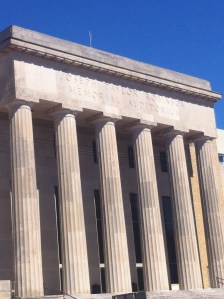
Black History Month Spotlight – Joseph Taylor Robinson Auditorium

IMG_7690The new Arkansas Civil Rights History Audio Tour was launched in November 2015. Produced by the City of Little Rock and the University of Arkansas at Little Rock allows the many places and stories of the City’s Civil Rights history to come to life an interactive tour.  This month, during Black History Month, the Culture Vulture looks at some of the stops on this tour which focus on African American history.

In March 1974, Little Rock hosted the second National Black Political Convention at the Joseph T. Robinson Auditorium and Camelot Hotel (now a Doubletree Hotel). The first convention was held in Gary, Indiana, in 1972, and garnered much publicity, producing a National Black Political Agenda that included demands for the election of a proportionate number of black representatives to Congress, community control of schools, and national health insurance. The Little Rock convention was co-convened by Congressman Charles Diggs of Detroit, Michigan; Mayor Richard Hatcher of Gary, Indiana; and poet Amiri Baraka. Plenary speakers included Atlanta Mayor Maynard Jackson and comedian and activist Dick Gregory. Jesse Jackson was also in town for the convention. The convention featured a moving testimonial and tribute to local civil rights leader Daisy Bates at Central High School.

For many years, the lower Exhibition Hall of Robinson Auditorium hosted many concerts, dances and sporting events, popular with black audiences. However, because the large concert hall upstairs had segregated seating, Duke Ellington declined to play there in 1961. Louis Armstrong played to the first integrated audience in 1966 after the 1964 Civil Rights Act ended segregation in public facilities and accommodations.

The app, funded by a generous grant from the Arkansas Humanities Council, was a collaboration among UALR’s Institute on Race and Ethnicity, the City of Little Rock, the Mayor’s Tourism Commission, and KUAR, UALR’s public radio station, with assistance from the Little Rock Convention and Visitors Bureau.

Little Rock Look Back: Robinson Auditorium opens in 1940

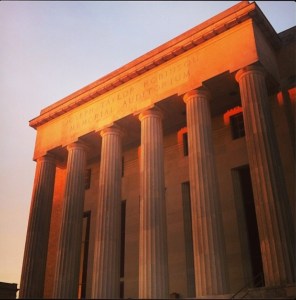
auditoriumduskOn February 16, 1940, after three years of planning and construction including several delays due to lack of funding, the Joseph Taylor Robinson Memorial Auditorium officially opened. It was a cold, rainy night, but those in attendance did not care.

Searchlights painting arcs in the sky greeted attendees. They were borrowed from the Arkansas National Guard. Newspaper accounts noted that only a few of the men who attended were in tuxedos, most were simply in suits. The work to get the building opened had been so harried, that it was discovered there was not an Arkansas Flag to fly in front of the building. Mayor Satterfield found one at the last minute courtesy of the Arkansas Department of the Spanish War Veterans.

The weather delayed arrivals, so the program started fifteen minutes late. Following a performance of Sibelius’ Finlandia by the fledgling Arkansas State Symphony Orchestra, Mayor J. V. Satterfield, Mrs. Joseph T. Robinson, Mrs. Grady Miller (the Senator’s sister-in-law and a member of the Auditorium Commission) and D. Hodson Lewis of the Chamber of Commerce participated in a brief ribbon cutting ceremony. Mrs Robinson cut the ribbon on her second attempt (once again proving that nothing connected with getting the building open was easy).

The ceremony was originally set to be outside of the building but was moved indoors due to the inclement weather. The ribbon cutting took place on the stage with the ribbon stretched out in front of the curtain. The opening remarks were broadcast on radio station KGHI.

Mr. Lewis, Mrs. Miller and Mayor Satterfield look on as Mrs. Robinson cuts the ribbon

Mr. Lewis, Mrs. Miller and Mayor Satterfield look on as Mrs. Robinson cuts the ribbon

Though he had previously discussed how he had voted against the auditorium in 1937 before entering public life, the mayor’s remarks that evening were appropriately gracious, statesmanlike and a testament to the effort he had invested to get it open upon becoming mayor. “We hope you have a very pleasant evening and hope further that it will be the first in a long series which you will enjoy in this, your auditorium.”

Tickets for the event, advertised as being tax exempt, were at four different pricing levels: $2.50, $2.00, $1.50 and $1.00.

The estimated attendance was 1700. Following the ribbon cutting, the main performance took place. The headliner for the grand opening was the San Francisco Opera Ballet accompanied by the new Arkansas State Symphony Orchestra (not related to the current Arkansas Symphony Orchestra). The featured soloist with the ballet was Zoe Dell Lantis who was billed as “The Most Photographed Miss at the San Francisco World’s Fair.”

At the same time that the gala was going on upstairs in the music hall, a high school basketball double-header was taking place in the downstairs convention hall. North Little Rock lost to Beebe in the first game, while the Little Rock High School Tigers upset Pine Bluff in the marquee game.

Black History Month Spotlight – L.C. and Daisy Bates House

Bates HouseThe new Arkansas Civil Rights History Audio Tour was launched in November 2015. Produced by the City of Little Rock and the University of Arkansas at Little Rock allows the many places and stories of the City’s Civil Rights history to come to life an interactive tour.  This month, during Black History Month, the Culture Vulture looks at some of the stops on this tour which focus on African American history.

L.C. and Daisy Bates were civil rights activists and co-owners and publishers of the Arkansas State Press newspaper. During the 1957 school desegregation crisis of Central High School, their home functioned as headquarters for the “Little Rock Nine,” the first black students to attend the school. The Bateses’ home provided a safe-haven for “the Nine.” It was a refuge, a place to study and receive counseling to contend with frequent harassment by white students and other staunch segregationists who demonstrated outside the school.

“The Nine” also visited with the NAACP legal team of Thurgood Marshall and Wiley Branton, who worked on the school desegregation case of Aaron v. Cooper. Daisy Bates, a mentor to the Nine, was president of the Arkansas State Conference of the National Association for the Advancement of Colored People (NAACP.) For taking a stand against segregated schools, L.C. and Daisy Bates had numerous missiles hurled at their home during the school crisis and had several fiery crosses—an emblem of the white terror organization the Ku Klux Klan— burned on their lawn. Segregationists mounted a boycott of the Arkansas State Press newspaper, putting it out of business in 1959.

In 2001, it was declared a National Historic Landmark.  The house is now being restored and turned into a museum.

The app, funded by a generous grant from the Arkansas Humanities Council, was a collaboration among UALR’s Institute on Race and Ethnicity, the City of Little Rock, the Mayor’s Tourism Commission, and KUAR, UALR’s public radio station, with assistance from the Little Rock Convention and Visitors Bureau.

Free admission at Clinton Center today

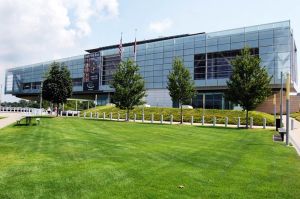
Clinton Library 3The Clinton Presidential Center is free today in honor of the George Washington Birthday Federal Holiday.  Also free are audio tours narrated by President Clinton.

This is a wonderful opportunity to see the final day of the temporary Coca-Cola exhibits.

Illustrations of an American Original is located in the Garden View Room and focuses the now-iconic images and advertising campaigns that have helped define the Coca-Cola brand.  An American Original at 100 is housed in the Temporary Gallery, bringing together historic bottle “firsts.” It features a 13-bottle chronology, including an original glass bottle produced in 1902, a replica of the prototype contour bottle created by the Root Glass Company in 1915, and a prototype of the aluminum bottle that debuted in 2008.
In addition to Illustrations of an American Original and An American Original at 100, the Center is also displaying a full-size antique Coca-Cola delivery truck produced in 1949 by the White Motor Company and a spectacular hanging installation comprised of more than 750 3D-printed, ribbon-shaped interpretations of the bottle’s classic shape.

Little Rock Look Back: Mayor John Wassell

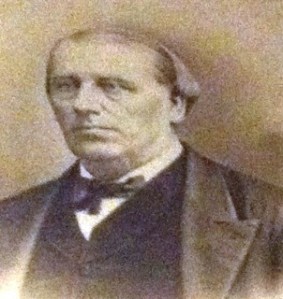
JWassellFuture Little Rock Mayor John Wassell was born on February 15, 1813 in Kidderminster, England.

In 1829, he came to the United States.  He learned carpentry and construction in Ohio and ended up in Little Rock.  One of his jobs was as the finishing contractor on the State Capitol building, now known as the Old State House.

He later gave up carpentry and became an attorney.  (It is said that he did so after becoming embroiled in a legal dispute arising from one of his construction jobs.) Wassell also served as a judge.

In 1868, he was appointed Mayor of Little Rock by President Andrew Johnson.  He is Little Rock’s only Mayor to have served through a military appointment.  Mayor Wassell died in January 1881 and is buried at Mount Holly Cemetery along with his wife and other family members.  One of his grandsons, Samuel M. Wassell also served as Mayor of Little Rock.

Final 2 Days of Coca Cola exhibit at Clinton Center

Coca-Cola-Bottle-History-v2-hiThe Clinton Presidential Center celebrates the art and history of the Coca-Cola Bottle’s 100-year anniversary during its upcoming temporary exhibit, Coca-Cola: An American Original. The exhibit closes on Monday, February 15.
The exhibit is divided into two sections and occupies both the Garden View room, located on the first floor, and the Temporary Gallery, located on the third floor.
Illustrations of an American Original will be located in the Garden View Room and will have as its focus the now-iconic images and advertising campaigns that have helped define the Coca-Cola brand. Illustrations will include three original paintings by Norman Rockwell, an American artist who created a total of six paintings that were ultimately used in finished Coca-Cola ads. The three others, known as the “Missing Rockwells,” have yet to be located. Additionally, Illustrations feature several images of Santa Claus, including the first Coca-Cola Santa painted by Fred Mizen that appeared in The Saturday Evening Post in December of 1930, as well as nine original Haddon Sundblom illustrations.
An American Original at 100 is housed in the Temporary Gallery, bringing together historic bottle “firsts.” It features a 13-bottle chronology, including an original glass bottle produced in 1902, a replica of the prototype contour bottle created by the Root Glass Company in 1915, and a prototype of the aluminum bottle that debuted in 2008.
Also, the exhibit showcases pop art by Andy Warhol—including videos, photographs, prints, and other original works—and folk art by Howard Finster, who incorporated the Coca-Cola bottle into dozens of his pieces over his prolific career. Another portion of this exhibit is dedicated to American presidents and their connection to the global brand. An American Original at 100 was recently on display at the High Museum of Art Atlanta.


In addition to Illustrations of an American Original and An American Original at 100, the Center is also displaying a full-size antique Coca-Cola delivery truck produced in 1949 by the White Motor Company and a spectacular hanging installation comprised of more than 750 3D-printed, ribbon-shaped interpretations of the bottle’s classic shape.
Coca-Cola: An American Original is the Center’s 42nd temporary exhibit. It will close on February 15, 2016.  Admission to temporary exhibits is included in the price of Library admission.