
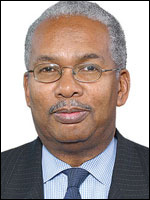
Little Rock Look Back: Ernest G. Green

Ernest G. Green is the Managing Director of Public Finance for Lehman Brothers in Washington, D.C.  Featured in the 2006 list of Black Enterprise Magazine’s “75 Most Powerful Blacks on Wall Street”, Mr. Green has served as senior investment banker on transactions for such key clients as the City of New York, State of New York, City of Chicago, Port of Oakland, City of Atlanta, State of Connecticut, Detroit Wayne County Airport, Denver Airport, and the Washington Metropolitan Airport Authority.

Mr. Green served as Assistant Secretary of Labor for Employment and Training during the Carter Administration.  President Clinton appointed him to serve as Chairman of the African Development Foundation.  Secretary of Education, Richard W. Riley, appointed him Chairman of the Historically Black Colleges and Universities Capital Financing Advisory Board.

Born in Little Rock, on September 22, 1941, Mr. Green was the first African American to earn his high school diploma from Central High School. At the age of seventeen he was awarded the NAACP’s Spingarn Medal, as one of the Little Rock Nine. In 1995, he was awarded the Distinguished Eagle Scout Award.  Mr. Green is also a recipient of the Urban League’s Frederick Douglass Freedom Medal, and the John D. Rockefeller Public Service Award. On November 9, 1999, with the Little Rock Nine, he was presented by President Clinton with the Congressional Gold Medal.

Several books, movies and documentaries have chronicled Mr. Green and his eight classmates’ historic year at Central High School in Little Rock — the most recent being the “Ernest Green Story”, produced and distributed by the Walt Disney Corporation.

Mr. Green holds a B.S. in Social Science and Masters in Sociology from Michigan State University, and honorary doctorates from Michigan State University, Tougaloo College, and Central State University.  He currently serves on the Board of Directors of Fisk University, Quality Education for Minorities (QEM) Network, Clark Atlanta University Board of Trustees and the African American Experience Fund Board of Trustees among other distinctions.

Mr. Green and his wife Phyllis live in Washington, D. C.  He is the proud father of Adam, Jessica and McKenzie Ann.

Little Rock Look Back: Jefferson Thomas

Jefferson Thomas was a track athlete at all-black Dunbar Junior High School in Little Rock when he volunteered to integrate all-white Central High School as a sophomore in 1957.  A few days before he entered the school, he celebrated his fifteenth birthday, having been born on September 19, 1942.

Mr. Thomas was a quiet, soft spoken, unique, and special person.  He had a subtle, infectious sense of humor that served him well throughout his life.  He would find that sense of humor and his love for humanity severely tested by the hate and violence directed toward him by some of the white students at Central High School.  Mr. Thomas graduated from Central High School in May 1960.

He served as the narrator of the Oscar winning documentary short, “Nine from Little Rock.”

Mr. Thomas married in 1965 and has one child (Jefferson, Jr.), still living in Los Angeles.  Mr. Thomas, Sr. was inducted into the United States Army in 1966.  He returned to civilian life in the summer of 1968.

After obtaining a Bachelor Degree in Business Administration from Los Angeles State College, Mr. Thomas went to work as an Accounting Clerk and later, Supervisor for Mobil Oil Corporation.  When Mobil Oil moved its Credit Card Operations, Mr. Thomas remained in Los Angeles, and entered Federal Service as an Accounting Clerk with the Department of Defense.  The DOD relocated parts of its LA operations to Columbus, Ohio, in 1989.  He sold his business and moved to Columbus.

After moving to Columbus, Mr. Thomas continued his commitment to serve the local community, Mr. Thomas took time to serve as a volunteer mentor in the Village to Child Program, co-sponsored by Ohio Dominican University.

He was a frequent speaker at numerous high schools, colleges and universities throughout the country, and an eager mentor to young people.  He was the recipient of numerous awards from local and federal governmental agencies.  These awards include the NAACP Spingarn Medal, and Congressional Gold Medal, this Nation’s longest-running tradition of honor, for helping make democracy work.  He was especially proud of the life-size sculpture of the Little Rock Nine at the Arkansas State Capital in Little Rock, the first in the state honoring living citizens.

Jefferson Thomas retired in September 2004, after 27 years of Federal Service. He departed this life in 2010.  His wife, Mary, still resides in Columbus, Ohio.

Little Rock Look Back: First Arkansas Razorback game at War Memorial Stadium

On September 18, 1948, the Arkansas Razorbacks took on Abilene Christian and won the game by a score of 40 to 6.  It was the first game of the season, and the Razorbacks went into the game ranked #13. They maintained that ranking for four weeks before falling out of national standings.  The team ended up with a season record of five wins and five losses. Playing four of their games at War Memorial that season, they were two and two in Little Rock. They were one and two in Fayetteville and amassed a 2-1 record on the road.
Dedication ceremony in 1948. Photo courtesy of the War Memorial Stadium Commission.

Dedication ceremony in 1948. Photo courtesy of the War Memorial Stadium Commission.

Prior to the game, the stadium was dedicated to the veterans of World War I and World War II in a ceremony led by former Razorback standout and Medal of Honor recipient Maurice “Footsie” Britt.  Though he would later be known for entering politics and becoming Arkansas’ first Republican Lieutenant Governor, in his college days he was known statewide as an outstanding Razorback football and baseball athlete.  During World War II, his bravery and courage allowed him to become first person in American history to earn all the army’s top awards, including the Medal of Honor, while fighting in a single war.

Also participating in the opening ceremony were a mass of high school marching bands from across the state. Reports indicate up to forty bands were on the field to play the National Anthem as part of the event.

The construction of the stadium had been a dream of Governor Ben T. Laney. He had encouraged the Arkansas General Assembly to create the stadium during the 1947 session.  In August of 1947, Little Rock was chosen as the location over Hot Springs and North Little Rock. West Memphis had abandoned its bid when it was unable to secure the necessary financial pledges.  Construction started in 1947 and continued up until opening day.  On the day of the game, newspaper photos showed heavy equipment grading the parking lot prior to paving.

Though it had been Laney’s dream, with the passing of the guard, a newspaper photo on the day after the dedication focused on the incoming governor, Sid McMath.  Because Arkansas was such a Democratic heavy state, the paper referred to him as Governor-designate even though it was six weeks prior to the 1948 General Election when he would face off against C. R. Black.  McMath won the race with 89.4% of the vote.

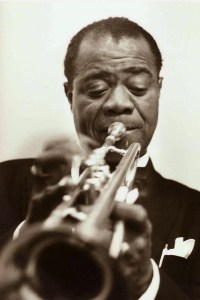
Little Rock Look Back: Louis Armstrong speaks out

As the Civil Rights movement started taking hold in the mid-1950s, many African American entertainers were vocal in their support.  Louis Armstrong stayed silent.  Until, that is, September 17, 1957.

That night, in Grand Forks, North Dakota, Armstrong blasted President Dwight Eisenhower for his lack of action to make Governor Orval Faubus obey the law.  This was in an interview conducted by a 21 year old University of North Dakota journalism student named Larry Lubenow.

Journalist David Margolick wrote about the incident in The New York Times in September 2007 in conjunction with the 50th anniversary of the integration of Little Rock Central High School.  He recounted how the story, written for the Grand Forks Herald, was picked up all over the country.  The entire Margolick piece can be read here.  Margolick tells that when Armstrong was given the chance to back off the comments, he asserted that he meant all of it.

On September 24, 1957, the night that the 101st Airborne was being mobilized to come into Little Rock, Armstrong sent Eisenhower a telegram again criticizing him for lack of action.  He used colorful language which sarcastically spoofed the “Uncle Tom” moniker which some of his critics had bestowed when they felt he was not doing enough for Civil Rights.  The Eisenhower Presidential Library has a copy of that telegram.  The incident between Satchmo and Ike was the basis for two different plays: Terry Teachout’s Satchmo at the Waldorf and Ishmael Reed’s The C Above C Above High C.

Little Rock Look Back: Minnijean Brown Trickey

On September 11, 1941, Minnijean Brown was born.

Although all of the Nine experienced verbal and physical harassment during their year at Central, Brown was first suspended, and then expelled for retaliating against the daily torment. She moved to New York and lived with Drs. Kenneth B. and Mamie Clark, the African American psychologists whose social science findings played a critical role in the Brown v. Board of Education Supreme Court case.

After graduating from the New Lincoln School in 1959, Mrs. Brown Trickey studied journalism at Southern Illinois University.  She received a Bachelor of Social Work in Native Human Services from Laurentian University and Master of Social Work at Carleton University, in Ontario Canada.

Mrs. Brown Trickey has pursued a career committed to peacemaking, environmental issues, developing youth leadership and social justice advocacy.  She served in the Clinton Administration as Deputy Assistant Secretary for Workforce Diversity at the Department of the Interior.   She has taught social work at Carleton University and community colleges in Canada.

Mrs. Brown Trickey is the recipient of numerous awards for her community work for social justice, including Lifetime Achievement Tribute by the Canadian Race Relations Foundation, and the International Wolf Award for contributions to racial harmony.  With the Little Rock Nine, she received the NAACP Spingarn Medal and the Congressional Gold Medal.

She is the subject of a documentary, Journey to Little Rock: the Untold Story of Minnijean Brown Trickey, which has received critical acclaim in international film festivals in Africa, the UK, the U.S., South America and Canada.  She was featured in People Magazine, Newsweek, the Ottawa Citizen, the BBC, the Canadian Broadcasting Corp, Donahue, as well as on numerous other television, radio and in print media.  She appeared with the Little Rock Nine on Oprah and the Today Show.

Mrs. Brown Trickey currently resides in Canada, and is the Shipley Visiting Writer for Heritage Studies at Arkansas State University. She is the mother of six children, Morning Star, Isaiah, Sol, Ethan, Spirit and Leila Trickey.

Little Rock Look Back: Plans approved for new City Hall…finally

City Hall circa 1908

After a judge ruled in August 1906 that the City of Little Rock could not build a new City Hall and Auditorium complex, it looked like Little Rock would be stuck with its existing inadequate building.

However on September 10 it became obvious that much work had been taking place behind the scenes after that ruling.  On that day, the Board of Public Affairs (a City body charged with overseeing municipal government construction projects and comprised of the mayor and two citizens approved by the City Council) voted to ask the aldermen to cancel plans and rescind legislation for the city hall, jail and auditorium complex.  The Board of Public Affairs then offered up a new plan for a city hall and jail building.  Because no auditorium was involved, these plans would not be in violation of the Chancery Court.

That same evening the City Council followed suit and revoked the plans for the original project.  The aldermen then voted to proceed with building a new city hall and jail without the auditorium.  There was only one dissenting vote; Alderman Jonathan Tuohey voted no.  He explained his negative vote was not a lack of support for the project, but he was not comfortable with the way it was rushed through.

Mayor Warren E. Lenon told the Gazette, “The Chancery Court has enjoined us from erecting an auditorium and the Board of Public Affairs has consequently rescinded all resolutions and orders pertaining to that structure.” He noted that there would “be no appeal from the injunction granted by Chancellor Hart, because there is nothing to appeal.”

The coverage of the actions of the City Council that night was in keeping with the manner in which the two daily newspapers had covered the lawsuit and the trial.  The Gazette headline cried “City Hall Ordinance Railroaded Through” while the staid Democrat merely stated “New $175,000 City Hall Provided by City Council.”  The tone of theGazette’s article matched the headline while the Democrat’s story was more straightforward.

Architect Charles Thompson adjusted his plan for the new City Hall by removing the auditorium wing.  With the revised Th0mpson plan and the approval of the City Council, Little Rock was at last on its way to a new City Hall.  This was over two years after Mayor Lenon had first broached the subject.

Originally slated to open in 1907, the building officially opened in April 1908.

Little Rock Look Back: The “Battle” of Little Rock

On September 10, 1863, Confederate forces under General Sterling Price evacuated Little Rock in advance of Federal forces, thus ending the Little Rock Campaign. By 5:00pm, his forces had left the city and at 7:00pm, civil authorities formally surrendered. Little Rock became the fourth Southern capital to come under Federal control.

The battle was the culmination of a campaign launched by Maj. Gen. Fred Steele, on August 1, 1863 to capture Little Rock. The campaign includes engagements at Westport, on 14 August, Harrison’s Landing, on 16 August, Brownsville on 25 August, the Reed’s Bridge, on 27 August, and Ashley’s Mills on 7 September 1863. After the Union army affected a river crossing east of Little Rock, effectively flanking the Confederate defenses north of the river, the Confederates staged a brief delaying action at Bayou Fourche to allow for evacuation of Little Rock.

As local historian Dr. Bobby Roberts has noted, “It was really more of a ‘skirmish’ than an actual ‘battle.'”

City of Little Rock leaders must have been anticipating the result of the battle.  In August 1861, they took the City’s treasury to an undisclosed location and started scaling back on City government.

The Battle of Little Rock is also known as the Battle of Bayou Fourche.