Pulitzers play Little Rock – UA Little Rock’s THE FLICK in 2017

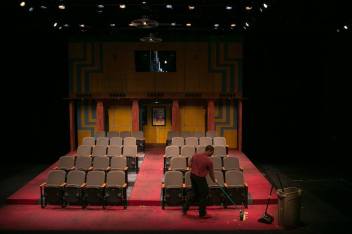
In 2UA Little Rock Flick014, Annie Baker’s The Flick won the Pulitzer Prize for Drama. The play mixes dialogue with long moments of no spoken words as the characters perform tasks on stage.

It is set in a run-down Massachusetts movie theatre and focuses on three millennials as they endure modern-day situations of race, class, and economy, all while working as underpaid employees.  The three actors are tasked with performing the cleaning of the set, just as the characters would be doing in between showings.  The original production received mixed reviews and sharply divided the audiences who saw it.  Feelings that were expressed ranged from brilliant to boring.

In February 2017, UA Little Rock’s Theatre and Dance Department presented the play.  It may have been the first production of it in Arkansas, it was certainly the first in Little Rock.  Giving the students the chance to work on such a new and challenging play is an example of the value of educational theatre.

2018 marks the 100th anniversary of the first Pulitzer Prize for Drama being given. To pay tribute to 100 years of the Pulitzer for Drama, each day this month a different Little Rock production of a Pulitzer Prize winning play will be highlighted.  Many of these titles have been produced numerous times.  This look will veer from high school to national tours in an attempt to give a glimpse into Little Rock’s breadth and depth of theatrical history.

90 years of Maya Angelou

Though she left this earth physically in 2014, Maya Angelou’s work and legacy continue on in the lives she touched and her writings.   Ninety years ago today, she was born in St. Louis.

On February 23, 1998, Maya Angelou appeared with the Arkansas Symphony Orchestra in a concert at Robinson Center.  The evening featured Dr. Angelou narrating Joseph Schwantner’s tribute to Dr. Martin Luther King Jr., “New Morning for the World.”

Dr. Angelou, a former resident of Stamps, Arkansas, was not a stranger to Little Rock. She had appeared before at Wildwood Park and would later appear at the Clinton Presidential Center.

A former Poet Laureate of the United States and Tony nominated actor, she won a Grammy Award for her reading of “On the Pulse of the Morning” which had been written for the first inauguration of Bill Clinton as President of the United States.

A poet, author, educator, dancer, singer, actor, and activist, she wrote seven autobiographies. The most notable was arguably I Know Why the Caged Bird Sings.  Born in St. Louis, she spent part of her childhood in Arkansas before moving to California.  She led a peripatetic life both geographically and career-wise ending as a professor at Wake Forest and residing in North Carolina.  It was there that she died in May 2014.

One of the ways her work continues is through the Celebrate Maya project which is led by Janis Kearney.

Pulitzers play Little Rock – Arkansas Rep’s 2013 DEATH OF A SALESMAN

Rep SalesmanOne of the seminal plays of the 20th century, Death of a Salesman explored and exploded the post-war view of the American Dream.  Arthur Miller won his only Pulitzer Prize for this play.

In 2013, Robert Hupp directed a production at the Arkansas Repertory Theatre, where he was Producing Artistic Director at the time. It starred TV and stage actor Robert Walden, who was living in Arkansas then, and Broadway veteran Carolyn Mignini.  Avery Clark (who had starred in several Rep productions), Craig Maravich, William Metzo, Jay E Raphael and Joe Menino were also featured in key roles.

Members of the cast and creative team appeared in a panel as part of the Clinton School Speaker Series.  A video of that panel can be viewed here.

2018 marks the 100th anniversary of the first Pulitzer Prize for Drama being given. To pay tribute to 100 years of the Pulitzer for Drama, each day this month a different Little Rock production of a Pulitzer Prize winning play will be highlighted.  Many of these titles have been produced numerous times.  This look will veer from high school to national tours in an attempt to give a glimpse into Little Rock’s breadth and depth of theatrical history.

Little Rock Look Back: The Assassination of Dr. King

On April 4, 1968,  when Dr. King was assassinated, Little Rock did not see the unrest that many cities did.  Part of that was probably due to quick action by Governor Winthrop Rockefeller.

The Governor released a statement fairly quickly expressing his sorrow at the tragedy and calling for a day of mourning. He also made the State Capitol available for the NAACP to have a public memorial, as well as worked with a group of ministers to host an interdenominational service.

Little Rock Mayor Martin Borchert issued a statement as well:

We in Little Rock are disturbed about the incident in Memphis. We are disturbed regardless of where it had happened.  Killing is not the Christian solution to any of our problems today.

In Little Rock, we feel we have come a long way in 10 years toward solving some of our problems of living and working together regardless of race, creed or color.

The city Board of Directors in Little Rock has pledged itself toward continuing efforts to make Little Rock a better place in which to live and work for all our citizens.

We feel the efforts of all thus far have proved we can live in harmony in Little Rock and are confident such an incident as has happened will not occur in Little Rock.  We will continue our most earnest efforts toward the full needs of our citizens.

The day after Dr. King was assassinated, a group of Philander Smith College students undertook a spontaneous walk to the nearby State Capitol, sang “We Shall Overcome” and then walked back to the campus.  President Ernest T. Dixon, Jr., of the college then hosted a 90 minute prayer service in the Wesley Chapel on the campus.

On the Sunday following Dr. King’s assassination, some churches featured messages about Dr. King.  As it was part of Holy Week, the Catholic Bishop for the Diocese of Little Rock had instructed all priests to include messages about Dr. King in their homilies. Some protestant ministers did as well. The Arkansas Gazette noted that Dr. Dale Cowling of Second Baptist Church downtown (who had received many threats because of his pro-integration stance in 1957) had preached about Dr. King and his legacy that morning.

Later that day, Governor Rockefeller participated in a public memorial service on the front steps of the State Capitol. The crowd, which started at 1,000 and grew to 3,000 before it was over, was racially mixed. At the conclusion of the ceremony, Governor and Mrs. Rockefeller joined hands with African American ministers and sang “We Shall Overcome.”

That evening, Trinity Episcopal Cathedral was the site of an interdenominational service which featured Methodist Bishop Rev. Paul V. Galloway, Catholic Bishop Most Rev. Albert L. Fletcher, Episcopal Bishop Rt. Rev. Robert R. Brown, Rabbi E. E. Palnick of Temple B’Nai Israel, Gov. Rockefeller, Philander Smith President Dixon, and Rufus King Young of Bethel AME Church.

Earlier in the day, Mayor Borchert stated:

We are gathered this afternoon to memorialize and pay tribute to a great American….To achieve equality of opportunity for all will require men of compassion and understanding on the one hand and men of reason and desire on the other.

Pulitzers play Little Rock – DRIVING MISS DAISY

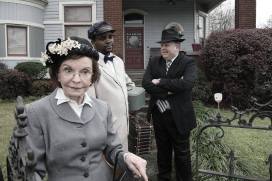
TWT DMDWith minimal set needs and only three actors, Alfred Uhry’s Driving Miss Daisy has been popular with theatres of all levels since it premiered in 1987.  There have been numerous Little Rock productions over the past thirty years.

Actress and director Judy Trice starred in the Weekend Theater’s production in 2016.  Her costars were Jermaine McClure and Jay Clark.  The play was directed by Andy Hall (who is currently directing Assassins for the Weekend Theater).  The three actors obviously relished the chance to age several decades over the course of the play and mine Uhry’s script for its humor and humanity.

While many plays may fall out of favor over time, it is likely that Driving Miss Daisy will continue to be performed repeatedly.

2018 marks the 100th anniversary of the first Pulitzer Prize for Drama being given. To pay tribute to 100 years of the Pulitzer for Drama, each day this month a different Little Rock production of a Pulitzer Prize winning play will be highlighted.  Many of these titles have been produced numerous times.  This look will veer from high school to national tours in an attempt to give a glimpse into Little Rock’s breadth and depth of theatrical history.

Little Rock Look Back: LR Voters approve additional funds for Robinson Center in 1940

Though Joseph Taylor Robinson Memorial Auditorium opened in February 1940, there was still money that needed to be raised to finish the construction and the building’s furnishing.  Ten days after the auditorium opening, the City Council approved an ordinance to call a special election on April 2, 1940, for the purposes of approving bonds for three separate projects.  One of these was for $30,000 for the completion of the auditorium; the bonds would not require any additional tax levy.
At the same meeting, a letter was read from the Young Men’s Business Association expressing support for the auditorium in the election, which was to be held in conjunction with the annual municipal general election. The Auditorium Commission had previously asked the City Council to consider issuing the bonds to pay for additional equipment for the building.  In their request to the aldermen, the members stressed that due to the current bond structure, these new bonds would not necessitate any tax increase.

The campaign for the new bonds used a similar structure and message as the 1937 election to build the auditorium.  There were newspaper ads by the steering committee (this time simply called the Citizen’s Committee and led by Omar Throgmorton) and support from civic organizations.  One thing very different from the 1937 campaign was the presence of an actual building.  On Sunday, March 31, just two days before the election, there was an open house for the public to explore the edifice.  From 1:00 p.m. to 9:00 p.m., members of various Little Rock Boy Scout troops led 4,000 visitors on tours of the auditorium.  Visitors were shown all over the building; one scout calculated that the walking tour equated to two miles.  Though most people were from Little Rock, the guest registry indicated visitors from California and Pennsylvania.

On April 2, 1940, Little Rock voters approved the new bonds 1,413 to 423.  Every precinct in every ward of the city voted in favor of the new bonds.  Shortly after the election, the bonds were issued.  The auditorium construction which had first been broached in 1904 was now completed in 1940.

Pulitzers play Little Rock – OF THEE I SING

OfTheeISingBefore Robinson Auditorium opened, the stage of Little Rock High School (now Central High) was the prime performance location in Little Rock.  In 1933, it welcomed the national tour of the Pulitzer Prize winning musical Of Thee I Sing.

This was the first musical to win the Pulitzer Prize for Drama.  In fact, because no musical had won the award before, the jury appeared to not know how to handle a composer in a writing category.  Librettists Morris Ryskind and George S. Kaufman and lyricist Ira Gershwin were named as recipients. But composer George Gershwin did not receive the Pulitzer.  (In 1998, he received a posthumous Special Pulitzer.)

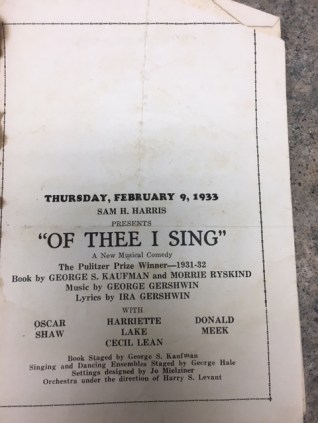
The musical, a satire of politics and popular culture, was directed by Mr. Kaufman.  The tour came to Little Rock for one performance on February 9, 1933. The Broadway production had closed less than a month earlier after 441 performances (a very long run at the time).

The tour starred Oscar Shaw (who had played the male lead in the original production of the Gershwins’ Oh Kay!) and Harriette Lake.  She would later change her name to Ann Sothern.  Other main roles were played by Donald Meek and Cecil Lean.   A few months after Little Rock, the tour played a month on Broadway.  Miss Lake continued in her role, but the men were replaced by their original Broadway counterparts.

2018 marks the 100th anniversary of the first Pulitzer Prize for Drama being given. To pay tribute to 100 years of the Pulitzer for Drama, each day this month a different Little Rock production of a Pulitzer Prize winning play will be highlighted.  Many of these titles have been produced numerous times.  This look will veer from high school to national tours in an attempt to give a glimpse into Little Rock’s breadth and depth of theatrical history.