
Little Rock Look Back: 1959 School district patrons show support of fired teachers

Arkansas Gazette photo of some of the patrons leaving Bale Elementary dedication

Following the May 5, 1959, firing of 44 administrators, teachers and staff, sections of the Little Rock community continued to coalesce in opposition to the actions taken by three members of the Little Rock School Board.

Later the evening of May 5, at a ceremony to dedicate Williams Elementary, Everett Tucker spoke against the teacher purge. His remarks were greeted enthusiastically by the patrons of the school.

On May 6, 1959, approximately 400 district patrons filled the auditorium at Forest Heights Junior High for a meeting. They expressed their opposition to the firing of the district employees. While the sight of the hands raised in support of the fired employees was an impressive visual, there was more community response to come.

May 7, 1959, had been set as the date for the dedication of the new Hardin Bale Elementary School.  School Board President Ed McKinley, who had been one of the three who fired the 44 employees, was scheduled to give remarks at the ceremony.  As he was starting the remarks, some patrons stood and challenged him.  Then approximately 75 of them got up and walked out.   McKinley then proceeded to use his remarks to defend his actions and to attack opponents.

Both Williams Elementary and Forest Heights Junior High served the more moderate-leaning Pulaski Heights neighborhood. That they would be in support of the fired employees was less of a surprise.  It was a bit more unexpected that Bale Elementary patrons reacted in the way they did.  That neighborhood was more working class and zoned for Central High, two elements that segregationist forces had been counting on for allies.

Mr. McKinley’s remarks were so strident that fellow School Board member Judge Robert Laster called a press conference distancing himself from Mr. McKinley.  He used that opportunity to also criticize Mr. Tucker, Ted Lamb, and Russell Matson for what he termed the politicization of the Williams Elementary event.  After Judge Laster’s comments, the remaining member, Ben Rowland, expressed support for Mr. McKinley. He further stated that he, Mr. McKinley and Judge Laster had previously discussed what Mr. McKinley would mention in his Bale Elementary remarks.

With a school board in turmoil, teachers uncertain as to the legality of their contracts or non-renewal of them, and civic organizations largely calling for the reversal of the firings, the Little Rock education scene was in turmoil.  There was talk swirling through Little Rock about the need to recall school board members.  But who would take the lead on this?

Little Rock Look Back: Rabbi and longtime CALS Trustee Ira Sanders

On May 6, 1894, Ira Eugene Sanders was born in Missouri.  After receiving an undergraduate degree and rabbinate degree in Cincinnati, he was ordained a rabbi in 1919.  He served congregations in Pennsylvania and New York before coming to Little Rock in September 1926.

Shortly after arriving to lead the B’nai Israel congregation, Rabbi Sanders became active in the Little Rock community.  Among his projects were the Little Rock Community Fund, Little Rock School of Social Work (which he founded), Central Council of Social Agencies, and University of Arkansas Extension Department. During the Great Depression, he helped organize the Pulaski County Public Welfare Commission.  Other areas of involvement over his career included the Arkansas Human Betterment League, Urban League of Greater Little Rock and Arkansas Lighthouse for the Blind.  On November 3, 1930, Rabbi Sanders debated Clarence Darrow about the existence of God in front of a packed house at Little Rock High School.

For his many involvements, he received an honorary Doctor of Humanities degree in 1951 from the University of Arkansas.  Three years later he received an honorary Doctor of Divinity degree from Hebrew Union College’s Jewish Institute of Religion.

A lifelong supporter of a Jewish state, he participated in nineteen bond drives for the state of Israel.  In August 1963, he retired as the leader of B’nai Israel after over 35 years. He would remain as Rabbi Emeritus until his deal in 1985.

In January 1978, Rabbi Sanders tendered his resignation from the Central Arkansas Library board of directors.  The City Board of Directors passed resolution 5873 which noted that he had served for 51 years on the Library Board. He was first appointed in 1926.  He served during 19 different Mayoral administrations from Charles Moyer’s first term through Donald Mehlburger’s.

On April 8, 1985, Rabbi Ira Eugene Sanders died of natural causes.  He is buried in the City’s Oakland Jewish Cemetery.  The Central Arkansas Library System honors his memory with an annual distinguished lecture series.

Little Rock Look Back: City of Little Rock formally establishes Museum of Fine Arts

On May 6, 1935, the Little Rock City Council formally established the Museum of Fine Arts by Ordinance 5235.  The ordinance was sponsored by Alderman Henry G. Leiser.
The ordinance authorized the construction of the museum in City Park.  The money for the construction was all privately raised. Once the building was completed, it would become the property of the City.

The ordinance also created the museum’s board. The original members were named by the ordinance.  They were: Fred W. Allsopp (appointed as a life member), Mrs. Frederick Hanger, Mrs. F.B.T. Hollenberg, George B. Rose, Mrs. C.M. Taylor, Mrs. Frank Tillar, and Dr. Frank Vinsonhaler. In addition, the Mayor and President of the Fine Arts Club were ex-officio members.

The building would start construction in 1936. The groundbreaking was in January 1936, and the cornerstone was laid in October 1936. The Museum of Fine Arts opened in October 1937.

Little Rock Look Back: 44 Teachers fired by divided LRSD School Board in 1959

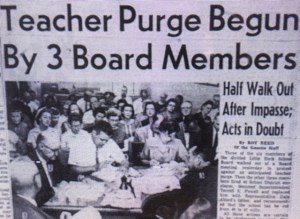
Arkansas Gazette coverage of the teacher purge

On Tuesday, May 5, 1959, the deeply divided Little Rock School Board met to consider contracts for the coming year.  The topic of contract renewal had been on the April agenda, but with two of the six members out of town, it had been delayed.

The 1958-1959 school year had been anything but routine in Little Rock.  To keep the high schools segregated, the city’s four high schools had been closed – first by action of Governor Orval Faubus and then by Little Rock voters.  Frustrated by actions taken at the State level, the School Board had resigned en masse by November 1958, except for the one member who had won a surprise write-in election to unseat Congressman Brooks Hays.  A new school board was elected in December and was equally divided between segregationists and those who felt the law and federal court rulings should be followed.

The May 5, 1959, School Board meeting began at 9am with a room packed full of spectators and was carried live on the radio.  There had been rumblings that the pro-segregation school board members were going to try to fire any teachers they viewed as in favor of desegregation.  Every vote in the morning session ended with a 3/3 vote as Everett Tucker, Russell Matson and Ted Lamb voted one way and the other three: Ed McKinley, Robert Laster and Ben Rowland, voted the other.

After lunch, Tucker, Matson and Lamb decided to leave the meeting. They saw no way to break the stalemate that was paralyzing the discussions. Upon advice of attorneys, they walked out. With only three members remaining, they three thought it end the meeting for lack of quorum.

School Board President Ed McKinley declared the remaining members a quorum. The trio alternated between open and closed sessions. At the end of the day, they had fired forty-four LRSD employees who they viewed as integrationists.  This included 39 whites and five African Americans.  Twenty-seven worked at Central High, while the other seventeen were scattered across other Little Rock schools.  Seven principals, thirty-four teachers, and three secretaries made up the group.  The meeting had lasted the entire day.  The afternoon Arkansas Democrat (with a mid-day deadline) carried a story pondering whether teachers would be fired.

At the same meeting, Superintendent Terrell Powell was fired.  He had taken the reins of the district in December 1958 after having been Hall High’s first principal.  Mr. Powell was replaced by Tom Alford, a former Jacksonville superintendent who was the father of congressman (and former LRSD school board member) Dale Alford.

During a portion of the school board meeting (which was at the corner of Eighth Street and Louisiana Street), phone calls were being made from the LRSD headquarters to a house a few blocks away.  That house was the home of Adolphine Fletcher Terry.  She was hosting an executive board meeting of the Women’s Emergency Committee that day.

Not ones to shy away on anything, the WEC executive board voted to condemn the firings and support the teachers.  Fairly quickly, the Parent Teachers Association of Little Rock, the Arkansas Education Association, League of Women Voters, and Little Rock Ministerial Alliance joined in the call condemning the action.  Leadership at the Little Rock Chamber of Commerce also joined in decrying the purge.

And the fallout was just beginning……

Little Rock Look Back: Pulitzer Prize to SOUTH PACIFIC

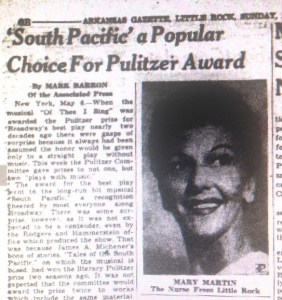
On May 5, 1950, the Rodgers and Hammerstein musical South Pacific captured the Pulitzer Prize in Drama. This would receive special attention in the Arkansas Gazette. The reason this carried such weight in Arkansas was that the musical had a connection to Little Rock.
The 1950 Pulitzer for Drama went to a musical, for only the second time in the history of the awards. The recipient was South Pacific by Richard Rodgers, Oscar Hammerstein II and Joshua Logan. The character was the leading lady of Nellie Forbush. She was an Navy ensign and a nurse stationed on an exotic island during World War II. The musical was based on a Pulitzer Prize winning novel, James Michener’s Tales of the South Pacific.

In the Michener novel, Miss Forbush is not from Little Rock. She is actually from a small town in Alabama. But the book does mention Nellie and her mother visiting Little Rock.  The part was written for Mary Martin from Weatherford, Texas. Rodgers, Hammerstein & Logan did not discuss why they relocated Nellie’s birthplace.

Originally the musical contained a song entitled “My Girl Back Home” in which Nellie sang of being from “Little Rock, A-R-K” while another character sang of being from “Philadelphia, P-A” and “Princeton, N-J.” It is possible the change to Little Rock was made because it offered more lyrical possibilities, but that is only a supposition on the part of the Culture Vulture. That song did appear in the movie version in which Mitzi Gaynor played Nellie Forbush. It was also featured in the 2008 Broadway revival, this time with Kelli O’Hara playing Nellie.

In the musical, Nellie struggles with her own prejudices. This issue of prejudice became an instance of fact meeting fiction. In 1957, a few weeks after Eisenhower sent troops into Little Rock to ensure that Central High would be desegregated, a production of South Pacific on Long Island was temporarily halted when the audience booed and yelled after Nellie mentioned she was from Little Rock. Interestingly, the movie was released in 1958, but retained references to Little Rock. That was either a testament to the expense of re-editing it, or the fact that audience reaction had lessened.

Little Rock Look Back: 2 Pulitzers for the ARKANSAS GAZETTE

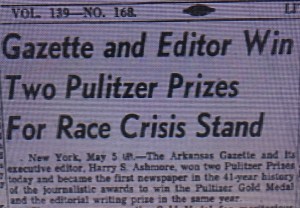
On May 5, 1958, it was announced that the Arkansas Gazette had received two Pulitzer Prizes.  These were for the coverage of the 1957 integration (or lack thereof) at Little Rock Central High School.

The first Pulitzer was for Public Service.  It was awarded to the newspaper.  The citation stated:

For demonstrating the highest qualities of civic leadership, journalistic responsibility and moral courage in the face of great public tension during the school integration crisis of 1957. The newspaper’s fearless and completely objective news coverage, plus its reasoned and moderate policy, did much to restore calmness and order to an overwrought community, reflecting great credit on its editors and its management.

The second Pulitzer was for Editorial Writing.  It was awarded to Harry Ashmore.  The citation read:

For the forcefulness, dispassionate analysis and clarity of his editorials on the school integration conflict in Little Rock.

This was the first time that the Pulitzer for Public Service and Editorial Writing went to the same publication in the same year.

The newspaper coverage in the afternoon Arkansas Democrat and morning Arkansas Gazette was provided by the Associated Press.  The Democrat‘s story ran on the afternoon of the announcement. The front page story had the headline “Pulitzer Honors Go to Gazette.”  The next morning the Gazette ran a longer story under the headline “Gazette and Editor Win Two Pulitzer Prizes for Race Crisis Stand.”  It included a quote from publisher Hugh Patterson, Jr.  He stated, “This recognition belongs to every member of the staff of the Gazette.  I am proud to be associated with these men and women.”

The Pulitzer for National Reporting went to Relman Morin of the Associated Press for his coverage of the events.  His citation noted:
for his dramatic and incisive eyewitness report of mob violence on September 23, 1957, during the integration crisis at the Central High School in Little Rock, Arkansas.

Photographer Will Counts of the Arkansas Democrat was the unanimous choice of the jury to receive the Pulitzer in photography for his photo of the crowd jeering at Elizabeth Eckford.  The board overruled that selection, as was their purview. Speculation was that the board may not have wanted to award four Pulitzers for the same news story.

2 Grants worth more than $1 Million Offered to Arkansas Rep

Arkansas Repertory Theatre’s Board of Directors has announced that they have received two matching grants worth more than one million dollars to fund The Rep’s Our Next Act campaign.

“We couldn’t be more thrilled about these challenge grants. They make it possible for those who love The Rep to double their gift!” Ruth Shepherd, Board Chair-Elect said. “With these gifts the Windgate and John & Robyn Horn Foundations have said loud and clear, ‘We believe in the future of a re-designed Rep.’ So now we need everyone to help us earn that match.”

The John & Robyn Horn Foundation •
The John & Robyn Horn Foundation approved a challenge grant of $25,000 designated for “General Support.”

Windgate Charitable Foundation •
The Arkansas Repertory Theatre received a challenge grant today for $1,000,000. • “I am pleased to notify you that the Board of the Windgate Charitable Foundation has approved a grant of $1,000,000, with an enclosed grant payment of $75,000 for operating needs,” said John E. Brown III, Executive Director of the Windgate Charitable Foundation. The balance of $925,000 is offered as a challenge grant for the Our Next Act Campaign. John E. Brown III concluded his letter, “We wish you great success in the coming year.”

Board Chair, Brian Bush said, “We are incredibly grateful to the Windgate Charitable Foundation and the John & Robyn Horn Foundation. This gives our public campaign the start that we’ve needed.”